
If you're reading this as a forward or from LinkedIn, subscribe to Ask a Chief of Staff to get these insights directly in your inbox. Join 14,000+ Chiefs of Staff who trust us for actionable insights.
If your LinkedIn inbox has turned into a second job, you’re not alone. As a Chief of Staff, every DM could be a client, a partnership, or a warm intro you really don’t want to miss.
That’s why I started using Kondo. It’s like Superhuman, but for your LinkedIn DMs. It makes your inbox actually operational instead of just overwhelming.
A few features I’ve found especially useful:
📥 Split inboxes: Triage by priority so you’re always focused on what matters most
🔔 Reminders & snooze: Resurface conversations exactly when it’s time to follow up
⚡ Snippets & keyboard shortcuts: Move through your inbox without touching your mouse
🏷️ Tags, labels & notes: Keep context organized across candidates, partnerships, and community convos
🔗 Cross-workflow sync: Connect your LinkedIn DMs to your larger operating system
🎁 Ask a Chief of Staff readers can try Kondo free for one month.
*If you’re interested in sponsoring a future issue of Ask a Chief of Staff, hit reply!
In earlier newsletters, I interviewed 4️⃣ Series A Chiefs of Staff and then 4️⃣ Series B Chiefs of Staff to map how the role evolves as companies grow. The most consistent follow-up question from both issues: “What happens at Series C?”
Series C is a fascinating inflection point. The scrappy startup energy hasn’t fully disappeared, but the pressure to scale sustainably, build repeatable systems, and prepare for what comes next (an IPO, an acquisition, continued growth, etc.) is very real. The Chief of Staff role at this stage reflects all of that complexity.
For this issue, I interviewed 4️⃣ Series C Chiefs of Staff to highlight the common threads and meaningful differences in the role at this stage.* Our panelists:
Nicole Schultz (NS) — Chief of Staff at Medcrypt
Alex Mangum (AM) — Former Chief of Staff at Atlas Obscura
Amy Healey (AH) — Chief of Staff to the President at Pelago
Eve Lechowicz (EL) — Chief of Staff for Business Operations at Loft Orbital
*Answers have been edited for length and clarity.
NS: We had just closed Series B and were starting our growth trajectory when I joined as employee number 20. Over the following eight months, I hired employees 21 through 50. Medcrypt helps healthcare technology companies ensure medical devices are secure by design, providing cybersecurity products and strategic consulting to help medical device manufacturers bring life-saving connected technologies to market.
AM: Atlas Obscura started its Series C fundraise about six months after I joined as approximately employee number 60. Atlas Obscura is a travel media company dedicated to exploring the world’s hidden wonders.
AH: When I joined Pelago, we had just raised our Series A. I came on board as employee number 31, originally as one of the regional Vice Presidents of Sales. Pelago is the world’s leading virtual clinic for affordable and accessible substance use management, delivering evidence-based, virtual care through partnerships with employers, health plans, and pharmacy benefit managers.
EL: I joined Loft Orbital right as the company closed its Series C. The round was announced about six weeks after I started, which gave me the chance to help lead the announcement. I came in at around the mid-200s in employee count. Loft Orbital makes space simple: we provide a fast, reliable path for customers to deploy their missions by integrating, launching, and operating spacecraft end-to-end.
NS: I started as an EA at small startups where the role was often undefined, which gave me room to take on larger projects over time. I eventually worked into CoS roles and did fractional CoS work, which helped me become fairly industry-agnostic. This is not my first Chief of Staff role, but it has been my longest tenure to date.
AM: I worked in content licensing at the New York Times in Paris, then produced branded content at a boutique agency before becoming Executive Producer of a commercial production company in New York. I then pursued a dual MBA and Master’s of International Affairs at Columbia, and took on the Chief of Staff role at Atlas Obscura immediately after graduating. It was my first time in the position, and I was drawn to the variety of the role and excited to be at a mission-driven company.
AH: Before stepping into the Chief of Staff role about a year ago, my career spanned sales, enablement, and strategic roles across health and benefits. The mission at Pelago is deeply personal to me. I’ve seen friends and family struggle with substance use and the barriers that prevent people from getting help. As Chief of Staff to the President, I get to translate that mission into execution. This is my first Chief of Staff role.
EL: I’m a three-time startup Chief of Staff. I began as a classroom teacher, spent time working with government agencies in D.C., and eventually found my way into the space industry. I was drawn to Loft Orbital primarily because of the people; I’d met the COO/Founder through my network years prior, and when the timing was right, I jumped at the chance. Life as a Chief of Staff moves fast and changes daily, and that’s what I love most.
NS: My primary areas are operational efficiency and change management, sales enablement and customer lifecycle management, and people operations. When I joined, the role leaned more toward support than strategy, but over three years I’ve found my voice with the C-Suite and now sit more squarely on the strategic side while still owning core business-operational accountability.
AM: My focus was on three areas: fundraising, leading cross-functional initiatives and special projects, and providing operational support to our largest revenue-driving division, brand partnerships. As the fundraise wrapped up, I leaned more into board management, investor relations, and hiring and onboarding. I worked closely with finance, editorial, product, and brand partnerships.
AH: My work falls into four buckets: strategic partner to the President; driving execution of initiatives that lack a clear owner or need noise reduction; ensuring cross-functional alignment so we operate as one commercial organization; and optimizing operational effectiveness through tighter rhythms and decision-making. In my first few months, I focused on building context. Over time, that shifted to shaping decisions and identifying what drives growth and helping the team move faster with greater clarity.
EL: My work centers on turning strategy into executable process. That includes supporting People and Finance as an internal consultant, board coordination, culture-building programs, improving how our executive team operates, translating strategy into annual plans and goals, and stepping into interim leadership when needed. I served as interim head of marketing for a period.
NS: It’s still a new challenge every day, and I love feeling like I have a direct impact. Being able to work cross-functionally and unblock people at so many levels is incredibly rewarding. We’re also at a stage of maturing our processes, which lets me look back, tweak what still works, and completely revamp what we’ve moved past.
AM: I enjoyed being at the center of large, cross-departmental initiatives and bridging communication gaps between teams and department heads. As Chief of Staff, your influence is directly tied to the quality of relationships you build with other leaders, and I genuinely loved cultivating that trust.
AH: Seeing strategy turn into motion–when the organization shifts from reactive to intentional and you can feel it. I also love the moment when team members connect their day-to-day work up to company strategy. When people see how what they do impacts where the company is going, there’s this clarity and pride that fuels real motivation.
EL: Seeing people grow and stretch as we move from development to scale. We’re constantly pushing to build better, faster, more efficient products and processes, and it’s pretty awesome to watch it take shape.
NS: The easy tendency to fall into “doing X is what got us here, so let’s just keep doing X.” Great products and processes helped get a company to Series C, but they aren’t always the ones that will take it to the next level. From my experience, companies that stall past Series C often get stuck in legacy thinking. Being willing to articulate a new vision and burn some old ways of doing things is critical.
AM: There are growing pains to growth and scale–systems that used to work break, and you have to move quickly to fix them. Team members may be attached to doing things a certain way, and rallying support for necessary change while preserving what matters about the culture is a real balancing act.
AH: At Series C, you’re straddling two worlds: the speed of early stage and the discipline needed to scale sustainably. The biggest challenge is pacing change–building systems fast enough to support growth, but not so fast that they stifle innovation. And you can’t forget to bring your people along. If they’re not bought in, the best strategy in the world won’t move forward.
EL: Change is hard, and leading people through it without creating drag or eroding culture is a daily balancing act. Some days are easier than others.
NS: Finding my voice has been the biggest shift. Coming up from EA into the Chief of Staff world, I was used to operating behind the curtain. I’ve learned to present my perspective on a larger stage, and I’ve gotten more comfortable being wrong. Most Chief of Staff types are perfectionists, and it can be hard to put yourself out there and admit when your premise missed. But failure is part of the process, and realizing your team respects you even when you need to pivot is very freeing.
AM: I developed a deeper knowledge of the fundraising landscape and how to move different teams with different working styles toward the same goal. I’ve always valued relationship building, but I’ve learned that doing it authentically–lending a compassionate ear to each department’s pain points, then speaking with radical candor when decisions require compromise–is what makes it stick.
AH: I’ve built stronger muscles around systems thinking and executive communication–learning to anticipate interdependencies earlier, translate complex ideas into simple frameworks, and bring clarity to ambiguity. I’ve also learned to lead more through influence than authority. What surprised me most: how powerful shared clarity really is. Driving that shared understanding of what “good” looks like has become one of the most rewarding parts of the job.
EL: My discernment has grown the most–learning when to push and when to pull back has been a years-long work in progress. Having been in this role at two prior companies also gives me perspective on what’s reasonable chaos versus actual red flags. The most surprising thing has been how addicting startups are. I wasn’t sure I’d love it coming from big companies. Now the next item on my career bucket list is to join as early as possible.
NS: Ask yourself: does the company’s vision (who they were, who they are now, and where they’re going) match your own passions? Did they maintain their mission as they scaled? Does their trajectory align with your career goals? And if you’d be the first Chief of Staff, make sure there’s a clear understanding of your KPIs, otherwise you’ll spend your energy fighting for your voice instead of using it.
Questions to ask: “What decisions did you make to get to Series C that you’d do differently with hindsight?” and “If you could IPO or be acquired tomorrow, what three things would be critical to maintain about the current business?”
AM: Vet the executive leadership team extensively and get a thorough understanding of the company’s funding situation–are they focused on raising more or on profitability? Do they have a Plan A, B, and C? The mindsets that matter most: flexibility, persistence, and patience.
Questions to ask: “What are the biggest challenges the company faces when it comes to scale? Is the company profitable and are the unit economics sustainable? What are the top three strategic priorities over the next 12–18 months?”
AH: Look for a company that knows what phase it’s in, with leadership that’s ready to evolve. The Chief of Staff role at Series C only works if the executive team sees it as a force multiplier, not just a fixer. You need systems thinking, adaptability, and business fluency. And the emotional intelligence piece can’t be overstated. Trust is what gives a Chief of Staff real influence.
Questions to ask: “How does leadership define success for the Chief of Staff role? Where does the company need the most leverage right now? What does the next 12–18 months of growth look like, and where might the Chief of Staff add the most value?”
EL: Get comfortable being uncomfortable. You have to be energized by chaos, ambiguity, and change. The more you can discern which hills to die on and which to leave, the more effective you’ll be. The people are the most important part of any startup: you’re going to be working long hours on hard things, so alignment with the people around you is everything.
Questions to ask: “If you knew what you know now, would you still have taken this role?” And: “Do you feel like you have someone you could call at midnight if there was a crisis?” That second one tells you everything about the culture.
💜 Huge thank you to Nicole, Alex, Amy, and Eve for sharing their experiences as Series C Chiefs of Staff! We hope this issue helps you understand what the role looks like at this stage, whether you’re considering it, currently in it, or just curious about what comes after Series B.
Thanks for reading! This post is public so feel free to share it.
Ready to accelerate your growth in 2️⃣ 0️⃣ 2️⃣ 6️⃣ ? Paid Substack members get exclusive access to a growing library of 2️⃣ 0️⃣ ➕ workshops from industry experts—covering everything from strategic planning, to navigating your next career move, to keeping cool under pressure 🧘♂️
New workshops added monthly! Recent additions include:
$1️⃣ 0️⃣/month or $1️⃣ 0️⃣ 0️⃣/year. Cancel anytime.
April 2nd: Communication Intelligence for Chiefs of Staff: Practical Tools for Navigating Team Dynamics
April 9th: Peer Resume Review
April 14th: Big Tech Chief of Staff: Secrets to Success
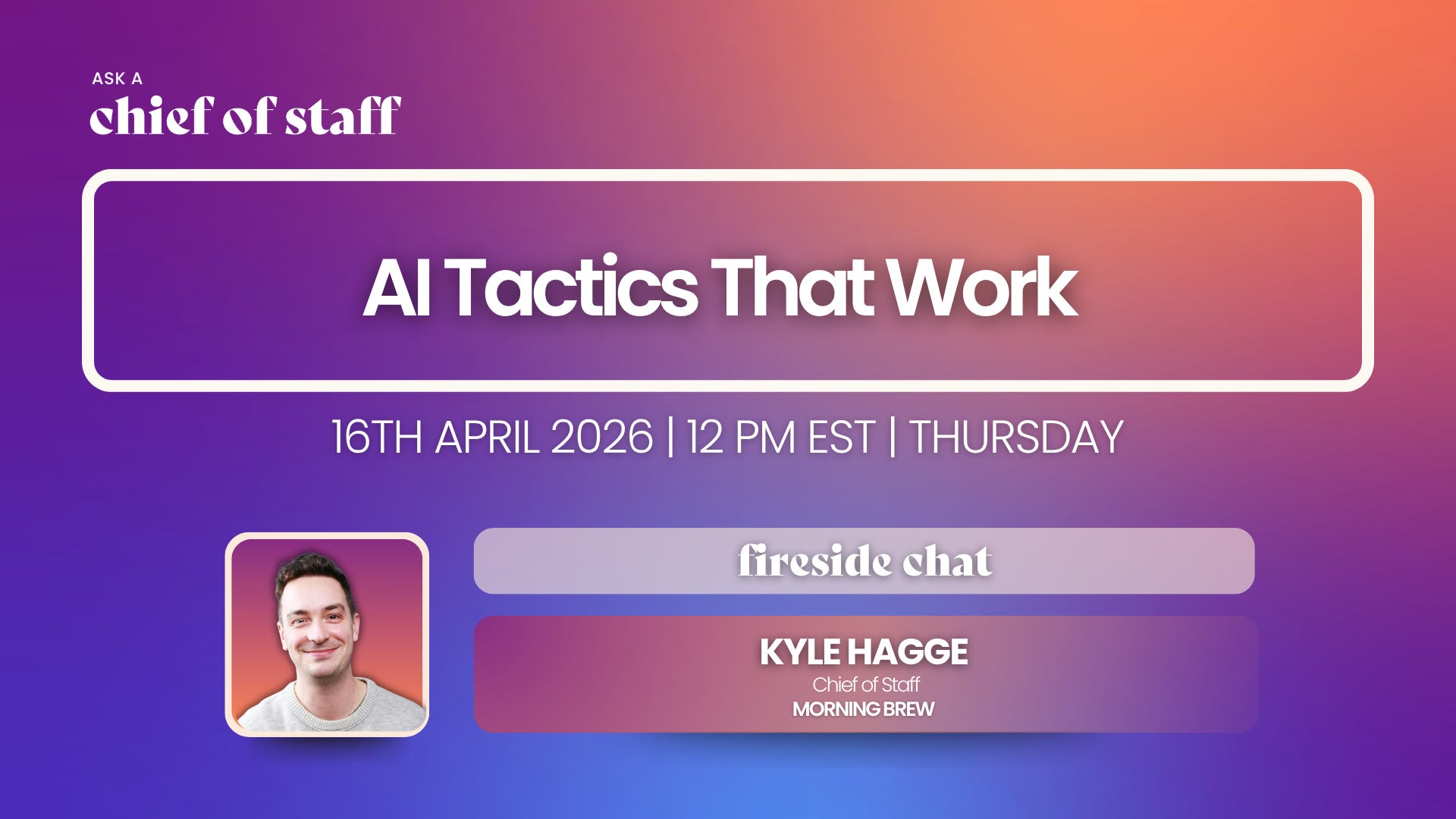
April 16th: AI Tactics That Work
April 14th: NYC Co-Working Day at Industrious
April 20th: RESCHEDULED FROM FEBRUARY: Ask a Chief of Staff Summit: NYC 2026 🗽🍎
As a reminder, events and workshops are free or heavily discounted for all Ask a Chief of Staff community members.
Visit our website and click the “Join our community” button to start your journey!
Comments
Nothing yet. Say the first thing.
Sign in to join the conversation.