
Welcome back, aspiring and current Chiefs of Staff! 👋
If you're reading this as a forward or from LinkedIn, subscribe to Ask a Chief of Staff to get these insights directly in your inbox. Join 14,000+ Chiefs of Staff who trust us for actionable insights.
🧠 The only email inbox system I trust
When email is your command center, you don’t need more organization hacks: you need a system.
As part of the Superhuman suite, Superhuman Mail is the one inbox setup I’ve stuck with because it actually keeps me ahead without constant tinkering.
Work effortlessly. Stay ahead all year.
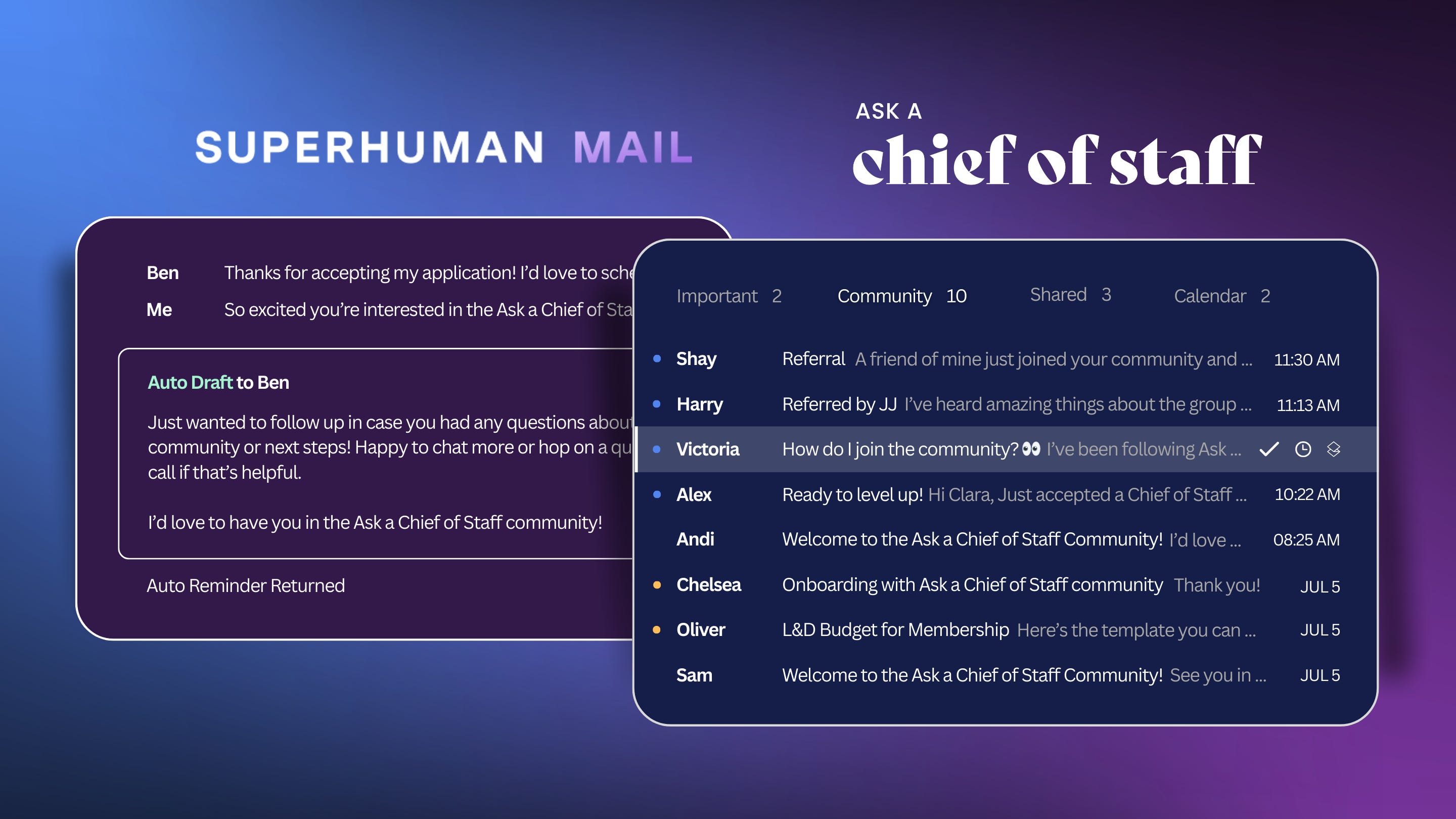
What makes it work for me:
Split Inbox keeps me focused, even when my inbox is overflowing.
Auto Drafts automatically drafts replies so staying on top of follow-ups becomes second nature.
Ask AI instantly surfaces key details from long threads, eliminating manual search, keeping your workflow fast and focused.
🎁 Set it up once and stay in control all year. Sign up for Superhuman Mail with our link and get one month free!
*If you’re interested in sponsoring a future issue of Ask a Chief of Staff, hit reply!
🏗️ Are YOU Holding Your Organisation Together — Or Is Your System?
This week’s issue is guest authored by Tyla Cleator, a Chief of Staff operating at the intersection of executive judgment, power dynamics, and organisational design. With global experience across scaling and complex environments, she focuses on building systems that enable durable ambition at scale. She is an award-winning Women in Digital Skills Development leader and writes on sustainable ambition and structural leadership through The Shadow Strategist.
📌 TL;DR
Relational trust is necessary, but it doesn’t scale without structure.
At scale, trust lives in decision rights, escalation design, governance consistency, and incentive alignment.
As organisations grow, misalignment becomes a systems problem, not an interpersonal one.
If you’re constantly re-translating intent, you’re patching a system that was never designed to hold without you.
Trust holds when how decisions get made and what the organisation says it values actually match—especially under pressure.
🛡️ Trust is often treated as a soft skill—something built through rapport and reinforced through communication.
But at scale, especially in the age of AI where visibility increases and execution accelerates, the cracks in how you’ve built trust don’t stay hidden. They get exposed.
In this piece, I explore how trust evolves as organisations mature, and what it takes to design systems that hold under pressure.
🤝 It Starts With Relational Trust
Most Chiefs of Staff begin their role focused on trust.
You build it quietly, by following through, exercising discretion, and doing what you say you will. Relational trust is consistency under pressure. It accumulates slowly and can disappear quickly.
But if you’ve been in the role long enough, you’ve likely felt a different tension. You can be fully aligned in the room and still watch execution drift outside it.
You re-translate decisions. You clarify intent. You correct sequencing.
Over time, you start to notice that alignment holds only when you’re there to reinforce it. That realisation isn’t philosophical. It’s operational.
A strategic priority may be clearly agreed at the executive level—resources aligned, messaging consistent. Yet months later, different parts of the organisation are still working toward different definitions of success. No one is acting in bad faith. The system simply hasn’t ensured that words and outcomes stay connected.
✨ That’s the inflection point. Relational trust is necessary. But without structure, it doesn’t scale.
💡 A Systems Thinking Approach
Systems thinking shifts the question.
Instead of asking whether people trust each other, it asks what the organisation reinforces when pressure rises?
At scale, trust lives in the practical machinery of how organisations operate:
🙋🏻♂️ Who has the authority to make decisions
⚠️ How problems get escalated
🏆 Whether incentives match stated priorities, and
🎯 Whether accountability is real and visible
When those elements bend under stress, trust erodes—even if individual relationships remain strong.
✨ Trust becomes architectural because it determines whether leadership intent survives complexity.
🧬 How Trust Evolves as Organisations Mature
Trust changes as organisations grow. What works early rarely survives scale unchanged.
I’ve seen three patterns consistently emerge across environments:
Stage 1️⃣: Proximity-Based Trust
In tightly held environments, proximity substitutes for structure. Clarity flows through conversation. Alignment is reinforced in real time. Decisions are social before they are formal.
Speed hides the lack of formal structure because decision-makers are close enough to catch misunderstandings quickly. Relational trust carries execution.
✨ The Chief of Staff translates and amplifies but doesn’t yet need to design. This works until complexity outpaces proximity.
Stage 2️⃣: Scaling Complexity
As organisations grow, informal alignment becomes insufficient. Stakeholders multiply. Incentives diverge. Constraints tighten. Velocity increases. Leaders may agree in principle while execution fractures in practice.
Formal frameworks often exist, such as capital allocation models, sequencing guardrails, and cross-functional sign-offs. The intent is clear. But under pressure, those guardrails get skipped. Informal pathways replace formal structure. The strategy may remain intact, but the mechanics shift.
When performance slips, the question becomes: “Why didn’t we see this earlier?” That burden frequently lands with the Chief of Staff.
At this stage, trust begins to erode. Without structural reinforcement, someone absorbs the gap.
✨ As the Chief of Staff, if you are repeatedly re-translating intent or manually correcting sequencing, you are patching holes in a system that was never designed to hold without you. That pattern is structural, not personal.
Stage 3️⃣: Governance Maturity
In more mature organisations, governance mechanisms exist. Decision forums are defined. Approval thresholds are documented. Accountability structures are visible.
Yet fragility persists when those mechanisms are inconsistently applied. And inconsistency is subtle; it rarely announces itself. It shows up as a one-time exception that quietly becomes precedent. A process that gets bypassed under pressure and never reinstated. A standard that bends for a senior stakeholder and stays bent.
Having the structures in place isn’t enough. Consistency under pressure is what creates trust, not the existence of the framework itself.
✨ At this stage, the Chief of Staff often becomes the institutional memory of what the rules actually are (and were). Which sounds like influence. But it’s closer to exposure.
The question becomes: Will this design hold when conditions change?
⚠️ When Trust Erodes
Trust breaks down when how decisions actually get made stops matching what leadership says matters.
Strategic objectives may be communicated clearly. Leadership may signal what matters. But under pressure:
↘️ Decision rights compress
↘️ Escalation pathways are bypassed
↘️ Capital allocation shifts without explicit trade-offs
↘️ Incentives reward outcomes that contradict stated priorities
The issue isn’t messaging. It’s the gap between declared standards and what actually gets enforced.
Organisations learn from decision patterns, not stated intent. If the rules flex unpredictably under stress, teams recalibrate. They optimise for what actually gets approved, funded, and rewarded.
✨ For the Chief of Staff, this is where things get visible. You find yourself explaining why a framework was adjusted. Clarifying why an exception was made. Reinforcing a priority the system just contradicted.
That work may smooth friction in the short term. But every unacknowledged exception makes the system a little weaker.
Trust doesn’t weaken because people disagree. It weakens when what the system says and what it does pull apart.
🛠️ What Good Trust Design Requires
Building trust into how an organisation operates comes down to a few practical foundations.
✅ Clear decision rights. Who contributes input, who makes the call, and who is accountable—especially under pressure.
✅ Designed escalation. Escalation follows structure rather than whoever has the closest relationship to the decision-maker.
✅ Decision memory. Trade-offs are recorded. What wasn’t decided is named. Conditions for revisiting a decision are explicit. Without this, reinterpretation becomes political.
✅ Stable standards. If declared priorities shift under stress, teams optimise for self-preservation. Good design means standards hold, even when inconvenient.
Trust isn’t just what is said in meetings. It’s what the system reinforces when you’re not in the room.
🤖 AI, Visibility, and What Gets Exposed
One of the most strategic parts of the Chief of Staff role is making sure work actually moves—not just administratively, but structurally.
That means decisions convert into action cleanly, trade-offs are understood, dependencies surface early, and escalation follows predictable pathways.
AI tools accelerate all of this through visibility and real-time alignment. But speed is a stress test. The faster things move, the harder it is to paper over gaps in how the organisation is designed to operate.
In complex organisations, leaders can be fully aligned at the top while execution drifts at the operational level—where priorities get sequenced differently, attention gets allocated inconsistently, and stated direction doesn’t always match what’s actually getting resourced.
👀 AI doesn’t create that misalignment. It reveals it.
If work only moves when someone is manually pushing it forward, that’s a signal worth paying attention to. The issue isn’t speed. It’s the underlying structure.
✨ As the Chief of Staff, the goal isn’t to remove yourself from the equation. It’s to build a system that doesn’t depend on you to function—so your energy goes toward decisions that actually require judgment, not patching gaps that shouldn’t exist.
Relational 🆚 Structural Trust
Relational trust asks: “Do I trust this person?”
Structural trust asks: “Does this system protect clarity under pressure?”
When the system isn’t well-designed, you end up re-translating decisions, absorbing drift, and becoming “indispensable”—not because of your strategic value, but because things fall apart without your constant intervention.
🚨 That isn’t leverage. It’s exposure.
💭 Building Something That Lasts
Ambition without good systems creates intensity. Ambition with good systems creates durability.
Organisations that hold up over time are ones where incentives actually reinforce the stated strategy, governance doesn’t collapse under urgency, and decision rights stay stable even when things get hard.
Trust isn’t built in alignment meetings. It’s built in what holds when you’re absent. If alignment depends on constant intervention, the organisation isn’t robust. It’s reliant. And reliance doesn’t scale.
Early in the role, you ask: “How do I build trust?”
Later, the question becomes: “How do I design trust so it holds?”
Trust isn’t a soft skill. It’s architecture. And whether strategy survives scale usually has less to do with alignment in the room—and more to do with what holds when no one is watching.
Thanks for reading! This post is public so feel free to share it.
👩🏻💻 Level Up Your Chief of Staff Skills
Ready to accelerate your growth in 2️⃣ 0️⃣ 2️⃣ 6️⃣ ? Paid Substack members get exclusive access to a growing library of 2️⃣ 0️⃣ ➕ workshops from industry experts—covering everything from strategic planning, to navigating your next career move, to keeping cool under pressure 🧘♂️
New workshops added monthly! Recent additions include:
$1️⃣ 0️⃣/month or $1️⃣ 0️⃣ 0️⃣/year. Cancel anytime.
🎥 Upcoming Events and Workshops:

💻 Virtual Events
March 24th: The Hidden Operational Cost of Mail (This is a webinar hosted by one of our partners, Stable, and I highly recommend attending if you’re struggling with the very real problem of snail mail! 🐌)
March 24th: From Full-Time to Fractional: Making the Leap as a Chief of Staff
March 26th: Shifting from Reactive Problem-Solving to Strategic Thinking
March 31st: Chief of Staff & The Skill of Emotional Fortitude
April 2nd: Communication Intelligence for Chiefs of Staff: Practical Tools for Navigating Team Dynamics
April 9th: Peer Resume Review
👋🏼 In-Person Events
March 26th: NYC Co-Working Day at The Malin
March 26th: Ask a Chief of Staff Los Angeles Happy Hour 🎊
April 14th: NYC Co-Working Day at Industrious
April 20th: RESCHEDULED FROM FEBRUARY: Ask a Chief of Staff Summit: NYC 2026 🗽🍎 (Early bird tickets still available!)
🔑 Members-Only Events
March 18th: Strategy in Practice: Drop-In Office Hours with Aarti Bhatnagar
As a reminder, events and workshops are free or heavily discounted for all Ask a Chief of Staff community members.
Visit our website and click the “Join our community” button to start your journey!
This Substack is reader-supported. To receive new posts and support my work, consider becoming a free or paid subscriber.
Comments
Nothing yet. Say the first thing.
Sign in to join the conversation.