
If you're reading this as a forward or from LinkedIn, subscribe to Ask a Chief of Staff to get these insights directly in your inbox. Join 15,000+ Chiefs of Staff who trust us for actionable insights.

This week’s newsletter is brought to you by Ambient, a context engineering platform and consultancy for teams looking to go AI-Native. Ambient replaces the manual work teams do to organize their meetings, messages, and documents, so your Claude / ChatGPT / Gemini can work at their best. Schedule a free consultation with the Ambient founders HERE.
Disclosure - I’m an advisor for Ambient and they also sponsored this newsletter, but I genuinely believe this tool would have been valuable when I was serving as a Chief of Staff.
*If you’re interested in sponsoring a future issue of Ask a Chief of Staff, hit reply!
This issue is guest authored by Lawrence Coburn, CEO / Co-Founder at Ambient, an AI-powered consultancy for leadership teams looking to go AI-Native. A four-time founder, Lawrence has spent the last two years speaking with hundreds of leadership teams about AI adoption, and what actually separates the companies getting real results from the ones still tinkering.
Recently, Jack Dorsey and Sequoia’s Roelof Botha published a piece arguing that companies don’t just need to change their tech and behaviors for the age of AI, but they actually need to reinvent the org chart.
🗣 Their argument: Today’s org charts are mostly a relic of humanity’s limitations, designed to pass information and context up and down the hierarchy.
Block, Dorsey’s company, is reorganizing itself as an “intelligence,” where AI replaces what the management hierarchy was built to do: route information, maintain context, and coordinate across teams. Middle management, a layer that was invented as a conduit to push updates up and strategy down, becomes obsolete. Human roles get morphed into one of three archetypes: builders, owners, and player/coaches, all working in the “places the model can’t go.” The keeper of the company’s knowledge becomes the AI.
🤔 It’s a provocative vision. And directionally, I think they’re right.
But here’s what I know from spending the last two years in the trenches with leadership teams, conducting over 400 interviews with C-suites about their AI posture: almost no company is set up to get there overnight.
There is simply too much change management in the air: new tech, new skills, new behaviors. The gap between what AI can do and how companies actually operate is enormous.
But the bottleneck isn’t your tools. It’s your operating model and behaviors.
And there’s one person in your org already equipped to help fix that: the Chief of Staff.
There is a fundamental law of the AI era that most companies have not internalized: AI impact is directly proportional to the context it receives.
For single-player tasks, context engineering is easy. Your Claude or ChatGPT can see what you can see: your calendar, your email, your docs. But it gets trickier for teams.
Context is the raw material that powers AI’s ability to reason, synthesize, and act on behalf of your team. And right now, most companies make it nearly impossible for AI to access the context it needs to deliver team-based gains.
Where is context leaking in most organizations?
Strategic thinking is locked in the CEO’s head, shared through private texts and one-on-ones that no system can access
Decisions get made verbally in meetings and never documented
Updates travel through hierarchies like a game of telephone
Communication is fragmented across Slack DMs, email threads, text messages, and four or five different note-taking apps
Critical institutional knowledge walks out the door every time someone leaves
This isn’t a tech problem. You can deploy the most advanced AI tools on the planet and they will underperform if your organization is not set up to feed them the context they need.
💭 I recently spoke with a Chief of Staff whose company is anti-recording (at the advice of counsel) and where critical project updates are often communicated over text. Unless behaviors and norms change at that company, AI simply cannot help, and they will continue operating like it’s 2023.
The companies getting genuine results from AI are not the ones with the fanciest tools. They’re the companies doing the boring operational groundwork that makes AI effective.
💭 One of my investors recently told me about the founder of a $400M company who was walking around asking his AI lead, “What should I name this document?” That is not a trivial question anymore. Every piece of metadata, every channel name, every meeting subject line is a signpost for an AI system trying to navigate your company’s knowledge. Naming conventions are now mission-critical.
💭 Another team I work with demonstrated that a task requiring four hours of manual context-gathering was completed in twelve minutes. The AI did nothing magical. The operating model made the magic possible because all the necessary inputs already existed in organized channels and recorded meetings.
🙄 And don’t even get me started on token consumption. If you lazily ask Claude to ask across the History of Everything to give you an update on a project, you are going to burn through your tokens lickety-split. Somebody needs to do the work to point your AI to the right neighborhood.
🎙️ They record everything by default. The AI assistant stays in the room unless there’s a specific, justified reason to remove it. Meetings are a chance to memorialize your smartest team members’ experience, perspectives, and thinking. (Do you ever find yourself waiting to start a meeting until the AI assistant has been admitted? Yeah, me too.)
📁 They organize context around projects and relationships. One Slack channel per initiative. One channel per key client. Recurring meetings mapped to their corresponding channels. No orphaned communication floating in general channels or DMs.
🚫 They kill the status meeting, and double down on brainstorms. AI can do your status updates, async, better than you can. But brainstorms become more important than ever as a way to memorialize knowledge and thinking.
🛠️ They standardize tools at the team level. The “everyone picks their own tools” era is mostly over. When a company runs five different note-taking apps, you lose shared memory. Each tool becomes a silo. A unified context layer is now a strategic asset.
✏️ They communicate with machine-readable clarity. Instead of “let’s circle back on that deck sometime soon,” they say “I will complete the draft by Friday, February 14th.” What’s good for AI turns out to be good for humans. More clarity means better alignment and better accountability.
🔇 They eliminate the backchannel. Work updates don’t belong in side conversations or informal texts. Companies with transparent, documented cultures will be the winners in this next chapter.
None of this is glamorous. None of it requires technical sophistication. But it’s really hard. It requires top-down leadership, discipline, and the willingness to change behaviors that feel comfortable but are now holding your company back. The hardest part? The execs themselves are often the ones most in need of changing.
❓ Who is equipped to change behavior and operating models at the organizational level? It’s a very short list: CEO. Chief of Staff. Maybe COO or President. And the stakes are getting higher by the day.
Dorsey and Botha are making a claim that goes well beyond “change your behaviors to unlock AI gains.”
They are arguing that the org chart itself, the hierarchical structure that every company on earth partially inherited from the Roman army, was designed around human strengths and human limitations at the time, and is no longer relevant.
🧮 The old math: Humans can only manage so many people. Humans can only hold so much context. So we built layers. Managers to route information. Middle management to coordinate across teams. Staff functions to synthesize and report.
🤖 AI changes the math on all of that: When a system can maintain a continuously updated model of an entire business, the rationale for many of those layers weakens. Companies will get flatter. Roles will be redesigned for an AI-centric workplace. The traditional org chart, optimized for a world where humans were the only coordination mechanism, will evolve into something we’d barely recognize today.
🧭 I believe this is where we’re headed. But we’re not going to get there overnight.
The good news: there’s no shortage of places to start. The behavioral changes above, like recording by default, organizing context, standardizing tools, and communicating with precision, make AI effective today and lay the groundwork for the deeper structural transformation that’s coming.
Org charts can morph gradually over time to reflect the work. Too much change at once is difficult for any company to digest.
Someone has to get your company from here to there. And the Chief of Staff is uniquely positioned to be that person.
Think about it. The Chief of Staff is already the human version of what AI wants to be 🤯
They’re in every room. They connect the dots across functions and keep tabs on key initiatives. Through a combination of access and judgment, they fill in the blanks that nobody else sees. They hold context across the entire organization. They already understand the information flows, the political dynamics, and the gap between how a company thinks it operates and how it actually does.
The Chief of Staff becomes the context engineer, and the final boss Human in the Loop. The person who:
✅ Audits where context is leaking
✅ Drives behavioral changes around recording and communication norms
✅ Configures AI systems to reflect how the team actually operates
✅ Serves as the human in the loop where judgment still matters
Over time, as AI takes on more of the coordination work, the Chief of Staff is the one guiding the organization through the structural changes that follow. Which roles evolve. Which layers compress. Where humans still need to be in the loop, and where they don’t.
This is a specialized form of change management, not software deployment. And it is the hardest part.
💭 Every operator I’ve talked to who has tried to install a new operating model says the same thing: the volume of questions from teams about where to put updates, what to name channels, which doc goes where, who owns the setup… there’s a whole layer of coordination and operational rigor that most companies under a thousand employees have never built.
🔮 I go back and forth between thinking of the Chief of Staff of the future as “Chief Human in the Loop” or “Chief Context Engineer.” The answer is probably both.
Dorsey and Botha wrote about the destination. It’s clear to me that the Chief of Staff is going to be a critical player in building the road to get there.
Most of the world is still debating whether to record their staff meetings. The window is open, and the person best positioned to drive this transformation is already in the room.
Thanks for reading! This post is public so feel free to share it.
Ready to accelerate your growth in 2️⃣ 0️⃣ 2️⃣ 6️⃣ ? Paid Substack members get exclusive access to a growing library of 2️⃣ 0️⃣ ➕ workshops from industry experts—covering everything from strategic planning, to navigating your next career move, to keeping cool under pressure 🧘♂️
New workshops added monthly! Recent additions include:
$1️⃣ 0️⃣/month or $1️⃣ 0️⃣ 0️⃣/year. Cancel anytime.
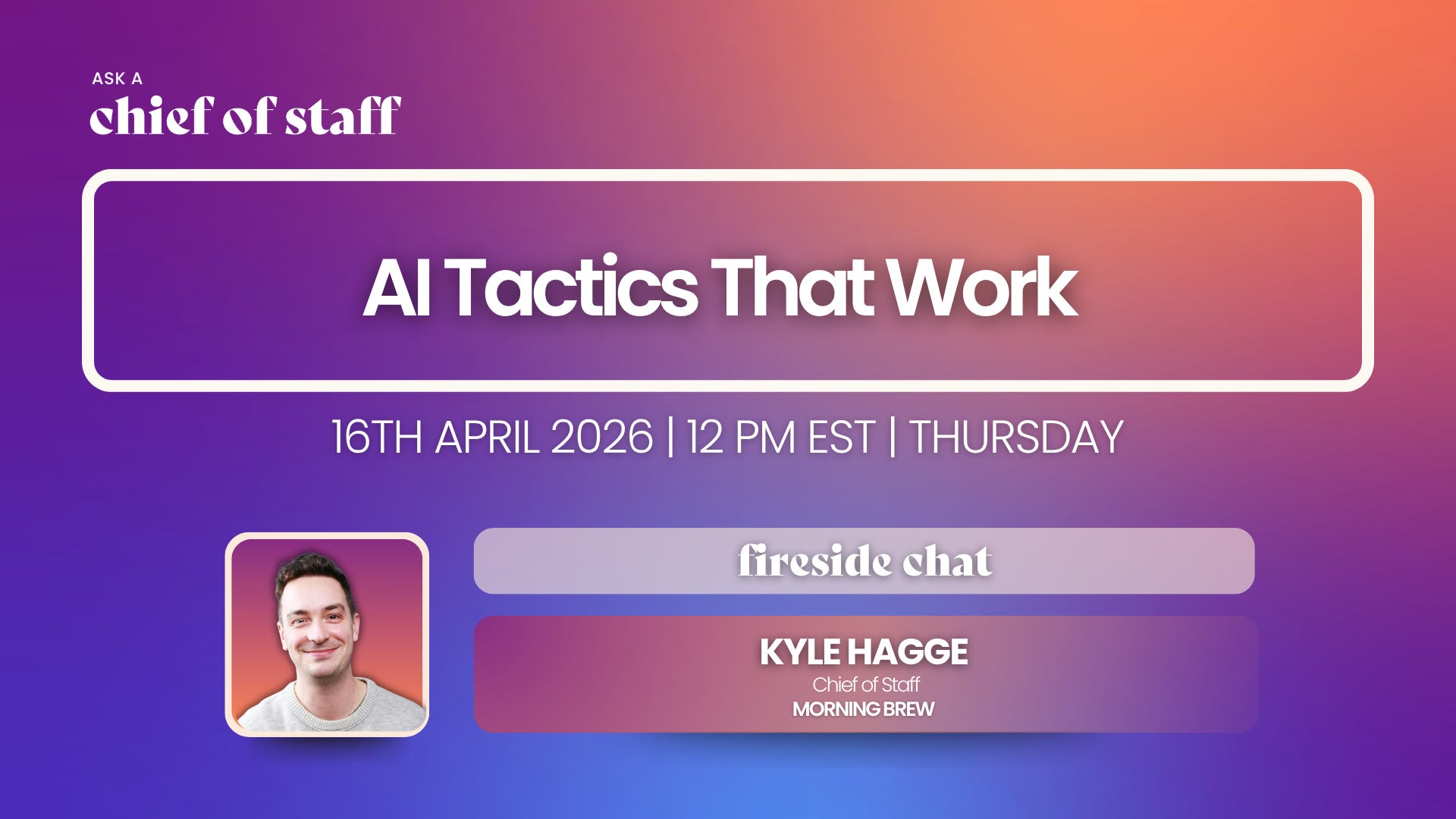
April 16th: AI Tactics That Work
April 21st: Spring Job Search Reset (A Two-Part Workshop Series)
April 30th: The Nonprofit Chief of Staff Exchange: A Peer Roundtable
April 30th: Scaling Teams and Organizations
May 5th: Being A Chief of Staff In 2026: What’s Changed, What Hasn’t, What Matters Now (presented by Offsite)
April 16th: DC Happy Hour 🎊
April 20th: RESCHEDULED FROM FEBRUARY: Ask a Chief of Staff Summit: NYC 2026 🗽🍎
April 22nd: Ask a Chief of Staff x Generalist World NYC Happy Hour
April 30th: Chicago Happy Hour
As a reminder, events and workshops are free or heavily discounted for all Ask a Chief of Staff community members.
Visit our website and click the “Join our community” button to start your journey!
Comments
Nothing yet. Say the first thing.
Sign in to join the conversation.