
The WPS-cult is just untethered from reality. They are, of course, against the PH-China joint oil exploration that the BBM administration is now cooking. The WPS-cult is operating in this logic: WPS is ours, therefore no joint exploration because it is ours.
But then they divorced their thinking form reality: China also have sovereignty claims. Whether you accept or China’s claim as true WILL NOT change the situation that you are in conflict with China.
From here, what could you do?
Mindset1: Deny there is a conflict. This is dogmatism based on delusion.
Mindset 2: Accept there is a conflict but you are fully right, the other is fully wrong.
Mindset 3: Accept there is a conflict but accept that you don’t have access to full truth.
What policies could spring from these three mindset and what are their policy and situational implications?
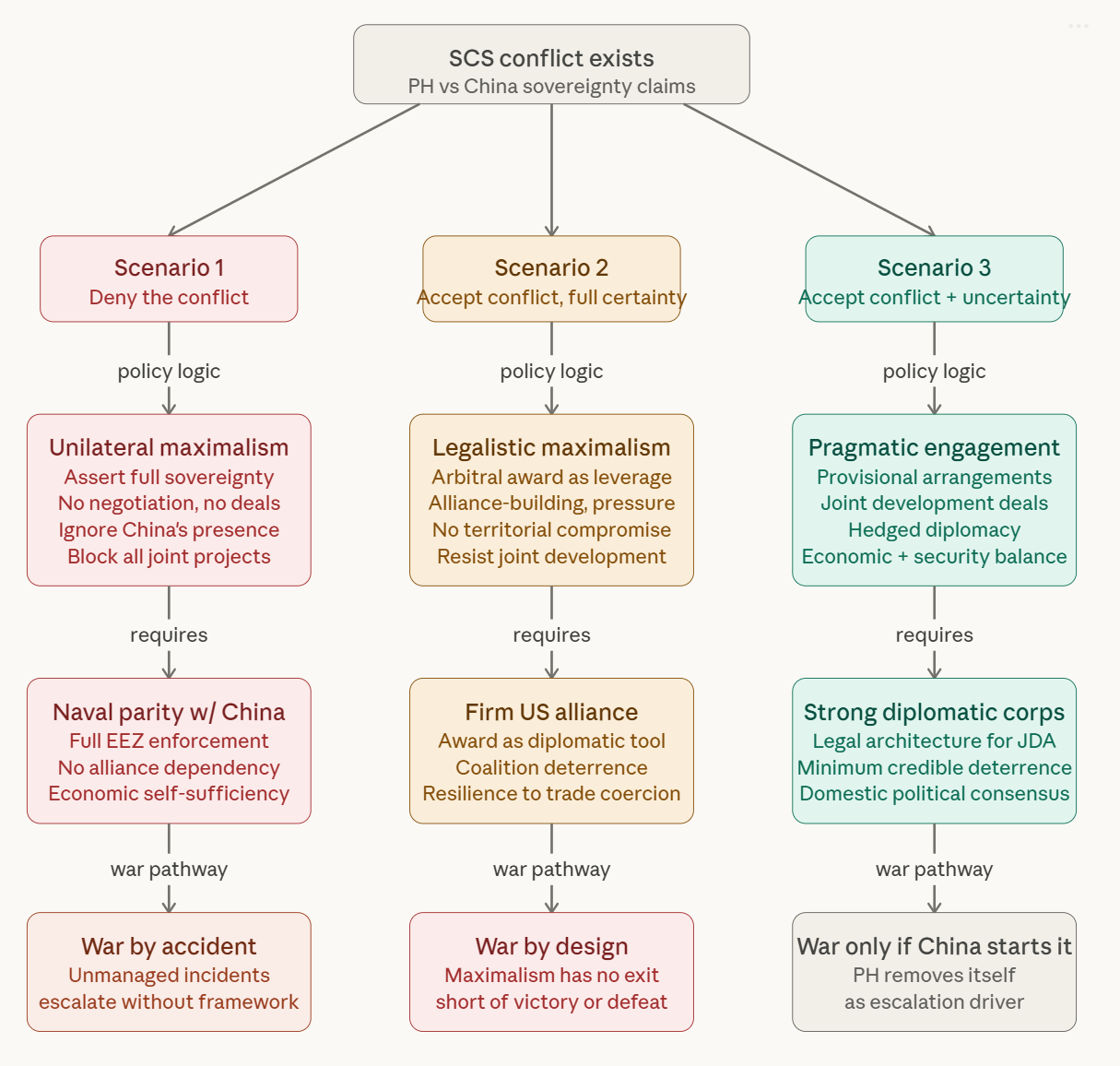
𝐒𝐜𝐞𝐧𝐚𝐫𝐢𝐨 𝟏: 𝐃𝐞𝐧𝐲 𝐭𝐡𝐞𝐫𝐞 𝐢𝐬 𝐚 𝐜𝐨𝐧𝐟𝐥𝐢𝐜𝐭
The policy that flows from this is unilateral maximalism — declare full Philippine sovereignty, oppose any negotiation or joint project on the grounds that doing so constitutes implicit recognition of China’s claims. The WPS-cult lives here. Every joint development proposal becomes, in their framing, a betrayal.
The capability requirement to make this policy work is naval and economic parity with China — the ability to physically enforce the EEZ against a country with the world’s largest coastguard fleet and a blue-water navy, sustained indefinitely, without alliance dependency. None of these capabilities exist.
The war pathway here is accidental. Denying the conflict doesn’t demobilize China— it just means every incident that occurs happens without a strategic framework to contain it. A vessel gets rammed, a politician demands a response, the military acts improvisationaly, and suddenly you are in an escalation neither side planned for but neither can easily back down from. This is the most dangerous kind of war — the kind nobody chose.
𝐒𝐜𝐞𝐧𝐚𝐫𝐢𝐨 𝟐: 𝐀𝐜𝐜𝐞𝐩𝐭 𝐭𝐡𝐞 𝐜𝐨𝐧𝐟𝐥𝐢𝐜𝐭, 𝐛𝐮𝐭 𝐰𝐢𝐭𝐡 𝐟𝐮𝐥𝐥 𝐜𝐞𝐫𝐭𝐚𝐢𝐧𝐭𝐲 𝐨𝐟 𝐫𝐢𝐠𝐡𝐭𝐧𝐞𝐬𝐬
The policy is legalistic maximalism — use the 2016 UNCLOS arbitral award as the definitive moral and diplomatic framework, build international pressure on that basis, deepen alliance commitments, and resist any deal that resembles a concession. This is a more serious position than Scenario 1 because it at least concedes that China is actually there and actually doing things.
The required capabilities are partially achievable: a firm US mutual defence commitment with clear tripwires, a diplomatic coalition among like-minded states, economic resilience against Chinese coercion, and sustained use of the arbitral award as a reputational instrument. The award has no enforcement mechanism — China disregards it and faces no binding consequence — so its value is political, not operational.
The war pathway here is structural. Maximalism with no exit ramp has a logical terminus: if you are entirely right and the other side is entirely wrong, the only acceptable outcome is full compliance from China. China will not comply. At that point you either back down — collapsing the entire moral framework your policy rests on — or you escalate. The alliance commitment becomes the question on the table. A miscalculation occurs. This is the scenario where war is not an accident but the terminal logic of a position that offers no resting place short of victory or defeat. The especially dangerous version is when the Philippines feels just emboldened enough by allied backing to keep pushing, but that backing is conditional enough that it won’t actually hold when the shooting starts.
𝐒𝐜𝐞𝐧𝐚𝐫𝐢𝐨 𝟑: 𝐀𝐜𝐜𝐞𝐩𝐭 𝐭𝐡𝐞 𝐜𝐨𝐧𝐟𝐥𝐢𝐜𝐭, 𝐚𝐜𝐜𝐞𝐩𝐭 𝐞𝐩𝐢𝐬𝐭𝐞𝐦𝐢𝐜 𝐥𝐢𝐦𝐢𝐭𝐬
The policy is pragmatic engagement — provisional arrangements that allow resource development to proceed without either side formally conceding its sovereignty claim. Both parties set aside the “who owns it” question in favor of “what can we each get from it.” This is not surrender; it is the acknowledgment that the situation is contested and that acting on what is achievable is better than demanding what is unenforceable.
The required capabilities are the most buildable: a diplomatic and legal corps capable of structuring joint development agreements that protect Philippine interests, minimum credible military deterrence — not to defeat China but to ensure aggression carries a non-trivial cost — and multi-vector positioning so the Philippines is not purely dependent on either China or the US.
The war pathway here belongs almost entirely to China. By removing itself as a driver of escalation, the Philippines forces any war to be a war China openly chooses and owns — which raises the political cost on China’s side and strengthens the case for allied intervention.
If you find value in what this blog does, please consider tipping via GCash - 09288956324 Buy me a Coffee: https://www.buymeacoffee.com/srsasot
Comments
Nothing yet. Say the first thing.
Sign in to join the conversation.