
“Don’t expect my story to be as positive and happy as the others…”
Ani came to the US around 3 years ago from Yerevan, the capital of Armenia. She came here on a tourist visa but later applied for political asylum.
English is not her first language. She speaks and reads Armenian and Russian with more ease.
I’ve deliberately kept my editorial hand very light.
Also, the interview was done a few weeks before the 2026 elections in Armenia, so her comment on the government back home refers to the previous leadership.
Why did you move from Armenia?
“It’s a very difficult region, we are always in a war situation,” she said over a video call. “We left because of the political situation after the war. We lost the war with our neighbor.”
Armenia’s neighbors include Turkey, Azerbaijan, Iran and Georgia. She’s referring to Azerbaijan here.
“We lost a very important part of our legacy. Our government is trying to erase our history of thousands and thousands of years, change our constitution, delete all mention of Armenian genocide… it’s a very turbulent time in Armenia currently. From a very democratic country we’ve become an autocratic country. Nobody in the world understands when you share that because we’re a small country…”
In 2020, when Artsakh was attacked and a 44 day war ensued, around 5,000 people died.
“For Armenia, it’s a big number.”
At this point, Ani is in tears.
At the time she left Armenia, things were volatile. Our conversation brings back memories she prefers not to dredge.
“There came a time when me, my husband and our two children had to leave the country, we had to choose somewhere to go for the time being, to be able to —we had to, we were never planning that but it just came, we just had to leave.”
“We’re not a strong passport country.1 So we had to choose from where we had visas to, where we were able to go… I had a visa for the US and I know the language (English), so I came here.”
“Our Armenian generic immigration growth goes towards Russia, Belarus, Ukraine, nearby countries, but Russia and Ukraine were in a war situation, we were not sure it would be safe to go in that direction, so we decided to come to the US.”
“It was a big surprise for everyone, especially for my children because they didn’t know anything.”
When they moved, her children were around 7 and 4.
“Till this day, when we move from one house to the other, my daughter asks me if we’re coming back to that place or not… because when we left, we left everything behind.”
It took around 6 months after they first arrived, for her and her husband to get work authorization.
“It was not an easy period for us, we didn’t know what we wanted to do, we didn’t know how we want to live, and didn’t know where we want to live.”
They first went to Florida, then to South Carolina.
“Our usual routine was leaving the children to school, coming home, drinking some coffee, and dreaming about life, me and my husband… then walking to the beach, coming back, picking the children… we didn’t have anyone else to hang out with… we have no family here, it was like being in isolation in a big, big, big city, you don’t know anybody, you’re alone… it just doesn’t feel fit.”
After a few months, they moved to California, to be closer to the Armenian diaspora — “to find more friends, to be more active and to find job.”
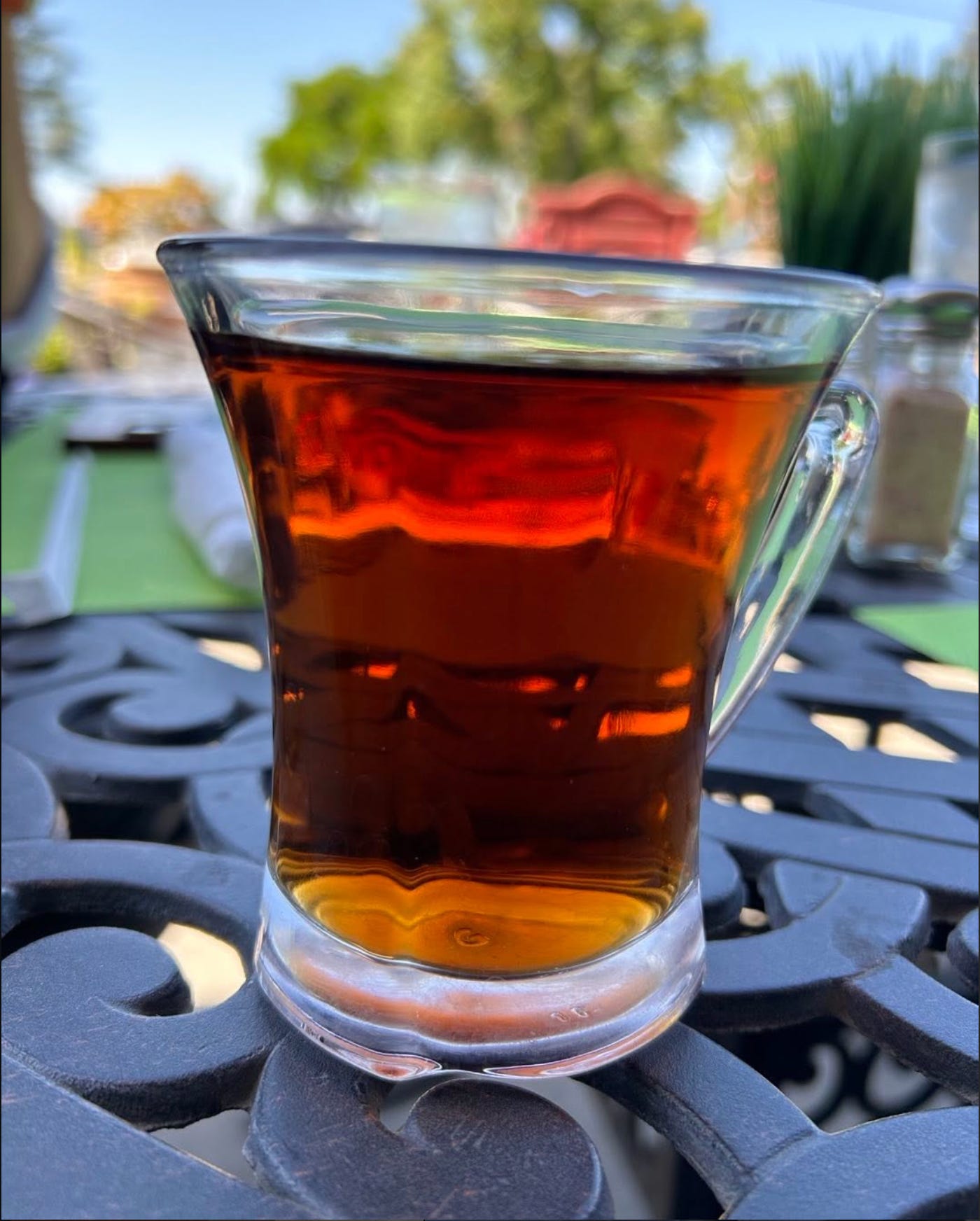
A strong cup of Armenian black tea I drank in Turlock —roughly, a 100 miles from Sunnyvale, where I live— comes to mind. I was there 2 years ago for a poetry reading2.
Ani is glad to have found work in her field of choice here, though it took some time.
“The job hunt was difficult - it never happened before that I was ghosted for months, but I was lucky enough to find a job within 5 months of my search… I didn’t have to work at the grocery store or do any ‘immigrant jobs’ as they say. I am very thankful to God for that.”
Her deadline for herself was 6 months, after which she was open to going back to the bottom of the corporate ladder, however grudgingly. But it didn’t come to that.
“I had so much experience, I had all these degrees — I did not want to waste that. So I’m happy that it was possible to find a job.”
She is a product experience manager, her husband works in tech.
She loves her job.
“When I am working I don’t think about my life! It’s a safe space for me.”
In general, Ani feels isolated. The much abused term ‘culture shock’ comes to mind here but as I type it, I know it sounds awfully reductive.
“I work from home, I don’t see a lot of people and I don’t feel a sense of social belonging. I have friends, I meet with them occasionally when our ‘schedules sync’ — here to meet your friends you have to plan 3 months before hand!”
She misses the effortless sense of community that is part of the social fabric in Armenia, including long gossip sessions, easy friendships and consequent deep bonds that often originate at work.
“Here people aren’t involved or engaged with one another — for them, a job is a job. Here people move on from people. I never move on from people.”
Maybe that’s the kind of person you are? Or is it culture over personality, I wonder aloud.
“What kind of person you are comes from society. If society says ‘everybody must live together’ then…”
I understand the rest of her unspoken sentence, and I’m not sure it’s because I’m an extrovert or because I’m an Indian.
“There’s no depression in our country (Armenia), we share so much with everyone, mothers, fathers, uncles, aunts, friends, they ask a lot of questions —‘how are you? you look a little bit strange, are you feeling good? is everything okay?’— you really don’t have any moments alone to feel depressed. In society there, everybody understands everybody. Here, I understand why people are depressed… they don’t have anyone to have genuine honest discussions with on any topic! It’s culturally very different for me.”
“In my country it’s customary to meet everyone several times a week, we eat dinner together, we go out of the city with friends almost all weekends, food is part of Armenian culture, meeting everyone to eat together is part of how we spend our time, so we have parties, potlucks, cooking a lot of meat, eating together, it was part of the culture.”
“In California we found that people are usually busy on weekends, they’re either working or they have plans… like, not fun plans — they go to the grocery store!”
People here sometimes make social visits to their parents on weekends, she noted, because they live separately, an oddity if one is used to living with parents and grandparents. But I fixate on the grocery store peeve and we share a laugh.
Like her, I came here 3 years ago as well and was also shocked when I discovered that driving to the grocery store on weekends is the most popular national pastime. Jest, of course. Humor is the way we reckon with everyday truths, after all.
“It’s difficult to form a community here… everyone is in a bubble of their own problems.”
And then, I got my headline.
“People here are used to their isolation.”
Ani misses the support of grandparents in the child-rearing process here, another cultural similarity with India.
“Me and my husband used to travel everywhere without children — here we’re 24-7 with children. So my husband and I have lost our adventure… we used to explore our country, we’ve explored Europe, Russia, parts of Africa… traveling was part of our identity. We lost it here because we can’t leave our kids with anyone here.”
She also found the car dependency of the US a challenge in the initial days, something many immigrants face on arrival.
“Armenia is very small. You don’t have to have a car to be able to travel. You can use public transportation, you can hire very cheap taxis.”
After a year in California, they went back to South Carolina. She lives in a town called Mount Pleasant.
But that’s not the only source of irony in her life as it stands today.
“Looking back, I wish I was able to explore the US more before moving here. I feel there is misperception regarding America all over the world. There is this idea of the American dream, American rights, American democracy. But we’re ignorant about American history. In school, we learned about Great Britain, France, the first world war, second world war, I had decent knowledge about world history but not enough about the US.”
Her little son was accused of being racist at school because he called an African American classmate “monkey.”
He might as well have said donkey, she notes, because she knows it was not a slur.
“They’ve never been exposed to topics like race, slavery, color difference.”
Ani, who hails from the Caucasus Mountains — where the word 3caucasian gets its name — is surprised to find that she is not considered white here. To my brown gaze, she looks very white. But there are different shades of white within the geo-social palette, I now understand.
“My child comes home from school and tells me - ‘I wish I was lighter in color, I feel I am dark’.”
Black and white aren’t the only colors she learnt more about after moving here. Her new rainbow now also includes red and blue. As I sat here in my sunny 4blue bubble, Ani spoke to me from a red state.
Despite everything, for someone who has escaped a volatile situation back home, isn’t the US the country that ‘rescued’ her? Is there gratitude or regret?
“When I came here, I was very grateful, and I’m still grateful to the US for taking us and shielding us for a period of time.”
“When the Soviet Union broke in the 1990s, all the countries were in a grey area — a lot of rules in Armenian legislation were in a grey area, you don’t know whether you’re breaking a law or not. To my mind, in the US, the rules are strict — this you can do, this you cannot do. When I came, I was so happy not to be worried whether I’m in a grey area or not. It was clear — if you don’t do this you will be fined. That was the best part of my life here when I came, because I know what to do, I’m following the rules. I don’t want this to be political but I don’t feel safe now. I’ve had so much anxiety for a year now… I can’t sleep. It’s the same anxiety I had in my homeland.”
She is in tears again and we’re both sorry.
“The government may not grant me permanent residency. I totally understand that. But at the same time I don’t want to feel second-hand. I don’t want to be part of a political game, I don’t want to feel like my family will be in jeopardy because something will change overnight. I don’t know what will happen tomorrow.”
Ani said she still has a lot of hope.
Besides medication, antidotes to her anxiety include cross-stitching and reading. She said she’s looking for a good book to lose herself in and I tell her about the 5Svetlana Alexievich-shaped literary rabbit hole I’m currently wandering in. She’s a Belarusian author who has written extensive monologues of people from the Soviet and post-Soviet era, including from Chernobyl. In fact, I’ve modeled my reportage of Ani’s story here along the lines of this brilliant author’s quote-heavy format.
Svetlana was paraphrased somewhere, while talking about the countless interviews that comprise her books, saying - it comes down to asking ordinary people important questions.
So I asked Ani a simple question: where is home?
“I don’t have a feeling of home here. The only target I have in my mind now is to make sure my children have a sense of home. When we move from house to house, I don’t decorate the house. It’s just temporary; I have a minimum quantity of items I need for daily life. I only decorate my children’s room. I don’t know how much time should pass and what should happen for me to finally have a sense of home.”
Armenia seems to have gone from being her home to being her homeland.
“It’s not that I am looking forward to going back to my country. No, I don’t want to go back, no.”
I first came across the concept of “passport power” through a comment on my LinkedIn post in which I asked the question “What's the difference between an expat and an immigrant?” The comments gave me so much to explore, that I ended up writing an essay on the subject. Read it here.
This poetry reading was held at California State University (CSU) Stanislaus. Watch the video of me reading my rhymes here.
Though credited with coining the term ‘caucasian,’ 18th century anthropologist Johann Friedrich Blumenbach’s theories, about where white Europeans originated, were later disputed.
Svetlana Alexievich won the Nobel Prize in 2015 for her work which falls in the zone between journalism and literary non-fiction.
No posts
Comments
Nothing yet. Say the first thing.
Sign in to join the conversation.