
When I started this blog, ‘I Live Here Now,’ I’d decided to slide into each immigrant’s story at a slant, through a conversation about an object they’d brought along when they moved. As I began asking around, this idea showed promise and items like pressure cookers, blankets and photo albums started coming up; I still fantasize about writing a series on people’s suitcases and backpacks.
But as I started taking interviews, I realized that I didn’t always need an item to usher me into these stories of migration. People were forthcoming and frank and, honestly, for a while I forgot all about the object-as-talisman idea until someone reminded me.
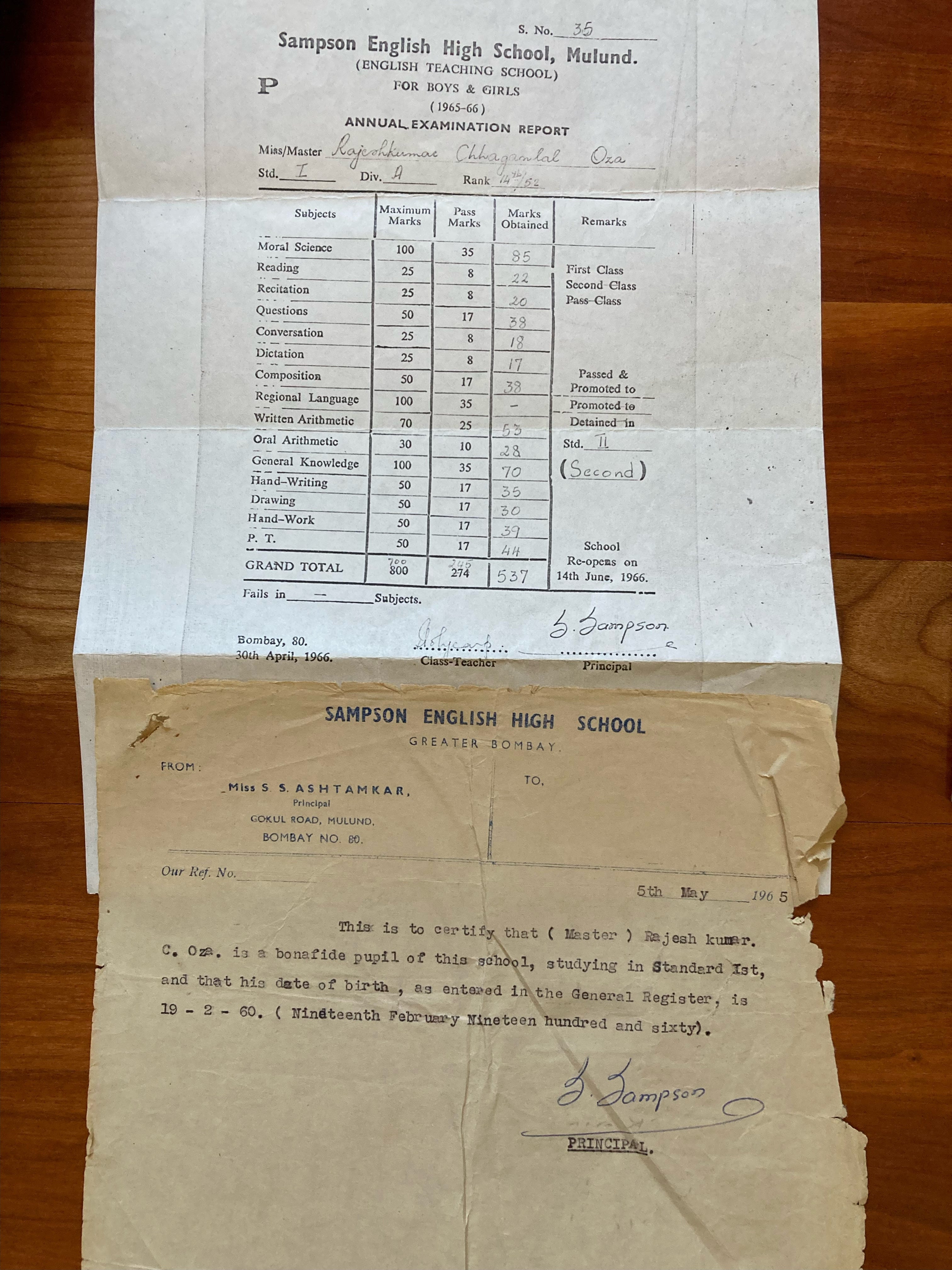
So when I approached my next interviewee, Raj, who moved from Bombay around 1965, I asked him if he still has a physical item from that time. I was delighted to discover that he has preserved a school certificate from back then. Raj was generous enough to send a photo of that magical piece of paper to me (keep reading, it’ll show up).
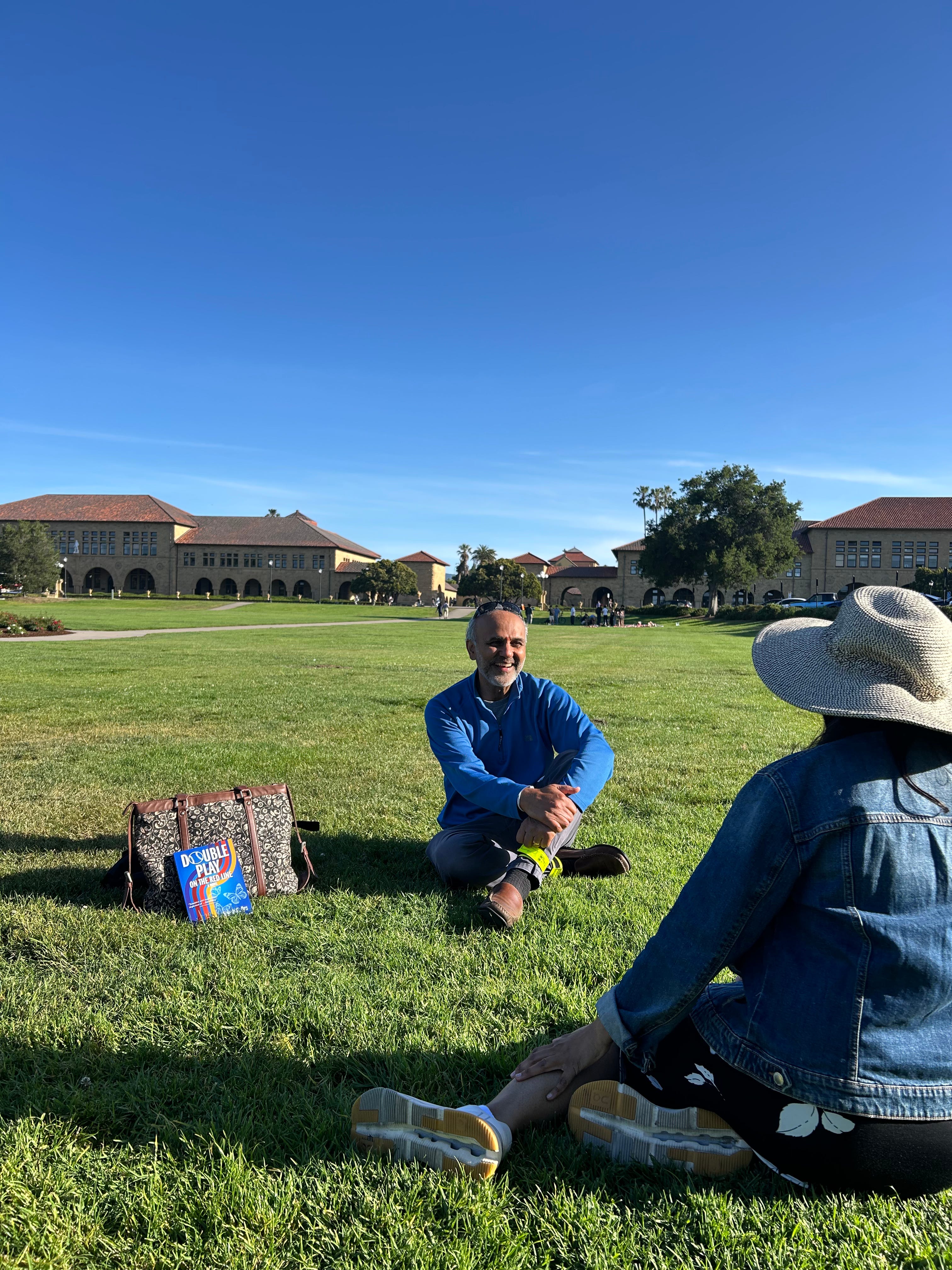
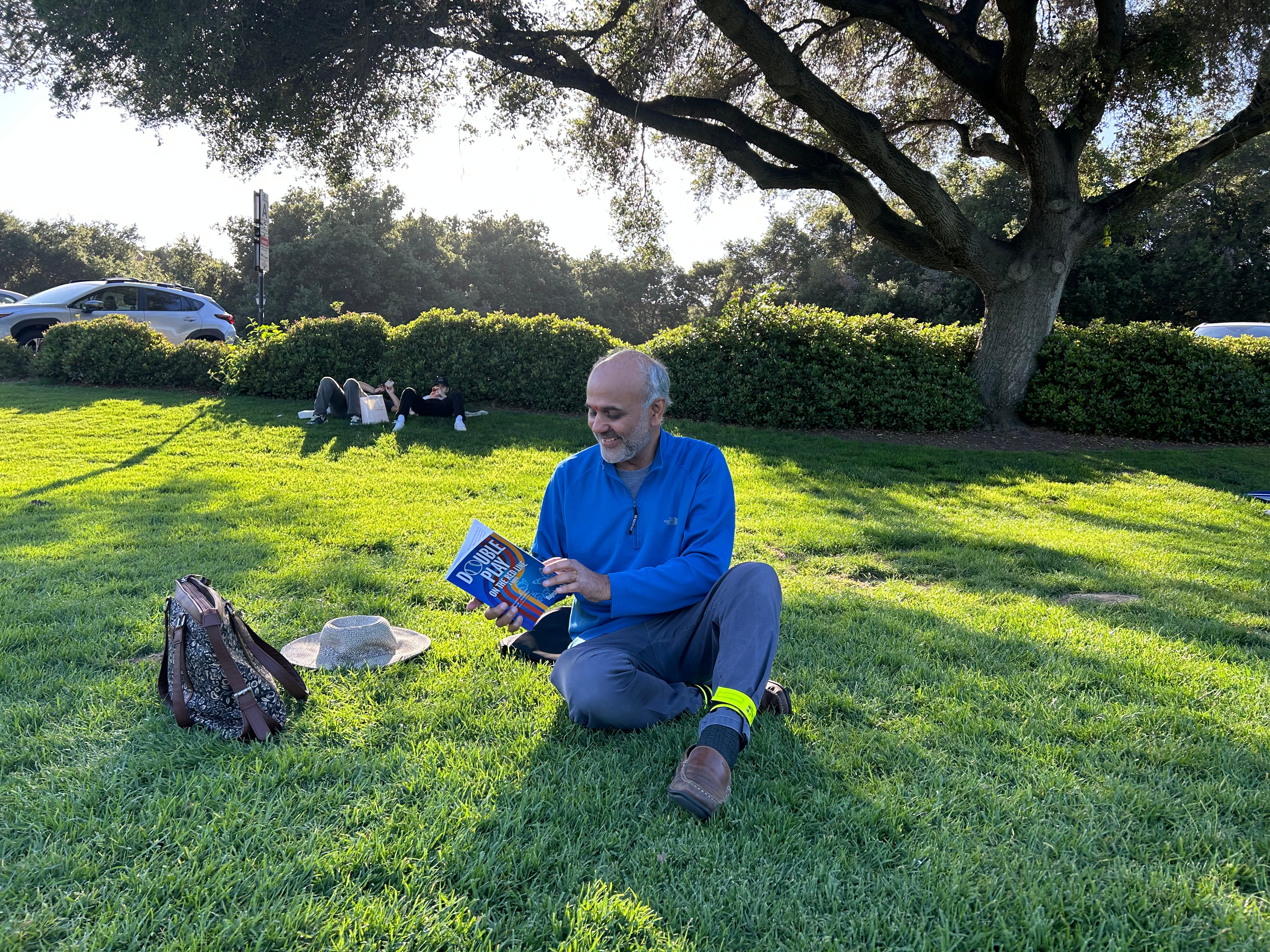
He was generous with his time too and spoke to me for over an hour about the move that shaped his identity. I bunked class and sat with Raj on the fresh green grass of Stanford’s front lawn. Together, we time travelled.
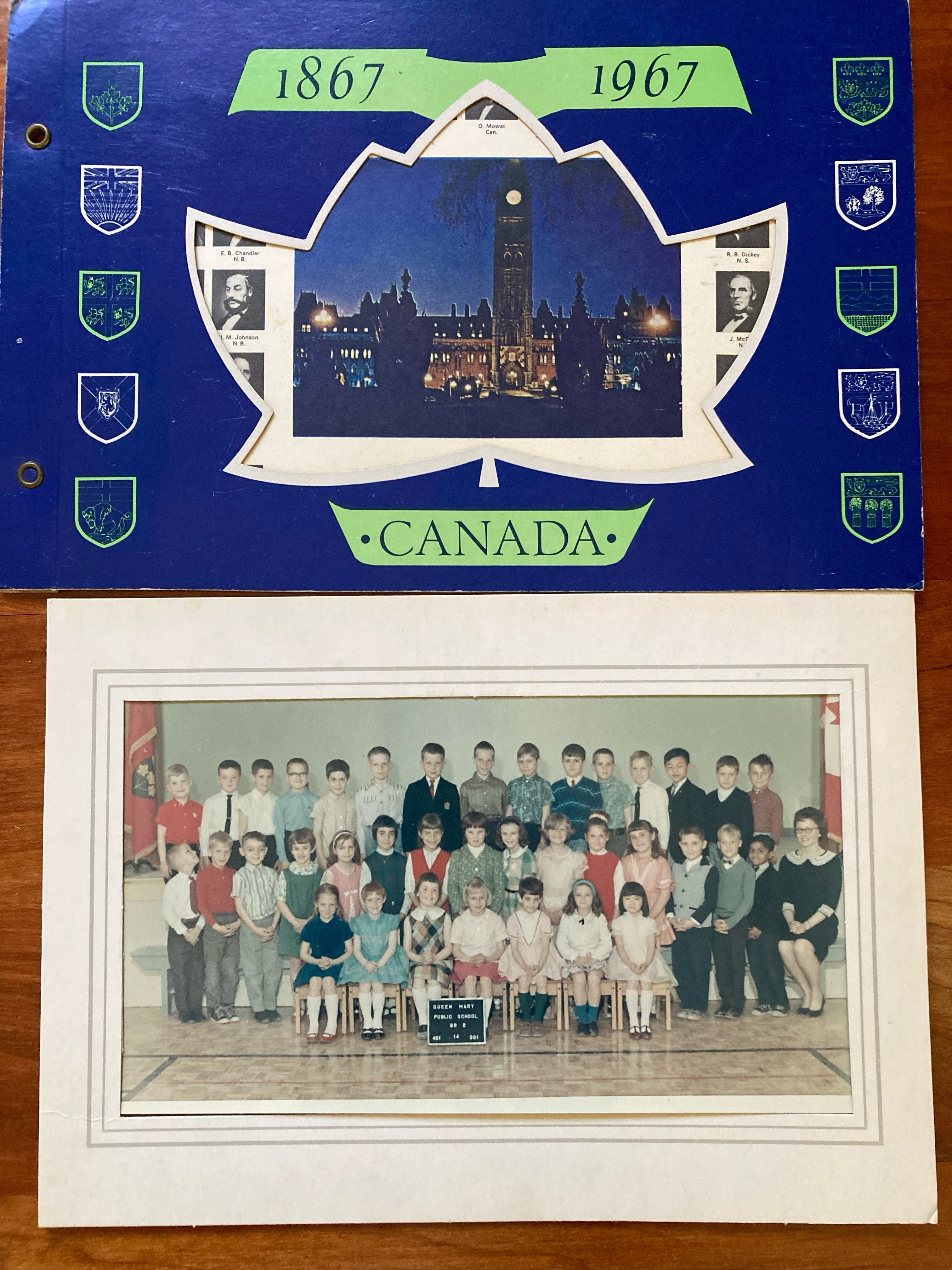
Raj was a little boy of around 5 or 6 when his family moved from Bombay to Chatham, Canada, and 9 when they moved to the US. This was back in the aerogram era, in the 1960s.
Raj told me he was “socialized into what it means to be American,” a process that began in 1969, when the family arrived in Evanston, a suburb of Chicago. “We are now very clearly in a space that’s in the middle — there is black and there is white and there’s this little brown family,” he said, using the present tense as he thought back to his boyhood.
The memories of that time must’ve made a deep dent on his impressionable mind, for six decades later they showed up in his novel 1‘Double Play on the Red Line,’ a work of autobiographical fiction. Take this anecdote, for example: “You choose to play dodgeball on the ‘white’ side of the line or the ‘black’ side of the line,” he said, remembering his own experience on the playground as a child. “You say, ‘why can’t I play on both sides?’ That’s a real story. I mean, fictionalized, but it’s a real story.”
Raj worked as a consultant for many years before he turned author. All through, he has been writing 2articles for India Currents, a 40-year-old news publication focused on the South Asian experience in America. He has lived in California since the 1980s.
He then spoke to me about both, his “geographic migration,” as well as his “emotional and intellectual migration,” and also, years later, his psychological “reverse migration,” by which he meant the process of recognizing his roots, prompted by questions like “who am I going to marry? what courses am I going to take? which part of the library am I going to sit in? which films am I going to go and see?” as a young adult poised to find his place in the world.
He explained what he meant. “You’re at college. You can see any film you want to. And I see Satyajit Ray’s Devi — little baby Sharmila Tagore. I sit in the part of the library where all of Gandhiji’s books are. I take courses on Indian history. I read R.K. Narayan. In some ways, I choose Mangla (his wife who grew up in Calcutta) and Mangla chooses me. None of this is forced upon us. You choose those things… so there’s a reverse migration in terms of becoming Indian again, after all those years of watching, you know, American television shows…” I understand that TV is his shorthand for all things American, which is only one half of how he self identifies.
Raj is Indian-American. “I really like the hyphen. I don’t know why the academics decided that we’re going to do away with the hyphen.” While he understands the arguments against the hyphen (like in the case of the term ‘African American,’ which is no longer hyphenated because doing so was considered divisive), when it comes to himself he prefers to hyphenate.
“I think that’s fine for others, but for me, I live in the middle, I live in the hyphen, I lean into the hyphen. I don’t want the blank space there. I’m a bridge. I connect the two, so I’m very fond of the hyphen. I never remove it. Editors like to remove it, but then we have to argue.”
This reminds me of author Bharati Mukherjee’s perspective on matters concerning the hyphen; she strongly rejected it. “I am an American, not an Asian-American,” she famously said, and I took an intellectual detour to read her 3reasons for this. I also discovered a detailed 4article titled ‘Drop the Hyphen in Asian American’ by journalist Henry Fuhrmann.
Raj’s first trip back to India, the place he left as a little child, was as a 17-year-old.
“Do you know this anthropological phrase — ‘turns’? There are moments in life where we have a turn, sometimes multiple turns. So that was the big turn.”
The year was 1977, but his memories from that trip are on hand.
“Given the sensorium that’s India, upon landing at the airport, one can feel overwhelmed. I didn’t. I just said, ‘so this is India.’ And I had no real sense of it. Of course, Papa and Mom made desi food all the time but I just thought that was our family food in some way. But now… all the smells, the taste — “paani tasted different, doodh tasted different — and the heat! It was June. Wow. The heat and later on the monsoon… I didn’t even have language for this. I don’t think I knew the word ‘monsoon’ until then!”
I could relate to that, with the word ‘fall.’ I knew what autumn was, thanks to books and movies, but fall became part of my vocabulary only after I moved to the US. I think they call it that because it’s when all the leaves fall from the trees. In Mumbai (my Mumbai is Raj’s Bombay), where I’m from, it’s either humid, very humid or there’s apocalyptic rain.
Other than the seasons, Raj also inhaled popular culture on his trip; he watched movies like ‘Amar Akbar Anthony’ — “that became my India!” — and ‘Sanyasi’ — “Hema Malini goes and changes her saree, comes back, she goes and changes her saree, and comes back again… that’s all I can remember of this film!”
He also visited rural Rajasthan, where his parents are originally from. His mom is from Nana and his dad is from Bisalpur. “Then I thought, ‘oh so this is India.’”
Towards the end of the interview, we spoke about things like family — (including an anecdote around the time an American employer asked his mom, a seamstress, not to wear a saree to work… she resigned! Raj told me, his mom, who was educated only till the fifth grade, is “literally the smartest person I know.” I should interview her on this blog, shouldn’t I?) — race and nationality. The next part of the interview is a distilled version of that exchange.
What does it mean to be American?
“Amartya Sen, in his book ‘The Argumentative Indian,’ argues that there are many ways to be Indian. If I can steal from that, I’ll say there are many, many ways to be American. You can be a tech bro here at Stanford, a descendant of slaves, and be fully American. And you can sit in Chicago and be a train operator, a child of immigrants from China, and be fully American. These are all ways to be American. So I don’t think there is a singular sense of what it means. But I do believe, culturally, America prizes individualism. Both the tech bro and the train operator are quickly told, it’s your life, it’s your freedom, it’s your choice.”
What does it mean to be Indian?
“I have a very romantic view of India and what it means to be Indian. I see India much more through rose-colored glasses. I see India as it could be, as it probably never was… as opposed to my very realistic view of America. Naipaul said ‘see the world as it is.’ So I see America as it is. I grew up here. I’m very clear-eyed about America and its myths and gaps around immigration.”
Such as?
“America has always aspired to be kind to the immigrant but the gap between aspiration and reality is huge… People say, ‘oh, you’re just being cruel to America,’ but I’m just being realistic. America invites a lot of immigrants, more than most, maybe all, countries. But our myth, that aspirational myth, is so inflated — Lady Liberty, Ellis Island, all that — compared to the actuality.”
In his novel, Raj writes about baseball as a metaphor for America.
“I love baseball. So for everyone who says, ‘oh, you’re so hard on America’ — I love America! This is my country. My children were born here. Look at what it’s given me. It’s made me who I am. But baseball sneakily assimilates you, inning by inning.”
He admitted using baseball as a “shield” when his brown skin drew suspicion.
“For so long, on every flight I took after 9/11, I’d go in and say, in this voice — the American voice (I reckon he meant accent) — ‘hey man, how you doing? how about that baseball game?’” And just like that, because he’d brought up “America’s national pastime,” people would perceive him as “harmless,” as “one of us.”
Baseball comes up again when I ask him what he makes of the phrase ‘the American Dream.’
“In baseball, there are four bases - first, second, third, and there’s home. Everyone’s intention in baseball is to make it home… I think the American dream is that here you really can find what home means for you. Even if it’s not here, then by dint of being exposed to America, you can find a home elsewhere.”
Speaking about the fictive Mohun Biswas’ family in V.S. Naipaul’s novel ‘A House For Mr. Biswas,’ Raj said, “… they’re informed by this sense of what’s possible, that you can find who you’re supposed to be, your identity, your place, your small little place on this earth. That to me is absolutely the American dream.”
Lastly, I asked Raj why he wears a bindi (red dot) on his forehead. One half of the answer is personal and has to do with gratitude to a higher power for restoring his mother’s health after a scare around 20 years ago.
The other half of the answer is about the hyphen we spoke about earlier. He told me he wears the bindi in defiance of total assimilation.
“As we get older, you want to somehow stay connected to what was, to what is slowly being lost. In ourselves, but also in our families. So it’s a marker, it’s my way of saying to this world — ‘no, you can’t have all of me; you’ve had a lot of me, but you can’t have all of me.’”
No posts
Comments
Nothing yet. Say the first thing.
Sign in to join the conversation.