
Welcome to THE FREEBIE, a sample-sized treat straight from my book.
Before I started researching Motherf*cked, I knew a few things about attachment theory. By then, I’d been the deputy editor at a mental health media company for a few years, and I’d edited articles about the ways our relationships can shape how we show up in life. I also knew about the oversimplification of attachment theory on TikTok and, generally, how it’s more complicated than, “Your ex treated you terribly, so now you’re anxiously attached to everything and everyone.”

And then I found this questionnaire designed to assess an individual’s attachment style to other people. It was developed by R. Chris Fraley, Neils G. Waller, and Kelly A. Brennan, PhD, and published in 2000 in the Journal of Personality and Social Psychology.
I took this quiz several times, assessing my attachment to Sean, my dad, my best friends, and, naturally, my mom.
The results helped me understand more about my fears and expectations in those relationships (more on that below). Thankfully, this psychological tool is part of the public domain, which means I can share it with Motherf*cked readers and all of you here. Hooray!
If you’re down, keep reading the excerpt below to assess your relationship with your mom and learn more about what to do with those data points. Let me know what you think!
As I said, the relationship most likely to be impacted by your early attachment to your mom may be the one with your mom. While we might have an idea of how we show up in this relationship, having tangible data to back you up is always validating. Also, who doesn’t love a personality quiz?
We’ve talked through the different kinds of insecure attachment styles, like anxious attachment, avoidant attachment, and disorganized attachment. But those terms don’t fully capture the nuances of attachment theory.
Current attachment theory research measures attachment styles dimensionally, assessing the behavior (like hyper-independence or clinginess) and the feelings behind them. This helps researchers better understand someone’s attachment style and also the motivations underlying avoidant or anxious behavior. That level of detail is extra helpful in distinguishing your specific brand of attachment in any given dynamic.
Another cool thing about attachment styles? Not only can you have a different one for every relationship; they also can change over time. So if someone proves to you that they’re trustworthy, your attachment to them can become more secure.
Use this quiz to determine your attachment style with your mom. Then read on to find out what that says about your current relationship with them.
For each statement in the following two sections, circle the number that aligns with your feelings toward your mom right now (that last part is important for accuracy). When you’re done, add up the numbers and divide them by the number of questions in that section. For this and other quizzes in the book, you will probably get a funky number with a decimal, and that’s OK.
Attachment anxiety is characterized by “low self-worth and a fear of abandonment and rejection,” according to Dr. Gillath and colleagues in Adult Attachment. They add that attachment anxiety can make you extra sensitive to signs someone is expressing love and rejection (again, this can be specific to your relationship with one person).
1. I worry that my mom won’t care about me as much as I care about her.
Strongly disagree 1 2 3 4 5 6 7 Strongly agree
2. I often worry that my mom doesn’t really care for me.
Strongly disagree 1 2 3 4 5 6 7 Strongly agree
3. I’m afraid that my mom may abandon me.
Strongly disagree 1 2 3 4 5 6 7 Strongly agree
YOUR TOTAL SCORE ___ DIVIDED BY 3=___
Attachment avoidance shows up as “discomfort with closeness, excessive self-reliance, and a lack of confidence in depending on others to meet needs for comfort and security,” write Dr. Gillath and colleagues. Within an avoidantly attached relationship, you might resist seeking help, comfort, or connection with the other person.
1. I prefer not to show my mom how I feel deep down.
Strongly disagree 1 2 3 4 5 6 7 Strongly agree
2. I don’t feel comfortable opening up to my mom.
Strongly disagree 1 2 3 4 5 6 7 Strongly agree
3. I usually discuss my problems and concerns with my mom.
Strongly disagree 1 2 3 4 5 6 7 Strongly agree
4. I talk things over with my mom.
Strongly disagree 1 2 3 4 5 6 7 Strongly agree
5. I find it easy to depend on my mom.
Strongly disagree 1 2 3 4 5 6 7 Strongly agree
6. It helps to turn to my mom in times of need.
Strongly disagree 1 2 3 4 5 6 7 Strongly agree
YOUR TOTAL SCORE ___ DIVIDED BY 6=___
On the attachment style matrix that follows, use your attachment anxiety score (bottom scale) and your attachment avoidance score (left scale) to find your spot on the matrix by placing a finger on each scale number and sliding them up and across until they meet. (This message is brought to you by fifth-grade math.)
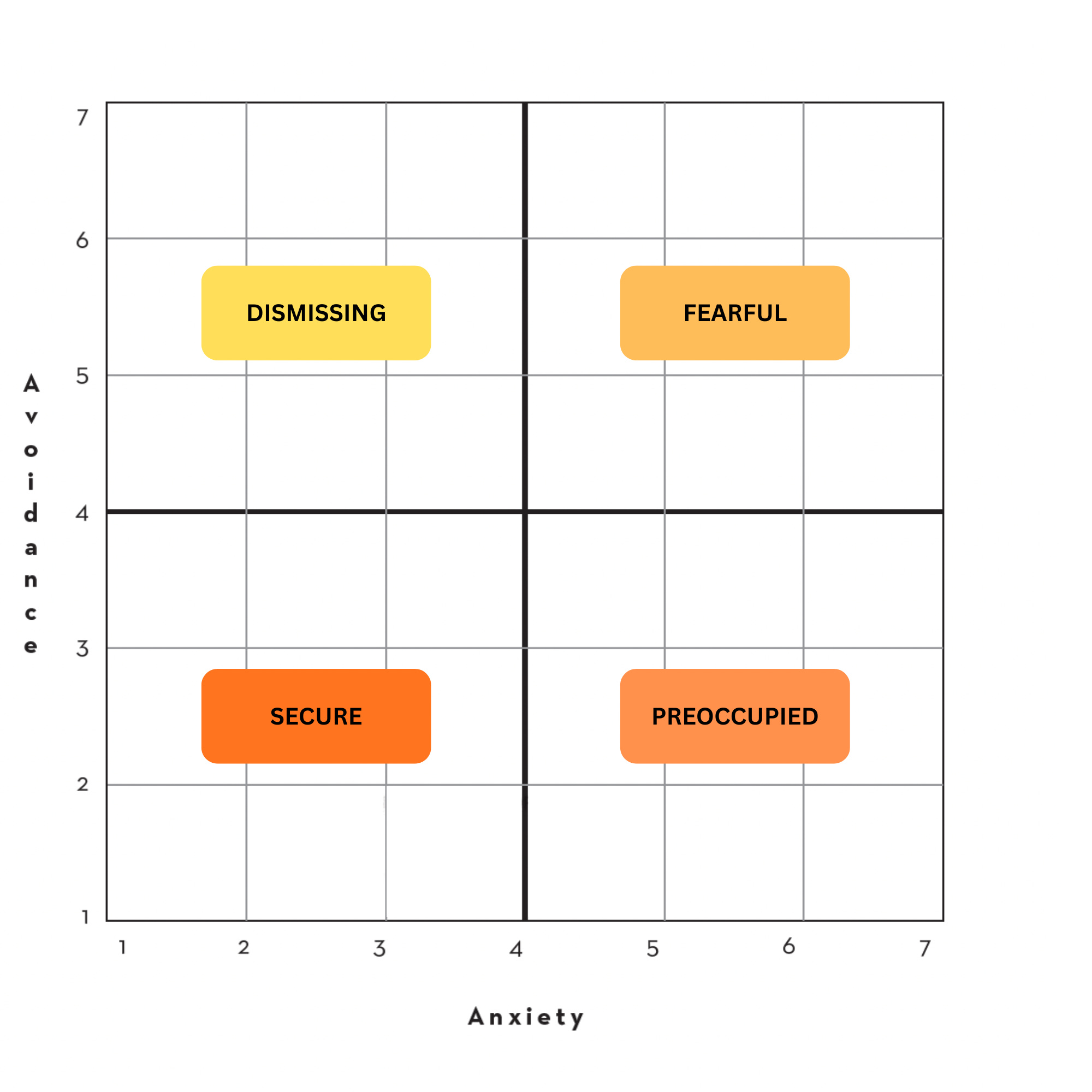
Secure: Welcome to the safety zone. If you landed in this quadrant, your relationship is relatively low in anxiety and avoidance. It’s easy for you to be emotionally close with your mom, and you feel comfortable doing so. You feel cared for by your mom, and free to be yourself.
You likely also feel safe depending on her. You know she’ll have your back. Even if you landed on the edge of this field, chances are you’re pretty secure. Still, there’s always room to become closer and more securely attached.
Fearful: On the other end of the matrix lies the highly anxious and highly avoidant piece of the attachment puzzle. If you’re somewhere in here, you likely avoid confiding in or depending on your mom in any way. However, the reason might be because you feel insecure and too vulnerable with them. Maybe you worry that they’ll use your words against you or let you down if you ask them for help.
Dismissing: You’re in the zone of, “Nah, I’m good.” Landing in this quadrant means you don’t like depending on your mom, you don’t like your mom depending on you, and you’re not worried whether or not they care about you. In the context of non-mom relationships, this might describe a dynamic with coworkers you don’t get along with or high school frenemies who lost touch. While this attachment is not the mom-child relationship dreams are made of, if your mom has proven countless times that they can’t be trusted, dismissing could be the safest place for you. If you found yourself here, it might indicate that you’ve accepted that your mom can’t or won’t provide closeness, intimacy, or safety. If that tracks for you, be proud of yourself.
Preoccupied: When you’re low on avoidance and high on anxiety, you’ll wind up here. This type of attachment to your mom can look like working hard to establish a close connection and worrying that your actions won’t be reciprocated. You want a deeper, more secure, loving relationship. Still, you suspect your mom is unwilling to get close to you. It can seem like, no matter what you do, your mom doesn’t care for you as much as you care for them.
This text was originally published in adapted from Motherf*cked: How to Stop Your Mother’s Toxic Drama from Ruining Your Life.
No posts
Comments
Nothing yet. Say the first thing.
Sign in to join the conversation.