
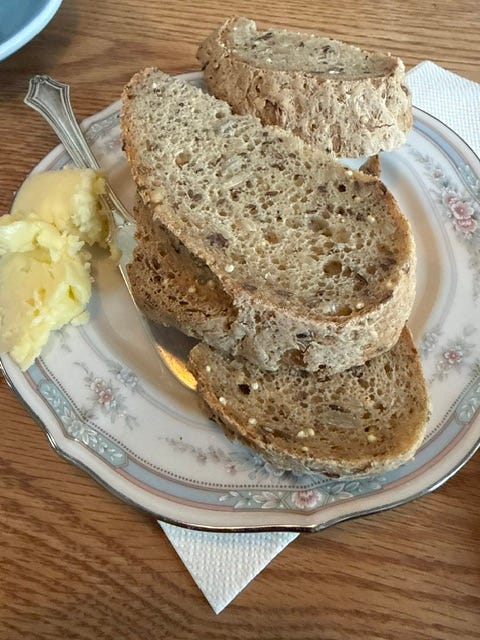
As I slathered butter onto the bread last month, I found myself deep in the suck.
The suck is what endurance athletes call it: the messy middle, the part of the endeavor where your body and mind uningnorably bring up every receipt for why you won’t be successful.
While enjoying every slathered bite, it occurred to me I was in a suck that my patients, colleagues and most of us experience at some point regardless of resources and access.
I am calling it the Wellness Suck.
What triggered it? Gluten.
Before you take a side, or guess mine, let me explain.
Before I ate my bread and butter, I snapped a pick. I was going to title it “the struggle is real” and have the post be about me, an ever-doing versus being, some might say overachiever struggling during my “month of do nothing”.
Then I hit the Wellness Suck? The bread was gluten-free (its from Bastion in PDX and I recommend ordering it shipped to your door or having on your next trip here). If I said or # gluten-free, I knew I was taking sides.
There’s a wellness squad that believes everyone in the US should be gluten-free, saving your gluten for the trips to Europe or avoiding to optimize gut health and longevity. And they were having a moment thanks to Matt Damon’s press tour where he served up his gluten-free diet as the singular solution to how he looked in Odyssey (even he seemed to forget his Jason Bourne-diet and all the other tools utilized over decades of a career of body changes).
And there’s the other wellness squad who see gluten as less of or a non-issue unless you have a diagnosed allergy. They bring the receipts with people who eat gluten, self-lovingly make sourdough and eat whole grains, as part of the choices that fuel their overall, not just dietary, wellness.
OMG that was just the gluten - I hadn’t even gotten to the butter.
We are in the Wellness Suck and It’s Killing Us
We have more data than any generation before us. More data-gathering tools — wearables, apps, labs, at-home tests. More ways to access information, if not always the resources, than ever in human history.
Most of those tools are sold to us as singular solutions: the ring, the shake, the supplement, the peptide, the app that will finally be the thing.
And in spite of all of it, we are worse off.
Only 1 in 8 American adults are metabolically healthy.
Early-onset cancer diagnoses — under age 50 — are up 24% globally since 1990.
1 in 9 Americans 65 and older now has Alzheimer’s, and deaths from it have risen 134% since 2000, even as deaths from stroke and heart disease have fallen over the same period.
1 in 5 kids has a diagnosable mental, behavioral, or developmental disorder, and 40% of high schoolers report persistent sadness or hopelessness, up from 30% just a decade ago.
Anyone celebrating National Wellness month didn’t get the memo: we are not well.
Here’s a clue why more information isn’t translating into more wellness: health-information overload is itself a documented predictor of anxiety, and of lower confidence in managing your own health. I wrote about INFObesity as an epidemic and shared my INFOload assessment and treatment protocol in Your Best Shot because it affects every aspect of weight health. It’s the thing no GLP-1 can cure, but most use cases worsen. More content, in every format available now including AI, isn’t just failing to help. The research suggests it’s actively making us feel less well.
The Wellness Suck is sucking the health out of us, the very goal the wellness industry sells us solutions to deliver.
You Can Do Wellness and Get Cancer.
I saw a version of this play out on Instagram this week. A beautiful, accomplished woman used a hook to invite her followers to think about cancer diagnosis differently. She had made all the choices — proudly, publicly — as a ‘poster child for wellness.’ Clean eating. The inner workouts. The physical workouts. The routine, executed close to perfectly.
She got cancer.
And she wants us all to know that her diagnosis isn’t a failure of effort.
I wrote to her on her post: THIS is why you are a poster child of wellness - which is not the avoidance of every disease or challenge but rather the resilience we aim to build in our bodies to handle adversity when it arises… because it will.
Myth: you can always be well.
Fact: you can pursue choices that support your body’s operations — mind and body — with the goals of reducing risk and overcoming what challenges it.
This reframe and the work required to embrace it is what we need to dig ourselves out of the Wellness Suck.
How Peptides and Specifically GLP-1 Medications Exemplify the Wellness Suck.
It seemed like it happened overnight, but its been at least a year in the making. A group of practitioners and industry got together last month in DC to put forth a plan to oversee peptide production and approvals. Without any regulation, no one can be sure what they are getting; even when there is research, and anecdotal practice evidence, it shouldn’t be used to promote a class of compounds if there isn’t consistent access to quality forms. And, based on our history, this may not be better owned by the pharmaceutical industry.
Guess what didn’t happen?
Magnesium’s DRI wasn’t updated. The mineral that the body uses for 400 reactions including those that impact peptide formation and utilization stayed at recommended levels from 1997. At levels based on sex and perceived associated caloric intake to determine needs.
Without that change, dietary recommendations in schools, hospitals, senior living, and all the ones affecting the 4 statistics of our unwell status highlighted above do not improve.
Peptides matter in our bodies and they are now part of the trillions dollar wellness industry as well as the billions dollar healthcare one. But magnesium actually matters more. And that’s got no attention other than by the supplement industry and their publicists battling out what form is better for whom.
And of course, GLP-1s can factor in too. It took about 15 years to mainstream the science of these medications, and it took less than 3 years for their wellness-related sales to exceed $5 billion globally (this is exclusive of the $120 billion medication value), just shy of $2 billion annually in the US.
But even with that $2 billion spend, 80% weight regain amongst those coming off, 60% of weight regained (where weight loss was a target), and millions stopping because of side effects including “it didn’t work for me”.
We Could Win at Wellness If We Wanted to Do the Work.
For 20+ years, I’ve shared a mantra with patients and colleagues “better not perfect”. It became increasingly critical to share as orthorexia was first and then widely diagnosed, as INFObesity rates rose to near everyone regardless of physical health status, and as the wellness industry made its first trillion.
There is no perfect health. There is no perfect wellness plan. There are better-for-your-being choices, today.
That’s the Wellness playbook we need. The one that assesses each person’s body today, comprehensively, and identifies what’s working and what could use optimization.
The order here is intentional and critical. Yes, we must first find what is working because you are making choices today that work for your body and yes, these are what need to be protected as we introduce new experiments to identify successful optimizations. Doing this first disrupts the core rule of the current wellness industry — to get you to define yourself as a total hot mess — and in doing so first lean into, invest in their fix.
And then doing experiments to identify optimizations that work for your body today. Noting that what works today may not be what works tomorrow. So this is a process that when invested in ongoing can deliver wellness.
Where wellness is the state of being well to build resilience that enables you to spend (hopefully) more time well, for the time you are gifted.
In the coming days and weeks, I am going to bust open the wellness pandora’s box through the shared lenses of a 25+ year practitioner and weight-health expert and that of an ex-advertising executive who designed ad campaigns to sell sugared cereals in the 90s.
I hope you will continue to join me this month ongoing and if you have comments or suggestions share them below or share this article with someone who may want to breakup with wellness the way its being sold. I’ve newly started exclusive content for paid subscribers as a thank you for investing in my work. You will get a preview and if that is a fit for you for a month or the year, thank you but don’t feel you have to if its not what you have the resources for at this time.
Ashley Koff RD
the backwards DR
Comments
Nothing yet. Say the first thing.
Sign in to join the conversation.