
Uber’s COO recently questioned whether the company’s AI investments are delivering real return.
This is the same company where 95% of engineers use AI tools monthly. Where 70% of committed code is AI-generated. Where adoption, by any measure, has been a success story.
And the COO is publicly asking whether it’s worth it.
Here’s why that matters. Uber burned through its entire 2026 budget for Claude Code and Cursor in four months. Heavy users were burning $500 to $2,000 a month each in inference costs. Their CTO said they were going back to the drawing board.
Meanwhile, CEO Dara Khosrowshahi said on an earnings call that Uber was slowing hiring to offset AI investments. Let that land for a second. They’re cutting headcount to fund AI tools they can’t yet prove are delivering measurable return.
This isn’t an Uber problem. This is the conversation happening inside every operations leader’s head right now.
Thanks for reading Success & Growth ! Subscribe for free to receive new posts and support my work.
The Era of cheap AI experimentation Is over
For the past two years, most companies treated AI spend as discretionary experimentation. Buy the tools. Give everyone access. See what happens. Nobody questioned the cost because the cost felt small relative to the promise.
That phase is done.
According to CloudZero, organizations reporting AI as an active FinOps concern jumped from 31% in 2024 to 63% in 2025. AI and ML workloads now represent 22% of total cloud costs at SaaS and IT companies. Forrester predicts that enterprises will defer 25% of their planned AI spend into 2027 because fewer than one-third of decision-makers can tie the value of AI to financial growth.
And there’s a new phenomenon spreading across enterprise AI deployments that has a name now: tokenmaxxing. Employees maximizing their AI token consumption, either because they believe it signals productivity or because the tools have become so embedded in their daily workflow that costs climb regardless of intent. Every query, every code generation request, every debugging session consumes compute that the company pays for.
Token pricing means the meter is always running. And most companies have nobody watching it.
The ops problem
Here’s why this is a COO-level conversation and not just an IT budget line item.
Traditional SaaS spending is predictable. You buy seats. The cost is fixed. You know what January will cost in December. AI spending doesn’t work that way.
With AI, every inference costs something. Every agent task, every token processed, every automated workflow runs up a tab. Usage doesn’t scale linearly. A team that doubles its AI usage can triple or quadruple the bill depending on model selection, prompt complexity, and whether anyone built guardrails around token consumption.
Microsoft killed Claude Code licenses for thousands of its own engineers. Not because the tool wasn’t working.. it was the more popular of the two options they offered. They killed it because the fiscal year was about to flip and the cost was uncontrollable.
This is the operational reality: AI tools are being deployed faster than the governance to manage them. And the person who eventually has to explain the gap between the spend and the return is not the CTO who approved the tools. It’s the COO who owns the P&L.
Nobody has figured out how to price AI. Your vendors haven’t either.
The pricing chaos on the vendor side makes the COO problem worse.
Salesforce changed Agentforce pricing three times in eighteen months. Started at $2 per conversation. Added flex credits at $0.10 per action. Added per-user licenses at $125 per month. Now they offer all of the above and let customers pick. Five thousand Agentforce deals closed in the first two quarters. Only 3,000 were paid. Customers wanted to try it but couldn’t commit to a pricing model they didn’t understand.
Cursor moved Bugbot from $40 per seat per month to usage-based pricing at $1 to $1.50 per run. HubSpot launched AI resolution pricing at $0.50 per resolution in April 2026. Anthropic announced that starting June 15th, agent tool usage gets its own metered bill.
Bessemer Venture Partners' AI Pricing and Monetization Playbook puts it plainly: unlike classic SaaS where serving one more customer costs virtually nothing, every AI query incurs a non-trivial expense. AI companies are seeing 50 to 60% gross margins compared to 80 to 90% for traditional SaaS. The math that worked at 10 customers won't automatically work at 1,000. And from their work with dozens of AI teams, hybrid models.. a base subscription plus usage or outcome tiers.. are winning because they give customers cost predictability while letting vendors capture upside as usage scales.
From a exec ops framing, this means three things:
Budgets are unpredictable. The cost of a tool you bought in January could look completely different by June depending on how your team uses it and whether the vendor changed their pricing model in between.
Vendor contracts require a different kind of scrutiny. The headline number on a pricing page tells you almost nothing about what production usage will cost at scale. The COO who signs off on AI vendor contracts without understanding the cost shape at projected volume is signing a blank check.
Renewals are getting harder. Your customers are navigating the same chaos. They’re renewing tools whose pricing changed mid-contract. They’re trying to evaluate AI products whose cost structures they don’t fully understand. The CS teams walking into those renewal conversations need to be equipped to have a fundamentally different kind of conversation than the one they had two years ago.
I’ve seen this movie before
None of this is new to me..
I spent the first couple of years of my career at Twilio, which was one of the earliest and most successful consumption-based pricing models in SaaS. Every API call cost something. Every message, every voice minute, every verification.. metered. The bill fluctuated month to month based on what customers actually used.
What that model forced on us — and this is the part that’s relevant right now — was a relentless focus on delivering outcomes. Because when the bill is tied to usage and usage can fluctuate, the value story becomes more important than the product story. You can’t coast on a signed contract and a locked-in seat count. You have to continuously prove that what the customer is spending is worth what they’re getting.
That’s exactly where I believe AI pricing is heading. And most post-sales and CS teams have never operated in a consumption model before. They’ve lived in a per-seat world where the renewal conversation is “do you still need the same number of seats?” not “was the outcome worth the cost?”
The teams that learned to sell value in a consumption model at companies like Twilio are the ones best equipped for what’s coming. The ones that haven’t? They’re about to learn very quickly.
Harvard’s AI Essentials for Business Program confirms this
This certification program was one of the best I’ve taken in a while. The course covered a principle that maps directly to what I’m seeing in practice: AI cost structures are fundamentally different from anything operations leaders have managed before.
With traditional software, cost is a function of access. With AI, cost is a function of usage. And usage is a function of behavior.. which means cost is ultimately a function of how well your organization governs what it builds, how it builds it, and who’s watching the bill.
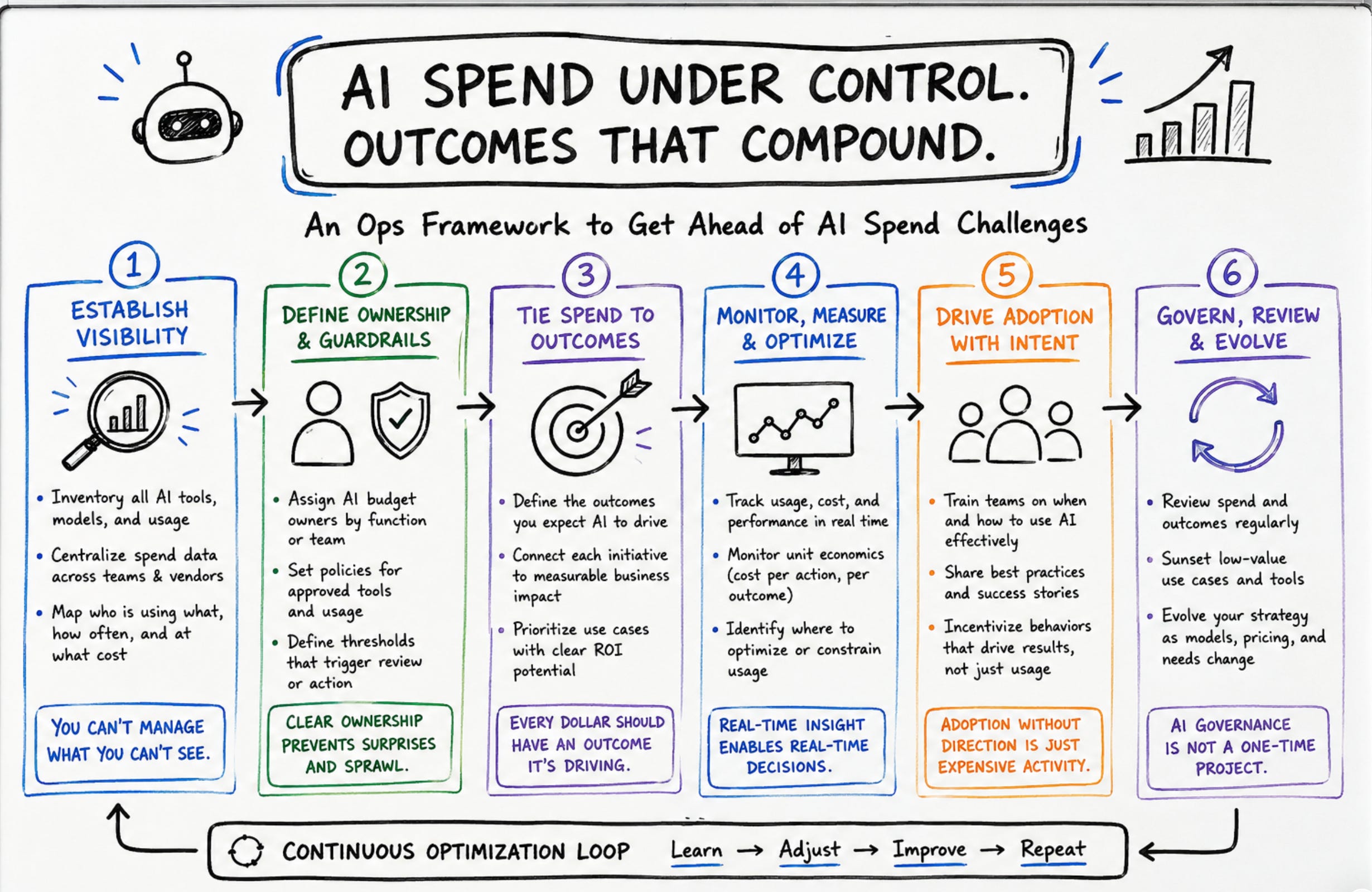
The companies getting this right are treating AI spend the way mature organizations treat cloud infrastructure. There’s a FinOps function. There are budget owners by team. There are defined thresholds that trigger review before the bill surprises anyone. There are standards for what gets built vs. what gets bought and a documented rationale for each decision.
The companies getting it wrong gave everyone access, called it an AI strategy, and now have no visibility into what’s being spent or what it’s producing.
The shift that’s coming
Uber’s executive team isn’t questioning whether AI works. She’s questioning whether the deployment can be justified on financial terms.
That’s a different question. And it’s the question every COO, VP of Operations, and RevOps leader will be asked to answer in the next twelve months.
The shift from measuring AI adoption to measuring AI outcomes is the defining transition of 2026. The organizations that built governance around spend before they needed it will navigate this with confidence. The ones that didn’t will spend the next year explaining why the bill grew faster than the results.
The companies hiring fractional AI strategists, operations consultants, and specialized agencies right now aren’t doing it because they can’t figure out the tools. They’re doing it because the stakes of getting the cost model wrong are high enough that having someone who’s seen this before is worth the investment.
This is the new operational discipline. Not whether to use AI. But whether anyone in your organization can explain what the AI bill is buying and whether it’s worth it.
Not subscribed yet? Join Success & Growth — practical AI thinking for post-sales and GTM teams, every week.
© Ashley Harpp | Success & Growth
Thanks for reading Success & Growth ! Subscribe for free to receive new posts and support my work.
Comments
Nothing yet. Say the first thing.
Sign in to join the conversation.