
If you spent any time in a customer-facing role in the last decade, someone drilled this into you at a kickoff, a training, or a 1:1.
Don’t sell features. Sell outcomes.
Thanks for reading Success & Growth ! Subscribe for free to receive new posts and support my work.
We learned it. We got good at it. We stopped leading with product capabilities and started leading with what the customer would be able to do, achieve, and become as a result of working with us.
And then AI happened.
And somewhere in the excitement — the models, the tools, the prompts, the tokens, the agents, the workflows — a lot of us went right back to selling fire flowers.
The Mario metaphor
Kathy Sierra, author of Making Users Awesome, made this point with a metaphor I think about all the time.
Picture Mario picking up a fire flower.
The fire flower is just an item. A little glowing plant sitting in a question block. Nobody is excited about the fire flower itself.
What they’re excited about is Fire Mario. The version of Mario who is bigger, more powerful, can throw fireballs, can defeat enemies he couldn’t touch before. That’s what the player wanted. The fire flower was just how they got there.
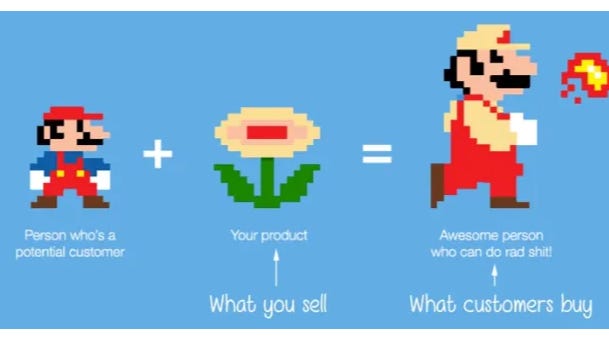
Sierra’s point: your product isn’t the thing customers want. The transformation is what they want. The product is the mechanism.
And right now, across every industry I work in, I’m watching teams lead with the mechanism again. AI this. AI that. AI-powered. AI-native. AI-first.
Cool. But.. what outcome did it produce?
The outcomes that actually matter
When a post-sales leader, a CRO, a COO, or a CEO evaluates whether AI is worth the investment, they’re not asking how many workflows were built, how many tokens were consumed, or how many prompts were run.
They’re asking:
Did we grow revenue? Expansion, upsell, cross-sell. Did AI help the team find and close more of it?
Did we protect revenue? Retention and renewal rates. Did we catch risk earlier? Did customers renew who might not have without better signals?
Did we prevent churn? Not reactive churn management. Early detection. Did the team act before the customer signaled they were leaving?
Did we improve efficiency? Did the team do more with the same headcount — or maintain quality with less?
Did we accelerate time to value? Did customers get to their first outcome faster? Did onboarding timelines compress?
Did we reduce escalations? Fewer late-stage fires. Less reactive leadership involvement. More predictable customer health.
Did we improve forecast accuracy? Better visibility earlier. Fewer surprises at renewal.
Did we improve the customer experience? Not a soft metric. A measurable one. Are customers more engaged, more satisfied, more likely to refer?
Every AI tool, workflow, agent, and automation should trace a line back to at least one of these. If it can’t, it might be a cool fire flower. But it’s not Fire Mario.
What most teams are actually measuring
Most teams evaluating their AI programs right now are tracking the wrong things.
Number of AI tools deployed. Adoption rates and active users. Prompts run per week. Workflows created. Tokens consumed.
None of those are outcomes. They’re activity metrics. They tell you something is happening. They don’t tell you whether it matters.
Measuring AI adoption at this point is like measuring whether your team used email this week. It’s a given. The question is whether the email moved anything forward.
The teams that will win with AI over the next two to three years are the ones who tie every initiative back to a business outcome from day one.. and measure the outcome, not the activity.
“AI native” is cool. Does your customer care?
There’s a phrase spreading through product marketing right now: AI native. Companies are leading with it in their positioning. Putting it in their taglines, their pitch decks, their LinkedIn bios.
I want to ask a genuine question: does your customer care?
Not “is AI useful.” It is. I’ve been clear about that. But does the fact that your business is AI native change the outcome your customer is trying to achieve?
I know nothing about plumbing. If a pipe burst at my house tomorrow, I’d grab my phone and search for a plumber. And I promise you I would not be filtering for “AI native business.”
I’d be asking four questions. How much do you cost? How soon can you fix my problem? What do your reviews look like? Can I get someone on the phone right now because I need to describe this situation out loud to another human being? (I genuinely know nothing about plumbing.)
If a plumber showed up and said “by the way, we’re fully AI native”.. as my kid would say, “cool bro.” But is the pipe fixed? How long did it take? Did I feel taken care of?
That’s the outcome. The AI is the fire flower. The fixed pipe, the fast response, the feeling that someone competent handled my problem.. that’s Fire Mario.
This should change how we talk about our products. Not just how we build them.
If you lead with “AI native,” you’re leading with the mechanism. The customer doesn’t care about the mechanism. They care about their outcome.
So the next time you’re crafting your pitch, your customer-facing narrative, your positioning.. ask yourself: am I describing the fire flower or am I describing Fire Mario?
Every customer is Mario. They’re on a level. They have a goal. They have obstacles. They don’t need a better flower. They need to throw fireballs.
Lead with that..
And yes, efficiency matters. But it’s not the finish line.
I want to be clear about where I stand.
I’m not saying efficiency gains aren’t valuable. They are. Time saved is real. Cognitive load reduced is real. Manual work automated is real.
And I’ll go further. There are things AI can do now that we simply should not still be doing manually. Not using AI where it clearly makes sense is a bit like saying you still send physical letters to customers instead of email. Or prefer phone calls when a quick video would do. The technology exists. The benefit is obvious. Choosing not to use it isn’t principled — it’s just friction.
Anyone that knows me knows how much I advocate for AI. I believe there’s an enormous amount of good it can do for teams, for customers, for the work we all care about.
But the question I keep coming back to for any business evaluating its AI investment:
What is the time back allowing you to do?
That’s the bridge. Efficiency is the mechanism. What you do with the efficiency is the outcome.
If your team gets two hours back every week from automating forecast prep.. great. What are they doing with those two hours? Spending more time with at-risk customers? Closing more expansion deals? Building relationships that improve retention? If yes, that’s a real business outcome and the efficiency gain is justified.
If the answer is “they’re in more internal meetings” or “we’re not sure”.. then you saved time and spent it on nothing.
A story about time saved that doesn’t connect to what the time enabled is just a story about something cool that never provided value.
The time back is not the outcome. What the time back makes possible.. that’s the outcome. And that’s the story worth telling.
What this should change
With all of this in mind, it comes down to one shift.
And if you’re not sure whether an AI initiative actually connects to a real outcome before you build it.. that’s exactly what the scoping framework I built is designed to answer. Four gates. Every initiative has to pass them before it earns a place in the backlog. The last gate is always the same question: which business outcome does this move? If you can’t answer it clearly, the idea isn’t ready. Drop a comment or reply to this email and I’ll send you the link to the full framework.
Stop leading with how you build. Start leading with what changes for the customer because you built it.
The product conversation should always end at the outcome. What does the customer’s week look like after? What problem went away? What metric moved? What used to take four hours and now takes twenty minutes.. and what did they do with the other three hours and forty minutes?
That’s the story. That’s what earns the renewal. That’s what turns a customer into an advocate.
AI is the most powerful fire flower we’ve ever had access to. But it’s still a fire flower. The customer doesn’t want the flower. They want to throw fireballs.
Don’t forget.
Thanks for reading Success & Growth ! Subscribe for free to receive new posts and support my work.
Comments
Nothing yet. Say the first thing.
Sign in to join the conversation.