
Ask most founders what it costs to close a deal. They’ll have an answer.. CAC, sales cycle length, commission, ad spend, all of it tracked to the dollar.
Ask them what it costs to deliver on that deal.. onboarding, implementation, the CSM hours, the rework when something goes wrong.. and you’ll get a shrug.
Thanks for reading Success & Growth ! Subscribe for free to receive new posts and support my work.
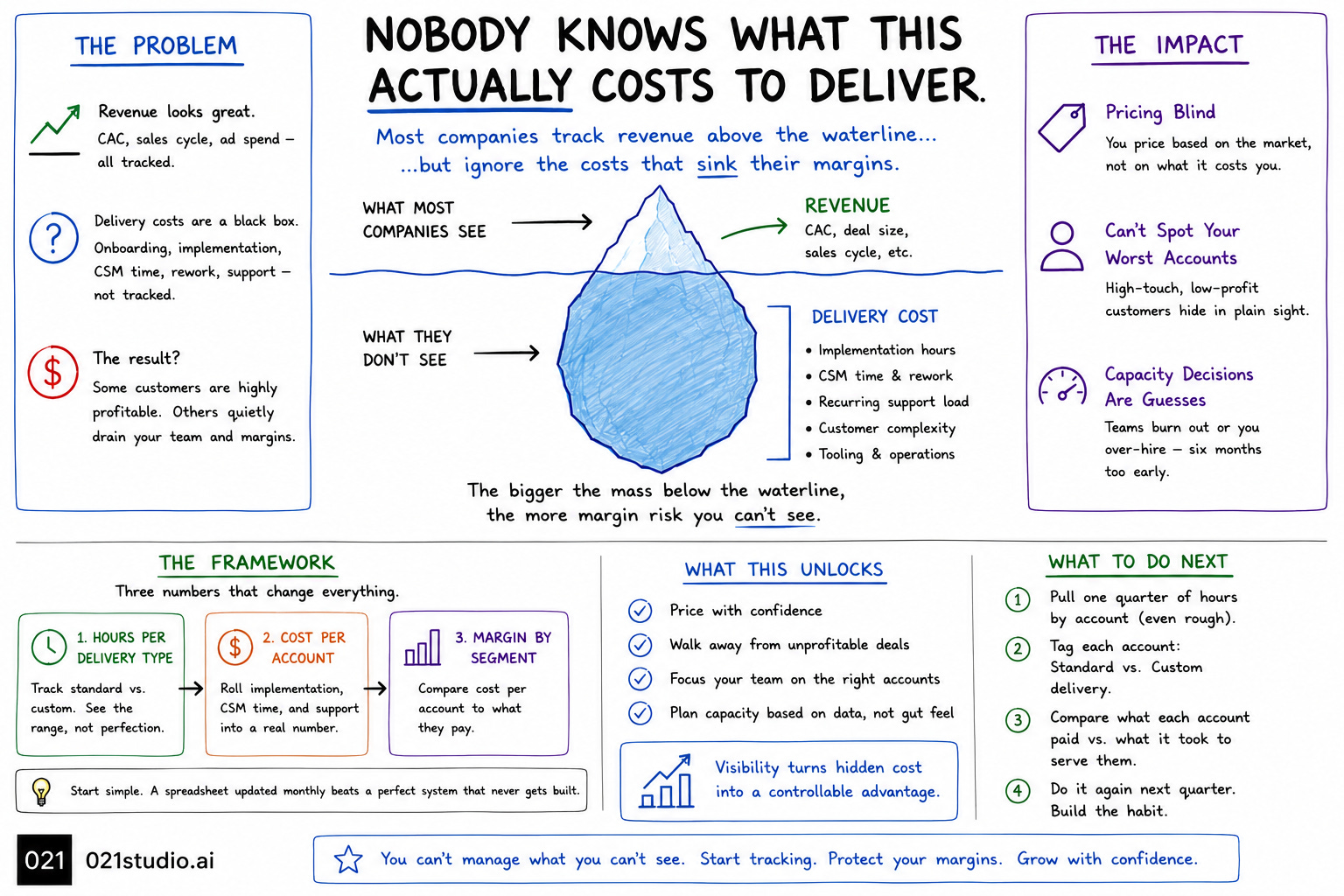
That gap is the most expensive thing in your business that nobody’s measuring.
Quick note from Ashley…
I’ve been pretty heads down lately, navigating a move and supporting my clients, so it’s been a while since I’ve written anything here. The funny part is, I don’t think I’ve ever had more learnings, patterns, and observations I’ve wanted to share. So I’m starting with something that’s especially fresh because I’ve been seeing versions of it across client work and prospect conversations: companies often know exactly what it costs to win business, but have a much fuzzier idea of what it actually costs to deliver it. Onboarding. Implementation. CSM time. Rework. Custom requests. Support that quietly grows over time. It’s the never-ending question of what might be bleeding margin out of the business without anyone realizing it. And this one is very real. So, let’s dig in.
TLDR
The company that’s flying blind
Picture a company growing fast. New logos every month. Revenue chart pointing up and to the right. Everyone’s celebrating.
Now picture the delivery side of that same company. One implementation takes 20 hours. Another, nearly identical on paper, takes 80.. because the integration was messier than sold, or the customer needed three rounds of rework, or the CSM had to hand-hold through a rollout nobody planned for.
Nobody’s tracking the difference. Not the hours. Not which accounts are eating the most support time. Not what a “typical” delivery actually costs versus what it’s priced at.
So the company keeps selling the same package at the same price to every customer.. some of whom are profitable, some of whom are quietly draining the team dry. And there’s no way to tell which is which until someone’s burnt out or the margins just don’t add up at the end of the year.
Growing revenue and growing losses can look identical on a slide. The only way to tell them apart is knowing your actual delivery cost.
Why this happens
It’s not negligence. I’ve found that its actually sequencing.
Early on, delivery is small enough that everyone just knows. The founder or the first ops hire can hold the whole picture in their head. Nobody needs a system because nobody needs to remember.. they were there for every deal.
Then the team grows. Hours stop being visible. The person who used to “just know” is managing eight people instead of doing the work themselves. And the systems that would’ve caught this.. time tracking against delivery type, cost-per-account visibility, a simple model tying hours to margin.. never got built, because nobody built systems for a problem they weren’t yet feeling.
By the time it’s felt, it’s expensive to fix. Pricing is already locked in with existing customers. Sales is already promising things services can’t guarantee, because sales has never seen a cost model that says otherwise. Capacity planning is a gut call, not a calculation.
What it costs you specifically
If you don’t know your delivery cost, three things are already happening whether you can see them or not:
You’re pricing blind. New deals get priced off what competitors charge or what feels fair.. not off what it actually costs you to deliver.
You can’t spot your worst accounts. The customer who calls the most, needs the most rework, and consumes the most CSM time might be one of your least profitable relationships. You won’t know until it’s a pattern, not a surprise.
Capacity decisions are guesses. “Do we need to hire?” gets answered by how stretched the team feels, not by what the numbers say. That’s how teams either burn out or over-hire six months too early.
A prospect call that made this real
I had a call two weeks ago with a founder in the edtech space. Same story, different logo. Revenue was up, the team was stretched, and nobody could tell me what it actually cost to onboard a customer versus what that customer paid. Not because they didn’t care. They’d just never had a reason to build it until now.
Here’s what I told them to pull together before we talk again:
A. One quarter of hours by account, even rough. Pull it from whatever’s tracking time today, a PSA tool, a shared calendar, project notes. It doesn’t need to be precise. It needs to exist.
B. A simple tag on each account: standard delivery or custom delivery. That one split alone usually reveals the pattern before any math gets done.
C. A side-by-side of what each account paid versus what it took to serve them, directionally. Not a full model. Just enough to see which accounts are carrying the business and which ones are quietly costing it.
Three simple pulls. No finance team, no new tooling. Just enough to walk into our next call with a real starting point instead of a feeling.
What actually changes once you start tracking it
This isn’t hypothetical, even outside that one call. It’s a learning from the Harvard Business AI course I recently took: a dental AI diagnostics company sharply cut its data labeling costs simply by linking its image database directly to electronic health records instead of labeling everything by hand. It’s a different problem than post-sales delivery, but the same underlying lesson: the cost was never fixed, it was just unmeasured and unlinked. The moment they connected the data, the “hidden cost” became a controllable one.
Delivery cost works the same way. It’s not that a 20-hour and an 80-hour implementation have to cost what they cost.. it’s that nobody connected the hours to the account to the margin, so nobody could act on it.
Why this is finally fixable without a finance team
This used to be the argument for why small services companies stayed blind: building cost visibility meant hiring analysts, buying BI tools, or diverting the ops lead for a quarter. That excuse is getting weaker.
Two studies are worth knowing here. Noy and Zhang (2023, published in Science) ran a randomized controlled trial with 453 professionals and found that ChatGPT cut task completion time by 40% and raised output quality by 18%. Separately, Brynjolfsson, Li, and Raymond studied 5,172 customer support agents at a Fortune 500 company and found a 14% average productivity gain, rising to 34% for newer or lower-skilled workers.
Pulling hours out of a PSA tool, tagging them by delivery type, and rolling them into a per-account view is exactly the kind of structured, repeatable analysis that gets meaningfully faster with the right AI workflow behind it. The barrier was never the math. It was the time it took a human to do it manually, quarter after quarter, until it quietly stopped happening.
The fix isn’t complicated.. it’s just untracked
You don’t need a finance team or a fancy BI tool to start. You need three numbers, tracked consistently:
Hours per delivery type. Not perfectly.. just enough to see the range. A simple, standard onboarding versus a complex, custom one.
Cost per account. Roll implementation hours, CSM time, and any recurring support load into an actual number per customer, at least quarterly.
Margin by segment. Once you have cost per account, compare it against what that account pays. This is usually the moment founders go quiet.
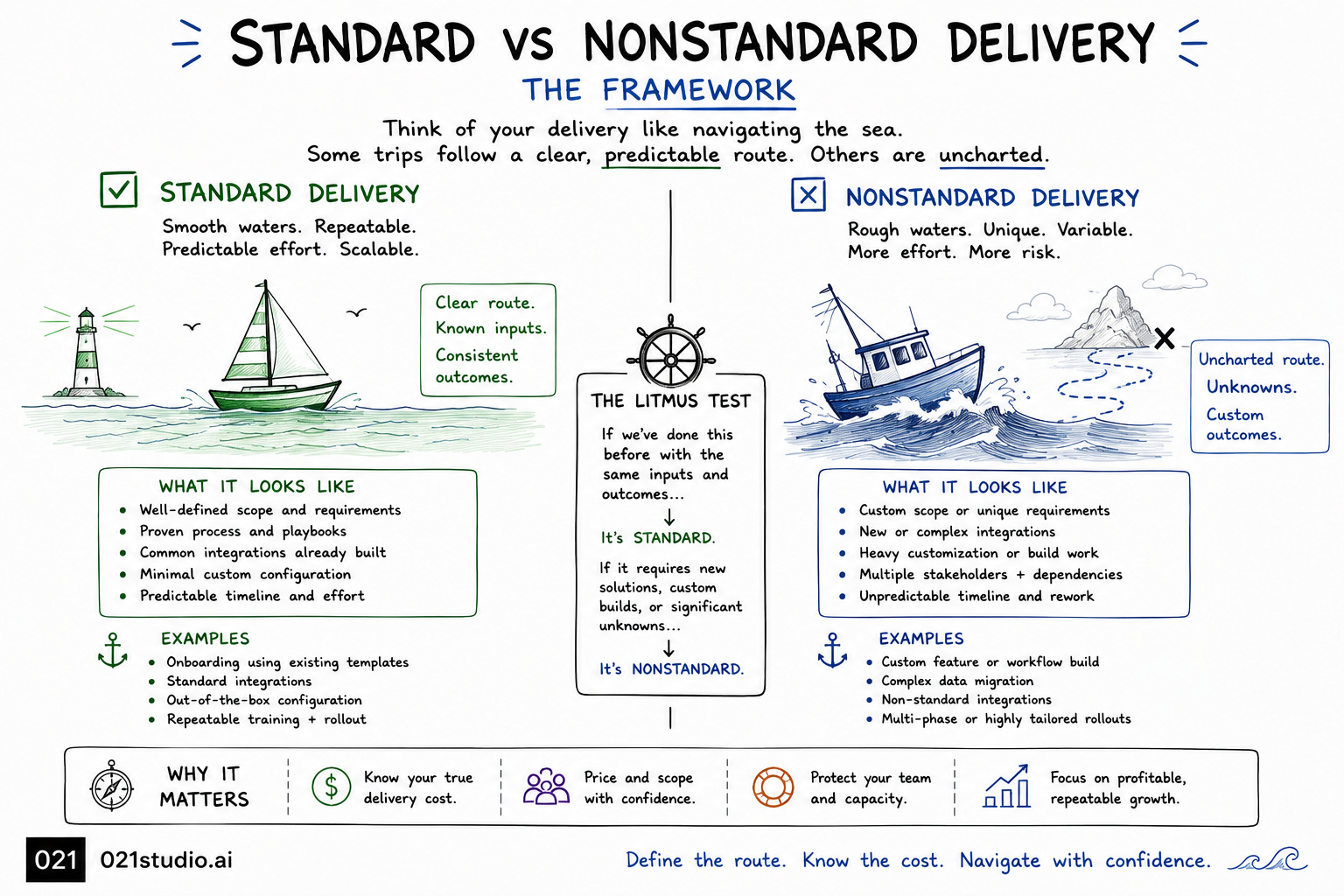
None of this needs to be sophisticated on day one. A spreadsheet updated monthly beats a perfect system that never gets built. That’s not just a scrappy-founder platitude, it’s a pattern AWS’s own ML leadership has flagged in enterprise AI rollouts: polished systems and dazzling demos that never ship kill more value than the rough version that actually gets used every month. The point isn’t precision. It’s visibility. You can’t manage what you can’t see, and right now, most companies can’t see this at all.
If your revenue chart looks great but you couldn’t tell me your delivery cost per account off the top of your head.. that’s not a data problem. That’s the next fire, just not lit yet.
Thanks for reading Success & Growth ! Subscribe for free to receive new posts and support my work.
Comments
Nothing yet. Say the first thing.
Sign in to join the conversation.