
What makes a good tabletop player-character? Is it a character who is mechanically strong? Is it a character with a good backstory? Is it a character who is funny?
The answer to all of these is ‘yes, but - ’
I have played enough scrawny characters to know that, even if the dice and numbers are not the main attraction for you, being mechanically weak can still sort of suck. A disappointing dice roll is always frustrating, because it slows down the game, whether that means drawing out combat or needlessly complicating the flow of a roleplaying scene. A strong character helps to keep the game moving, rather than grinding to a halt.
The ‘but’ is that you do not want, under any circumstances, to be a power-gamer. Players who put stats and abilities above all else are a plague - they have a competitive relationship with other players, and often an adversarial relationship with the DM, who is treated as an opponent to be overpowered rather than another player there to take part and have fun. They also tend to have little interest in roleplaying, which is not great when you’re playing a roleplaying game.
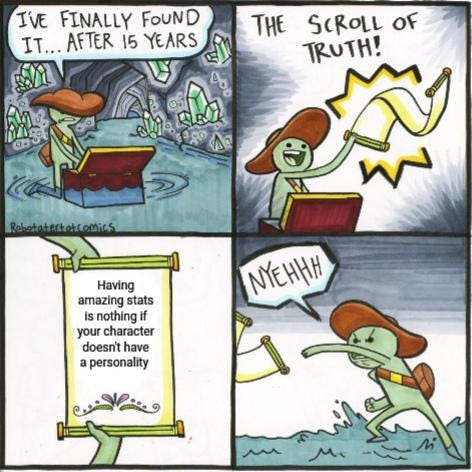
Speaking of roleplay, a good backstory is absolutely essential for any long-term campaign. An actor wouldn’t set foot on a stage without a thorough and definite understanding of their character, and nor should you, particularly since you are going to be making up every line and stage direction on the spot.
The ‘but’ is that you actually need to tell people your backstory at some stage, and many players are painfully self-conscious doing that - I can’t tell you how many times I have seen players just clam up whenever questioned or prompted,1 to the point that real-life weeks and months will go by without your characters gaining any trust or confidence in one another. Schroedinger’s backstory - which we are assured exists, but is never revealed - is often the same in practice as having no backstory at all.
Unfortunately, when given these three non-exclusive attributes - strong, backstoried, funny - many people breeze straight past the first two and opt for funny. I say unfortunately not because I’m a total killjoy,2 but because people tend to underestimate how difficult a funny character is to pull off, and also how limiting this starting point can be.
In the first place, being funny on purpose is a very different thing from being funny spontaneously - the latter tends to happen naturally when a group of grown-ups get together to play at being elves, and needn’t be forced. On-purpose comedy, on the other hand, is a full-blown art form, which an enormous amount of trial and error goes into behind the scenes. There’s timing, technique, set-up, context, juxtaposition. It’s a very tricky thing, which looks easier than it is, and doesn’t look that easy to begin with.
Of course, playing a funny-by-design character in a tabletop game isn’t exactly like delivering a stand-up routine, but they are similar in that they both involve a deliberate, pre-meditated effort to make someone laugh. The trouble is that a) effort is unsexy,3 and b) it’s often ineffective. We’re often a great deal funnier when we are being ourselves, and reacting to scenarios naturally, than when we are actively trying to perform funny.
The other thing about setting out to play a funny character is that, before we even begin, we have to ask - what is a funny character? If you don’t have a good understanding of the answer to that question, you are in trouble.
The name-pun: your first red flag
To start with, we might want to establish what is not a funny character. In RPG Philosophy’s video on gimmick characters,4 the example he gives of the typical DnD joke character is an ‘Orc War Chef’ - like a war chief but a chef, wears ‘plate armour’ made of kitchen plates, wields skillets as weapons, etc.
For me, this example is blisteringly accurate: in one short-lived Warhammer RPG, a player who is a frequent offender in this category wanted to play a genestealer named ‘Jean Steeler.’5 More recently, someone else introduced a character with a similar name pun, whose comedic gimmicks were already wearing thin at the second session.
RPG Philosophy goes on to make the point that, while these types of throwaway characters might be okay in a one-shot game, they are out of place in any long-term campaign, as they are not going to be able to respond appropriately to more serious story beats, nor are they likely to develop over time. Whereas the tone would usually vary from session to session, a static joke character keeps it artificially anchored in one place, at the cost of others’ enjoyment.
Funny, but not just funny
Returning to the question of what a funny character is - and, more broadly, what kinds of funny characters could actually be dynamic enough for long-term roleplay - examples of funny yet substantial characters are everywhere for those with eyes to see:
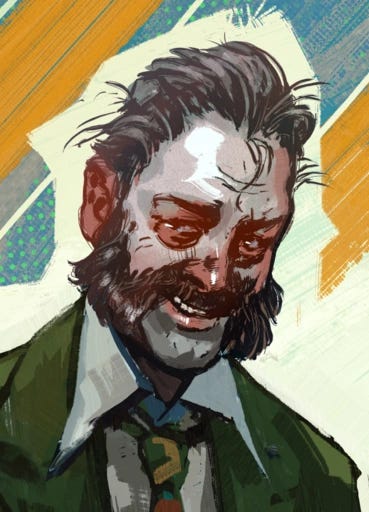
Disco Elysium’s Harry DuBois is a very funny character. He is also a desolate, washed-up train-wreck of a man, who has developed amnesia not as a result of any recent shock, but because of a catastrophic break-up seven years ago, combined with the chronic stress of being a detective. As the game puts it, Harry has spent every working day meeting people on the worst days of their lives. Harry is pure tragicomedy,6 and the juxtaposed comedy and drama of the character heighten each other. You could absolutely play a Harry - a character who is superficially funny, but also has real, long-term problems to consider - in an RPG, and if you’re any good at it, it could be the adventure of a lifetime.
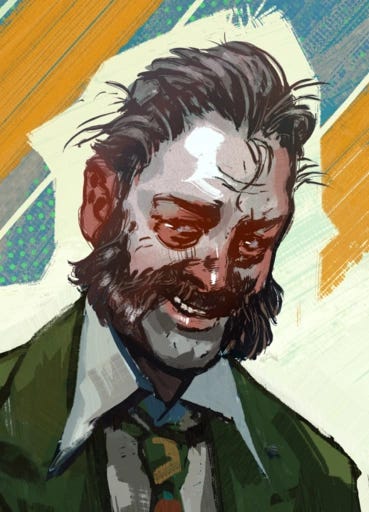
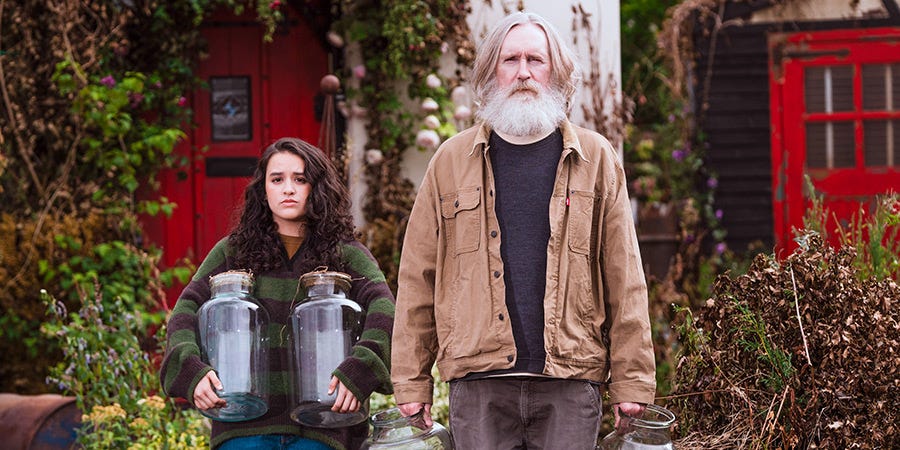
Harry’s trademark rictus grin, referred to as ‘The Expression,’ gives him a real Hide the Pain Harold energy. Small Prophets’ Michael Sleep is a fairly similar archetype. An eccentric middle-aged man who works in a DIY shop, Michael has a deep sadness in him. His girlfriend Clea disappeared on Christmas Eve years ago, and, though everyone else in his life has moved on and accepted her likely death, Michael clings to the possibility that she might return. His house is packed with boxes of her things, and his living room is still arranged based on a picture of her favourite childhood Christmas, which he had hoped to surprise her with. As the story goes on, he discovers an old book of alchemy, and his sweet but demented father urges him to use it to create homunculi, which will be able to divine Clea’s fate. It is a very funny show, but also an extraordinary drama, and the lighter moments contrast with the more serious to great effect. You could absolutely be a Michael, on a harebrained quest to learn the fate of a lost loved one, in an RPG, and if you do it right, you could be a hell of a lot funnier than Jean Steeler.

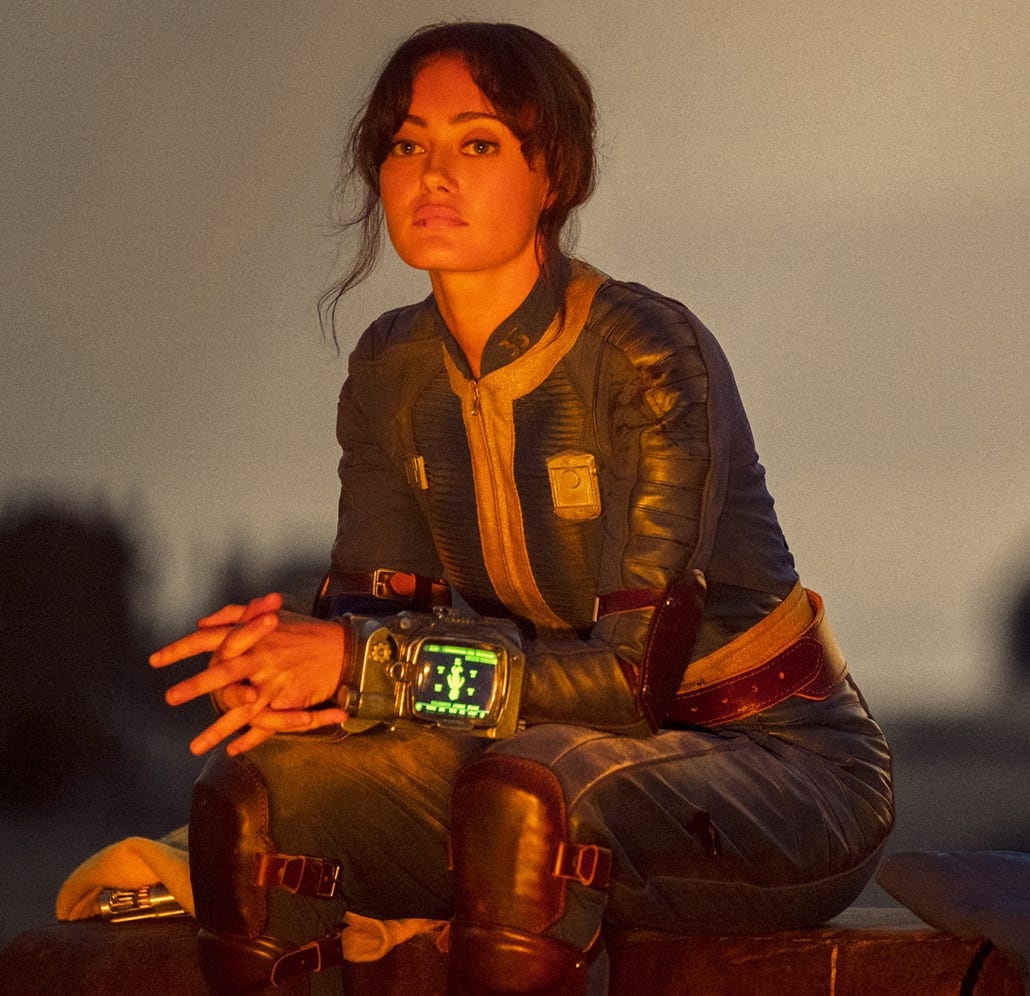
Michael with co-worker Kacey, another tragicomic figure whose insane, impossible dream is to be in Neighbours, the cancelled Australian soap opera. Fallout’s Lucy MacLean is another good example, and a fitting one, as she is heavily based on the average Fallout player-character experience. Her naive optimism and folksy speech are comically at odds with the hostile atmosphere of the wasteland, and her efforts to be a peacemaker are frustrated more often than not. However, Lucy is far from a one-note clown, and the drama and comedy of her character operate off the same thing: her humane worldview is contradicted at every turn by the bleakness around her, which takes a toll over time. Having played opposite Lucy-esque characters, I can confirm that a Lucy is a far more interesting, dynamic, and yes, funny PC to interact with than any Orc War Chef could be.

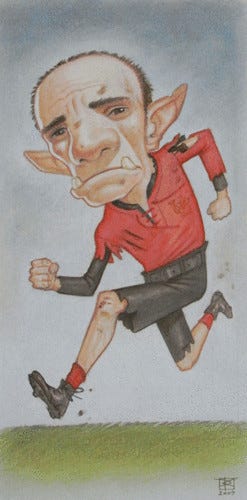
I get such a kick out of the show’s costumes and props. Discworld is bursting with examples of funny but substantial characters. Whether it’s the Watch series or Tiffany Aching, Terry Pratchett was a master at using initially comic characters and scenarios as a springboard to launch into deeper themes. For example, Unseen Academicals is superficially about a group of elderly wizards forming a football team, but it actually centres on class, racism, and the politics around work. The character Nutt is an Orc who has been raised to be the ‘good’ example of his near-extinct race, to prove that they are worthy of existence, but as a result he is a neurotic whose self-worth is inseparably tied to work, and he can’t conceive of himself as having innate value as a person. He is counterpart and love interest to the university cook, Glenda, who is chronically undervalued and dissatisfied with her own working life.7 It’s a serious novel, and offers one of the most refreshing takes on Orcs in fantasy, but it’s also very funny. It’s perhaps not a coincidence that Pratchett was himself an avid tabletop roleplayer and video gamer, who spent time playing Oblivion in his later years.
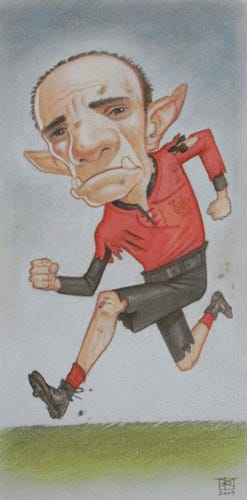
Nutt by Paul Kidby.
Why do we clown?
With so many examples of funny but substantial characters in pop culture, it can be hard to make sense of why so many tabletop players end up making shallow, name-pun characters instead. Surely, this is not the main attraction of the hobby. It’s also very much not what campaigns tend to look like on paper, or indeed on the many actual play podcasts out there, which typically combine comedy and drama.8
The decline of literacy could be part of it: when D&D began in the 70s, roleplayers were readers almost by definition, whereas many players today will not have finished a novel in years, and therefore won’t have come into contact with good, literary comedy like Pratchett’s.
But this still falls short of an explanation - funny but resonant TV is wildly popular, whether it’s Succession, Breaking Bad, or The White Lotus, and has been for decades. In video games, we have Disco Elysium and its offshoots, but also Baldur’s Gate 3, which matches the tonal range of a good D&D campaign with characters like Astarion, who brings high-camp comedy, but also has one of the darkest and most challenging backstories in the game.
My feeling is that the tendency towards joke characters isn’t necessarily rooted in a lack of understanding of what a good character is, or even a lack of desire to play good characters, but rather a defensive impulse. Many would-be roleplayers enter the hobby with the ghosts of disapproving parents and high school bullies looking over their shoulders, and one way of dealing with the resulting stage-fright is to clown instead of actually trying to roleplay.
Of course, it’s totally normal to feel anxious about the performance element of roleplaying games. Any performance is a risk - people might think that your ideas are rubbish, and of course fumbling a story you want to tell is mortifying. If you don’t try to do that, and instead set your sights on lower-hanging fruit, you can reduce the risk of feeling embarrassed, but you also pre-emptively limit your potential enjoyment, and are likely to miss out on the things that attracted you to the hobby in the first place. In my experience, those who play joke characters are always the first to become bored and lose interest in any given campaign, because they’re not really engaging with the interesting bit of the activity.
It’s also worth thinking about the implicit agreement between players when we set out to play these games - the deal with RPGs is that we all risk making fools of ourselves together, and that means we each need to be prepared to be perceived (and judged) by others. If only one or two players are willing to risk embarrassment, while others take cover behind clown personas, you are not sharing equally in the risks and rewards of the game. The result is that it feels less like a group activity, and more like a handful of isolated individuals contributing unevenly to the game, often at cross-purposes with one another.
And the other thing to remember is, trying and failing at anything in public sucks, and that’s also true of failing to make people laugh! If you’re playing a character whose name is their primary punchline, then your comedy routine is pretty much already on life support at session one, and will be dead by the third session at best. In a way, it’s actually easier to play a character who is funny sometimes but serious at others,9 and this approach gives you far more freedom to react naturally to developments in the story.
Therefore, be brave! Do more than the bare minimum! Don’t be a Jean Steeler or an Orc War Chef! Be a sad amnesiac with a hideous tie! Be a wistful alchemist! Be an idealist in a cynical world!
Ashlander Analysis is a reader-supported publication. To receive new posts and support my work, consider becoming a free or paid subscriber.
Which you should be happy about! If people are asking questions, it means you’ve got their interest! Which means you’re doing a good job!!! Don’t lose your nerve now!
I really do try not to be, albeit with limited success. My position here is not anti-comedy, it’s anti-bad comedy, and pro-comedy/drama.
(and you’re probably less good at disguising the effort than a good stand-up)
Which I would recommend. His description of the bully archetype is also on-point, and depressingly common. I’ve seen some real Theodor Adorno shit unfold in roleplaying groups, where one bully-type changes the dynamic of the whole group, and the whole moral centre of gravity shifts, until you’re no longer playing the kind of game you signed up for. Many such cases.
He was talked out of this by the DM, and instead opted to play a racist bully.
The man is so on the edge at all times that he can die from trying to retrieve his tie from a ceiling fan, being made to sit in an uncomfortable chair, or simple social embarrassment.
There’s a great scene where Nutt and Glenda are on a bus (? - probably not an actual bus, some bus-equivalent) and fellow commuters begin to praise Nutt after they realise how industrious he is, comparing him favourably to less productive working class people, and Glenda is quietly furious, because she knows that this is feeding his belief that his worth is conditional. There is another excellent bit at the end when she confronts Nutt’s mentor-figure, Lady Margolotta, who raised him to be this way.
10/10 stuff, Nutt and Glenda are the best Discworld couple.
Shoutout to Narrative Declaration’s first Warhams campaign, which was very funny, but took a hard turn into serious character stuff in its later episodes. Their Rotgrind campaign also has some 10/10 stuff, notably from SpeakerD, who is always a class act.
Which is true of many (/most?) great literary characters. Even goddamn Cormac McCarthy is funny sometimes. Dostoyevsky can also be very funny, in a cringe comedy/tragicomedy way.
Comments
Nothing yet. Say the first thing.
Sign in to join the conversation.