
Introduction
Armando Iannucci’s 2017 film, The Death of Stalin, has been part of my backlog of acclaimed movies for many a year, and some months ago1 I gave it a chance. As many readers will know, Iannucci is best known for political comedies, particularly The Thick of It, Veep, and In the Loop, as well as the various Alan Partridge offerings. These are of varying quality, ranging from biting satire to more complacent fare. We’ll get into the trend towards the latter, which I’d suggest The Death of Stalin is part of, but first, a rough overview.
The Death of Stalin is, as you’d expect, about the death of Stalin, and is an adaptation of a French graphic novel of the same name by Fabien Nury, which it follows closely. The choice of subject is, it must be said, kind of a weird one - as historian Richard Overy wrote at the time:
Where the suicide of Hitler in the bunker has a squalid drama, captured effectively in the 2004 film Downfall, the death of Stalin has to have the drama squeezed out of it, drop by drop. He did not take his own life nor, as far as the evidence suggests, did anyone else.
Accordingly, it was found necessary to spice things up by a) distorting the real timeline to connect various tangential events with the titular death, and b) inventing things that straight-up didn’t happen, including two fictional massacres.
The slant of these inventions is always to make the Soviet regime more seedy, violent, and absurd than it already was. Unsurprisingly, the film was banned in Russia and a number of other post-Soviet states, which many critics took to be proof that TDOS was a hilarious masterpiece that hit the mark, and like any banned media, the bans added fuel to the film’s legend.
My feeling, however, is that if you are going to go after the USSR and/or current Russia (and there are perfectly good reasons to do so), you could at least keep the focus on things that actually happened, instead of continually shifting it to things that didn’t. It’s not as if you have to invent anything to make Stalin’s era look grim, yet Nury/Iannucci did just that, many times over, and in the process made it very easy for Russian leaders to justify treating it as defamation.
In terms of plot, an elderly Stalin dies of natural causes early in the film, and the rest of the story revolves around his ministers squabbling over power in the aftermath. The most important of these are Nikita Khrushchev (Steve Buscemi), then a high-up minister, and Lavrentiy Beria (Simon Russell Beale), head of the secret police.2 The all-star cast is very prestigious, and it’s a quality production, but the film has its critics, and I’ve found myself to be one of them.
The inventions
The Yudina incident
The film’s opening is true to Nury, but not to reality. It begins with Stalin making a call to a radio station which has just broadcast a live music concert, asking for a recording. Since the performance wasn’t recorded, a panic ensues. The director has a new audience dragged out of their beds to record applause, rushes a fresh conductor in after the previous suddenly collapses, and bribes the pianist, Maria Yudina, who initially refuses because she hates Stalin. Subsequently, she sends a note to Stalin denouncing him, and while he is laughing at the note he collapses.
This is ‘based on a true story’ only in that it’s based on a story. The anecdote comes from a memoir which is purportedly by the composer Shostakovich, the authenticity of which is still disputed. The story has not been substantiated by biographers, and even this uncertain version differs greatly from what is shown in the film.
The discrepancies are as follows:
a) The film shows dozens of people dragged out of their beds literally at gunpoint for the sake of the recording’s acoustics. There’s no mention of an audience in the source,3 only Yudina and two replacement conductors, nor does it seem likely that a theatre director would have the authority to summon whole squads of riflemen at short notice.
b) The collapse/death (?) of the first conductor is another embellishment. The source says that he was too nervous to perform, not that he was so nervous he literally dropped dead on the spot.
c) In the film, Yudina is bribed with 20,000 roubles by the director after she refuses to play. In the source, this sum wasn’t a bribe, but an unexpected gift from Stalin himself afterwards,4 which prompted Yudina to send her reproachful note in response. Yudina was also known for being extremely generous and careless with money, and the idea of her demanding a bribe, as she does in the film, seems out of character (and we know a lot about her character, because she was a well-known public figure and a very unusual one, and many friends wrote about various episodes from her life).
d) The purported incident took place ‘in Stalin’s final years’ with no exact date, but it definitely did not happen on the night of his death. The source described Stalin’s surprising lack of reaction to the note, so he had time to receive the recording, send the money, receive the note, and to unexpectedly take the high road afterwards.
e) Yudina in the film says multiple times that her family was killed by Stalin. If this is true, I can’t find anything about it, though there are many English articles about Maria Yudina, mostly covering her biography by Elizabeth Wilson and her status as a dissident icon. If Stalin had killed her family, you’d think these articles would mention such an important and relevant fact.5
f) Yudina in the film is wildly miscast, being played by the elegant former Bond girl Olga Kurylenko, then in her thirties, dressed in blue silk. In reality, Yudina was an eccentric, intensely religious woman in her mid-fifties, noted for wearing floor length black dresses made of sack cloth.
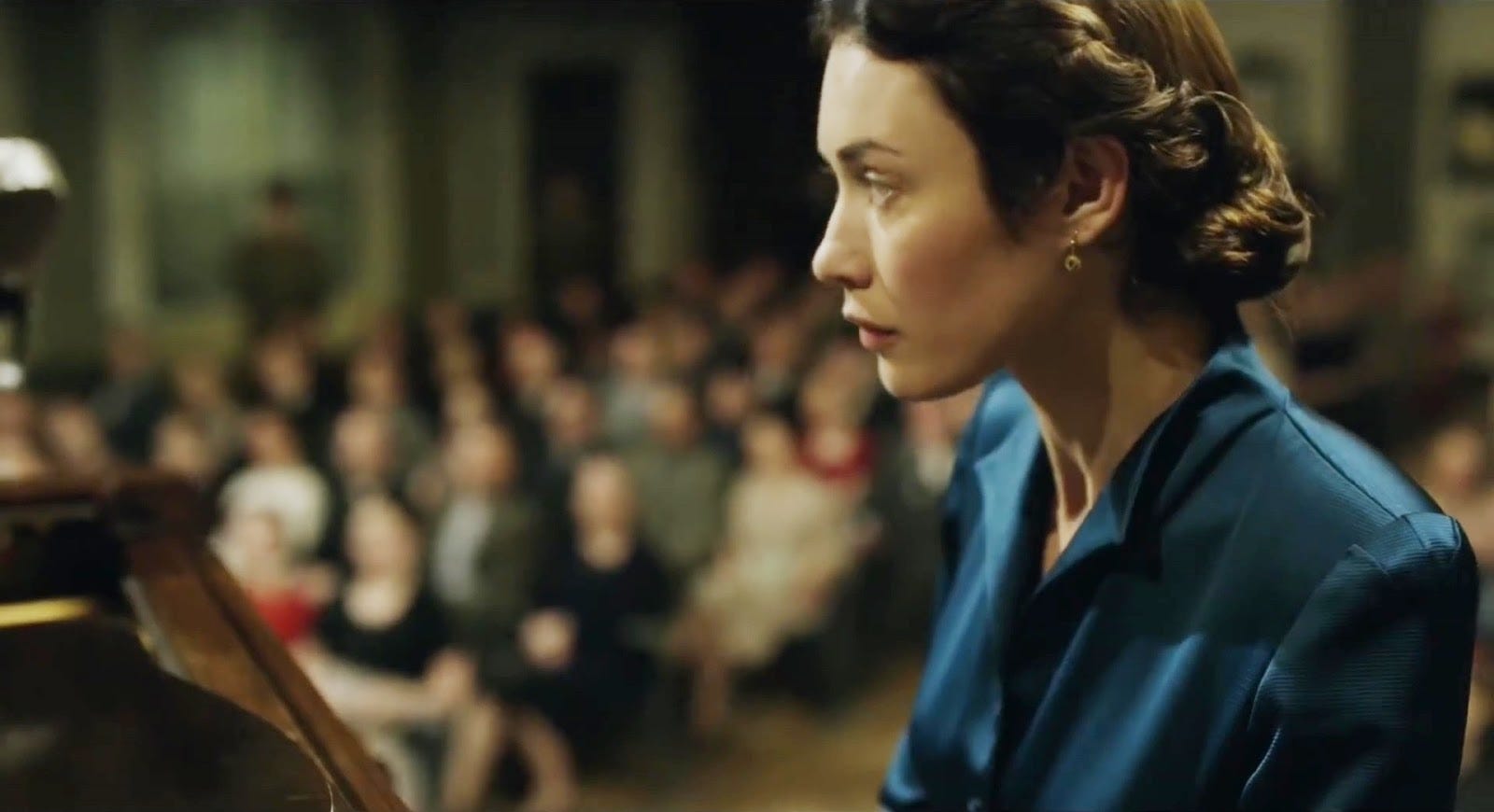
While the source’s story is unsubstantiated, it is at least consistent with Yudina’s character. She was a zealous Christian convert (originally from Judaism) who always wore a large cross when she performed, which was asking for trouble in the aggressively secular climate of the time. She was also homeless for years as a young woman, and lived her whole life in poverty and debt. She gave away what little money she had to charity, and was banned from performing for five years for reading Boris Pasternak’s banned poetry.
With this context, it’s absolutely believable that Yudina would risk her life by sending a critical note to Stalin: after all, she spent her whole life taking risks and making sacrifices for her beliefs, and was not anyone’s idea of a pragmatic person.
The film’s yassified, contextless version of Yudina, in contrast, is thinly characterised and self-contradictory, and inferior to the more interesting woman she’s based on. She’s hard-nosed enough to demand a bribe, yet reckless enough to provoke Stalin. She’s also both fearless enough to send the note, and fearful enough to be terrified when Beria finds it. The film also makes her a friend of Khrushchev, which endangers him politically, and for this reason among others it’s beyond unlikely that such a relationship existed in reality.
Massacres and arbitrary killings
TDOS also features not one but two fictional massacres, both of which have a pronounced scent of bullshit about them, so it’s no surprise to learn that they didn’t happen. The first takes place when, upon Stalin’s death (tm), the NKVD proceeds to loot his dacha and murder the entire staff, from guards to elderly maids, for no apparent reason. This feels very much like a movie trope of the sort of thing that might generically happen upon the death of a dictator, and of course no such thing happened in reality.
Not content with this, the filmmakers invented a second, even bigger massacre when crowds of mourners are shot by the NKVD during the state funeral. This one feels particularly devious, since Buscemi’s Khrushchev puts a number on it, saying that 1500 people (!!!) had been killed. The use of a specific figure could make an uninformed viewer think that this really happened, but it’s also completely made up. The factual basis is that over a hundred people reportedly died in a crowd crush during the disorganised funeral, which is very different from over a thousand demonstratively loyal Soviet citizens being massacred for no particular reason by the state. It’s hard to read these falsehoods as anything other than demonisation.
Further, TDOS enjoys showing arbitrary on-the-spot killings, such as Beria’s execution. In the film, he is dragged straight from the committee’s meeting room to some kind of barn and given a four-minute trial that is more of a shouting match, before being shot on the spot. In reality, the process was far more drawn out, with Beria arrested in June, and tried and executed in late December. The trial was by no means a fair legal process (and did indeed happen in some kind of barn), but the months of deliberation provided a veneer of legitimacy. The film also shows Beria’s guards and supporters being gunned down in the Kremlin itself, which didn’t happen - some were indeed killed, but after formal arrest and imprisonment.
Svetlana’s exile
The film ends with another distortion as a final flourish - the fictional banishment of Stalin’s daughter, Svetlana, who Khrushchev decides must leave the Soviet Union and go into exile in Vienna. As with Yudina, this is not only a total falsehood, but does a disservice to a real woman, who died only six years before the film’s release. Svetlana really did leave the Soviet Union as a defector, but a) this happened a full fourteen years later, in 1967, and b) more importantly, this was on her own initiative, and the real story of her defection is far more interesting.
The film vaguely alludes to the extent to which Svetlana’s life is dominated by the state, referring to her partner Alexei Kapler. The film heavily implies that Kapler was murdered by the state, which did not happen, though he was politically persecuted and spent five years in Arctic exile and another five in a forced labour camp. However, there’s no context provided re. Kapler’s imprisonment - the film doesn’t explain, for instance, that Stalin hated his relationship with Svetlana partly because Kapler was an artist, which Stalin disapproved of, and partly because he was Jewish (which is a whole other discussion).
By retconning fourteen years of Svetlana’s life, the film also erases her later unsanctioned relationship with Brajesh Singh, an Indian communist who she was forbidden to marry. She defected on her one and only permitted trip outside of the Soviet Union, when she visited India to bring Singh’s ashes to his family after his death, and took the opportunity to seek asylum via the US embassy.
TDOS makes Svetlana’s courageous choice into an unwilling exile, implying that she wanted to stay in the USSR and was for some unexplained reason forced out by Khrushchev. This makes little sense politically, since she was no threat to the men in charge, whereas her defection and subsequent criticism of the state was embarrassing for them.
The invented detail of Svetlana being exiled to Vienna specifically gives the distortion a gloss of truthfulness - like the invented number of murdered mourners, this false detail makes it feel all the more dishonest. As far as I can tell, she never went to Vienna, making her way to the US from New Delhi via Rome and Geneva.
The effect of the inventions
The problem with these inventions is that a) they stand out in a way that prompts the viewer to do some reading, and if you do any reading at all you’ll start to realise it’s bad fanfic, and b) the bad fanfic distracts from and undermines the things that really did happen, including some of the most shocking elements.
For instance, the film is actually quite good about showing what a truly horrific individual Lavrentiy Beria appears to have been. Not only was he responsible for brutal purges and millions of deaths, but he was also a prolific serial rapist and murderer - they were still digging up skeletons around his old mansion in the 90s and 2000s.6
The film is unflinching about depicting this, including really odious details, like the girls being given flowers afterwards - if they did not accept the flowers (which were supposed to imply consent), they were promptly arrested. The trouble is, in light of the deceptive details re. the massacre and the exile, it’s easy to mistake details such as this as yet more mythologising.
The fact that the film has the rapist Beria leering at and threatening its hot young fictional version of Yudina comes across as cheap, particularly with the context of the actual history. The sense is that they erased the real woman a) because the middle-aged, eccentric Christian Yudina isn’t very marketable and doesn’t cleanly fit into the film’s liberal, secular outlook, and b) to allow for greater drama via implied sexual menace.
All of this also makes the film’s end credit sequence, which shows photographs of characters being changed and blotted out, feel particularly ironic and in bad taste, because the film itself is willfully changing and blotting out real people who lived not that long ago, particularly the film’s women. It’s erasing Yudina’s faith, and blotting out Svetlana’s defection, i.e. their most defining biographical features.
It’s more interested in creating a picturesque vision of Soviet villainy than showing how real people resisted state tyranny, and to this end, it’s as happy to distort the truth as the Soviet state itself was.
Foundational problems
Apart from the tendency to make shit up, which is likely to be problematic in any historical story, it seems to me that the shortcomings of TDOS - comedically, politically, and dramatically - all stem from its awkward premise and subject. Because TDOS is about Stalin and the USSR in the 1950s, it has to clear many hurdles, and it doesn’t always succeed. These hurdles are:
Audience ignorance.
The bleakness of the subject.
The fact that it’s a political comedy.
1. Audience ignorance
This is a fairly straightforward and obvious problem, and it’s one that the filmmakers don’t really manage to resolve. It’s clear that TDOS would work much better if the average person knew who even half of these people are, but as it is, very few could name more than one or two of Stalin’s ministers, let alone explain who they were and what they did.
In Western countries, Molotov’s name might be the best known, if only because of the Molotov cocktail and the Molotov-Ribbentrop Pact, and people vaguely know who Khrushchev is. But Malenkov? Bulganin? Mikoyan? Yudina? Vasily and Svetlana? Whereas In the Loop used familiar proxies and composites to satirise the Iraq War, then ongoing, TDOS struggles to get knowing chuckles out of its audience, because this all happened in 1953, and who are these people again?7
References to events like the doctors’ plot don’t really land either, because 99% of the modern audience is going to need to consult Wikipedia to get the joke, and when they do they’re not going to find it that funny, because ethnic persecution isn’t very funny.
Speaking of…
2. The bleakness
TDOS also struggles to be comedic because it is dealing with such unrelentingly grim material. The film’s depictions of political violence, including many references to torture, give it a bleak and edgy quality, which is particularly acute given that much of this really did happen on a massive scale, and not that long ago. Overy was right to talk about the film wringing drama from its subject, because that’s more often than not what TDOS feels like - a drama rather than a comedy.
The genres can be skillfully combined, but here you can kind of see the seams where they’ve been knitted together. There are still funny lines and scenarios,8 but the simple fact is that In the Loop would have had a different vibe if Malcolm Tucker, on top of being a bully and a warmonger, had also been a serial rapist, and that’s sort of what TDOS is trying to pull off.
3. The politics
Finally, TDOS is trying to be a political drama about an era that virtually everyone already agrees about. Politically, Stalin’s Russia is the epitome of low-hanging fruit, and saying that Stalin was bad is as close as you can get to saying nothing at all.
Given the safe nature of the territory, it seems odd that TDOS, due to its banned status, has an air of punk rock about it, and was given glowing reviews by many an outlet for what it had to say. As a general thing, I’d suggest that if you’ve made a piece of political art and it’s universally lauded by mainstream papers, then you probably haven’t really said anything. The less content, the less controversy.
The Russian ban says less about the value of the film, and more about Russian sensitivities. It’s important to remember that Stalin’s status in Russian memory is complicated, not least by the fact that he led the country through the Second World War, during which tens of millions of Soviet people were killed.9 Is it any wonder that people might have mixed feelings about him, and might take umbrage to a geopolitical enemy making fun of his death?
Many (including the creator himself) have also suggested that the film was relevant to Trump, which… is it, though? Does 2017 Trump, a bloated plutocrat in the first year of his first term, really have much to do with 1953 Stalin, a former bank-robber/newspaper editor twenty-nine years into a revolutionary dictatorship? Do these sound like fundamentally similar men?
Stalin’s background is worth considering here: as a child, his father often beat him so badly there was blood in his urine, and he grew up in a poor provincial town where brawling was commonplace. It’s possible to draw a line from this early abuse at home, through his education in an oppressive seminary, to the many years spent in Siberian prisons for political crimes, and come away with some understanding of the conditions that made Stalin the ruthless, paranoid man he became. He was desensitised to violence almost from the moment of his birth.
It would be hard to think of a background less similar to that of Trump, who was reportedly a millionaire by the age of eight, and whose only likely role in a revolution would be organising counter-revolutionary death squads, or in the best case scenario being torn apart by angry SNAP recipients. You have to go really far in de-historicising individuals and ignoring material conditions to arrive at the conclusion that Trump is just like Stalin.
If truth be told, the comparison is an insult to Stalin.
Closing thoughts
So, why, then, was The Death of Stalin so acclaimed?
Well, a) five seasons into Stranger Things, I think it’s fair to conclude that people like shit stuff, and b) it’s not unwatchable - the cast is good, the production looks expensive, and the screenplay, for all its problems, has its moments.10 To a casual, not-too-opinionated viewer (that is, the antithesis of me), TDOS might manage to pass as a better movie than it actually is.
However, I would argue that there’s a deeper reason TDOS struck such a chord with so many critics, which has less to do with quality, and more to do with Western nostalgia about the Cold War. This was, after all, an era when Western people could think of themselves as enlightened, upstanding people opposing an evil empire.
Nowadays, many still hold versions of that position, but with a lot more cognitive dissonance - it’s hard to uncritically support your geopolitical bloc when you’ve watched American/British/German-made bombs hitting refugee camps every week for two years, while proponents make speeches more evocative of Hitler than Stalin. The week of publishing, the US crossed a new threshold, with the administration openly defending a murder committed on camera by a government agent, while in the UK hunger strikers are in critical condition after seventy days without food. Meanwhile, Israel has just announced plans for a new ‘offensive’ against what is left of Gaza, having banned 37 aid organisations this same week.
With all of this ongoing, The Death of Stalin’s tendency to depict tyranny as foreign and eastern, rather than saying what the director says he means,11 has not aged particularly well. If you were going to make a satire about Trump, wouldn’t it be better to make it about someone who actually resembles Trump, and isn’t tied to a historic outgroup?
Of course, at this point, a long-form Trump satire would have the same foundational problems as TDOS, in terms of content - a genocidal narcissist who is as likely to be in the Epstein files as Epstein is almost too bleak a subject for satire, and you’re also going to struggle to differentiate it from The Boys.

Thanks for reading! For more on film, books and video games, please consider subscribing!
Likes, shares and comments also help!
Circa September I think? This one has been pushed back many times.
Which was actually called the MVD at this point, and had been for seven years. The use of the wrong but well-known name signals that this is a movie by and for Westerners.
The sum was significant - the average Soviet worker’s salary around this time was supposedly something like 6000 roubles a year, so this would have been an extremely generous gesture, and not the kind of money a theatre director would be able to throw away; Yudina gave it away to charity according to the story.
I do now have a copy of Wilson’s biography, which I mean to read at some point: from a skim of the index and relevant pages, I can’t find any reference to Yudina’s family being killed by the state. I’ll update this if I’m wrong, but I don’t think I am.
He has his defenders who argue that it was all made up by Khrushchev, but the consensus says otherwise. I don’t know that Khrushchev would have to make up such a long and detailed list of sex crimes to justify getting rid of Beria; also, good people do not end up running a secret police service.
Presumably people in post-Soviet countries have a bit of a leg-up in terms of understanding who is who, but the film clearly was not made with them in mind (hence, the bans).
Jason Isaacs is very funny as Zhukov, as is Rupert Friend as Vasily Stalin.
Lately, an EU official made the truly moronic statement that Russia and China had no role in defeating the Nazis. TDOS’ lack of recognition of this part of Stalin’s legacy forecasts this stupid belief becoming general.
(‘You are a child! You are mostly hair! You are not a person, you are a testicle!’).
And I would not say he’s insincere - his social media largely passes the vibe check. He does talk about Gaza, whereas many people with his kind of platform don’t.
Comments
Nothing yet. Say the first thing.
Sign in to join the conversation.