
CW: CSA, incest.
Spoilers ahead.
Introduction
For those who are not sufficiently attuned to obscure French horror that was advertised nowhere, The Vourdalak is a 2023 vampire drama directed by Adrien Beau, and it is also possibly the best horror movie I watched in the whole of last year. An honourable mention would go to Interview with the Vampire, with which it has some overlap - as I said of IwtV at the time, it’s a very stylish film, but also a nutritious one, bursting with social and political connotations, and leaving plenty for the viewer to decode and interpret.
The same can be said of The Vourdalak, which, like IwtV, is concerned with abuse, and situates that abuse within a family. The plot is loosely based on ‘The Family of the Vourdalak,’1 an 1839 novella (first published 1884) by Alexei Konstantinovich Tolstoy,2 but innovates on the source material in a substantial way.
The novella is set in the 18th century, and framed as a story told by an aged French aristocrat of his travels in Serbia as a diplomat in his youth. There, he stayed with the family of Gorcha, a local man who has disappeared into the mountains in pursuit of Turkish raiders. Before departing, Gorcha says that he will be back within six days, and warns that if he returns any later, then he must have become a vourdalak, a kind of vampire that feeds on the blood of its own family.
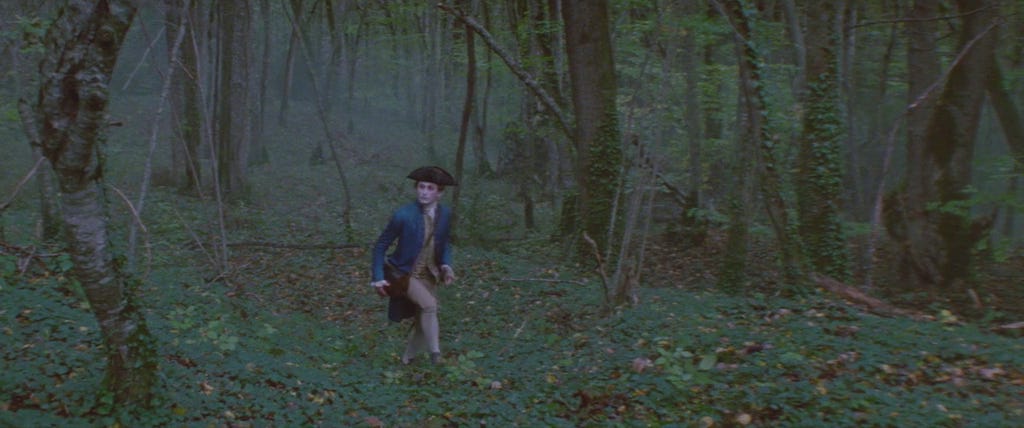
Of course, this is exactly what happens, and the Marquis bears witness as, over several days, the undead Gorcha picks off his family one after another, starting with his young grandson.
However, whereas the novella has a fairly quaint and comfortable atmosphere, and is peopled with straightforward stock characters, Beau’s film is far more forbidding and psychological from the outset. It’s a story full of twists and turns, and it gets very dark very quickly.
The casting and direction are both superb, and give it an intimate, stage-like feeling, while the stifling domestic setting concentrates all of the cast’s energies into a common space. Between that and the queer overtones, it’s a sort of vampirism via Tennessee Williams, and deserving of far more attention than it got.
Dramatis personae
Given the structure of the film, a rough outline of the characters seems a good place to start:
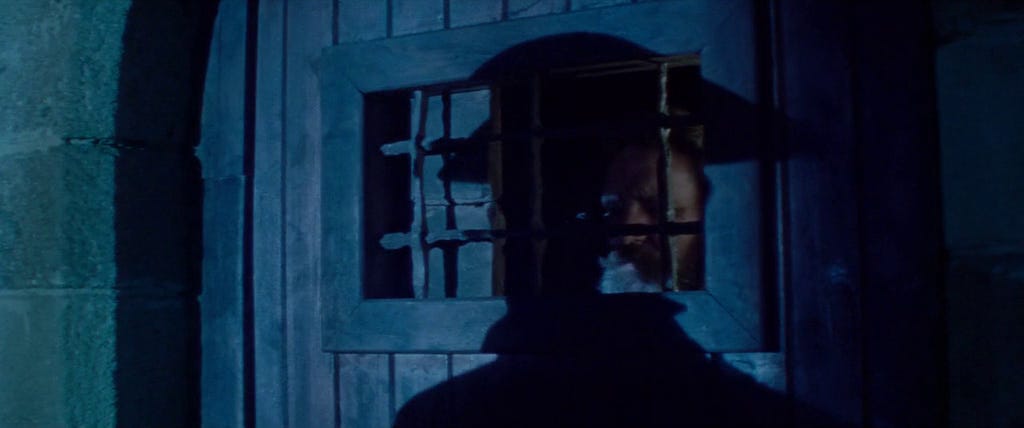
Marquis Jacques Saturnin de Antoine, the protagonist. A young French aristocrat and diplomat, complete with powdered white face, beauty spot, auburn wig, and male pattern baldness. Robbed by brigands and left without a horse, he is advised to seek out Gorcha’s house for help. A bit of a fuckboy, and comically ineffectual in a fight, but ultimately virtuous. We like him.
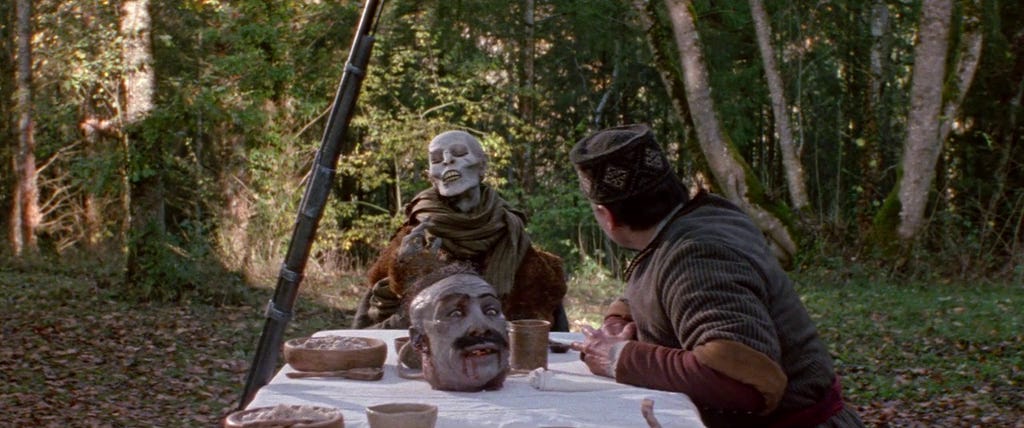
Gorcha, the patriarch of the family, now a vourdalak. He is a rotten and emaciated corpse, represented by an intricate mannequin voiced and performed by Beau himself. The juxtaposition between his hideous appearance and his son Jegor’s uncritical adoration has an almost comical effect - Jegor dotes and fusses as Gorcha coughs blue slime all over his food - but also figures into the central drama in a significant way. Whereas the others in the family are horrified by Gorcha from the moment of his return, Jegor cannot (or refuses to) see him for what he is.
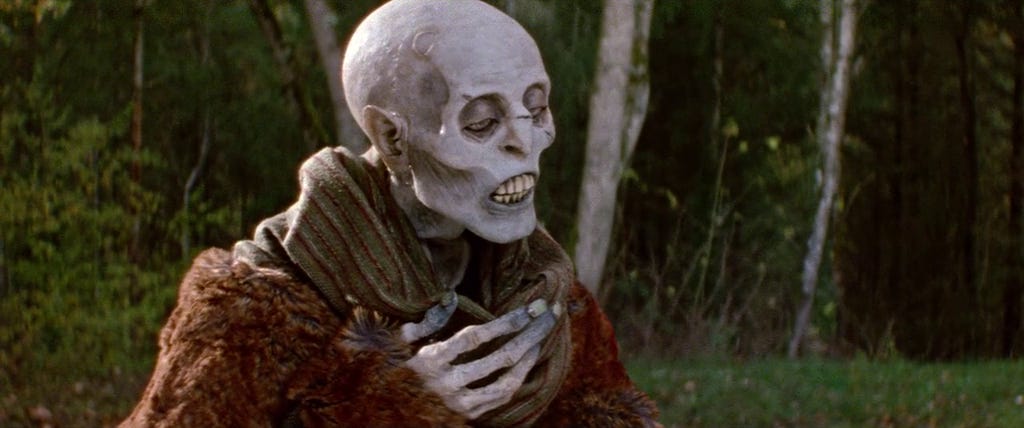
The Gorcha mannequin. Unlike many vampires, he is not harmed by daylight, and he also lacks fangs: a horrible wet crunching and chewing is his signature sound, and his formidable front teeth emphasise the violence of his predation. Jegor, Gorcha’s eldest son, and leader of the family in his absence. In his presence, the others are cowed and stand in silent subservience, their heads bowed. Jegor is the family’s protector against the Turks, but he cannot see the enemy within, and is utterly devoted to Gorcha, who can do no wrong in his eyes. A heavy drinker, intolerant, dismissive of women.
Pyotr, Gorcha’s second son. Heavily implied to be gay and/or trans.3 When Jacques first encounters Pyotr, he is wearing women’s clothing and earrings, but changes into men’s clothes after the return of Jegor, who scolds him. Pyotr is gentle and withdrawn, and joins the women in the family in the conspiracy against Gorcha.
Sdenka, Gorcha’s daughter, who Jacques becomes infatuated with. Strange and secretive, with mystical leanings. Sdenka has a strong depressive tendency, and still lives with the family because her reputation was ruined by an affair with a vagabond, who Gorcha murdered. De facto leader of the attempted mutiny against Gorcha.
Anja, wife of Jegor and mother of Vlad. Whereas Jegor fusses over Gorcha upon his return, Anja is disturbed and quickly takes Vlad away when Gorcha begins to pay attention to him. Anja overhears Gorcha attacking Vlad in the night, and finds the boy sick the next morning, but Jegor refuses to listen to her, leading her to join the others in the mutiny against Gorcha.
Vlad, Gorcha’s grandson. Like Jegor, he seems unable to see through Gorcha, and becomes his first victim.
Jegor the enabler
From these rough character outlines, it’s clear enough that this is very much a story about patriarchy, and the hierarchy within a patriarchal household, which is in this case less of a spectrum, and more dialectical: all of the authority lies with Gorcha, the head of the house, while those beneath him are faced with a choice: either they submit, or they band together against him.
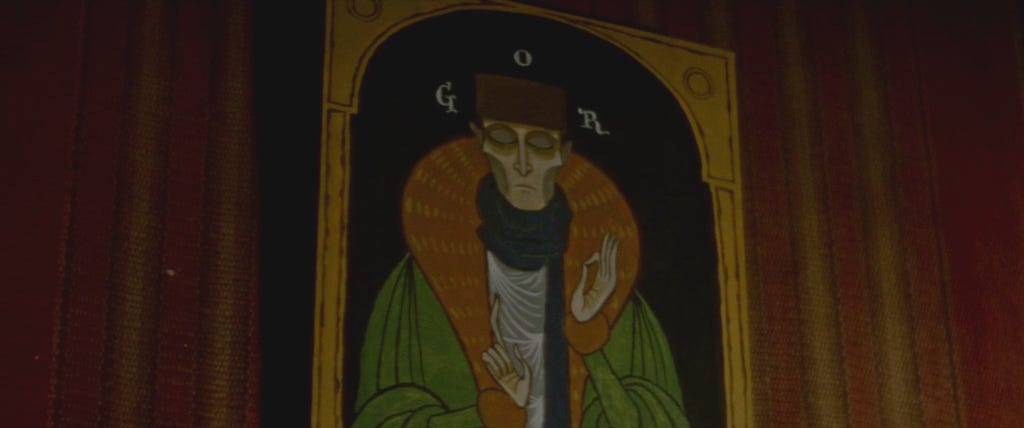
Unfortunately for the would-be vampire slayers, they are also opposed by Jegor, the eldest son and Gorcha’s heir apparent, who acts as his right hand. In his father’s absence, Jegor has absolute authority; in his first scene, he is a stern and imposing figure, and the others automatically submit. Here, though speaking harshly to Pyotr, Jegor comes across at least somewhat sympathetically, having just returned from fighting the Turks who have massacred most of their neighbours. He is affectionate to Anja and Vlad, and behaves courteously towards Jacques, promising to secure a horse as soon as possible.
However, in Gorcha’s presence, Jegor is utterly transformed. His former dignity is replaced by a slavish sycophancy, and he becomes Gorcha’s unquestioning enforcer, bullying the others for their disobedience and demanding they submit to their father’s every whim.
This is illustrated in a gruesome episode when Gorcha first joins them at the house: Pyotr’s dog is alarmed and barks at him furiously, and the vourdalak demands that Pyotr kill the animal. Pyotr refuses, but Jegor forces him to do it, using Gorcha’s rifle.4
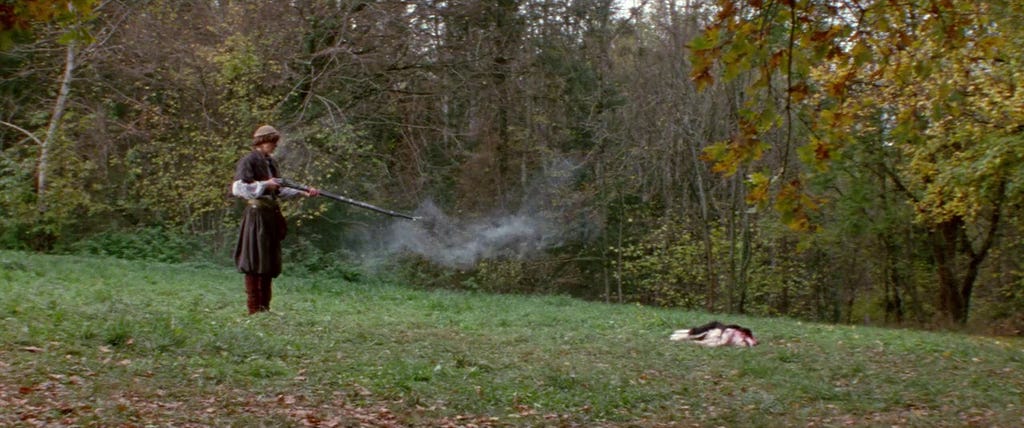
Pyotr is left distraught: as Jacques says afterwards, a dog’s love is unconditional, and is without judgement or assumptions (and therefore the perfect companion for the excluded Pyotr). It is bitterly in keeping with the premise of the vourdalak creature (that it feeds on its family) that Pyotr is estranged and abused by his own father and brother, yet is understood and accepted by Jacques, a stranger.
It’s also worth noting that as soon as Gorcha arrives, Jegor begins to drink heavily. It may be that he is following his father’s example (there’s a clear parallel between Gorcha’s addiction to blood and Jegor’s alcoholism), but there’s also a sense that Jegor too is fearful in his father’s presence,5 and copes by drinking and by trying to appease Gorcha. There is certainly a history of abuse between father and son, which Gorcha justifies in terms of ‘making a man’ of Jegor.
Wigs, coats and scapegoats
Adrien Beau worked in the fashion industry for ten years, and so it is no surprise that The Vourdalak puts great emphasis on the importance of outer appearances, often juxtaposing the surface and what lies beneath. We see this in Pyotr’s cross dressing, in the dissonance between Gorcha’s appearance and how Jegor treats him, and in Jacques’ makeup and wig, which he loses towards the end, revealing a balding head. Early in the film, Jacques bites into a beautiful red apple only to find a worm wriggling inside, and this key moment foreshadows several toe-curlingly horrible twists towards the end.
Costume is also essential in Jegor’s characterisation. Shortly after Gorcha’s return, he takes to wearing his father’s fur-trimmed coat, and, like his alcoholism resembling blood-drinking, the ominous costume change hints at his gradual transformation into a second Gorcha. Sdenka scolds him for it, drawing the audience’s attention to the symbolism.
In a crucial scene, Gorcha himself places the coat around Jegor’s shoulders after he had earlier taken it off; moments later, Jegor himself lets the coat fall to the ground, shocked by [major spoiler in footnote]6, only to quickly find in Jacques a new target for the anger that should be directed at Gorcha.
And of course, in the very next scene, Jegor is wearing the coat again.
Gorcha the abuser
If Jegor is a coward and an enabler, Gorcha is far more malignant. Previously, I’ve written about vampires as symbolic rapists, and The Vourdalak’s depiction of Gorcha leans heavily into this, and in a particularly disturbing way.
The film’s depiction of Gorcha’s predation on young Vlad is laced with disturbing innuendo. This undertone is first felt in Anja’s visceral danger instinct when Gorcha clowns at the dinner table, making the young boy laugh: she quickly seizes the boy’s hand and takes him away, putting him to bed early despite his protests. In the novella, Gorcha entices the child in the same scene with promises of gifts, ignoring the discomfort of the adults.
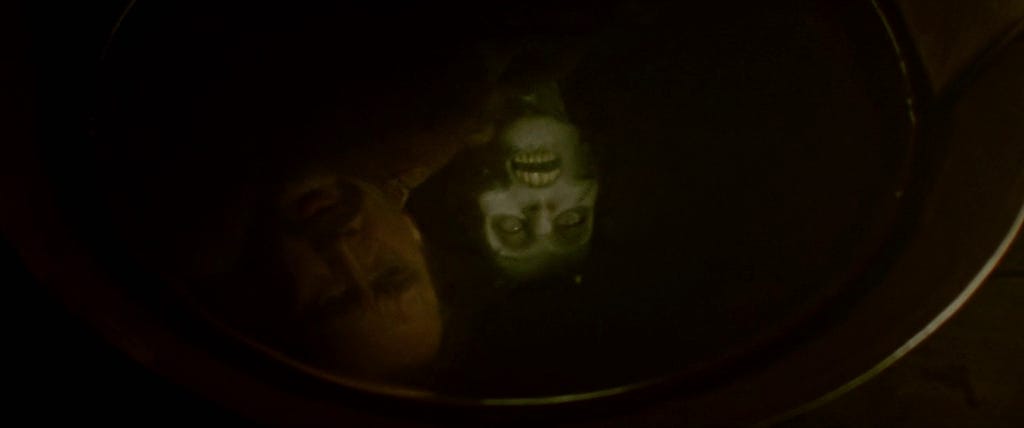
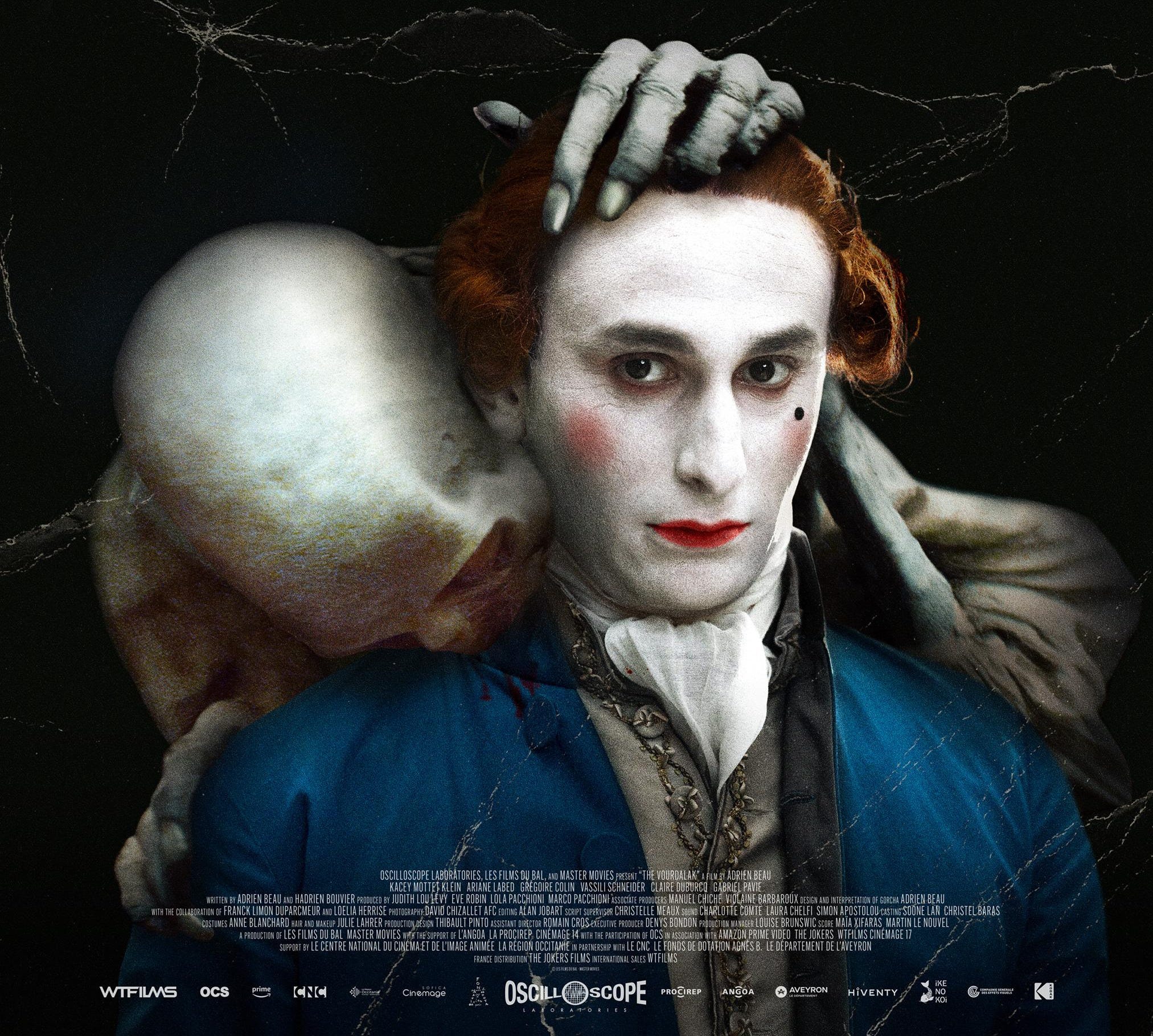
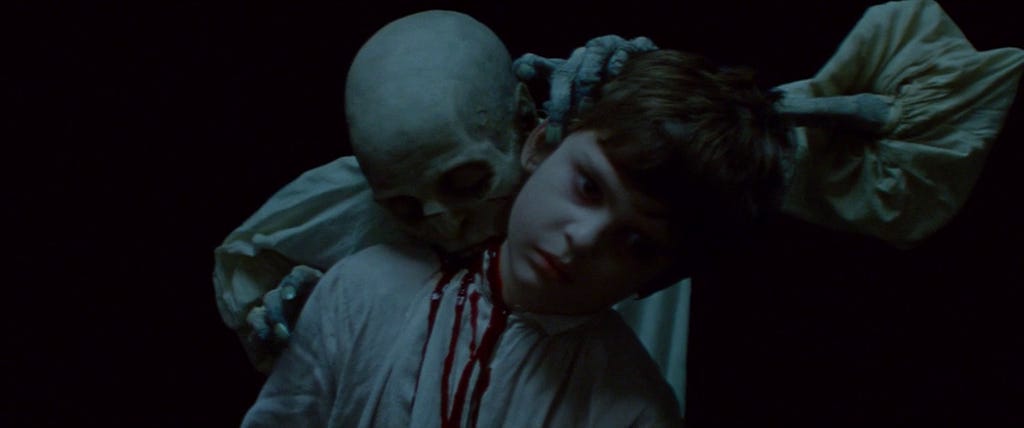
The next morning, Gorcha is absent from his bed, and Anja reports hearing him whispering in the boy’s room at night, and says that she discovered the bed empty apart from ‘a damp and soiled sheet.’ Anja tells this story in a drawn out and uncomfortable scene, with Pyotr and Sdenka listening in horror. It’s not a great leap to make the connection with sexual abuse, particularly given that Gorcha’s vampirism is elsewhere associated with lust. This seed is planted almost immediately before Anja’s story, in a nightmare sequence showing Gorcha in Jacques’ bed,7 and whereas the poster shows Gorcha looming behind Jacques about to bite him, the film itself has a nigh identical shot showing Vlad in the same position.
Jegor’s refusal to listen to Anja, or even to consider that Vlad might have been attacked, is also suggestive in this context. Anecdotally, we probably all know of rapists and child molesters whose families, friends and colleagues simply refused to accept the truth, and like Jegor, they instead find scapegoats in victims, witnesses, or even the legal system (in the rare case of conviction), instead of the abuser in plain sight. And of course, we see the same thing constantly in public life.8
Tellingly, whereas Jegor denies the threat to his son until it is too late, closing ranks with his father instead, it is the women who recognise the threat straight away and move to protect the child, helped by Jacques and Pyotr. It is no coincidence that both of the men who side with the women are considered effeminate,9 and both soon become targets for violence because of it.
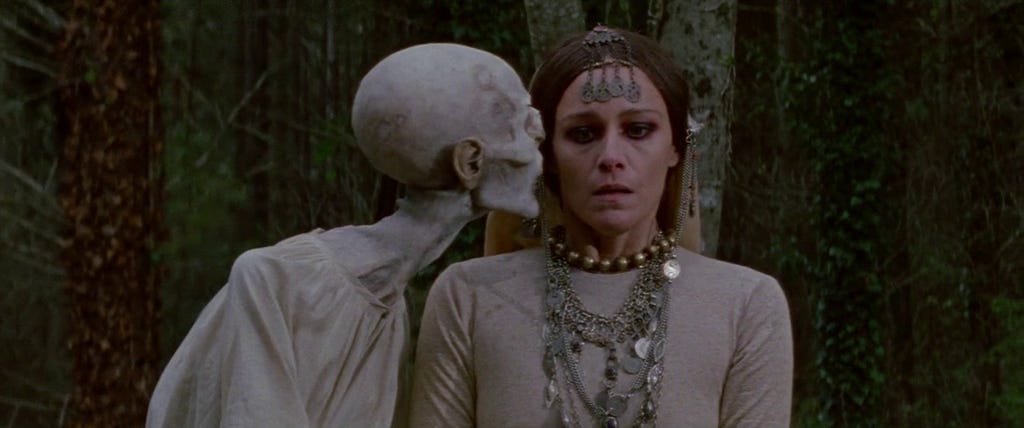
In keeping with this theme of misogyny, there is also an implication that Gorcha may have abused Sdenka in the past. He leers at her, leaning in close and groping her breast with his skeletal hand, saying that he feels ‘more than love’ for her.10 In light of this substantial hint, Gorcha’s murder of Sdenka’s lover takes on a new significance: was this just about honour and reputation, or was there also an element of jealousy?
Class in The Vourdalak
As Adrien Beau noted in an interview with Variety, his film is in a sense a role reversal of the typical vampire scenario. Whereas Dracula casts the vampire as an aristocrat lording over a castle and the surrounding lands, The Family of the Vourdalak was written more than forty years before, and instead depicts an aristocrat who finds himself staying with a vampire from the peasant class.
This is perhaps unsurprising, given that Alexei Tolstoy was himself an aristocrat with connections to the tsar’s court, who travelled through Europe as a diplomat, much like the Marquis in the story, around the time it was written.
However, despite this difference in perspective, Beau’s elaboration on the source actually brings it closer in line with the symbolism and subtext of vampire stories more generally. Whereas the Dracula type11 carries a social subtext, with the elite depicted as predatory and literally parasitic, sucking the blood of their subjects, The Vourdalak models this in miniature. Gorcha may not be the ruler of a fiefdom, but he is the lord and master of his household, and can prey on his subordinates with impunity. In Marxist terms, there is very much a class struggle going on in Gorcha’s house, but it has nothing to do with the visiting aristocrat, who happens to be on the side of the uprising.12
When push comes to shove, Gorcha’s authority is ultimately backed up by violence, but Beau also shows that Gorcha’s power is not only the result of menaces, but normative, rooted in societal expectations and taboos. For Jegor, and to some extent the other children, to go against their father is unthinkable in itself. Without directly threatening violence, Gorcha is thus able to quite literally get away with murder.
Production and presentation
Before concluding, it must also be said that The Vourdalak is a very beautiful and stylish film despite its (presumably miniscule) budget. It was recorded on 16mm film, giving it a pleasantly vintage look, and uses copious vaseline to give the light in each scene a soft and hazy quality, evocative of historical paintings.
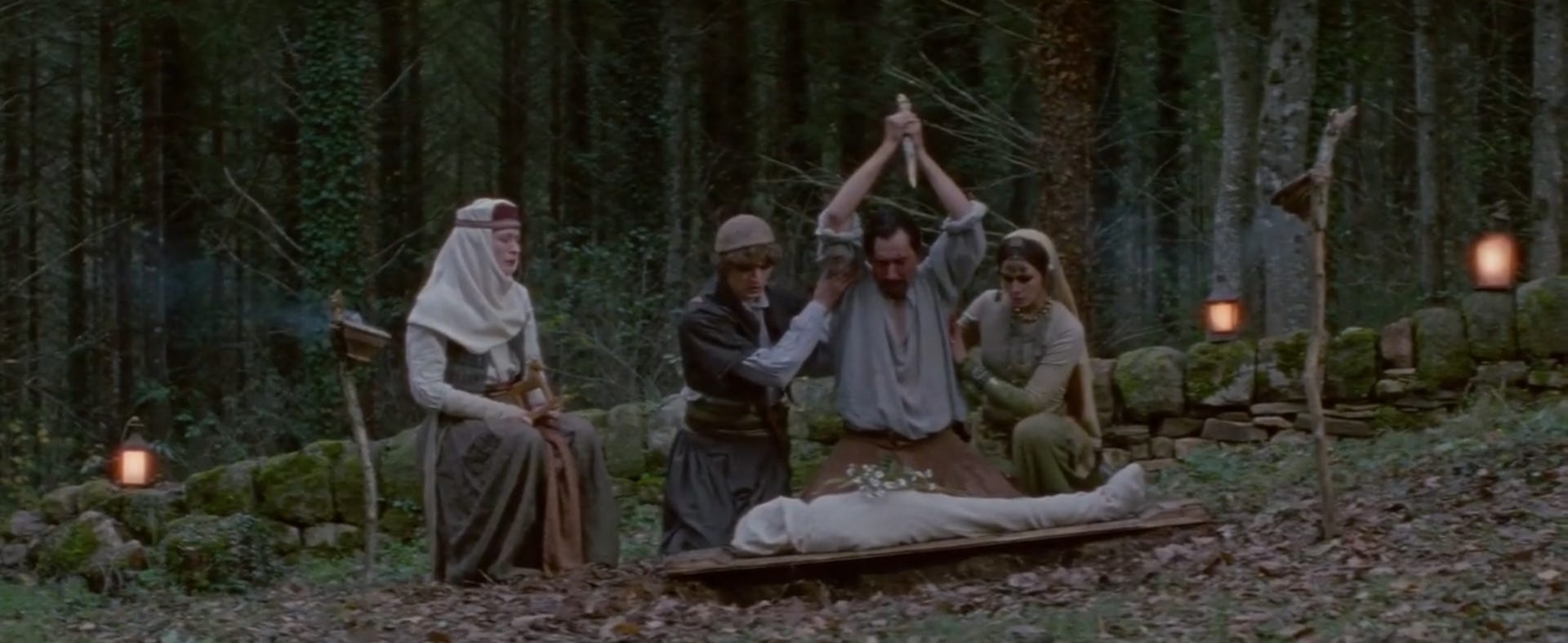
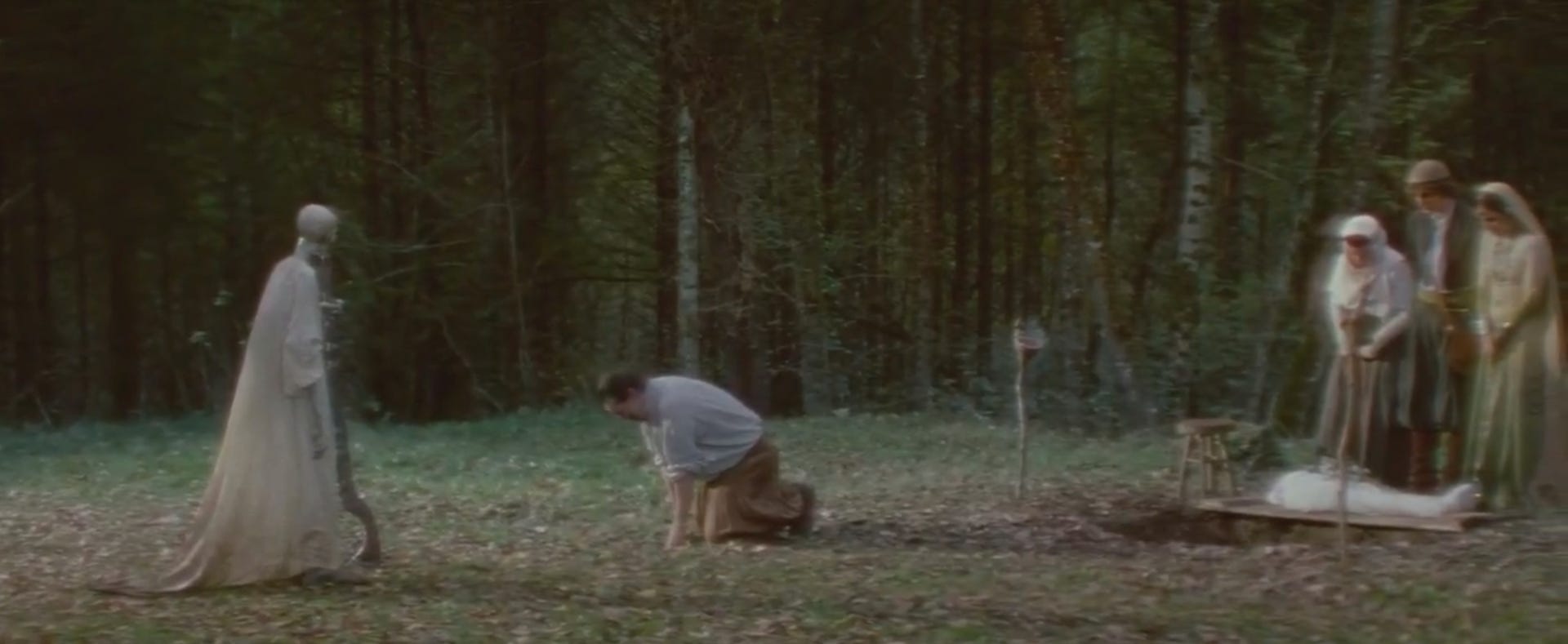
There is nary a hint of the mandatory blue/grey filter of Hollywood productions, with the outdoor scenes in something that resembles natural daylight (!!!) with no desaturation to speak of, and Jacques’ vivid blue frock coat and auburn wig making him look like the foppish young aristocrat he is. The landscapes are especially picturesque, with bright autumnal woods and dramatic cliffs surrounding the candlelit stone building where the grim drama plays out.
One haunting shot follows another, and the film is incredibly successful at drawing the viewer into another time and place, from Jacques’ first tentative steps into a haunted woodland, to the skin-crawling horror of the final scenes.
The use of a mannequin to play the vampire is divisive, with a minority of viewers finding it too outlandish, but personally, I adore the tactile creepiness of the Gorcha puppet, and find that it helps the film to stand out in the age of CGI (not to mention the post-postmodern AI-based unreality we appear to be hurtling towards). Beau explained the choice in terms of the limited budget, which would have ruled out extensive use of digital effects, but also noted that:
…with special effects it looks real but it feels fake, and with what we created, it looks fake but hopefully it feels real.
Closing thoughts
The Vourdalak is a ‘good’ film in terms of illustrating uncomfortable social truths in an effective way, but it’s also a very watchable film, and in fact a very re-watchable film. Generally, I don’t rewatch very often, but I found myself going back to The Vourdalak within a couple of months of discovering it, and enjoying it perhaps even more on a second viewing. In sharp contrast, I went off (the superficially similar) Nosferatu almost completely on a second viewing, which I didn’t expect, and it took me a while to puzzle out why.
The most obvious, mathematical difference is in the runtimes: The Vourdalak is a trim ninety minutes, whereas Nosferatu sprawls out to 132, and frankly, there is no reason on earth for it to be that long.13 Where Noferatu goes beyond suspenseful and teeters on the verge of self-indulgent, The Vourdalak is a lean, efficient beast: every scene is disciplined and purposeful, packed with visual hints and layers of foreshadowing, and there is very little redundant dialogue, with almost every line having some wider significance or double-meaning.
Without wishing to spoil too much, it also benefits from a more lively (ha) and psychologically complex vampire. There’s a flirtatiousness to Gorcha, and an element of camp offsetting his uncanny appearance and unctuous voice, whereas Eggers’ Orlok is pretty much exactly what you’d expect him to be and little more.
Speaking more generally, The Vourdalak is a reminder that you don’t always need tens of millions of dollars and all of the latest technology to make something really good. You can, in fact, still go down to the woods with a strange puppet, a supply of 16mm film, and some talented French people, and make something wonderful. In a world increasingly preoccupied with money and technology, perhaps that’s a worthy point to end on.
Ashlander Analysis is a reader-supported publication. To receive new posts and support my work, consider becoming a free or paid subscriber.
There is a good reading on Youtube if you want to listen.
Second cousin of Leo Tolstoy. The original story was French language, as this was the era when French was a primary language of the Russian upper classes and most Russian literature was written in French.
For the sake of simplicity I will stick to he/him, as we don’t really know, and only have a male name for Pyotr.
This moment is lifted directly from the novella, though it’s more impactful in the film, given the layers to Pyotr’s character that are absent from the original; there’s also a literal Chekhov’s gun going on with the rifle used in this scene, which I won’t spoil.
Possibly even more fearful than the others, who are able to stand up to Gorcha, whereas Jegor always crumbles in his presence, even when he was on the cusp of facing the truth.
…by the death of Pyotr, who rushes in wearing women’s clothes and makeup armed with a stake, ready to confront Gorcha, only to be shot in cold blood by the vourdalak. ‘If a father is not everything to his children, then he is nothing,’ concludes the vampire.
And Gorcha’s attraction to Jacques is, shall we say… firmly established towards the end. I won’t say any more, not wishing to spoil.
Judy Dench lately defended Harvey Weinstein and Kevin Spacey* in the same interview; Peter Mandelson is currently out [checks notes] shilling for the annexation of Greenland, despite his close friendship with Epstein becoming public knowledge mere months ago; dozens of celebrities banded together to petition in defence of Roman Polanski a little over a decade ago; and of course Trump has had dozens of cases against him (on the day of publishing, more Epstein files were released). There’s a weird thing where rape is at once a crime so horrible that it sends bystanders into full-on denial, yet apparently not horrible enough for people to sustain censure after the fact.
*Who is currently in hiding in Israel, and expressing his wish to ‘tell Israel’s story.’ Fork found in kitchen.
Jacques, of course, would be considered totally normative at the French court, but his wig and makeup make him an outlandish figure in the Balkans, and the film often draws attention to this, showing him powdering his face and applying beauty spots each day. He is also less of a ‘masculine’ figure compared to the warrior Jegor, lamely boasting of his family’s military deeds centuries ago, and he lacks physical courage until the very end of the film.
At least, this is how the slightly janky subtitles on the stream I watched translated the line. Given the context, I think it’s probably correct.
And pre-Dracula types - one of the first English-language vampire stories was The Black Vampyre, an 1819 anti-slavery novella about a murdered slave boy who returns as a vampire to take revenge on his white master. The obvious question here is, who is really the blood-sucking parasite in this scenario? Scholars have also linked it to zombie myths among enslaved Black people, which were to a great extent a manifestation of the fear of slavery continuing post-death.
Albeit for his own nefarious sexual reasons (trying to sleep with Sdenka). However, this initial not-so-noble motive is replaced by a more genuine friendship and sympathy.
Coppola’s Dracula, which is virtually the same movie, was a few minutes shorter, but did far more in the time it had. There’s the whole Lucy subplot, the sweeping melodrama of the backstory, the cuntiest costume department ever, various Bloodborne outfits, literal bat men… Coppola is not a very nice man, but he cooked with that one.
Comments
Nothing yet. Say the first thing.
Sign in to join the conversation.