
Welcome back to those who read last week’s post! If you haven’t, I would advise starting there, as the following is likely to be incomprehensible otherwise.
In Part 1, I established the relationship between the roleplaying game Skald: Against the Black Priory and the first season of HBO’s True Detective, from which Skald borrows key phrases, concepts and images. Both also make close reference to Robert W. Chambers’ The King in Yellow.
Major spoilers for both Skald and True Detective ahead!
As regulars will remember from Part 1, Skald and True Detective both feature circular narratives, which accords with shared symbols (both stories feature an evil cult with a circular spiral pattern as its mark), and the shared concept of eternal return, explained in True Detective’s iconic phrase ‘Time is a flat circle.’ Variations of this phrase are repeated many times in Skald.
This week, I want to get further into the parallels (and differences) between the two stories by examining their endings more closely.
In True Detective’s final episode, detectives Rust and Marty finally succeed in putting together the pieces and tracking down the child-killer Errol Childress,1 a key figure in the depraved cult of the Yellow King. On the way, they have a conversation which echoes their first on-screen dialogue: these bookended scenes cement the circular nature of the narrative.
More importantly, during the confrontation with Childress, seeds from that first conversation finally bear fruit. During that initial cargument (one of the show’s most iconic scenes), the atheist Rust justifies the crucifix in his house, explaining that he uses it for meditation: ‘I contemplate the Garden [of Gethsemane] - the idea of allowing your own crucifixion.’
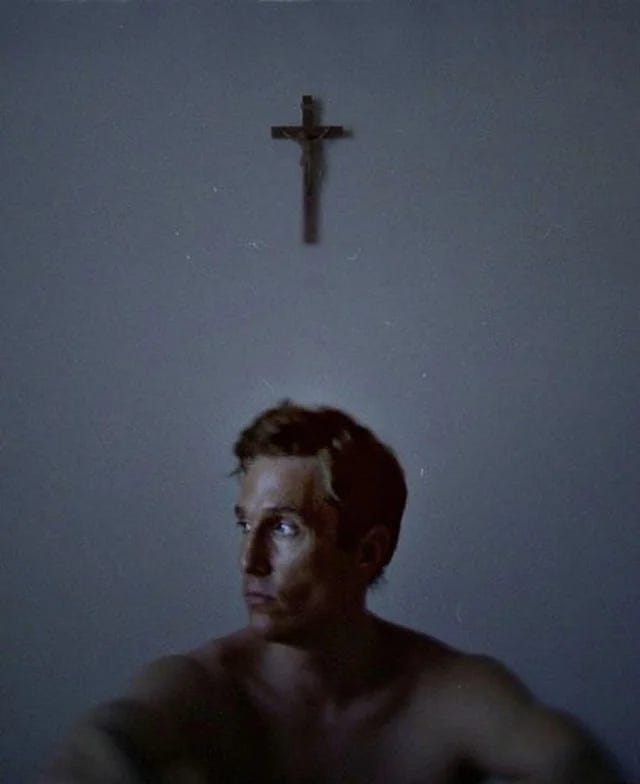
This is, of course, an odd thing to say for a guy who fervently argues that there is no God, and Marty is as nonplussed as the viewer. Marty picks up on the flagrant contradiction in a following episode - as Rust pours scorn on the people at an Evangelical gathering, Marty remarks that Rust sounds like he’s panicking, and trying to convince himself rather than anyone else.
The contradiction is further stressed when Rust is shown to be incredibly proficient at getting confessions out of suspects: he himself explains his interview style in terms of religious confession, and his entire vocabulary and body language during these interviews screams priest, as he comforts and reassures even the vilest offenders, and holds out the promise of absolution in return for confession. Even his habit of proselytising his pessimistic beliefs ties in with this: in a twist of irony, the man who rails against religion is an evangelist of his own gloomy philosophy.
Rust is also implied to have a supernatural sensitivity, hinted at by several visions connected to the case. The show does offer a mundane explanation for these - Rust has drug-related nervous issues, causing hallucinations - yet several of his hallucinations coincide a little too neatly with developments in the story, in a way that allows for the possibility of a genuine psychic faculty,2 which affirms his symbolic priestly role.
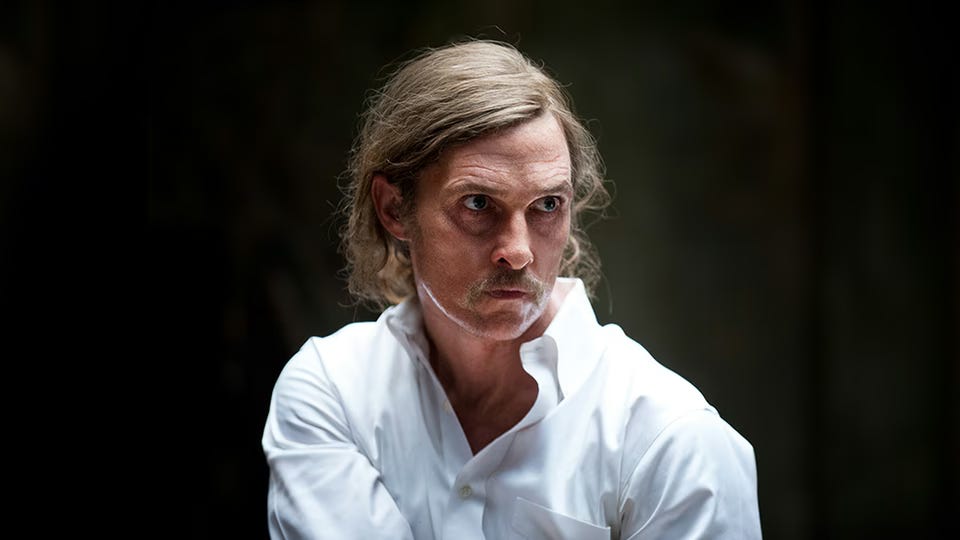
This is further reinforced in his confrontation with Childress: the killer addresses Rust as ‘little priest,’ and sees him as suitable for a special sacrifice that will allow Childress to ‘ascend,’ becoming something other than human. Dressed in a spotless white shirt, Rust is likened to a sacrificial lamb, and in yet another twist of irony, his long hair gives him a distinctly Christ-like appearance. He follows Childress alone into a nightmarish overgrown ruin, and confronts him before a sacrificial altar. As foreshadowed, Rust willingly goes to his own crucifixion.
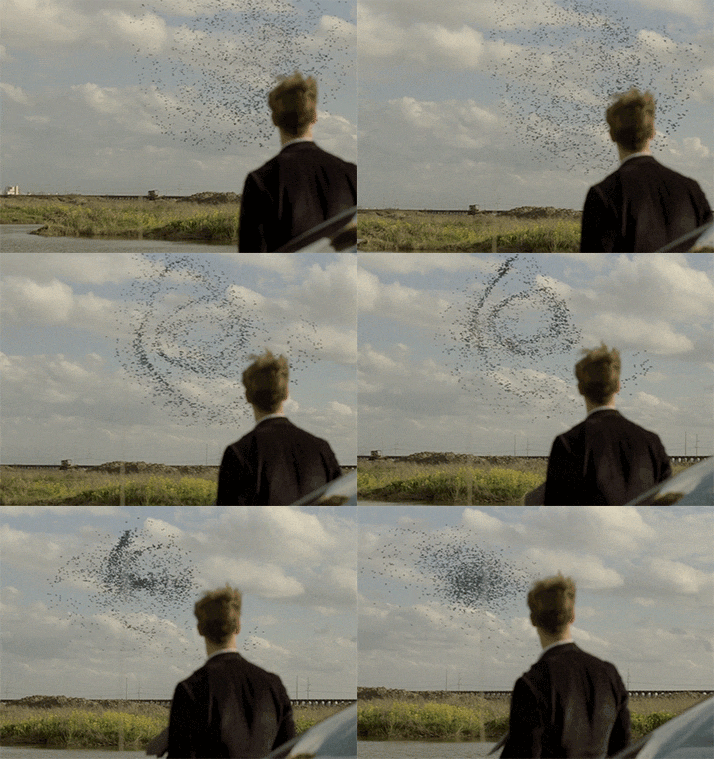
In this climactic sequence, we are also given two new possible interpretations of the cult’s spiral sign - the spiral may represent the maze-like stone ruin with the cult’s altar at its heart, or it may represent what Rust sees there. Before being ambushed by Childress, Rust has a vision of a dark vortex above him, and fans theorise that this, rather than the ruin itself, is what the cultists are referring to when they speak of ‘Carcosa,’3 which seems to be the cosmic realm where the Yellow King resides. Could the vortex be the entrance to Carcosa?
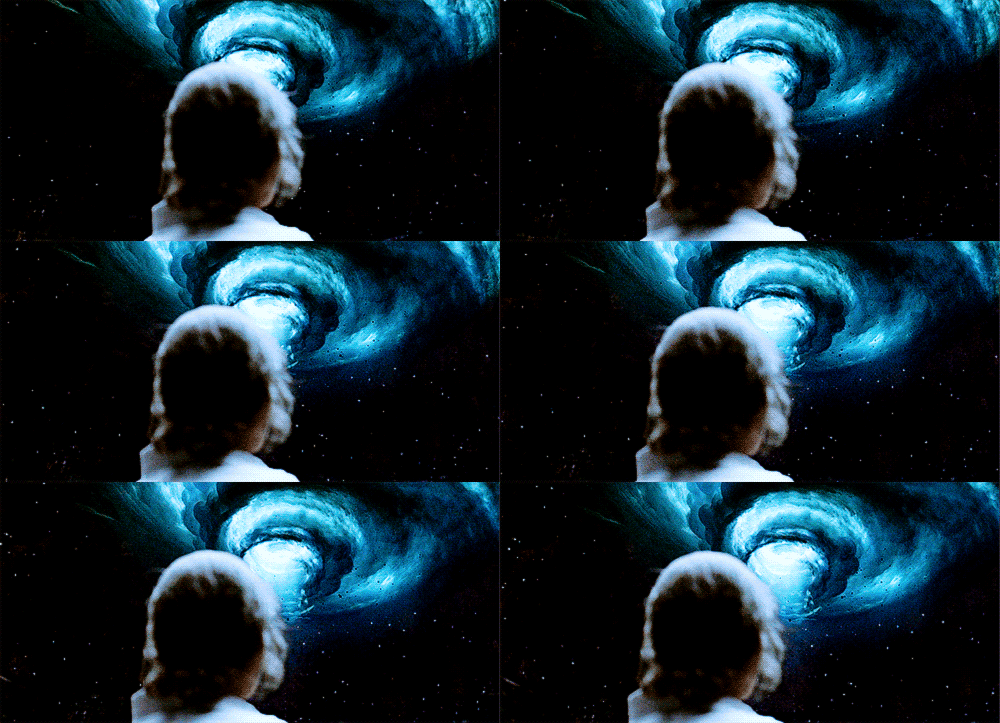
In the confrontation with Childress, Rust is stabbed in the abdomen4 and undergoes a symbolic death and resurrection. Afterwards, he confides in Marty about his near death experience, saying that he felt the presence of his lost loved ones. Rust is deeply affected by this brush with death, and for the first and last time in the show, he breaks down in tears.
It’s also worth noting that Childress’ last words to Rust, ‘Take off your mask,’ are lifted directly from The King in Yellow, and also feature in a memorable subplot of Skald.
Whereas True Detective closes its circular narrative with two car conversations, Skald’s beginning anticipates its end with a journey through a maze. This alone might give us pause, since Rust also passes through a maze on the way to his symbolic crucifixion.
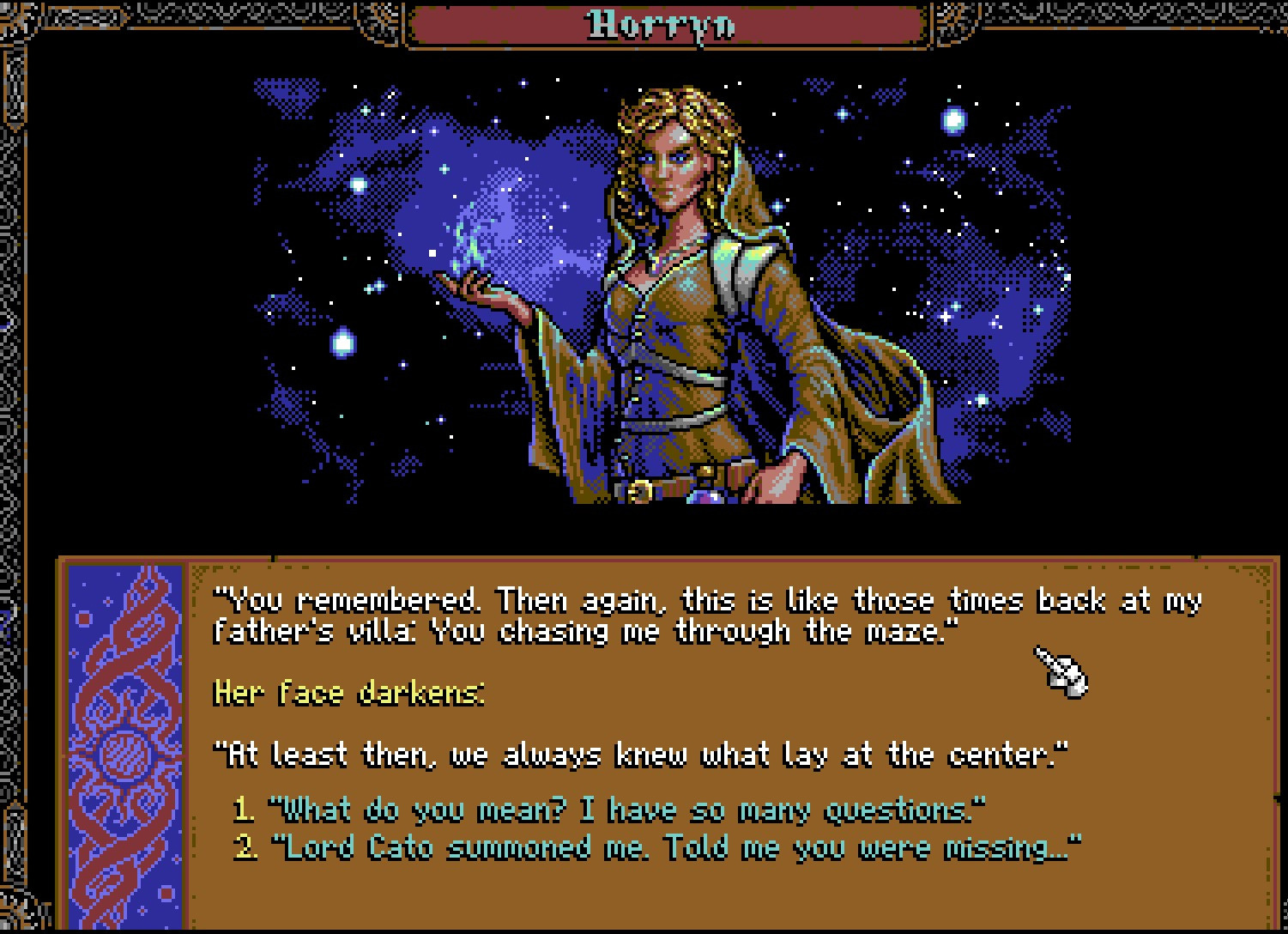
The first maze encounter takes place at the beginning of the game, in a childhood flashback where the protagonist chases Embla through a dark maze on her father’s estate. At the heart of the maze, Embla is found wading in a pool, and as she trails her fingers across the surface of the water, kaleidoscopic colours swirl from her hands.5 This signposts her uncanny supernatural aptitude, which is crucial in the second maze journey, at the end of the game.
This second maze encounter takes place beneath the ominous Black Priory. It is rumoured that the Priory is the resting place of Emperor Gallian, a powerful Magos who founded the Empire thousands of years ago, but in actual fact, the Priory is implied to be not thousands, but hundreds of thousands of years old, and built by inhuman hands.
After traversing a maze in pitch darkness, the protagonist (now with Embla in tow) discovers what can only be described as a dormant spacecraft in the biomechanical idiom of H.R. Giger.6
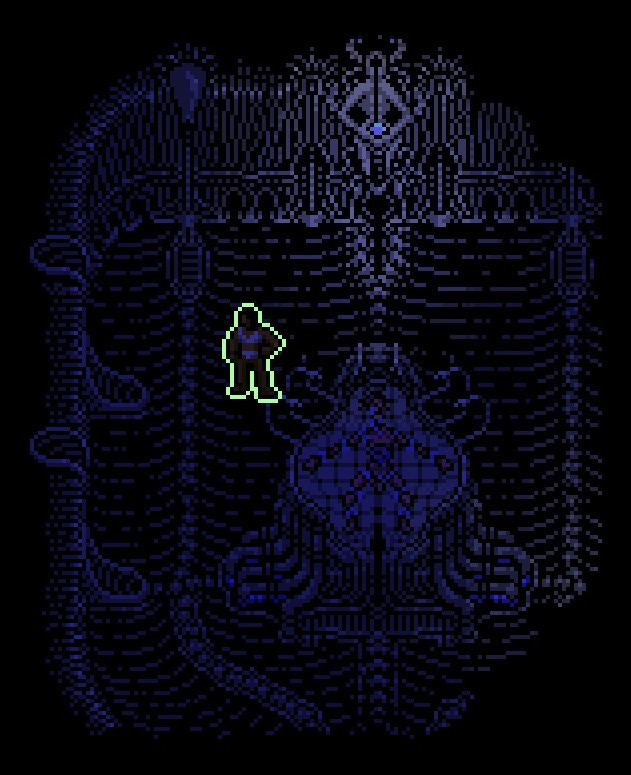
The protagonist falls unconscious after crossing the threshold, and awakens naked and alone. The dark hallways of the ship form yet another maze, and, one by one, the protagonist discovers the chilling fate of each of their companions, so that by the time they arrive at the middle, they are well and truly alone (and the player is mildly traumatised).
Clues within the spacecraft help us to glean some understanding: we learn that a god-like being lies dormant within, and has been dreaming for eons,7 but now must wake up, or fall prey to his ancient rival, a monstrosity known as the Dragon, whose antagonistic presence is felt throughout the game. It is implied that this would also doom humanity.
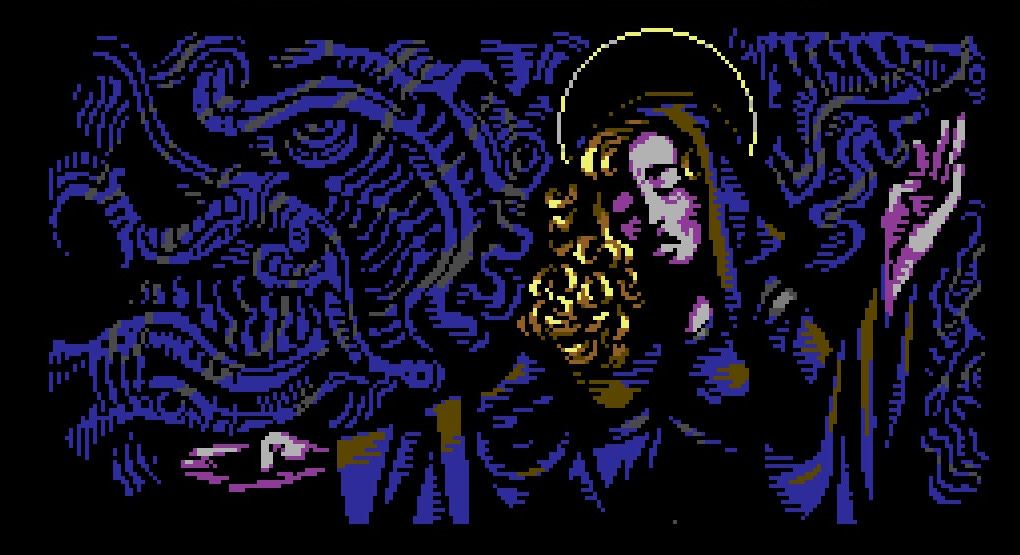
Once again, Embla is found at the heart of the maze, and here, the final piece falls into place. Embla, of unknown paternity, and known as ‘Star-child,’ is revealed as the daughter of the dreaming titan in the centre of the ship.8 Her destiny is to merge with him, and be consumed, allowing the god to awaken, but giving up her own life in the process. In keeping with the fatalistic nature of the story, the protagonist has no choice but to assist her in this.
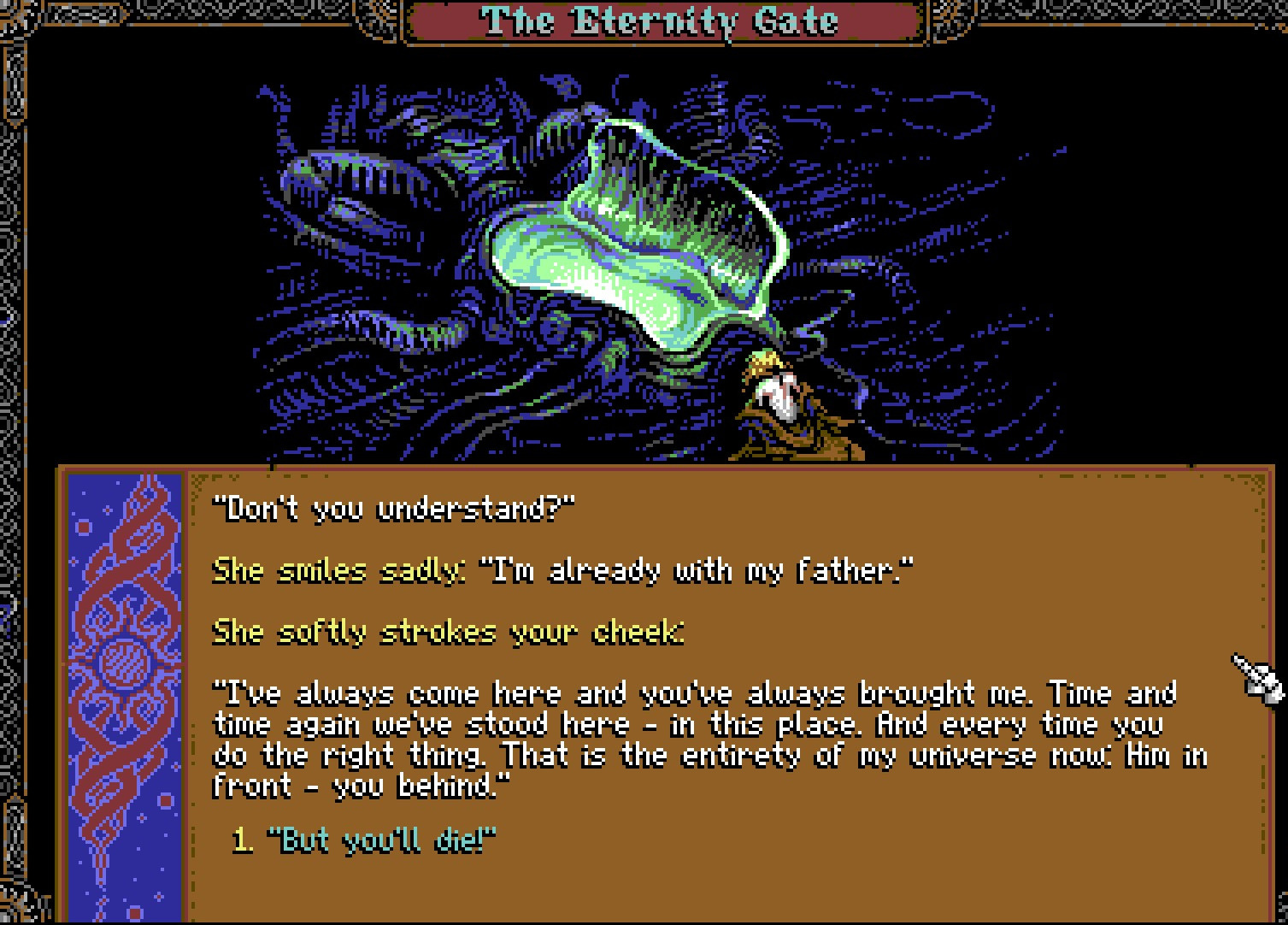
As in the flashback, Embla descends into a watery pool - this time a mechanical pod where her body is absorbed. Symbolically, there is a connotation of return to the womb (and the term ‘anti-womb’ is indeed used), but perhaps also of baptism and rebirth - Embla speculates that some part of her consciousness may live on within her awakened father.
More obvious are the parallels with Christ, the sacrificial Lamb of God. Embla is the mortal child of a god, sent to live among humans, and must willingly give her life for the sake of mankind. She obviously shares this symbolism with Rust, and, like Rust, she is also depicted as spiritually sensitive through her supernatural faculty.
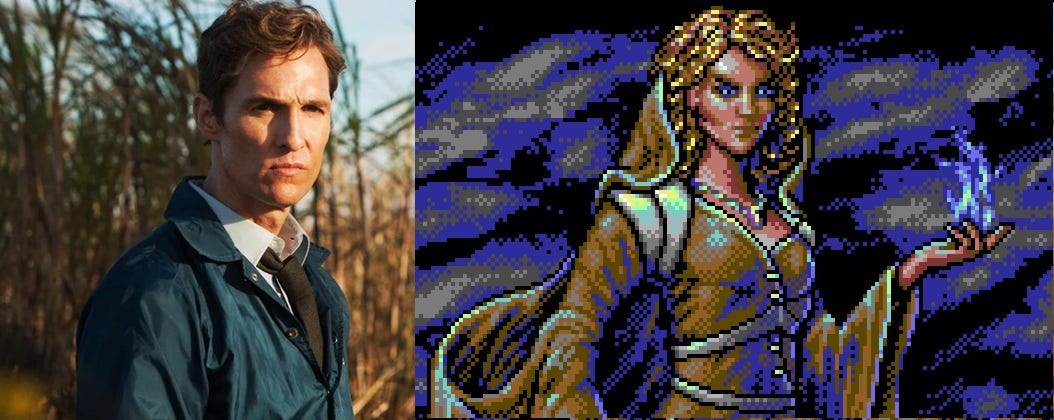
Although the two endings share many key elements, there are also profound and fundamental differences. True Detective’s ending is bittersweet - Rust broods on the fact that many of the cultists are still at large, and although Marty’s estranged family visits him in hospital, he weeps with regret over their separation.
However, the overall feeling is optimistic. Rust’s near death experience has shaken the foundations of his pessimism, and made way for the possibility of a moral and spiritual rebirth. For the first time in decades, he is able to look up at the stars and appreciate their beauty. The stars are the topic of Rust and Marty’s final words of the series:
Marty: It seems to me that the dark is holding a lot more territory.
Rust: Once, there was nothing but dark. If you ask me, the light’s winning.
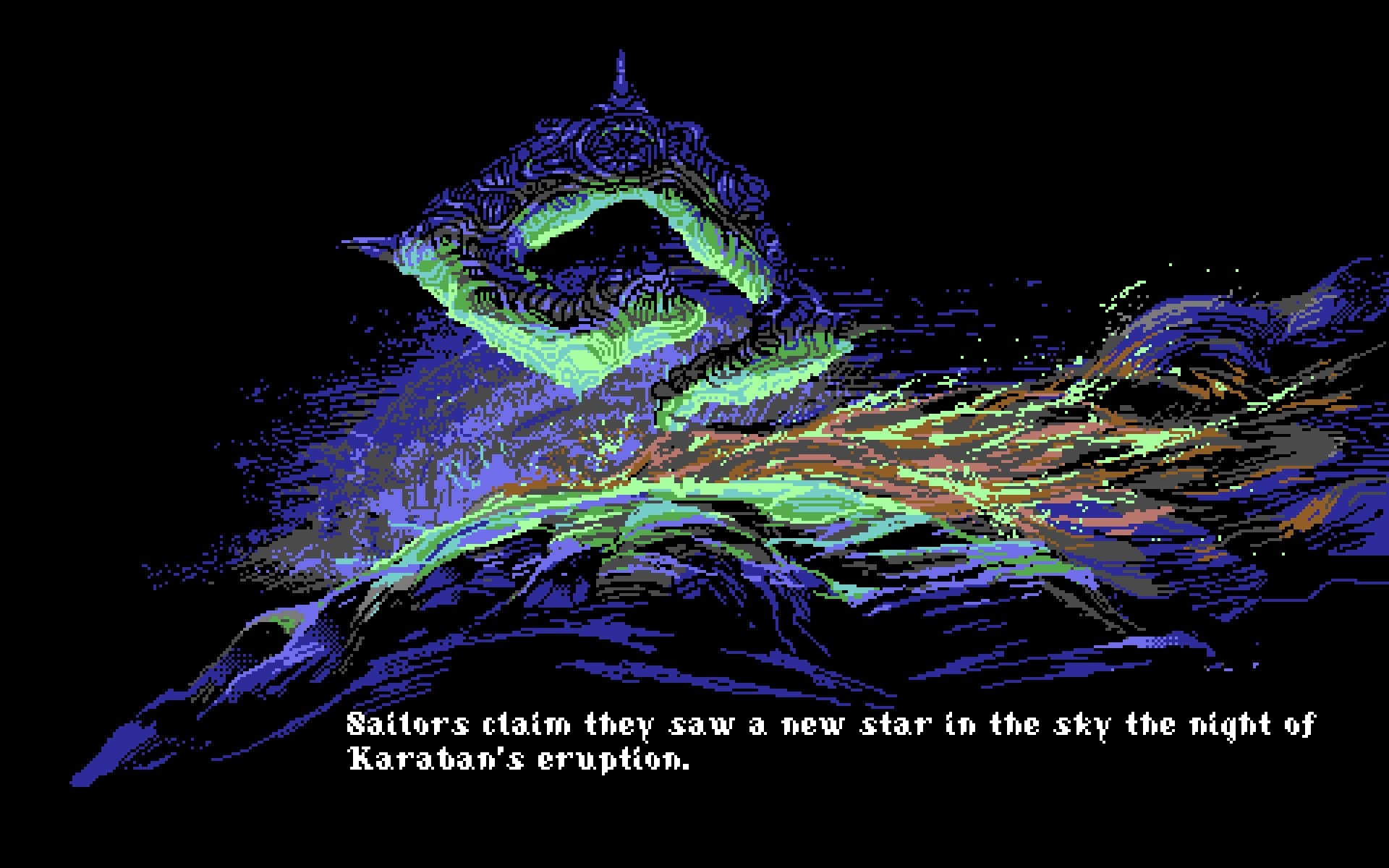
Skald’s ending, by contrast, is like a kick in the stomach. The player’s companions are cruelly and casually picked off, left either dead or worse. The protagonist’s fate is uncertain at best, and, with the awakening of the god and the launch of his spacecraft, the Outer Isles and all their inhabitants are destroyed in what the Empire writes off as a natural disaster. In a twisted echo of True Detective, the ending notes that ‘a new star is born’ (this being the spaceship).
Eerily, the spaceship in flight is shown to exactly resemble the reaver cult’s spiral symbol, which, together with other hints, raises an uncomfortable question: was the cult serving the Dragon, or were they serving Embla’s father all along?
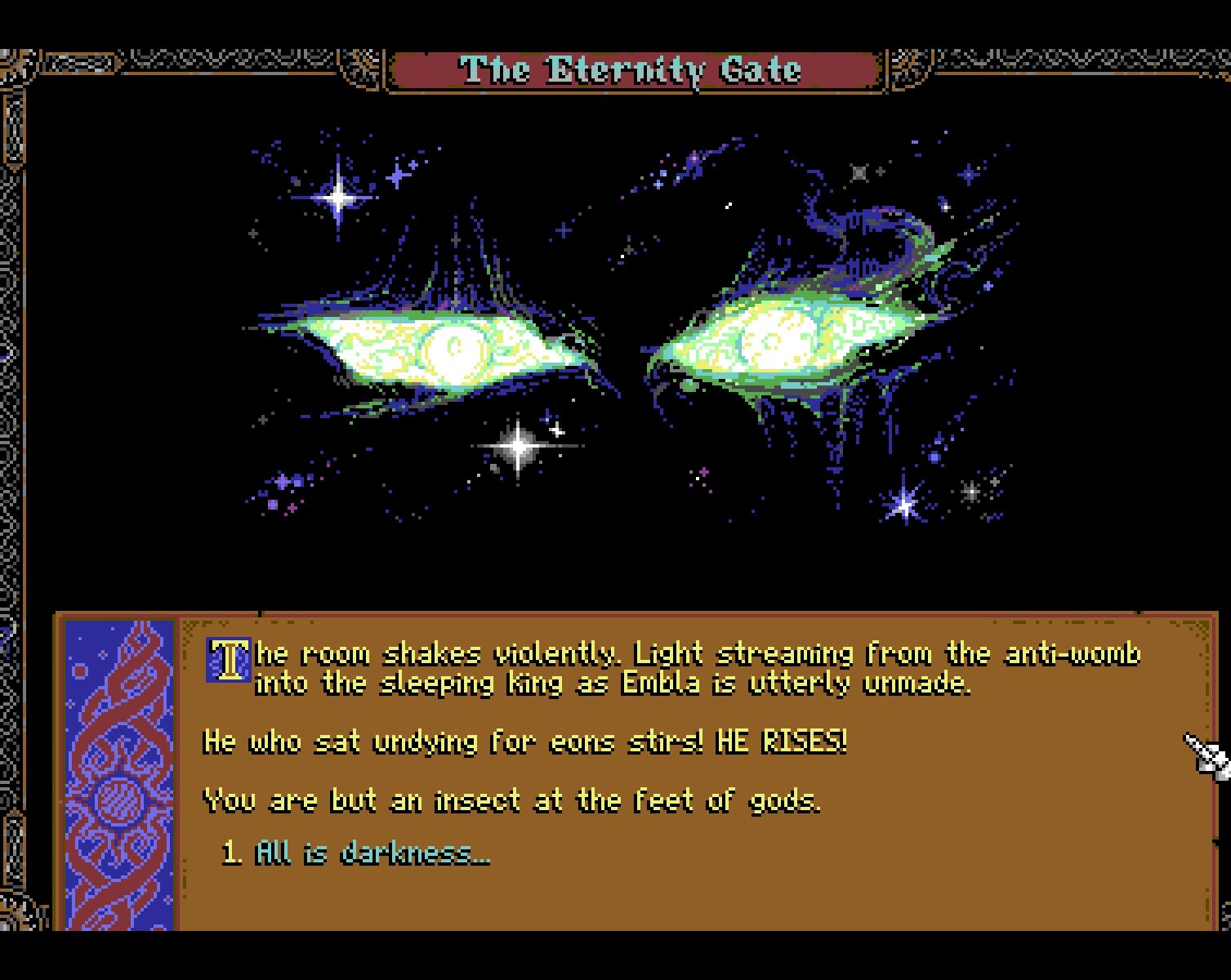
From the murky circumstances of Embla’s conception (see Part 1), to her father’s likely role in manipulating the cult, to the cruelty inflicted on the player’s companions, not to mention the fate of Embla herself, the message is clear: the god’s awakening is, at best, a lesser evil, but the powerless player, ‘an insect at the feet of gods,’ has no choice but to accept it.
Having said that, it should be noted that, whereas TD’s ending is definitively the conclusion of Rust and Marty’s story, Skald was intended as the first part of a series. The creator has spoken about his wish to continue the story, though it’s not clear whether work is currently underway. Still, there are unanswered questions: is the Dragon defeated, or is this only the beginning of a new conflict on a cosmic scale? Does Embla’s ghost live on within her father? And did any of her companions survive?
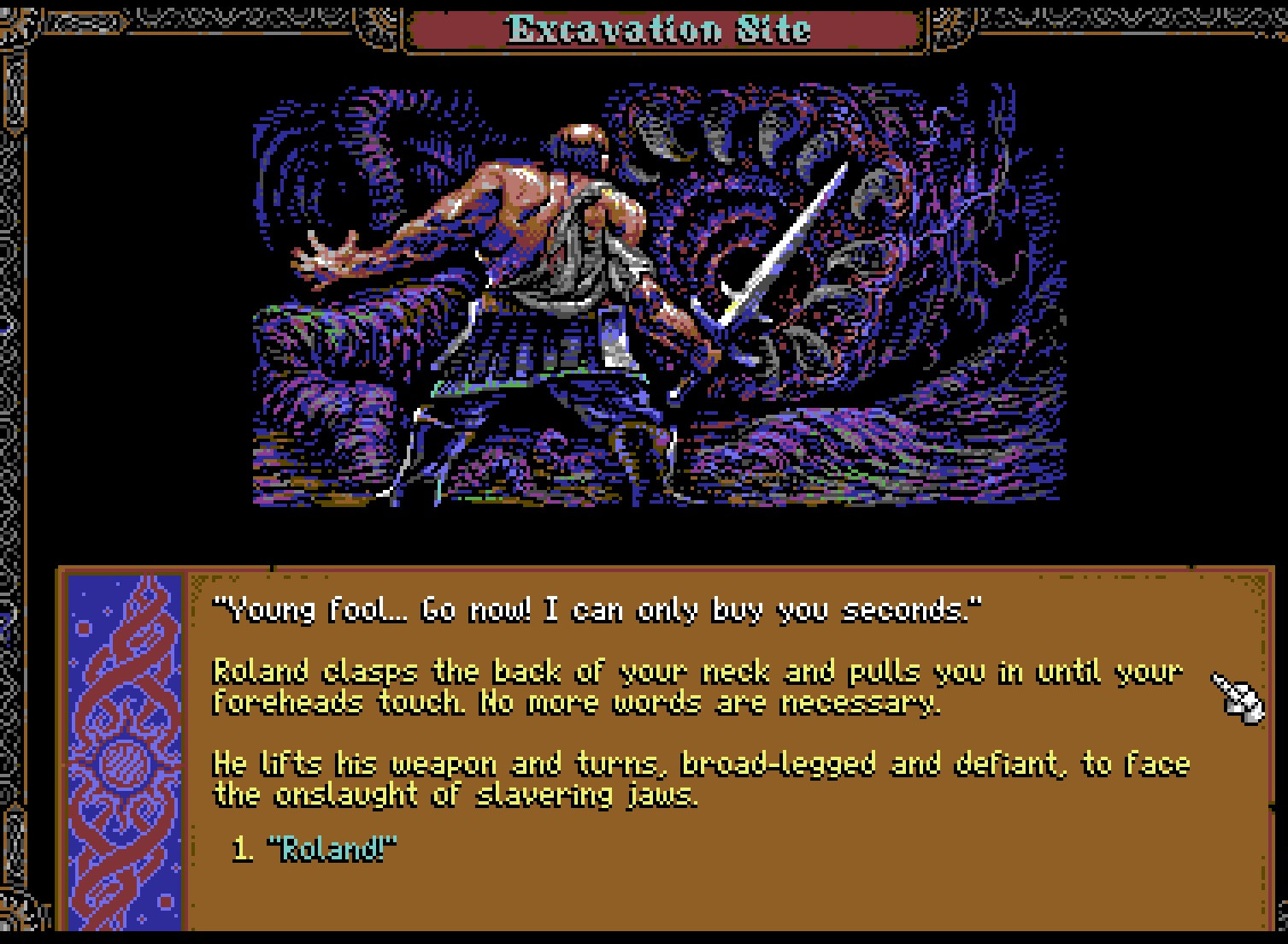
The spirit of Skald as a whole is perhaps best illustrated by the fate of Roland,9 the first of the player’s companions to fall. A grim and bitter mercenary, racked with guilt and self-loathing, Roland is the last person you would expect heroic action from.
And yet, after suffering an infected wound on the threshold of the spacecraft, he accepts his fate, and chooses to sacrifice himself for his companions’ sake. Of all the companion characters, Roland goes to his death with the most courage and dignity, and in this, we see a familiar theme of ‘grimdark’ fantasy - even in the most hopeless circumstances, noble deeds are possible, and perhaps meaningful.
As such, for all its contrast with True Detective, Skald might not be as utterly bleak as it appears.
Thank you to those who have read both parts. Posts like these are always phenomenally unlikely to drive traffic, but a game like Skald deserves care and attention, and who would write something like this if not me?
If you enjoyed these posts, you might also like my posts on HighFleet, which I looked at in terms of Dune and Lawrence of Arabia.
Whose surname name contains a bitter irony.
There’s a very good old tumblr post by Nissa Campbell which touches on this, arguing that Rust is not the only character in TD with this sensitivity.
As the post points out, Reggie Ledoux, Dewall and Childress all identify supernatural qualities in Rust - Dewall sees Rust as having ‘a demon’ and ‘a shadow on [him]’; Reggie seems to confide in Rust, addressing him specifically with his ecstatic rant; and Childress identifies Rust as a ‘priest’ and suitable for a special sacrifice. Miss Dolores, another affiliate of the cult, also begins to rant about Carcosa in Rust’s presence, and he alone seems to understand some of what she says (‘That should worry you, mister.’)
A name featuring in The King in Yellow, though Chambers took it from Ambrose Bierce’s An Inhabitant of Carcosa, a short story about an survivor of an extinct ancient city by the same name. Lovecraft and others would later use the name in their own stories.
(perhaps an allusion to the wound in Christ’s side?)
Very reminiscent of Rust’s synesthesia and hallucinations.
Rather like Cthulhu, who is ‘dead but dreaming.’
Worth noting that Embla was the name of the first woman in Norse mythology, who was created by a god from an elm tree. Skald is a Norwegian game, and its title comes from the same tradition - a skald was an Old Norse poet.
Likely named for the Song of Roland, about a Frankish hero who sacrifices himself in battle.
Comments
Nothing yet. Say the first thing.
Sign in to join the conversation.