
In the last few days, there have been reports of a leak that would suggest a profound shift in Iranian strategic policy.
Larry Johnson and Pepe Escobar have received information from a source in Iran that they consider credible, that Iran has made the decision to go nuclear if America and Israel do not cease their wars against Iran and Lebanon. The leak says this decision has been communicated to Marco Rubio.
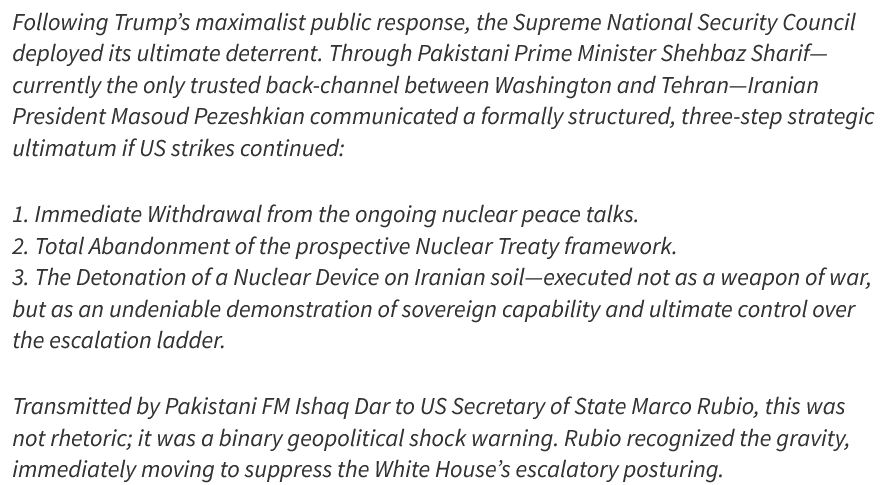
Of course, many would argue that this leak is a bluff. Maybe. Why choose Johnson and Escobar to release the leak? These two bloggers mainly serve an audience that is opposed to US actions in the Gulf. Would it not have been more useful to pass on the leak to Axios or the NY Times? Possibly. But on the other hand, perhaps Johnson and Escobar are seen as more likely to have real sources inside Iran and thus better as conduits for the leak.
In any case, I think both of these questions miss the point. Arguably the most important issue is not if what is in the leak is TRUE, but rather COULD IT BE TRUE. And clearly Iran has the fissionable material and technical knowledge to build nuclear devices. And motivation? We can all thank Trump and Bibi for providing sufficient motivation. So, yes, it could well be true.
Deterrence in international relations rarely relies on absolute certainty. Instead, it operates heavily within the realm of strategic ambiguity. State actors do not need to prove they will act; they only need to convince their adversaries that the risk of inaction is unacceptably high. A credible leak serves as an instrument of this ambiguity. By allowing information about a potential policy shift to enter the public and intelligence domains, a state can signal resolve without crossing an irreversible threshold. The adversary is forced to weigh the potential consequences of a nuclear test against the benefits of continued military pressure. This uncertainty introduces friction into the decision-making process, which is the primary goal of deterrence.
The current status of the negotiations between Iran and America is at a standstill. Neither side seems willing to concede on major issues. For Iran, it is existential. For Trump, it is existential “politically” and in terms of his legacy. This gambit by Iran, if it is in fact real, is what I would do. Trump needs to be pushed, very, very hard to make concessions, so hard that he has no choice. That is what a credible threat to cross the nuclear threshold would do.
A leak suggesting that this political decision has now been made bridges the gap between latent capability and overt action. It communicates a definitive red line. The message to Washington and Tel Aviv is clear: further military escalation will not merely delay the nuclear program, but will make it a reality. An immediate reality.
Credibility is the essential currency of this dynamic. For the leak to act as a deterrent, it cannot be easily dismissed as mere propaganda or psychological warfare. However, relying on deterrence by rumor carries inherent risks. Miscalculation remains a constant threat in nuclear geopolitics. Could Israel or the USA ignore it? Or even respond to this with a pre-emptive nuclear attack? Only if they had near certainty that it would remove the threat, which seems unlikely.
Therefore, despite these dangers, from the perspective of the state deploying the leak, it would remain a low-cost, high-reward maneuver.
This can also be seen as confirming what some have started to say out loud: nuclear non-proliferation is moribund if not actually dead. And the USA and Israel are the one’s responsible for killing it.
Ultimately, the debate over whether Iran is truly preparing to test a nuclear device misses the immediate strategic reality. The power of this leak lies perhaps not in its factual accuracy, but in its utility. In the high-stakes arena of nuclear statecraft, a credible possibility is often sufficient to halt an adversary’s advance. By weaponizing uncertainty, the leak may achieve what overt threats often cannot: it forces America and Israel to hesitate.
The ball is now in Trump (and Bibi’s) court.
No posts
Comments
Nothing yet. Say the first thing.
Sign in to join the conversation.