
This one is a long one, but when aren’t these? View it in the app or on the desktop if it gets cut off.
The Nine Noble Virtues are one of those “Asatru 101” things that often go unxamined. So, I figured that I’d talk a bit about them, and defend them from the attacks of universalists who don’t like them. For example, The Troth, before its collapse, actually explicitly disavowed them, and the idea of “virtue” entirely, on the grounds that “virtue” was an inherently Folkish and hierarchical concept.
This isn’t really an attempt at defending the Nine Noble Virtues as the ultimate moral precept or something, as much as it is a defense of virtue as a concept period, from attacks by both Christianity and atheism. There are other ethical schemas in Asatru: the Nine Values, for example, and the gnomic truths of the Havamal, are two other such examples.
The purpose of Asatru is to make us into better men, and so discourse on how to be better men is going to be complex and varied. But this is a good place to start that discourse!
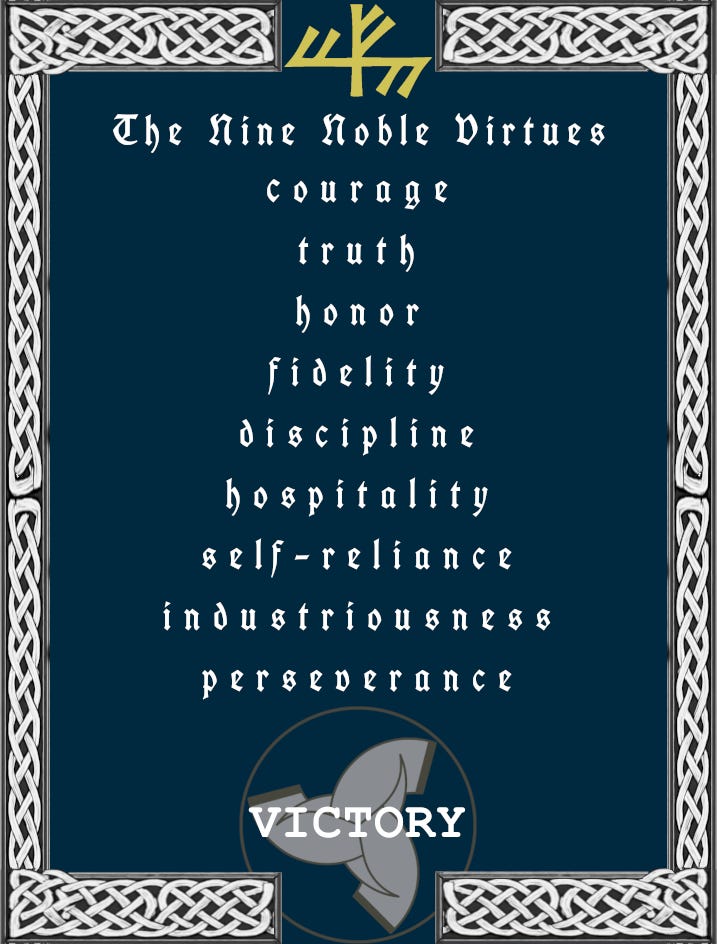
The Nine Noble Virtues were a product of the now-defunct British Odinist group, The Odinic Rite. As the story goes, John Gibbs “Hoskuld” Bailey came up with the first eight, due to his involvement in earlier British Odinist groups, and John “Stubba” Yeowell came up with the ninth. Perseverance is always the last in all of the lists that I can find, so I assume that it’s the one that Yeowell added.
As a bit of a terminological matter, the terms “Odinist” and “Odinic” were, up until WWII, used in academic literature as equivalent to what we would call “elder Asatru” today: the religion of the Germanic peoples (“forn siðr” is a later Christian term, and refers to far more than just religion). However, after WWII, in British and American usage, “Odinist” comes to be used as a byword for “Nazi spirituality”, or less pejoratively, “anything from or peripheral to Das Völkisch movement that wasn’t Christian”. It isn’t until Else Christensen starts publishing The Odinist in 1972 that the term takes on its “modern” usage. Interestingly however, “Odinic” actually maintained the earlier “elder Asatru” usage, and was not used to mean “Das Völkisch”.
The term “Ásatrú”, meanwhile, came into usage in Icelandic sometime at latest during the 1800s. It is not attested in the Eddas or Sagas, however, so it is postmedieval. The earliest usages of the term in English that I’ve found are actually in Lutheran texts stating that “Ásatrú” was the native religion of the Germanic peoples. But, it didn’t seem to replace “Odinic” and “Odinist”. It was then used by Magnus Magnusson in his book Viking Hammer of the North. Then, the Herald, Steve McNallen, saw it in that book in the 1970s, and it spread out into the Anglosphere from there.
The first eight virtues were developed during Bailey’s time in “earlier Odinist groups”. What exactly those groups are is mysterious, in part because John Gibbs Bailey himself was quite mysterious. The first usage that I can find of the phrase “Nine Noble Virtues” is actually the Spring 1981 issue of Mankind Quarterly, which cites an earlier 1974 publication by The Odinist Committee. At the time the Odinic Rite was calling itself “The London Society for the Committee for the Restoration of the Odinic Rite”, or some variation of that, and would only later declare the Odinic Rite to be restored, and start going by that.
The 1974 publication in question is usually said to be This Is Odinism: Guidelines for Survival. But I can’t find that that publication on its own. I can find versions that are included in The Religion of Odin, by Irv Slauson. However, those actually have the Nine Charges, a separate ethical theory that the Odinic Rite came up with, and lack the Nine Noble Virtues. Mankind Quarterly is either citing an older version of This Is Odinism, or a different text.
Academics are of negative help here, as is the norm: for example, Jennifer Snook’s book American Heathens: The Politics of Identity, says that the Nine Noble Virtues were “possibly codified” by Dr. Stephen Flowers “during his time with the AFA” (she means the Asatru Free Assembly; Dr. Flowers is not and has never been a member of the Asatru Folk Assembly). Except Dr. Flowers didn’t even know the AfreeA existed until 1978. Her source is the 2003 work Germanic Spirituality, by Bil Linzie. He in turn cites Our Troth.
The problem with this is 1) Linzie is citing Our Troth, not A Book of Troth, which matters as Our Troth was the later book written by Stephen Grundy, not Stephen Flowers, and 2) Grundy’s book doesn’t say that Flowers came up with the Nine Noble Virtues. Flowers’s book (A Book of Troth) doesn’t say that either: it doesn’t actually say who came up with the Nine Noble Virtues, although it does list them in the “canonical” order: academics are quite keen to point out that the order can vary... except that the order basically never changes because everyone copies them verbatim from a prior source. Now, Flowers did come up with the Six Fold Goal, so perhaps Linzie assumed that Flowers came up with the Nine Noble Virtues too. In any event, Snook just didn’t bother to look into the matter, which is comedically common in American Heathens: The Politics of Identity.
Like, at one point she says that the Hammer Rite was invented by Steve McNallen and Stephen Grundy, but the AfreeA was doing the Hammer Rite as far back as 1984, and Grundy wasn’t involved with Asatru until 1989, 2-years after the AfreeA had collapsed. She doesn’t cite a source for this, she just says it. Also, as far as I’m aware, Grundy and McNallen never actually met.
Matthias Gardell’s Gods of the Blood cites a 2010 webpage by the Odinic Rite (archive.org takes that URL back to an earliest point of 2000’s March 01st). No other academic literature discusses the Nine Noble Virtues at all.
The “Ygg-Noble Virtues”, in the canonical order, show up in 1983’s Spring issue of the Runestone, but I actually found an issue of Robin Hood’s Barn (1980’s Spring issue) that has an advert for the Asatru Free Assembly that mentions the Noble Virtues (again, in the canonical order). The Herald actually met John Yeowell while he was in Europe during his military service, which was 1972-1976, and established a friendship with him.
There was a lot more cross-pollination in Asatru back then. “Universalist heathenry” hadn’t been invented yet, and everyone involved was quite keen on this being a real thing done in real life and observed by outsiders. The internet didn’t exist, so “internet only heathenry” was impossible. For example, the Odinic Rite ended up taking up The Herald’s fun little catch phrase “ODIN LIVES!”. So, somewhere between 1972 and 1980 the Nine Noble Virtues came into being, as a way to summarize the ethical and moral values of the Eddas and Sagas, which the Odinic Rite had been studying. They then entered into the Asatru Free Assembly from there, and from that went into the Asatru Alliance and the Ring of Troth, and from that into the broader “heathen” sphere.
Purely as an aside, the phrase “courage truth honor fidelity” actually brings up quite a few things of age, going back to the 1840s. But “courage truth honor fidelity discipline” immediately brings us to the Nine Noble Virtues. I wonder if “courage truth honor fidelity” was some kind of stock phrase in Britain or something?
Allsherjargoði Flavel added Victory as the “tenth” of the Nine Noble Virtues, as a sort of goal and overarching disposition. Why this is the case will be added below.
Courage, Truth, Honor, Fidelity, Discipline, Hospitality, Industriousness, Self-Reliance, and Perseverance. As a goal, and theological promise, Allsherjargoði Matt Flavel added “Victory” as the “tenth” of the Nine Noble Virtues. This is the “canonical” order, and it’s the order that these show up in every instance that I’ve ever seen them. I can’t say that they’re never in an order other than this, but when I went looking they were always in this order.
The Nine Noble Virtues fulfill act as a heuristic to fulfill two functions: a tool to help us attain sufficient value to dwell with the Gods in the next life, and a tool to help us be valuable to our Folk in this life. “Value”, or “ worth”, is important in Asatru. We have two cute sayings, “words are wind, deeds are iron” and “we are our deeds”. Both of these are fun ways of saying “put your money where your mouth is”. “Living true”, that is, actually living your ideals in a confirmable, testable, manner, is a big deal for us.
The Nine Noble Virtues were created as a sort of summation of ethical and moral behavior, namely that of the Havamal. Memorizing a 120+ stanza poem in Norse is just not feasible to ask of people, but asking them to remember nine words is not a big ask (every time I type out the virtues in this work it is from memory). I’m sure that you, the reader, can rattle off the Seven Deadly Sins from memory, having absorbed them via osmosis.
“Virtue Ethics” is an ethical theory that holds that virtues are a series of abstractions that describe behavior. Maximizing these virtues (all of them, not just one) results in things being better. People sometimes get upset about this idea, saying things like “too much courage makes you dumb”, but that’s sort of missing the point of what a virtue is. Virtues are always contrasted with vices, which are their opposites: courage is a virtue, cowardice is a vice: by definition, it’s not actually a virtue if it’s not bringing you good things. So, being so eager to fight that you die like an idiot isn’t “courage” at all: infodumping ad nauseam every little detail about something isn’t “truth”, nor is telling people things that are true, but aren’t relevant. Virtues, when maximized as a whole, lead to a general state of betterment.
There are two general theories of religion and philosophy that answer “why do we do this”. The first, which we don’t do, is to make a Big Book of Rules, and then enforce those rules upon people. The second, and this is the one that we do in Asatru, is that we are trying to make men better. Thus, the virtues aren’t legal commandments to “never lie”, but are rather characteristics that we are trying to maximize: honorable men are better than dishonorable men, so we want men to be more honorable, and we are ourselves trying to be more honorable.
This is not just a matter of affairs concerning in-this-life, but also the next. We want to be better men so that we can be received as heroes by our Ancestors, or even better, to ascend and join the Gods in their halls. Thus, we gain value by being more virtuous, and we also gain greater fame in the eyes of the Gods. So, the Nine Noble Virtues in Asatru fulfill two functions: they are a program to make us better people in this life, and they are a program to attain value such that we are worthy of ascension in the next.
Making lists of virtues is a human universal, and a very old European practice. Coming up with pithy lists of what defines a “good man” was no doubt something that predates Linear A, as the oldest stratas of Greek literature treat this as old-hat. Virtue ethics as a philosophical discipline begins with Plato (whose virtues were “wisdom, courage, moderation, justice”), Aristotle then made some more (“courage, temperance, generosity, ambition, patience, honesty, wittiness, friendliness, justice”), and Westerners have been doing this ever since. The Romans seem to have independently come up with a list of virtues to maximize (the “MOS MAIORVM”), which are (generally, combining several writers) something like “excellence, duty to the Gods, seriousness, perseverance, self-control, diligence, trustworthiness, authority”).
But, again, this is pretty much a human universal: the Pashto have “hospitality, asylum, revenge” amongst a bunch of lesser virtues, the Confucian ethical theory has a pretty core aspect of virtue ethics, as does Daosim, virtue ethics is a pretty consistent part of Hinduism (and far too complex to discuss here), Arabs had a virtue ethic code (something like “honor, generosity, hospitality, loyalty, courage, protection of dependents”), Bushido was an independent Japanese invention of this. Many ethnicities define themselves by a single virtue (Albanians are big on “besa”, the Finns are big on “sisu”, and I’m sure someone will get upset that I defined them by the wrong virtue).
I bring this up as this idea of “how do we reduce huge amounts of ethical theory to a simple list” is a human universal, but the resulting lists are not. When given nine-words to define yourself by, what you choose is actually really dependent upon who you (or your group) are. The list itself isn’t ironclad or a commandment from on high (the Odinic Rite made the Nine Noble Virtues, and we use them because they’re good, but it’s not like Freyja gave us this list or something), and it can’t be universalized beyond the values, rights, privileges, duties, and obligations of a given group. “Hospitality” shows up often in the lists of virtues Indo-European peoples, but not necessarily in the virtue lists of other peoples because of this.
This is actually one of the big criticisms of virtue ethics amongst academic philosophers (what a disgusting phrase): that it is extremely Folkish, and cannot be universalized as no set of virtues can apply to all humans. A Christian criticism of virtue ethics, meanwhile, is that while on the surface things like “courage” or “discipline” can be universalized via vague statements like “there are no humans who benefit by being cowards”, the benefit of the virtue is granted to the performer of it by the innate qualities of the virtue: the benefit is not granted by the Christian clerical bureaucracy as a reward for benefiting the clerical bureaucrats, which doesn’t square with Christianity’s goal of uniting all of mankind as one universal body under one universal bureaucracy.
Both of these criticisms ultimately come down to the idea that virtue as a concept must be done away with as it is too intimately tied up in the identity of a people and the lived reality of morality. Other ethical theories can, however, be universalized, and through them ethics can be made into something that you merely affirm because it benefits certain groups rather than something that you actually do.
This contextuality is not just in regards to groups, but also hierarchies: virtue is more important as one moves up in the hierarchy. It is more important for a king to be courageous than it is for a peasant to be courageous. It is good for a peasant to be courageous: it is necessary for a king to be courageous. Hierarchy is built into our religion, and we can see this in the ethical tradition. This is another common criticism of virtue ethics: virtue is not universal not just horizontally, but also vertically. We do not have Halakhic style “every Jew must do X” commandments: we do have expectations from the Gods about what they want from people in various positions in society. We in Asatru care about what they want from Aryans in various positions in our church and society. We also, as people who have souls that have been uplifted by the Gods, posit that it is intrinsically important for us to be virtuous.
The word “soteriology” means something like “savehood-lore”, and is used to mean “the study of how a religion posits that one gets the good afterlife”. “Salvation” comes about in Christianity because Yeshua saves us from Yahweh, who has damned us to hell because he made us subjectable to Original Sin and all that. But the term is also by academics in reference to the relations with the-next-world as posited by Buddhism, Islam, Judaism, Hinduism, Taoism, various other ethnoreligions (like Chinese Folk Religion), Ancient Greek Mystery Cults, and so on, despite these religions not having Original Sin.
“Soter” as a title is actually a Greek military term, used to refer to a general whose brilliant stratagems had lead to his army being saved from destruction, rout, loss of supply lines, and so on. It was also commonly used as a title referring to this or that Olympian (Poseidonos Soter was invoked during storms, for example). Christianity’s usage of it for Yeshua actually is taken from Epicureanism, not Hellenism proper, however, as the term came to be used to refer to Epicurus as the “general”, or leader, of the Epicureans, who had given to his “soldiers” a stratagem to prevent their destruction (that stratagem being the philosophy/ideology of Epicureanism).
The chronologically earliest European religious tradition that we have meaningful written theological statements for is actually the Eleusinian Mysteries, which was a Greek religious tradition predating Classical Greece, and the Bronze Age Collapse, going back to Mycenaean Greece (meaning that it’s from roughly 1,500BC). This was a Greek ritual tradition that involved a purification, or perhaps uplifting, of the soul to ensure a desirable afterlife.
Universalists and atheists occasionally attack the idea of people being concerned for the next life, arguing that humans used to live in proto-Communistic moment-to-moment bliss until Hitler invented Capitalism in WWII, or some other stupid nonsense like that, but that’s pretty obviously not the case if you spend five minutes looking at how ancient peoples engaged with the idea of an afterlife. “Soteriology” is quite old.
The Nine Noble Virtues is thus part of Asatru soteriology, and is essentially a summation of the ethical and moral doctrines of the Havamal: it is thus a stratagem given to us by our “general”, Allfather Óðinn, whose wisdom saves us from defeat in this life, and helps us reach our desired destination in the next. Or, rather, who wants us to display certain characteristics such that we are worthy of dwelling with him and his tribe.
A catechism. They are not a catechism. Asatru’s formal catechism is the Trúlögmál, not the Nine Noble Virtues. The various (there’s many, even within a given denomination) catechisms of Christianity are essentially a discourse on how to educate people in Christianity. The idea ultimately comes from the religious and secular instruction of Greeks in Hellenism and Greek culture (Greek and Italian city-states actually had something roughly akin to public education).
In various ancient European cultures, a youth would go through a period of education, wherein they learned how to be a proper member of society. When Christianity reached a critical mass to be a subsociety, it had to do the same, because all societies must impart how to behave unto the youth. This is literal: Christian liturgies have portions where catechumens (people who aren’t “adults” in their Christianity) are required to leave the building so as to not see the rituals proceed, as they are not read for them yet.
As we in Asatru become increasingly coherent in who we are, what we believe, and what we want to be, educating our youth to live as proper adults becomes increasingly important. That’s partially why we have the Asatru Academy, our homeschooling program, which isn’t mandatory or something like that; it does provide parents with additional instruction to give to their children about Asatru if they attend public or private school, if desired.
They are also obviously not a “viking replacement” for the Ten Commandments. The Ten Commandments were a series of laws given to the Jewish prophet Moishe by Yahweh. They are ten laws (hence “Commandments”) that the government of Israel has to enforce. The Ten Commandments, or rather “Ten laws that the Israeli government must enforce”, only apply to Jews. That goes both ways: “thou shalt not bear false witness” is not expected of gentiles, nor does it apply to how Jews must treat gentiles.
They are:
I am the lord thy god
Thou shalt have no other gods before me (often folded into the prior)
Thou shalt not make unto thee any graven image (iconoclasm)
Thou shalt not take the name of the lord thy god in vain (further elucidation confirms that this actually means “do not use the specific name ‘Yahweh’ in an oath if you’re not going to keep it”).
Remember the Sabbath day, to keep it holy
Honour thy father and thy mother (this actually means “obey” in a legal fashion)
Thou shalt not kill (“kill” actually means “murder in an illegal fashion”)
Thou shalt not commit adultery
Thou shalt not bear false witness (this means “don’t be disloyal to Israel”, but it also means to not lie in court)
Thou shalt not covet thy neighbour’s house
Thou shalt not desire thy neighbour’s house
Thou shalt not covet thy neighbour’s wife
... or his slaves, animals, or anything of thy neighbor
You shall set up these stones which I command you today, on mount Argarizem
(Each commandment was carved on its own stone tablet, which was originally to be setup on a mountain for easy viewing, but due to stuff that happens they put them in an ark and carry them around, which is an etiological myth for the arks that Torah Scrolls are stored in. In Christian statements, Laws 0, 1, and 2 are usually combined, as are 9-12, sometimes with 11 being separate, with 13 being excluded almost universally)
It’s usually said that Yeshua ends up turning this into a moral law, such as translating “the government must punish murder” to “the government must punish people getting angry”, “the government must punish cheating on one’s spouse” becomes “the government must punish people who don’t think about Yeshau enough ”, “the government must punish people who fantasize about sleeping with their neighbor’s wives” becomes “the government must punish people who engage in sexuality”, and so on.
But what is usually missed in discourse about this is that these are literal: thinking about sexing up your neighbor’s wife was, according to Yeshua, now crime, to be punished in a court of law by the Israeli state. Yeshua was not the first Rabbi to come up with this idea, and he actually quotes earlier Rabbis a few times. So, it’s not really moral, he just wants people to be punished for their internality, not just their externality.
In both the Jewish and Christian formulations, these are laws: if you do not follow them, then you are punished. They aren’t really ethical or moral statements, because Yahweh is merely instructing the government of Israel on whom he wants to see tortured: he’s not actually saying that adultery or lying in court are bad, just that he wants to see Jews who perform these actions be punished. He is listened to because the Jews are doing so by fulfilling their end of the covenant, not because he’s actually telling them what is good. Most of the 613 Mitzvot are totally meaningless and victimless, like not eating shellfish, not wearing mixed fabrics, or eating certain things while mourning.
What makes Yeshua’s reformulation unique is that he extends “Israel” outwards to all of mankind, which means Christians, and all of the world, are the stray sheep of Israel, meaning that this all applies to Pagans. Christians are thus justified in punishing Pagans for not following Christian laws. Again, these are literal: the claim is that violence against Pagans by Christians who work for the government is justified as Pagans do not attempt to control their anger, or their sexuality, and so on. I’m harping on this, but I have to repeat: this is extremely literal, akin to how “do not go over 55MPH or you get a ticket” is extremely literal. The Gospels say, to use modern terms, that Yeshua wanted the police to punish people for not thinking about him enough, or for losing their temper during haggling-sessions in the marketplace.
Virtue doesn’t work like that. Virtue isn’t an arbitrary law to be enforced, but rather a characteristic of an individual that results in a better man and world as it is greater. We are trying to be the best Aryans that we can be.
So what we’re going to do is this: I’m going to list each virtue, give my brief commentary on it, give a Havmal citation, and then a goði or gyðja is going to give us some words of wisdom on that given virtue. The Havamal citations won’t be exhaustive or lengthy.
This is facing your fears. The suitability is obvious. Tacitus’s famous list of undesirables begins with “cowards”. Etymologically, this word means something like “heart-hood”, off of the common European association of the heart with physical power and bravery.
Havamal 15, 16, 28, 48, 76.
Courage is exactly what it sounds like. It’s bravery not in an absence of fear, but in spite of fear. It’s taking right action into your hands and using it even when it’s a tougher choice to make, even when there are going to be negative consequenes to yourself for making that choice. One of my favorite definitions of courage comes from Freidrich Nietzsche. He says it’s “a willingness to defy misfortune”. That’s always really stuck with me and I think people should look at it like that because it kind of implies that anyone can have courage, y’know. I mean, if somebody is physically disabled, like they’re a paraplegic or whatever, like yeah, we don’t believe in the whole equality thing: you’re not going to be the same as an able-bodied man, but a courageous disabled man is a thousand times higher in the eyes of the ancestors and the eyes here than a lazy, useless, able-bodied man.
Courage as it relates to Asatru though is being willing to be openly Asatru: to wear your hammer outside your shirt; to tell your employer when you’re going to an AFA event, y’know, don’t tell them just, “oh, I’m going camping”, you tell them, “I’m going to a church event”. When somebody asks you if you’re religious, you say, “yes, I am, I’m Asatru”.
-Spekingr Trent East
This means living in accordance with reality, not just not lying. Etymologically it actually comes from a word that’s equivalent to “Fidelity”, but today in Modern English it’s always focused on epistemology. The word comes to use from Old English “trēowþ”, meaning “loyal”. The semantic shift from “loyal” to “factually correct” was something like “loyal > willing to fight for > willing to stake clout on it being factually correct > factually correct”.
Havamal 28, 42, 43, 44.
The virtue of truth is consistently speaking and acting in accordance with reality. Valuing honesty and integrity and avoiding deception and falsehoods. Truth is what it is and is not changeable. Truth is a core value that is the most basic element of conforming to reality. In today’s world, there is a high value on not offending anyone. If you don’t have an honest assessment where you are and how reality is, you can’t change your circumstances or change yourself unless you have an accurate gauge of where you currently are and where you want to go. If you think about it in a modern concept, we should consider how we present truth. When our friends and family ask us what we believe, do we answer with conviction that we worship the Æsir? Or is it easier to tolerate the degeneracy of the world than stand firmly in opposition? Truth is standing firmly and unapologetically on the side of facts and faith.
-Gyðja Sara Ault
This actually means to recognize value and act accordingly. Recognition of value is a big deal in Asatru, so the suitability is obvious. Etymologically, this comes to us from Latin referring to proper recognition of status and office; it displaced the Middle English “menske”, which comes from Old Norse “mennska”, which means something like “manship”, specifically the value of one as a man (not gendered). “Honor” as “self-harming following of rules” didn’t exist as something beneficial in the Germanic world.
Havamal 1, 42, 76, 77, 127.
Honor is an interesting thing. Honor has almost an entirely different meaning and aspect in the historical record as it does in the modern day. And, unsurprisingly, the modern definition of honor is much askew. So, honor, you see it in the historical record, and it is this very precious thing to be defended, so much so that to have your honor besmirched is likely, y’know, a death sentence for somebody.
Part of that actually does tie to hospitality because your individual honor is sort of your path into other places, right? Like, y’know, I’m not going to take you into my home and treat you hospitably if you are without honor, and your honor may be besmirched because you stole from your last host. So, you know, there is one of the practical sides of honor.
But honor in the modern day has been taken to mean very much your opinion of your worth. And that is false. That is something that is a de-evolution of the meaning of honor because so many of our valuable virtues and culture has been washed away. Honor is almost the opposite of that. It is much rather than your own personal view of your value: it is a societal estimation of your value. It has to do with fame, it has to do with reputation. So, if you, for instance, if you’re known for going from place to place and begging and then stealing from your host, you would lose much honor very quickly.
If you are otherwise, let’s say you’re someone who goes out, and you’re known for helping people and being strong and maybe you’re a great warrior, maybe you’re a great artist, what have you... But you are showing excellence in fields that men find respectable. Then, you build honor, you build fame. And that’s the way that it was seen in the historic record. And so, that’s the aspect of personal honor. So, personal honor exists, but personal honor exists as your fame and reputation among others.
What is most important is your honor among your peers, your superiors, your inferiors. So, you know, your fellows within the tribal unit. And there might be tribal units outside of your own that are honorable, that are considered honorable by your tribe. And so, your honor among them matters as well. But, you know, you couldn’t be expected to curry honor among, you know, vargar, or someone who is dishonorable or a group that is dishonorable. And, you know, it is worth noting because many people will notice in the modern day that they are vilified by a society that is generally dishonorable. And so, you know, it does bear mention that it is an honor placed upon you among your own people and your own tribe. It’s great to get honor from other tribes, from other people, from other groups, you know, from non-folk, from different tribes within the folk.
-Goði Jon Rock
This is loyalty of spirit, not just professing to being on the right team. The word comes to us from Latin “FIDES”, which means something like “loyalty; faithfulness”. “Faith” also comes to Modern English from that same Latin root. We use it in the older usage, from back when “faith” meant “loyalty”, not “to believe despite it not being true; to profess without evidence for, despite evidence against” as it is commonly used to mean today.
Havamal 34, 41, 42, 44.
Fidelity or loyalty are both really important, and it’s like [how] the Allsherjargoði, as he always says to kind of start off: “Asatru means not belief in the Aesir, but it means ‘true to the Aesir’”. [It means] loyal to the Aesir, having fidelity to the Aesir. And then from there, kind of like the Gifting Cycle, it starts with the Aesir, but then it goes down. We have to be true to our ancestors, we have to have fidelity to our ancestors, we have to be true to our Folk, the Folk within, that stand with us, with the Aesir, and have fidelity to the same Folk.
Fidelity is also what upholds frith in a lot of contexts. Frith can exist between people that don’t like each other or even care for each other, of course, in certain situations, but largely it’s a matter of fidelity. Sometimes there’s someone in your life, and they’ve got to do stuff that can be annoying, or obnoxious. They might have good reason to do that, they’ve just got to get it done, and that involves doing something that bothers you. They can get on your nerves so bad, or you can get on their nerves so bad, that when you see’em you’re like, “ugh, this person”, y’know, for just a minute. But you have to keep that frith and not be a jerk because that’s fidelity, they’re still your friend, your mom, your dad, your kid, your boss, your coworker or employee, your Allsherjargoði, your kinsman, your fellow churchmember, your whatever. And you’re still loyal to them, even if they’re nagging about something and its wearing on your nerves, y’know?
Fidelity, loyalty, to your spouse, to your church, loyalty to non-Asatru friends, loyalty to family, loyalty to your community, loyalty to your job, loyalty to your kids, whatever. It’s... it sounds almost like, grandiose and fantastical a little bit in a modern context because we’re all so cynical nowadays, but fidelity and loyalty really, really, truly is a tie that bind. It’s not blood, even if it should be, it’s not faith, even if it should be, it’s personal and communal fidelity.
-Spekingr Trent East
This is self-control. It’s not about doing something that is scary (that’s courage), or about continuing to do something that’s tedious (that’s perseverance), it’s about remaining firm and not getting distracted, or pulled into vice. Etymologically, this word comes from Latin “DISCIPLINA”, meaning “instruction, teaching”.
Havamal 20, 60.
The virtue of discipline can manifest in various ways, such as controlling one’s tongue, actions, and emotions, and focusing on goals and value. The word discipline comes from the Latin word “disciplina”, meaning instruction and training. It is derived from the root word “discere”, to learn. Discipline is to study, learn, train, and apply a system of standards. Discipline is not something others do to you. It is something you do for yourself. It is important to understand that discipline is a choice, that you are in control.
For example, say you want to wake up at 4:00AM every day to start your day because you must have the rest of the family out the door by 7:00AM. So you get up at 4:00AM, you work out for an hour, shower, return emails, and even get in some reading. Then at 6:00AM, you wake up the family, make breakfast, and get everyone off to school. And work by 7:00AM. Your first accomplishment of the day is done, and you have set yourself up for a more productive day. Now consider if you didn’t choose discipline, you decided to sleep in, you are late getting everyone up, your children miss the bus, you have to rush them to school. In general, everyone in the family feels grumpy at this point. Now as you are heading into work, you are trying to figure out when you can sit in a workout and finish the chapter you need done for homework. You feel defeated. You are no longer in control of yourself or the day. So being stressed, you grab three donuts, because why not? The day is wasted at this point anyway. What this shows is when we maintain discipline by our choice, we control our work. And when we make a choice not to, we are controlled by it. Choosing discipline puts us in control of our life and help us achieve higher standards.
-Gyðja Sara ault
This is guest-host relations as a whole, as in Xenia. It’s being both a good host, and a good guest. It’s about acting properly when not alone. This is a very complex Indo-European concept, marked by the fact that it’s actually just one role: that of the guest-host. Guest and host are not separate, and the words at play here all really mean “stranger”, and do not separate the guest or the host as roles. For example, the Latin “HOSPES” means both the guest and the host.
This has too many appearances in the Havamal to list them all. I will write something about hospitality in detail later.
Hospitality is pretty easily defined. Everyone understands the definition of it: treating someone well, particularly when they are a guest, either a guest in your home or if they are under your protection or provenance for some reason. This is particularly important historically. That’s one of the reasons we see it so emphasized in the historic record among our ancestors, because often times exposure to the wilderness meant death. So if you were traveling, the only way to facilitate travel across distances was to engage in a sort of cultural understanding of hospitality. I would know that if I were traveling to a faraway town to trade trinkets of some sort, that then I could see your house, and I could stay there without, y’know, being murdered in my sleep. There were theological implications to help reiterate this.
But the practical usage was so that commerce [and such] could take place, and so that people could travel safely. But then [there’s also] the guest right. This was a cultural understanding where, y’know, I get a place to sleep tonight and, and some food, right? And then, so my part of the equation is there is a necessity for hospitality on the part of the guest: as a guest I am not going to steal, I am not going to attempt to undermine or betray you because I realize that I am existing on your good will. So, in the historical record, people kind of understood that as being under someone’s protection. If you were a wealthy landowner, and I’m traveling through your lands, and I have your permission [to do so]. It would be a breach of societal contract for someone to come murder me on your land. This was such an integral part of our ancestor’s world. And, I mean... It’s in the Havamal. You can find it in, in the lore all over the place.
-Goði Jon Rock
This is not being a drag on the group, but also not being a loner. “Reliance” comes from “rely”, ultimately from Latin “RELIGARE”, which means something like “to fasten tightly”. Thus, to rely on (to be fastened to) the self is not about not being connected to others, but rather to be a coherent and fastened individual, not pulling others into oneself (usually out of lack).
Havamal 21, 22, 26, 29.
Self-reliance comes from the ability to support, defend, and care for yourself. The more self-reliant you are, the less you need anyone else. And as a result, the stronger and more powerful you likely are. One of the reasons why self-reliance is important is because the person who is not self-reliant is inevitably a burden. Now, you can be a heavy burden, and you can be a light burden, and we’re all some sort of burden at some point. There’s no sense in behaving in a manner as though any lack of self-reliance at any moment is, to be, I don’t know, despised. However, it is generally good to be a self-reliant person.
I don’t feel like I need to do much more to define self-reliance. I think people understand it. But there are aspects of self-reliance that apply particularly in the modern day. This is an easier one to understand in the modern parlance because it is still similar to what self-reliance meant in historic times. Now, I will say more emphasis was probably put on self-reliance in the historical record because if there is a small group in like, a village, or as a raiding party, or what have you, then the weak link does drag everyone else down, whether that’s in a battle, or whether that’s that you’re lazy and so you didn’t farm and now you need food to keep your family alive through the winter, or what have you. Whether you’re fearful and you panic easily and so, therefore, you spread fearful rumors and then you start to bring down the moral of the tribe, or whatever.
Things were often more of a bleak life or death scenario when we dealt with self-reliance in the historical record. In the modern record, we live in a land of so much ease and plenty versus our ancestors that a lot of times people don’t really get an account for the importance of self-reliance. However, it is vitally important still in the modern day, even though there are safety nets to catch you. And I’m not saying that people should not use those safety nets. I mean, if you’re eligible for WIC or for help with your children or something, go out and get it. I mean, your ancestors have paid taxes for it, go get it. You deserve it. They’re giving it away to others anyhow. But, you know, just because you’re using that does not mean that you should not strive for and cannot be self-reliance. Our people are on a precipice of whether or not we are going to survive, not only genetically but culturally, and we need strong people to do that. Many of the strong and self-reliant people of our whole, they are content to sit on the sidelines.
And so we particularly need those who are champions of our people to be self-reliant first so that they then can help our people along. And so our people need to be physically self-reliant. They need to be healthy. They need to be strong. They need to be financially self-reliant. That way they can weather unforeseen expenses that will come their way. Really to an extent, they need to be spiritually and culturally self-reliant. Now, I don’t mean they should not seek out the wisdom of the church. But a lot of our people are in, I don’t know, it wouldn’t be right to call it diaspora, but a lot of our people are spread out and we have not collected ourselves together. We live all over the country and the world. And so our people need to develop a self-reliance within themselves that they don’t need to simply glom on to whatever culture or people are around them. And they need to be able to stand alone and say “I’m going to raise my family” or “I’m going to exist in the culture that is correct, even though I’m 700 miles away from the next person who knows and understands the things that I know and understand”. And we have a lot of people that are spiritually and socially weak, and so they don’t have the self-reliance that they need to be a part of the solution for our people rather than those who break ranks and flitter away.
-Goði Jon Rock
This is about being productive, about working persistently. The word comes from the Latin “INDVSTRIVS”, meaning something like “diligent”, but literally meaning “to burn inwardly; to be consumed by an inner drive”.
Havamal 71, 72.
Industriousness with a capital I. I’m going to use something the Allsherjargoði says a lot to kind of frame my point: “Entropy and inaction is when chaos sets in. That’s what allows chaos to seep in and to thrive and we do nothing.”. There’s another quote, “All it takes for evil to prosper is for good men to sit back and do nothing.”, essentially. And that’s in a nutshell why industriousness is important.
In an Asatru context, industriousness would be one of many things. It could be making sure you go to hof work days. It could be that profane sense of industriousness, putting in actual work or donating more money if you’re able, so we can have nice things, or being willing to make a five-hour drive to a hof, even if you can only stay for one day out of a three-day event. It can also be at home going through blot yourself and teaching your family about our Heroes yourself, because then you’re at least participating in that gift cycle and you’re adding to, well, not adding to your kin-fence, but adding Asatru to your kin-fence and making those posts in the kin-fence stronger by rooting them to something serious. It can be caring for the gifts of Odin, Vili, and Vé, the Ond, Oðr, and Lá, body, mind, and spirit. So going to the gym and eating right, making sure to read, keep your mind sharp, and then doing all the stuff I said previously about keeping your soul fed, so to speak, being part of the gift-cycle, et cetera.
-Spekingr Trent East
This means to continue when things get hard. To keep going when it’s no longer fun. This word comes from Latin “PERSEVERARE”, which means something like “bound (to something) strictly”.
Havamal 23, 58, 81.
The virtue of perseverance is continuing to go on, even when you don’t feel like it. Things happen in life and we cannot always control them. We can only control our actions. So no matter what hits us in life, we continue to move forward with right forward action. And that is the only way to achieve our goals: to keep moving forward.
-Gyðja Sara Ault
This “virtue” is the result of doing all of the prior ones. It is the sort of capstone of the Nine Noble Virtues as a programme: why does one do these things? Because they grant victory. But it’s not just the means but also the goal. Victory is something that we want. We do not want to “lose beautifully”: we want to win. Etymologically, it comes from Latin “VICTOR”, meaning “the one who overcomes”.
The Nine Noble Virtues aren’t just, y’know... those aren’t the only virtues. There are certainly many more virtues to Asatru, but those were the virtues that stood out as hallmarks of defining characteristics that our ancestors sought, and that have always been valuable to our Folk. Something that in recent times is, I would say, an overwhelming effect of the Soul Sickness on our people is [that] they become very comfortable with loss and with failure, and they no longer look up to see what they can achieve. They look down to pity the things they don’t have or all the things they can’t do.
The focus on victory is extremely important to our Folk now and always. It was certainly a hallmark of leaders worth following to our ancestors. There was a tendency towards victory by somebody who was doing right action at the right time. I don’t think there was ever a case where, y’know, someone was so virtuous that they would always win at everything they tried, but a momentum towards victory and overall embodying victoriousness was absolutely and continues to be a virtue amongst our people. And the reason I thought it was so important to add to the list, it’s in a lot of ways, the culmination of the other virtues in action with consistency.
But I also saw that it’s something that our people need to focus on and pay particular attention to and have their eyes toward. We miss so many opportunities by lamenting the state of the world or, y’know, envisioning the way we wish things were, instead of going out there and making victories happen in our lives and victories for our folk where we get lost in pettiness. The focus on winning and being winners and raising winners amongst our folk and amongst our children is essential and I think is, you know, of tremendous virtue in showing worth and building worth amongst our people.
So that’s why I thought it was very important to have that be a focus and to add that to the list of virtues.
-Allsherjargoði Matt Flavel
There are some people that are uneasy about the fact that, unlike Jews, we do not have strict ethical commandments for the government to torture us if we do certain things. Topically, this often comes up in regards to ingroup preference, but there’s also a very American conception of morality that goes something like “you can only know if something is good or not if the Bronze Age Israelite State would torture you to death over the matter”.
Fundamentally, our innengard and outengard are moral choices that we as individuals must make, like all moral choices. You can cite all of the problems that come from leaving your innengard and abandoning your Folk, and all of the benefits of not doing that; some of those benefits are given to us by the Gods (see Hyndluljoð)! But fundamentally it’s still an individual’s choice to remain true, or to wander off into the wilderness. The fact that we do actually have textual statements from the Gods as to how they want us to live, and what they do and do not like, is irrelevant: you can still choose to be a bad person even after reading in Hyndluljoð that Freyja and Óðinn like it when people care about their family and ancestry.
You may want to find some easy way to tell people “you have to do this”, rather than asking them to make what is, in this day and age, a difficult and deeply personal decision. But, you will never find it. Hey, don’t listen to me, go look at the Christians: they have all sorts of rules that tell the government to torture people for this or that. They have a whole book about it. And... people don’t listen to it. Go ask everyone who has left Christianity how much “the big book of rules says...” matters to them. Go ask all of those people who talk about “Biblical morality” what the fabric-composition of their third wife’s dress is, and be amazed at how suddenly “well, it’s not up to me, the Bible says...” doesn’t have any weight. The Bible explicitly condemns catamy, and when you, the reader, see the words “Catholic Priest”, that’s the first thing that you think of.
You have to make a personal choice about how you live your life, and whether or not you are going to resist the forces of dissolution. You cannot cite some external force that obviates you from needing to make choices in the world. Like it or not, the world that we live in has played out such that you must make a personal choice to grasp your birthright as an Aryan, and live in accordance with divine will, or to set that birthright aside as the weight of the task is simply too heavy for you. If you are one of those who remain true, your reward is eternal glory: if you don’t, and you end up getting mired in vice, you fade into namelessness, having rejected your worth.
The world was not made to be easy. But then, we don’t tell tales of men who did things that were easy. No one dwells in the halls of the Gods because “they lived an easy life”.
For more about the Ásatrú Folk Assembly, visit our website!
Thanks for reading the Runestone Newsletter! Subscribe, share, and donate to help bring the Folk home.
.
No posts
Comments
Nothing yet. Say the first thing.
Sign in to join the conversation.