
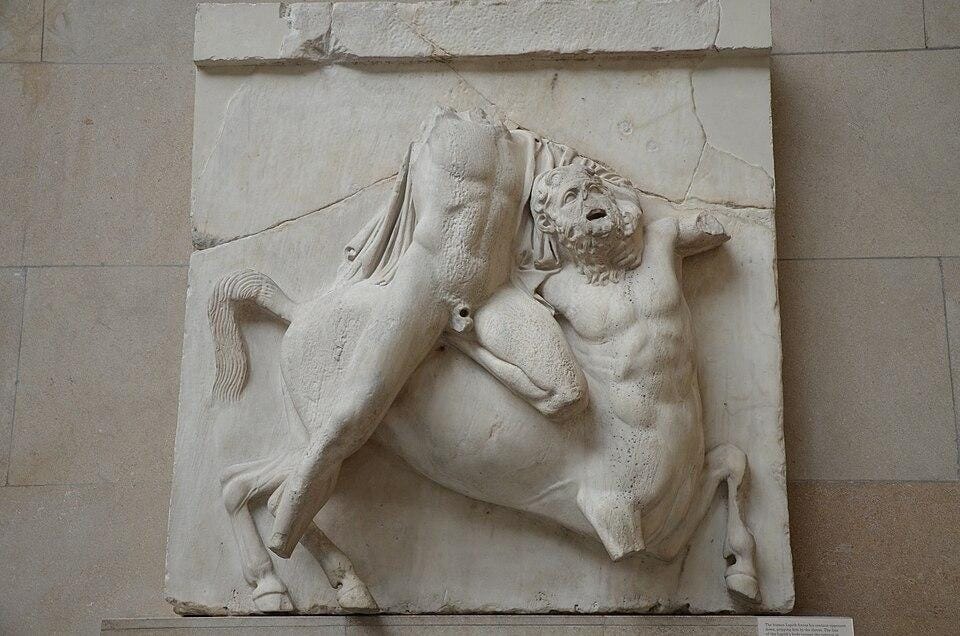
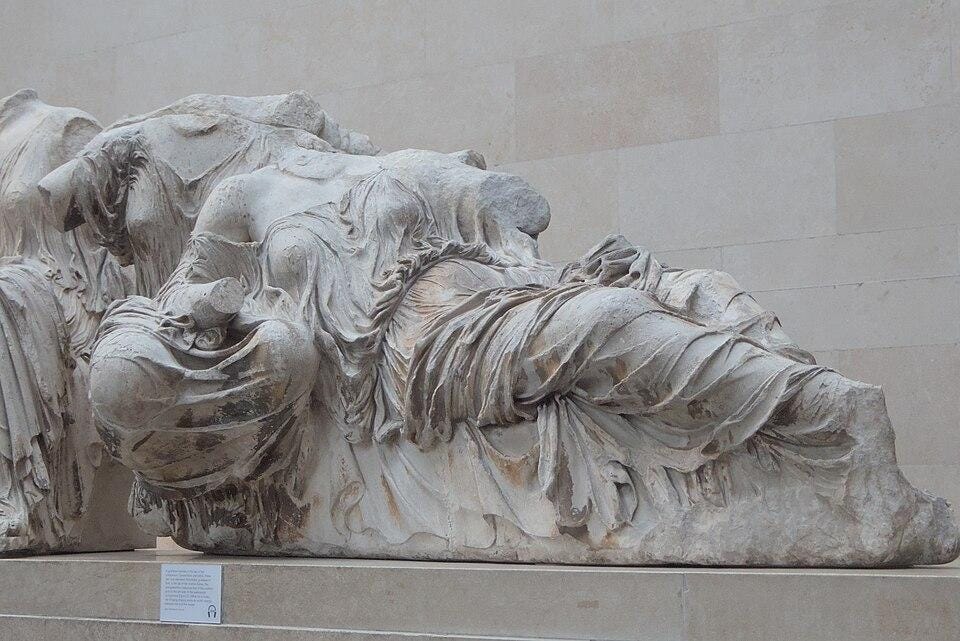
Walk into Room 25 of the British Museum. The – Parthenon sculptures fill the space – breathtaking, enormous, and described on the wall label with two words almost no one questions: “447 BC.” Before Christ. Before a religious event that the Athenian sculptor Pheidias had no knowledge of whatsoever. He was not living before anything. He was living in his own present, in a city that considered itself the centre of the civilised world. That label places him in a countdown to an event he never knew was coming – and frames an entire civilisation through a calendar that belongs to a completely different one.
One wall label. At least four assumptions. That is where art history begins – and it is precisely why, before examining a single movement or period, we need to examine the frame itself.
Most people who approach art history start in the wrong place. They move directly to movements – Impressionism, Modernism, Contemporary – and find themselves lost in distinctions that feel arbitrary, or reverential about names that carry no real context. The problem is not intelligence. It is sequence. Before understanding why Cubism mattered, or what separates Postmodernism from Contemporary art, or why a Basquiat commands more than a Boucher, a more fundamental question must be addressed: what art history actually is, how it was constructed, whose knowledge built it, and which structural biases shaped it before the first brushstroke was ever catalogued. This article, and the series that follows it, begins there.
1. The Frame: Whose Calendar, Whose World?
BC and AD are not neutral academic conventions. They are theological ones – encoding a specific religious event as the zero point of all human time. Most scholarship now uses BCE and CE (Before Common Era, Common Era), which is a partial improvement: the year zero is unchanged. The anchor is the same; only the label has moved.
This matters because the calendar structures the entire chronology. The Islamic Hijri calendar begins in 622 CE – the year of the Prophet Muhammad’s migration from Mecca to Medina. The Hebrew calendar is currently in the 5780s. The Chinese system counted time through dynastic succession. The Indian Saka calendar runs on a different axis entirely. When a Mughal miniature is dated “circa 1600” in an auction catalogue, it could equally be described as circa 1008 AH – no less accurate, simply less familiar. The choice of dating system is not neutral. It is a decision about whose framework counts as universal.
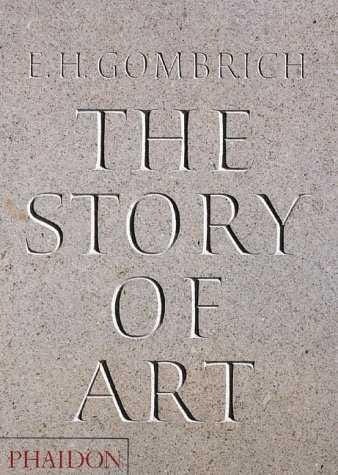
The geography of the canon carries the same problem. Open Gombrich’s The Story of Art – published in 1950, still among the most widely read introductions in the world – and the sequence is: Egypt and Mesopotamia, Greece and Rome, the Christian Middle Ages, the Italian Renaissance, four centuries of European tradition, then New York after 1945. This is not a history of art. It is a history of one tradition, presented as the history of all art.
The omissions are substantial. While Raphael was painting in Rome: the Ming Dynasty was producing ceramics of extraordinary technical refinement; the Aztec capital Tenochtitlán – larger than any contemporary European city – contained monumental sculpture on a scale that astonished the Spanish soldiers who destroyed it; the Vijayanagara Empire in southern India was commissioning temple architecture of remarkable formal complexity. None of these appear in the standard sequence as primary subjects. They appear, when they appear at all, as brief context before the narrative returns to Florence or Paris.

The Western canon was never the story of all art. It was the story of who had the institutional power to write the story.
The art market is in the middle of an active correction. Works from African, Arab, South Asian, and Latin American traditions are being reappraised as primary subjects with their own sophisticated histories. The Arab Modernism of the 1950s and 1960s – the Baghdad Modern Art Group, the Hurufiyya movement – is not a footnote to Western Modernism. It is a parallel development of considerable intellectual force, made by artists simultaneously in dialogue with Paris and New York and rooted in calligraphic and geometric traditions that European Modernism never had access to. Collectors who understand that history are better positioned than those encountering it as novelty.
2. What Counts as Art, and What Survived
Western art history has a specific answer to what qualifies as art: an autonomous aesthetic object, made by an identifiable individual, intended for contemplation rather than use. A painting on a wall. A sculpture on a plinth. This definition is culturally specific, historically recent, and narrow in ways that have profound consequences.
The Benin Bronzes were not made to be displayed in glass cases in Berlin and London. They were made to sit in the royal court of the Kingdom of Benin as ceremonial memorial objects with specific ritual functions. When they were removed – violently, during the British Punitive Expedition of 1897 – and placed in museums, they became “art.” The objects did not change. The institutional frame did. The same logic excludes from art history entire categories of sophisticated making: Persian carpet-weaving, Japanese lacquerwork, West African kente cloth, Islamic geometric tilework. These traditions are classified as “decorative arts” not for aesthetic reasons but because the institutions that built the hierarchy assigned them a lower status – one that has followed them directly into the auction room, where “decorative arts” means lower estimates, separate sale departments, and less scholarly attention.
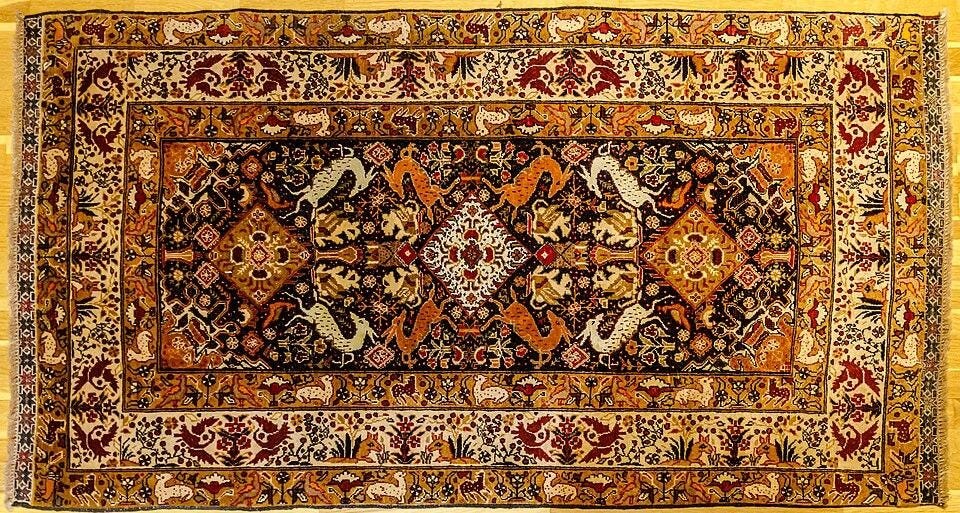
When you call something “decorative art,” you are not making an aesthetic judgement. You are making a power judgement about whose making counts.
Art history is also, fundamentally, a history of what survived – and survival is not random. Stone outlasts wood. Monumental outlasts intimate. Objects that entered institutional collections in the nineteenth century were conserved; those that remained in communities were used and lost. Literate cultures left more archival traces than oral ones. The discipline is consequently biased toward the durable, the monumental, and the institutionally endorsed – qualities that correlate directly with political and economic power.
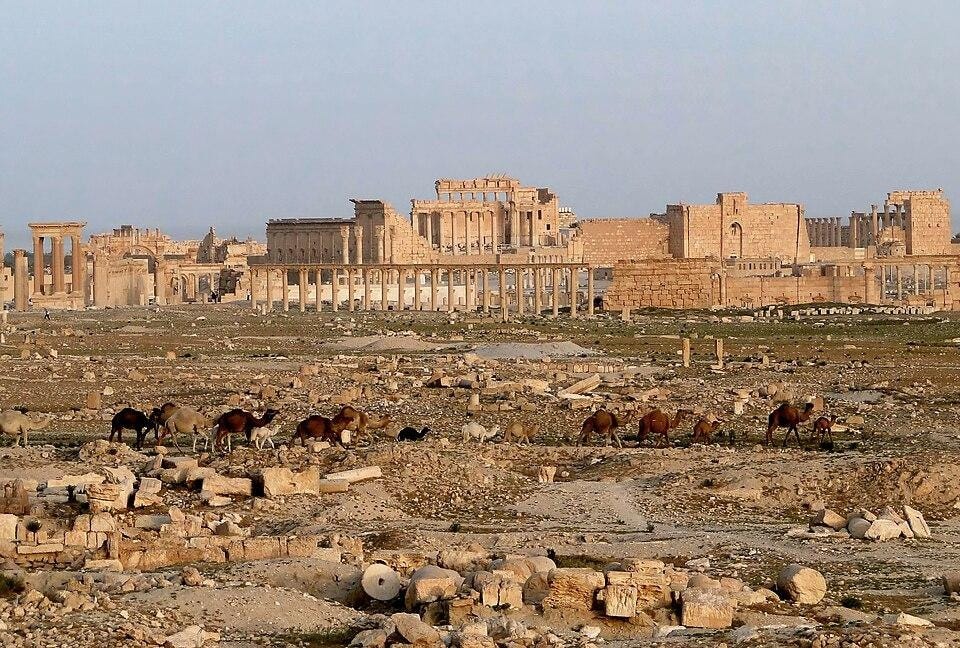
Then there is deliberate destruction. Byzantine iconoclasm erased thousands of images in the eighth and ninth centuries. The Protestant Reformation stripped centuries of devotional art from Northern European churches. Colonial expeditions removed objects from their cultures of origin. The Taliban destroyed the Bamiyan Buddhas in 2001; ISIS dismantled Palmyra in 2015. The archive has been shaped as much by destruction as by creation. When art history says it has “no record” of a tradition, this frequently means those records did not survive, or were not deemed worth preserving by those who controlled the archive. Absence of evidence is not evidence of absence.
3. Who Made It – and Who Gets the Credit
In 1968, one of the most celebrated paintings in the canon hung in the Gemäldegalerie in Berlin: a portrait of a man in a golden helmet, attributed to Rembrandt. In 1985, the Rembrandt Research Project – a team of Dutch scholars conducting systematic technical and archival analysis of the entire Rembrandt corpus – issued its verdict. The helmet picture was not by Rembrandt. It was, in the project’s precise language, “workshop production.” Not a single brushstroke had changed. The name attached to it had. The painting lost approximately ninety percent of its market value overnight.
This is not exceptional. The Rembrandt Research Project has reduced the number of works attributable to the master from over six hundred at the start of the twentieth century to fewer than three hundred and fifty today, with ongoing contestation. Every revision is presented as scholarship – the patient work of connoisseurship. In practice, it is also a market mechanism of extraordinary power.
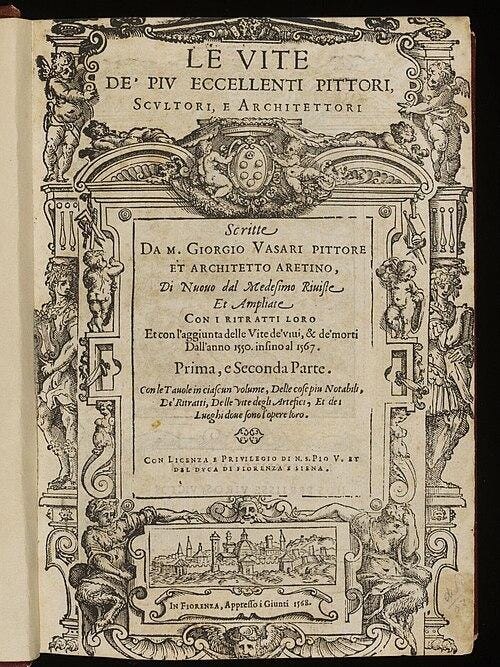
Individual authorship – the idea that a single named genius is solely responsible for a work of art – is one of art history’s most persistent fictions. Medieval works are almost entirely anonymous: the illuminated manuscripts, the Byzantine mosaics, the Gothic cathedrals built across generations were communal acts of devotion, not individual expression. The framework of named genius was formalised by Giorgio Vasari, whose Lives of the Artists (1550) is effectively the founding document of art history as a discipline – organised entirely around biographical narrative and the concept of individual genius. Even within the Renaissance, however, the named master frequently did not execute the majority of the work bearing his name. Rubens ran what was closer to a manufacturing operation than a studio: he conceived compositions, painted the principal figures, and delegated the rest to trained assistants. Buyers understood this. What was being purchased was access to a name and a quality standard, not sole manual execution.
When a museum label reads “Rembrandt van Rijn, c. 1665,” it records the conclusion of an argument, not a fact. The Vermeer catalogue – among the most studied in art history, comprising only thirty-four to thirty-seven works depending on current consensus – has been revised by virtually every generation of researchers. Works enter and exit. The paintings are unchanged. For collectors, the practical implication is precision rather than cynicism: purchasing a major attribution means buying into a current scholarly consensus, with all the instability that entails.
4. Who Was Permitted to Make Art
Access to art-making was, for most of recorded Western history, formally restricted. The guild system – which governed artistic production in most European cities from the medieval period through the seventeenth century – required membership for legitimate practice. Membership required apprenticeship. Apprenticeship required, in almost all cases, being male. Women were also excluded from the life-drawing classes that formed the technical foundation of academic painting – on the grounds that studying the naked human body was improper for women. The Royal Academy in London did not admit women as full members until 1936, one hundred and sixty-eight years after its founding in 1768. The École des Beaux-Arts in Paris did not admit them until 1897.
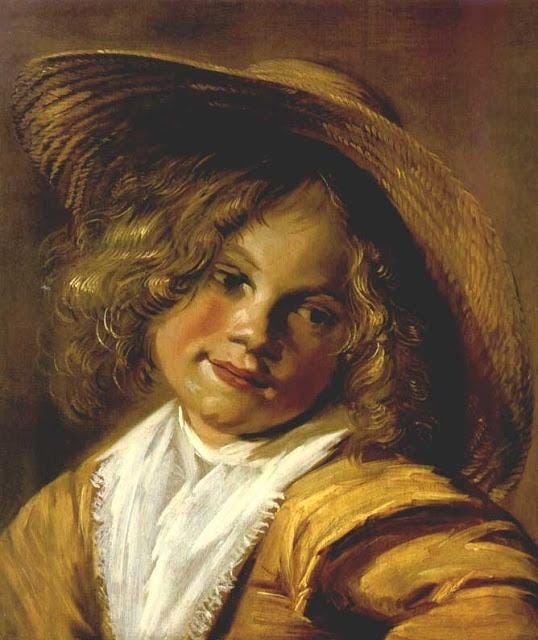
Women made art regardless. Artemisia Gentileschi painted with technical command equal to any contemporary in the Caravaggist tradition – and was for centuries catalogued under her father’s name. Judith Leyster was so thoroughly erased that several of her paintings were attributed to Frans Hals and sold at Hals prices until a researcher identified her monogram beneath the attribution in the nineteenth century. The Bayeux Tapestry – seventy metres of embroidered linen narrating the Norman Conquest of England, produced around 1070 – was almost certainly made by women, and represents one of the most ambitious narrative objects in European medieval culture. It has its own dedicated museum. It rarely appears in mainstream art history curricula with the same analytical weight as a painting of comparable scope made by a named man.
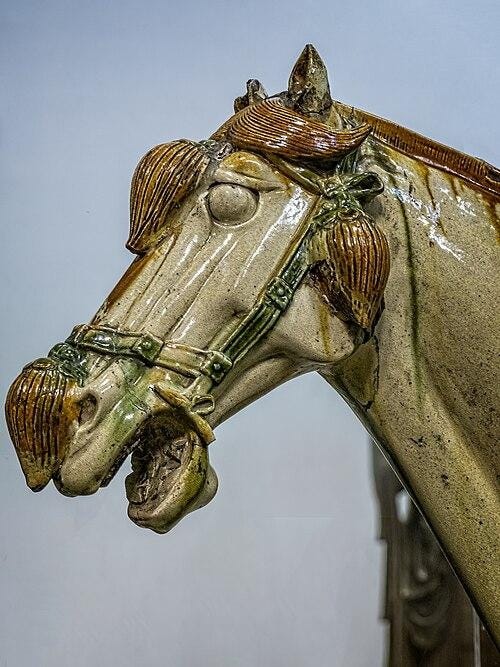
The exclusion shaped not only who made art but which art forms were valued. Embroidery, weaving, and textile work – assigned to women in most European cultures – were classified as minor, decorative, or craft. This classification followed the labour, not the object. In Tang Dynasty China, ceramic production was among the highest arts. In the Islamic world, calligraphy – which Western art history struggles to categorise as either painting or sculpture – was considered the highest visual art form, closest to divine expression. The Western hierarchy of media was formalised by the academies, which ranked history painting at the summit and excluded the decorative arts entirely. These institutional categories became the categories of art history, and then the categories of the market.
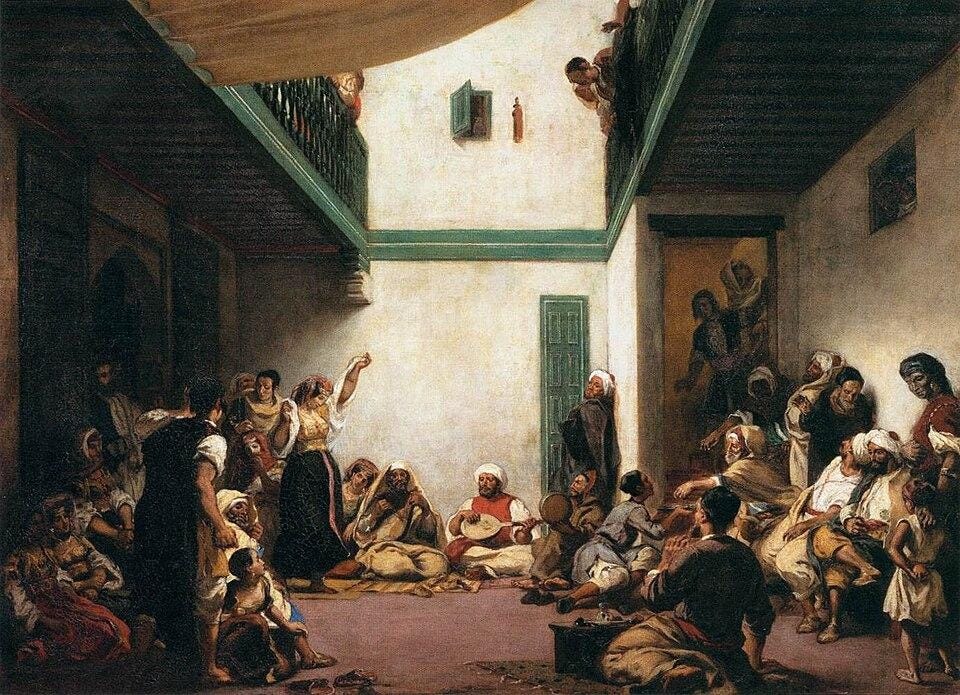
The racial dimension operates with similar structural logic. The nineteenth-century European genre of Orientalism – Gerome’s Egypt, Delacroix’s Morocco, Lewis’s Cairo – produced images that entered the major museums of Europe and America, shaped how the Middle East and North Africa were imagined globally for over a century, and did so with no equivalent institutional capacity for those depicted to represent themselves in return. Writing from Doha, this history is not abstract: the Gulf region was among the most intensively painted and most systematically misrepresented subjects in Western nineteenth-century art, precisely as European powers were extending their economic and political reach into the region. Understanding this is not a detour from art history. It is art history.
5. What We Did to the Objects
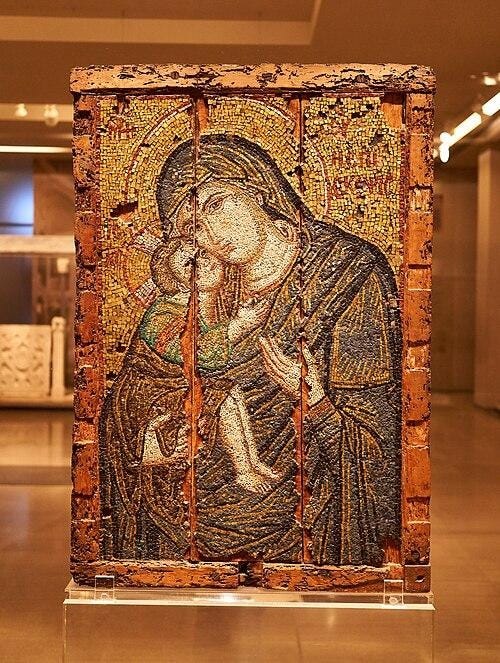
The overwhelming majority of what we call art history before roughly 1750 was not made as art. It was made as religion. A Byzantine icon was not made to be beautiful. It was made to be holy – to function as a point of contact between the human and the divine. The formal conventions of icon painting – the gold background, the frontal pose, the elongated figures, the deliberate absence of cast shadow – were theological decisions, not aesthetic ones. Gold signified divine light. Frontality signified direct address to the viewer understood to be in the presence of the sacred. The flattening of space was not a failure of perspective but a rejection of it: the icon existed outside ordinary space and time.
A Gothic cathedral was not made to be architecturally impressive. It was made to be a physical argument for the existence of God – the soaring height, the dissolution of the wall into coloured light, the complexity that no single viewer could ever fully absorb, all calculated to produce a specific experience of smallness, awe, and transcendence. These were instruments of theology, built by committees of clergy and master builders across generations, not expressions of individual artistic vision.
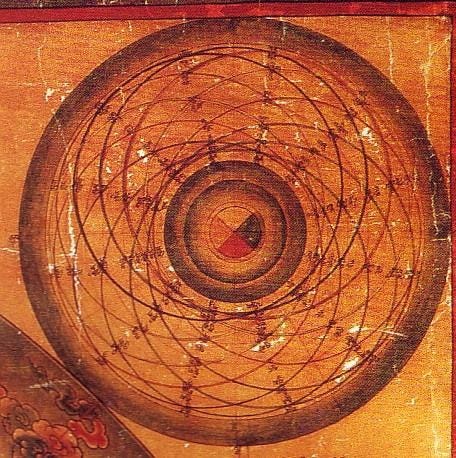
The secular museum – a product of the Enlightenment’s reorganisation of knowledge, emerging primarily in the eighteenth and nineteenth centuries – extracted these objects from their original functions and reframed them as aesthetic experiences. The context that gave them meaning was replaced with white walls, explanatory labels, and the apparatus of attribution and periodisation. A Tibetan thangka, purchased at auction, was made as a portable meditation aid – a sacred space to focus contemplative attention. A Yoruba bronze figure was made as an interface with ancestral presence. The market treats them as formal objects. That treatment is not wrong, but it is incomplete. The collector who understands original context holds more of the object’s meaning, and is better equipped to understand why it looks the way it does.
When you stand in front of a Raphael Madonna in a museum, you are not seeing it. You are seeing a secularised translation of it – removed from the devotional setting for which it was made and encountered instead as art history.
The Elgin Marbles were removed from the Parthenon between 1801 and 1812 under a permit of disputed legal validity issued by an Ottoman official. They are now among the British Museum’s most visited exhibits. Greece has formally requested their return since 1983. The British Museum’s position – that it functions as a universal institution holding objects for the benefit of all humanity – is precisely the logic of secular displacement: the museum’s frame supersedes the object’s original one. It is an argument about power, dressed as an argument about access.
Before the History Begins
None of this is an argument against art history. It is an argument for a more honest version – one that is, in practice, more useful. Every chronology is an argument. Every periodisation is a choice. Every museum label is a decision made by a person with specific institutional assumptions about what matters and what does not.
The collector who understands that the canon is constructed rather than revealed is better positioned to recognise market corrections as they happen – not after the fact. The professional who grasps these structural biases arrives in any cultural conversation with a different quality of understanding: not just the names, but the reasons behind the names, and the reasons behind the silence around everything else.
The articles that follow begin the history itself – from the earliest known human image-making through every major tradition, period, and movement to the present day. The questions raised here will travel with us throughout. Not as a distraction from the art, but as the condition for understanding it honestly.
Images selected by Nadiia Puzakova
Comments
Nothing yet. Say the first thing.
Sign in to join the conversation.