
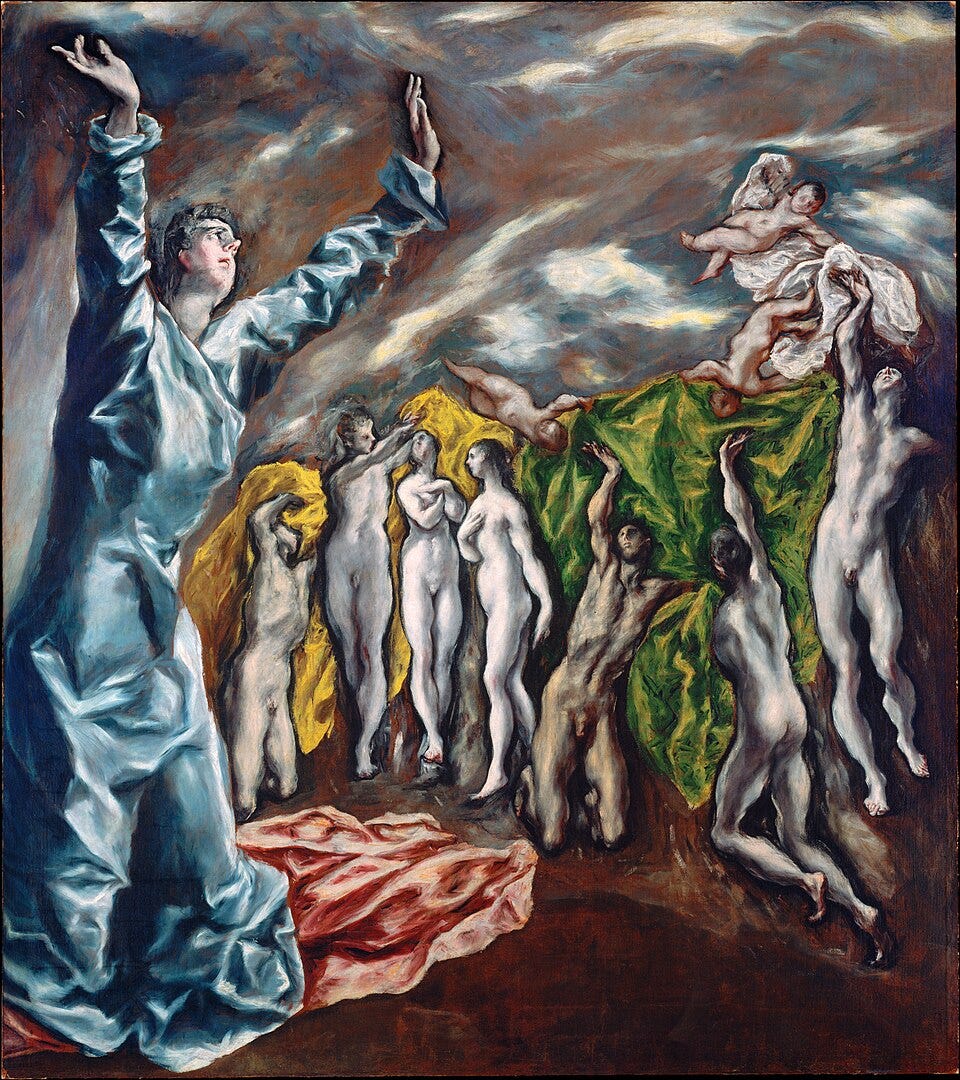
Painted in the last years of his life for a side-altar of the church of Saint John the Baptist in Toledo, The Opening of the Fifth Seal (c. 1608–1614) is El Greco’s vision of a passage from the Book of Revelation: souls who had been slain for their faith rise before heaven, receiving white robes as their reward. The canvas – 225 × 193 cm, now in the Metropolitan Museum of Art, New York – was left unfinished at the painter’s death and later cut down from a larger altarpiece; the missing upper register is thought to have shown the Lamb breaking the seal itself. What survives is a knot of elongated, wind-blown bodies, arms flung upward, robes rendered in raw greens, yellows and blue-greys applied with a broad, almost unfinished brush. It is one of the strangest and most modern-looking paintings of the entire 17th century.
El Greco was born Doménikos Theotokópoulos in 1541 in the Kingdom of Candia – modern Crete – then a Venetian possession and a centre of Post-Byzantine icon painting. He trained and qualified as a master within that Byzantine tradition before leaving, like other Greek artists of his generation, for Venice at the age of twenty-six. There he absorbed the colour and painterly freedom of the Venetian Renaissance, studying under the influence of Titian and Tintoretto. In 1570 he moved to Rome, opened a workshop, and folded in the elongation and twisting poses of Mannerism.
In 1577 he settled permanently in Toledo, then the religious capital of Spain. His timing was, in a sense, an accident of Spanish court politics: Philip II badly needed painters for the vast decorative programme of El Escorial, but Titian was dead and Tintoretto, Veronese and Anthonis Mor had all declined to travel to Spain. The king had been relying on the comparatively modest talent of Juan Fernández de Navarrete; when Navarrete died in 1579, the field was open, and El Greco – freshly arrived and hungry for major commissions – stepped into it. Toledo gave him the two works for which he is best remembered: the luminous, storm-lit View of Toledo, and, at the very end of his career, The Opening of the Fifth Seal.
Throughout, El Greco kept signing his canvases not with his adopted Spanish nickname but in his own Greek letters, often adding the word Krḗs – “Cretan” – a quiet insistence on an identity that never fully dissolved into any of the three artistic worlds he passed through.
What makes El Greco remarkable is less any single innovation than his refusal to stay still stylistically. He fused Byzantine iconography with Venetian colour and Mannerist distortion, then pushed the mixture further than any of his contemporaries dared – bodies stretched past anatomical plausibility, palettes veering into acid, almost hallucinatory combinations, brushwork that reads as unfinished even where it isn’t. Audiences in his own lifetime were largely baffled by it. It took three hundred years, and the arrival of Expressionism and Cubism, for critics to recognise what they were looking at: modern scholars now describe El Greco as an artist so singular that he fits no conventional school at all, and identify him as a genuine precursor of both movements. His work has also left its mark outside painting – it drew the admiration of poets Rainer Maria Rilke and Nikos Kazantzakis, inspired composer Vangelis’s 1998 electronic album El Greco, and was the subject of a 2007 biographical film directed by Yannis Smaragdis.
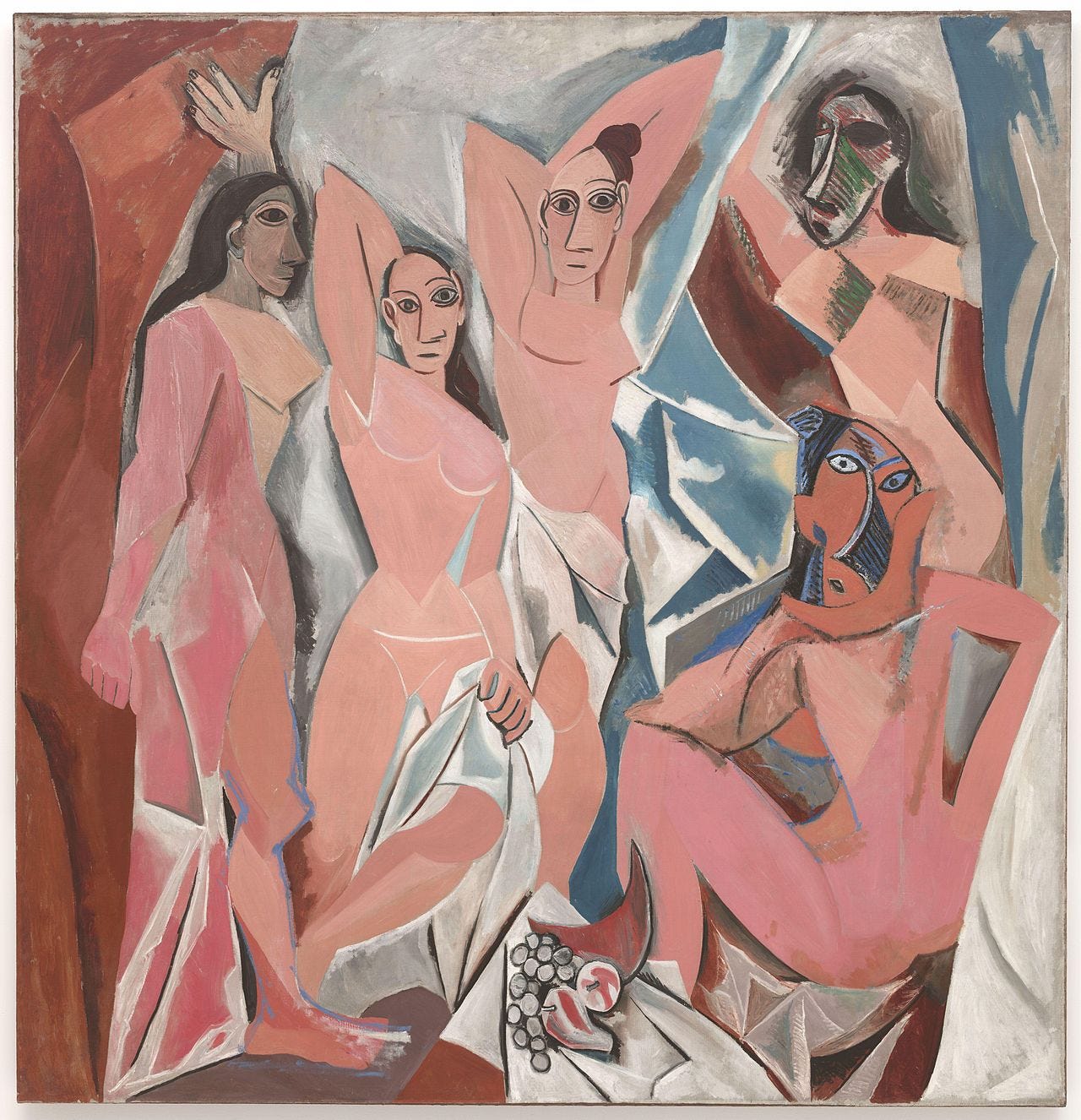
The connection to Picasso runs through a very specific chain of ownership. The Opening of the Fifth Seal was bought in 1897 for 1,000 pesetas by the Spanish painter Ignacio Zuloaga, a friend of the young Picasso and an important figure in reviving European interest in El Greco, whom he considered a genuine “precursor of modernism.” While working on Les Demoiselles d’Avignon in 1907, Picasso repeatedly visited Zuloaga’s Paris studio and studied the painting there in person.
Art historians have traced the debt closely. Picasso’s biographer John Richardson argued that Les Demoiselles owes at least as much to El Greco as to Cézanne. Efi Foundoulaki went further, identifying a shared visual grammar of V-shapes and inverted triangles running through both canvases, and describing a Picasso–Cézanne–El Greco relationship that carried straight through into Cubism. Beyond composition, critics point to something harder to pin down but easy to feel: the same apocalyptic charge, the same sense of bodies caught mid-rupture, passes from El Greco’s Revelation scene into Picasso’s five confrontational figures.
The relationship wasn’t confined to the Demoiselles, either. Picasso’s Rose Period painting Boy Leading a Horse (1905–06) echoes the elongated proportions found in El Greco’s Saint Martin and the Beggar. Decades later, in 1950, Picasso painted Portrait of a Painter after El Greco, a direct Cubist reworking of El Greco’s own Portrait of Jorge Manuel Theotocopoulos – his son and fellow painter – as if closing the loop on a conversation that had run through his entire career.
Seen this way, El Greco isn’t merely a historical curiosity rediscovered by modernists. He was, in effect, one of the first artists to break figuration apart in service of feeling rather than resemblance – three centuries before Cubism gave that impulse a name.
From art investment or art collecting advice, marketing for art galleries, to coaching artists:
Comments
Nothing yet. Say the first thing.
Sign in to join the conversation.