
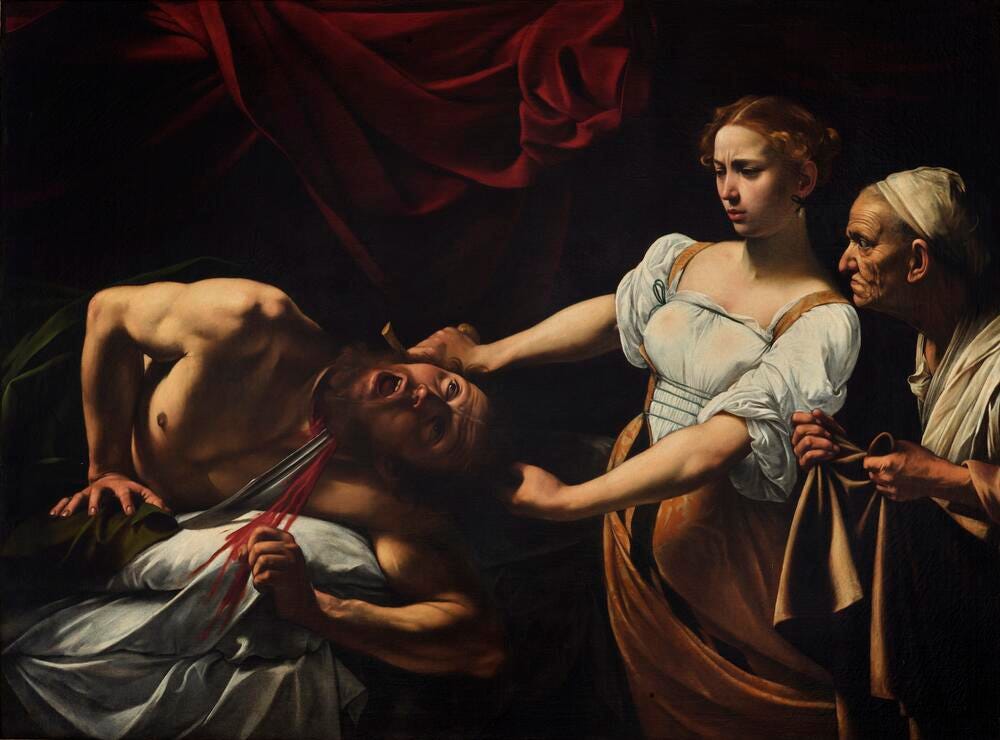
Judith and Holofernes is a large, violent canvas of a widow decapitating an Assyrian general, painted around 1607 and attributed by some of the most respected Old Master specialists alive to Caravaggio. It had been missing since a documented sale in Antwerp the year it was likely painted. Then, in April 2014, a Toulouse auctioneer called to appraise a water-stained canvas in a family attic found it hanging exactly where burglars had left it, having judged it worthless. Cleaned, researched for five years, declared a French national treasure, and exhibited in Milan, London, Paris and New York, the painting was set to go under the hammer in Toulouse on 27 June 2019, with an estimate as high as €150 million. Two days before the sale, it vanished from public view again: bought privately by an undisclosed foreign collector, for a price that has never been released. Not every scholar accepts the attribution – one historian resigned from a Milan museum’s board in protest, and a rival theory credits the Flemish painter Louis Finson instead. Four hundred years after it was made, nobody will confirm who painted it, what it sold for, or where it hangs now. If one object explains both what Baroque art is and how little has changed about the business built around it, this is a strong candidate.
1. What Baroque Means
Baroque describes European art and architecture from roughly 1600 to 1750 – conventionally the century and a half between the High Renaissance’s cooling and the featherweight frivolity of Rococo. The name was an insult before it was a period: barroco, in Portuguese, meant a misshapen pearl, and eighteenth-century critics reached for it to describe what they considered the previous era’s excess – too much movement, too much emotion, too much gold, next to what they saw as the Renaissance’s superior restraint. The word carried that sneer for over a century, until the Swiss art historian Heinrich Wölfflin’s 1888 study Renaissance und Barock finally treated Baroque as a style with its own internal logic, rather than a lapse from someone else’s.
Comments
Nothing yet. Say the first thing.
Sign in to join the conversation.