
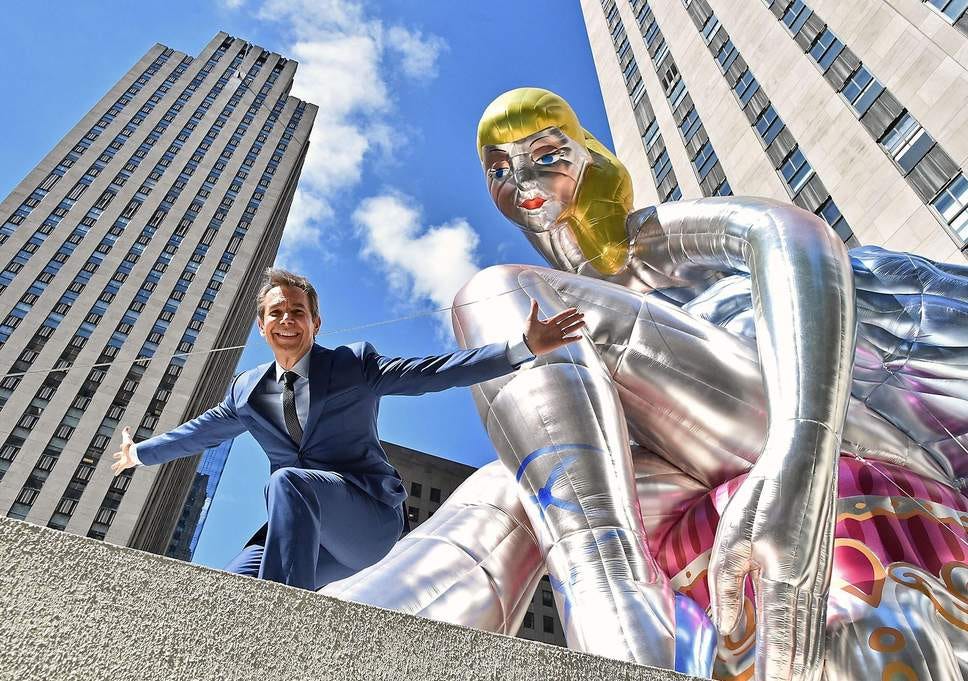
Every generation of the art market produces one figure who refuses to stay in his assigned box. Jeff Koons (born 1955, US) is ours. He has been called the heir to Warhol, the saviour of painting, the art world’s greatest con artist, and its most sincere practitioner – sometimes in the same review, sometimes by the same critic. His auction records are extraordinary. His critical standing has swung from canonical to discredited and back again within a single decade. He is, by almost any measure, the most controversial serious artist alive.
That controversy is not accidental. It is structural. Koons sits precisely at the intersection of three of the most important categories in contemporary art discourse – Postmodernism, Contemporary Art, and Metamodernism – without belonging cleanly to any of them. Understanding why he resists classification is not merely an art-historical exercise. It is one of the most useful lenses available for anyone trying to navigate the market, understand value, or simply make sense of what the last forty years of art have actually been doing.
The Postmodern Case: Why He Gets Filed There
Koons emerged in New York in the early 1980s, at the height of the Postmodern moment. His earliest critical context was Neo-Geo – a movement whose entire vocabulary was built on the appropriation of commercial imagery, the self-conscious manipulation of consumer desire, and the deliberate collapse of the distinction between high art and mass culture. In this environment, Koons was not an outsider. He was a central figure.
The formal evidence for his Postmodern credentials is substantial. His first major series, The New (1980–87), placed brand-new vacuum cleaners in illuminated Plexiglas cases – pristine, unused, preserved as fetish objects. The gesture was unmistakably Postmodern in its logic: the readymade pushed past Duchamp’s irony into a territory where commodity and artwork were genuinely indistinguishable. His Luxury and Degradation series (1986) reproduced alcohol advertisements – Jim Beam, Frangelico, Hennessy – at monumental scale in painted stainless steel, their aspirational messaging amplified until it tipped into something between celebration and critique.
The factory-scale production of his work, the delegation of fabrication to specialist craftsmen, the explicit engagement with brand culture and commercial aesthetics – all of this placed him squarely in the Postmodern lineage that ran from Warhol’s Factory through the Pictures Generation. Institutional framing confirmed it: his work was exhibited, theorised, and collected within a Postmodern critical apparatus that read it as commentary on commodity culture.
The Postmodern reading of Koons makes sense – until you spend time with the actual work, which refuses to behave like commentary.
The problem with the Postmodern label is not that it is wrong. It is that it is insufficient. Postmodernism, at its core, requires ironic distance – the artwork holding its subject at arm’s length, examining it with skeptical intelligence. Warhol had that distance. Kruger had that distance. Richter had that distance. Koons, by contrast, appears to have none at all.
The Sincerity Problem: Where the Label Breaks Down
Koons has stated, in interview after interview across four decades, that his work contains no irony. He means it. The balloon animals are genuinely celebratory. The gleaming surfaces are genuinely meant to be beautiful. The kitsch is not being held up for examination – it is being embraced, elevated, and offered back to the viewer as something worthy of serious attention and genuine feeling.
This is not the standard artist’s deflection of critical interpretation. It is a sustained, coherent, philosophically consistent position. And it produces work that operates entirely differently from Postmodern irony. When you stand in front of a Koons – particularly the large-scale stainless steel works, or the porcelain figurines of the Banality series — the experience is not one of detached intellectual recognition. It is something closer to confrontation. The objects demand a response. They are too large, too perfectly made, too aggressively present to be dismissed as quotation.
Postmodernism used the language of advertising and popular culture against itself – turning the tools of consumer desire into instruments of critique. Koons used the same language lovingly. That is a fundamentally different gesture. A critic who loves what they are criticising is not, in any meaningful sense, a critic. They are something else entirely.
Where Warhol maintained the cool remove of a documentarian, Koons insists on the enthusiasm of a true believer. The difference matters more than it might seem.
His most commercially and critically successful works – the Rabbit (1986), the Balloon Dog series, the Celebration sculptures – are not deconstructions of consumer objects. They are apotheoses of them. The stainless steel renders cheap, ephemeral party objects as permanent, monumental, precious. This is not critique. It is a form of devotion – an insistence that even the most disposable corners of popular culture contain something worth preserving at the highest level of craftsmanship the art world can produce.
What you are looking at
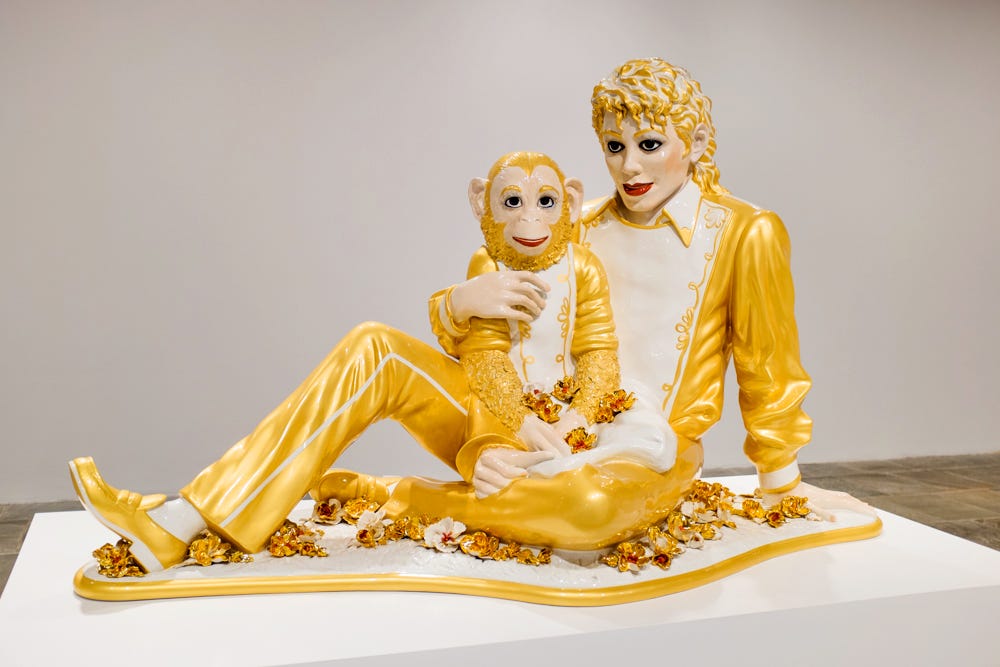
The sculpture depicts Michael Jackson reclining on a gilded floral surface, his pet chimpanzee Bubbles nestled against him. Both figures are rendered in identical white and gold porcelain – Jackson in his military-style jacket, Bubbles in a matching outfit. They are the same scale. They share the same surface treatment. The flowers beneath them are hyper-detailed and equally gilded. Everything gleams.
It is enormous – nearly 1.8 metres wide – and it is technically staggering. The porcelain work required specialist fabricators in Bavaria and took months to produce. The surface finish is immaculate. The modelling of the faces is precise to the point of portraiture. Every flower petal, every gold accent, every fold of fabric has been attended to with an obsessive care that borders on the devotional.
The formal choices and what they mean
The decision to render both Jackson and Bubbles in identical materials and at the same scale is the work’s most disorienting formal move. There is no hierarchy between man and animal – or rather, the hierarchy that exists is purely compositional. Jackson reclines slightly above Bubbles, but the visual weight of the two figures is equivalent. The effect is deeply strange. It refuses the viewer the comfort of a stable reading.
The gold and white palette is a direct citation of Rococo and Baroque decorative traditions – specifically the kind of gilded porcelain figurines produced in 18th-century European courts, the Meissen and Dresden pieces that were the luxury objects of their era. Koons is not being subtle about this. He is explicitly elevating Jackson – a Black American pop star, the most famous human being on the planet in 1988 – into the visual register of European aristocratic culture. The gesture is simultaneously an act of celebration and a profound complication of taste hierarchies.
The work places the world’s most famous entertainer in the formal language of the world’s most prestigious decorative tradition – and refuses to tell you whether that is an honour or an absurdity.
The historical moment
It was made in 1988, at the precise peak of Michael Jackson’s cultural dominance and before the first allegations of child abuse surfaced in 1993. This timing matters more than it might seem. The work is a portrait of a specific cultural moment – a moment in which Jackson represented something genuinely extraordinary: a figure who had transcended race, genre, and the ordinary boundaries of celebrity to become something closer to a global mythological presence. The chimpanzee Bubbles was not merely a pet. Bubbles was a fixture of Jackson’s public image, a symbol of his determined refusal of ordinary human socialisation, his retreat into a private world of his own construction.
Koons captures this without commentary. He does not analyse Jackson’s strangeness or hold it at ironic distance. He renders it with the full seriousness of Baroque portraiture – the same seriousness with which Velázquez painted the Spanish court, or Bernini sculpted papal commissions. The comparison is not hyperbolic. It is the point.
The critical reception – and what the market did
The work was initially received within the Postmodern critical framework that dominated discourse in the late 1980s – read as commentary on celebrity culture, consumer desire, and the manufactured nature of fame. This reading was not wrong, but it was incomplete, and over time it has become less persuasive as the primary interpretation.
One of the three editions sold at Sotheby’s New York in 2001 for $5.6 million – then a record for Koons. A second edition was sold privately. The works now sit in major institutional collections. Their market position has proved far more durable than most of their Postmodern contemporaries, precisely because the work supports multiple readings and does not depend entirely on any single critical framework to function.
The complication of the work’s meaning following the abuse allegations – and the posthumous reassessment of Jackson’s legacy prompted by the 2019 documentary Leaving Neverland – has not collapsed the sculpture’s art-historical significance. It has, if anything, deepened it. A portrait made at the apex of a myth, now viewed from the wreckage of that myth, becomes a document of a particular kind of cultural innocence – or cultural complicity, depending on where you stand. The work does not resolve that tension. It holds it.
The Contemporary Label: Accurate but Insufficient
In the administrative sense, Koons is contemporary art. He is alive. His work continues to be produced, exhibited, and collected. Christie’s and Sotheby’s file him under the contemporary category and price him accordingly. By sheer auction volume and institutional presence, he is one of the defining figures of the contemporary market.
But as we have established, “contemporary” as a category tells you almost nothing about what the work is actually doing. Gerhard Richter and KAWS are both “contemporary.” That sentence is true and nearly useless. The more productive question is not when Koons made his work but what intellectual and emotional register it operates in – and there, the contemporary label simply kicks the analysis down the road.
What the contemporary framing does usefully capture is the breadth of his influence. Unlike a purely Postmodern artist, whose influence operates primarily within art-world discourse, Koons has shaped popular visual culture, luxury brand aesthetics, interior design, and the way celebrity and commerce intersect in public life. His vocabulary – the gleaming surface, the monumental balloon form, the elevation of the everyday object – has migrated so thoroughly into mainstream visual culture that it is now almost impossible to see a high-end product campaign without some trace of his influence.
The Metamodernist Reading: Why It Fits Best
The most accurate intellectual location for Koons is not Postmodernism, and it is not the neutral administrative category of contemporary. It is Metamodernism – and specifically, he is a figure who arrived at Metamodernist sensibility before the framework existed to name it.
Metamodernism describes an oscillation between Modernist sincerity and Postmodern irony, a cultural condition in which artists engage with feeling, beauty, and genuine emotion while remaining fully aware of the critical apparatus that surrounds those gestures. It is sometimes described as “informed naivety” – the deliberate choice to proceed with feeling despite knowing all the reasons to be suspicious of feeling.
Koons fits this description with striking precision. He is not naive about the art world, about the market, or about the history of the gestures he is making. He has worked within the most sophisticated institutional structures in the art world for four decades. He knows exactly what he is doing. And yet the work insists on sincerity – on beauty, on celebration, on the legitimacy of popular culture as a subject for serious art – with a conviction that the Postmodern framework never quite accounts for.
Koons did not arrive after Postmodernism. He grew inside it and refused its most fundamental premise – that sincerity was a form of failure.
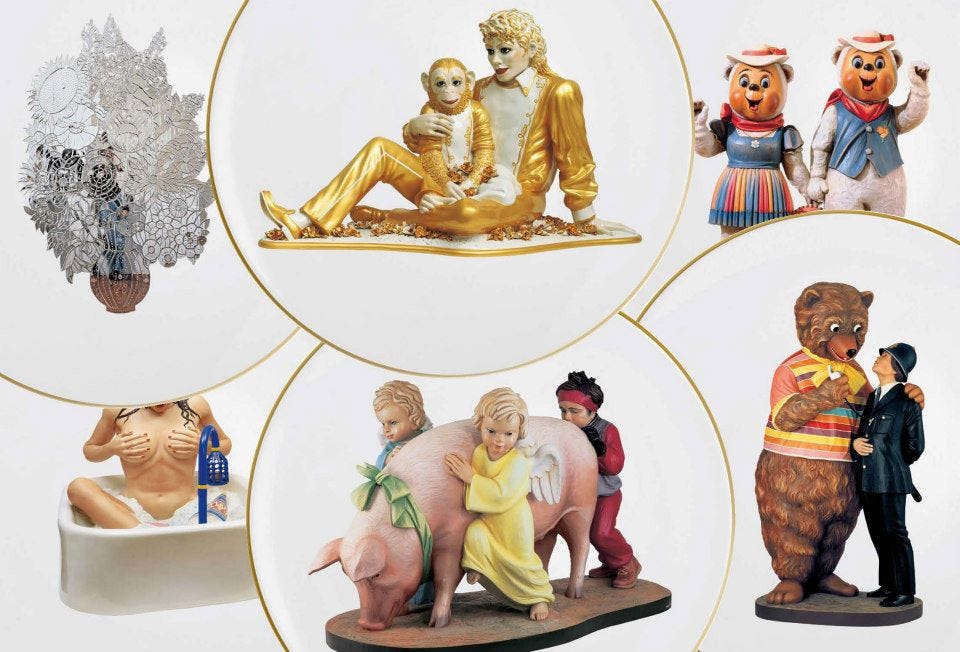
The Banality series, of which Michael Jackson and Bubbles is the centrepiece, is the clearest expression of this. The series took objects from the kitsch repertoire – tourist figurines, religious icons, pop cultural celebrities – and rendered them at monumental scale in the most prestigious materials available. The effect was not to ridicule kitsch or expose its mechanisms. The effect was to insist that kitsch contained real human meaning, genuine popular feeling, and a form of beauty that the art world’s inherited hierarchies of taste had simply failed to recognise.
This is a Metamodernist position avant la lettre. It is the argument that beauty and meaning are not the exclusive property of approved cultural forms – that the balloon animal and the Baroque figurine are engaged in the same human project, separated only by the historical accident of which one the institutions decided to take seriously.
The artists who would later be grouped under the Metamodernist umbrella – figurative painters insisting on emotional directness, installation artists working with sincerity rather than irony – are, in a real sense, working in a territory that Koons mapped three decades earlier. He was not celebrated for it at the time. He was accused of cynicism, of market manipulation, of elevating vulgarity. The accusations were not entirely wrong about the facts. They were entirely wrong about the intention.
What the Koons Problem Teaches Us
The reason Koons remains both instructive and divisive is that he forces a question the art world has not fully resolved: can a work be simultaneously embedded in the most sophisticated commercial mechanisms of the art market and genuinely sincere in its emotional ambitions? The Postmodern answer was no – sincerity within the market was always already compromised, always already complicit. The Metamodernist answer is that this binary is itself the thing to be questioned.
His secondary market has been volatile in recent years – prices for certain works have retreated significantly from their peaks. This is partly a function of market cycles, partly a function of changing taste, and partly a function of the ongoing critical reassessment of the Postmodern moment whose institutional structures supported his highest valuations. But the works themselves – particularly the Banality series, the Celebration sculptures, and the early stainless steel pieces – have proved more resilient than the critical framework initially used to justify them.
That resilience is the argument. A purely Postmodern work, stripped of its institutional context, risks becoming a very expensive joke with no one left who remembers the punchline. A work that operates on the register of genuine feeling – even feeling directed at kitsch, even feeling produced at factory scale, even feeling packaged and sold at auction for tens of millions – retains a different kind of durability. It continues to produce a response.
Michael Jackson and Bubbles do not require the critical apparatus of the 1980s to work. You can stand in front of it knowing nothing about Neo-Geo, nothing about Baudrillard, nothing about the Pictures Generation – and it will still stop you. The scale, the gleam, the uncanny doubling of man and animal, the particular historical weight of that face. Something registers.
That is not a Postmodern experience. That is something closer to what art has always, at its most serious, been trying to do.
Comments
Nothing yet. Say the first thing.
Sign in to join the conversation.