
Beckett was infamously cagey about Waiting for Godot, giving his interviewers only the vaguest answers about its symbolism and meanings. Even the simpler questions — its protagonists’ backgrounds and the location in which it is set — went unanswered. And when reviewers made assumptions and drew comparisons, Beckett once quipped, “Why people have to complicate a thing so simple I can’t make out.”
And at its core, it is simple: Waiting for Godot is the story of Vladimir and Estragon, two men waiting for a man named Godot. Godot, it seems, is the key to some change in their fortunes. But he never arrives, and the men are left to pass the time. Should they wait? Should they leave? Should they hang themselves from the nearest tree? Everything is uncertain.
Until now, I had studied the play but never seen it performed. Like the play’s characters, I’ve just never been in the right place at the right time. So, I suppose I, too, have waited my whole life for Godot. When the Theatre Royal Haymarket put on this production, I bought tickets on the first day.
What I can say is this: if I had to describe my perfect production of Waiting for Godot, it might have looked a lot like this one. It is funny, patient, beautiful, horrible, reverent and irreverent in all the right places. It does not overly interpret the script so much as highlight its frustrating ambivalence.
Beckett would have liked it.
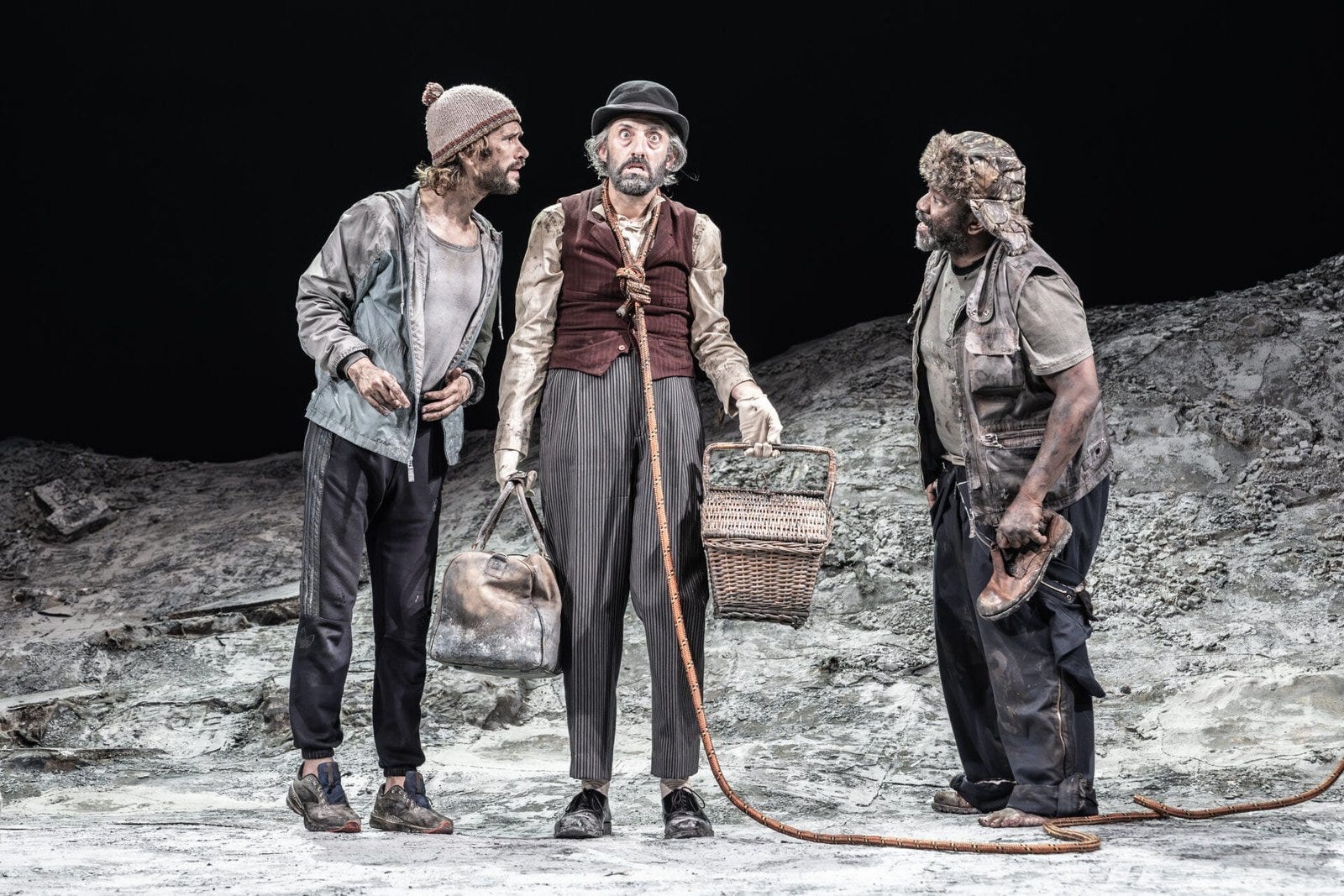
The first thing that will hit you is the jaw-dropping set. Godot is meant to have a minimal set, and the Royal Haymarket production takes this to an extreme — not by laying bare the boards and performing there, but by building a barren landscape seemingly made of papier mâché — even the lone tree is like a twisted model from a child’s school project. And as the curtain opens, this entire stage — raised slightly off the boards — rotates just a few degrees so that one corner dangles outward into the audience.
Seen within the frame-like proscenium of the Royal Haymarket, the effect is of a canvas torn from its frame, and two men occupy this space, trapped within its borders like miniatures. This diorama effect becomes even stronger when the tree sprouts its second-act leaves, which make it look more like a household money-plant than a willow. I can’t imagine a better way to encapsulate the characters’ predicament than to place them on an empty page.
Director James Macdonald doesn’t stray far from the traditional interpretation of Vladimir (Ben Whishaw) and Estragon (Lucian Msamati) as transient figures, except to bring them into the present. They wear the kind of clothing you might find on any unsheltered person in an urban setting — Vladimir in a hoodie and track pants, a pair of unlaced trainers. His traditional bowler is now a knit cap. Estragon’s hat is a Russian ushanka. His clothing is earthy, almost military.
But while Vladimir and Estragon skew urban and contemporary, Pozzo (Jonathan Slinger) and Lucky (Tom Edden) are more distinctly mid-century — Pozzo arrives in rumpled English country style, and Lucky wears similar, but with a tired bowler and waistcoat. But despite Pozzo’s affectations of wealth, he is as dirty and ill-kempt as the rest.
This mix of urban and countryside, present and past, in the costuming is just one of several choices that add to the script’s ambiguities. The contradictions swirl in the same space as the doubt over how much time has passed between Acts One and Two. Is Act Two really the next day? Are Vladimir and Estragon really so old? Who is actually heavier? Surely not Vladimir, here.
There are no quantitative details in Macdonald’s Godot. The production works hard to erase even those few that are hinted at in the script, placing the focus on its characters — these opposites that cannot escape one another. They give and take; they hope and are hopeless.
Whishaw and Msamati’s movements convey their inner worlds — Whishaw seems to shrink in on himself, yet walks on his toes with an anxious energy, yearning ever upward toward something beyond. Msamati, when he moves from the safety of his rock, shuffles heavily around the stage, his legs and feet paining him, always ready to escape into sleep. His Estragon also has a wry comic timing that brings the audience along, even when up against Vladimir’s more sympathetic optimism.
Beckett’s best-known play is always going to be open to interpretations. In its lack of specifics, and even in its deliberate confusion, it becomes a kind of ink-blot test in which audiences and reviewers see their own ideas reflected.
For me, saturated as we are by dystopian stories, I was tempted to see this staging as a kind of post-apocalyptic landscape where the few survivors wander around fighting for food and being beaten at night. After all, they are traumatised, forgetful, and reaching for memories of better times. But this is exactly the kind of uncalled-for interpretation that Beckett would have hated.
Still, what is Waiting for Godot if not a story of survival — one of dependence and co-dependence in the face of a senseless existence? Do these men really even know each other? Do they support one another or drive one another mad? Does the action take place in two hours? Two days? Two years? In Beckett’s world, a lifetime is both ridiculously short and infinitely long — everything in between is nothing but killing time.
On the Royal Haymarket’s papier mâché stage, all of this appears in stark relief. For me, at least, this is the Godot I’d been waiting for. ◾️

Waiting for Godot has been extended at the Theatre Royal Haymarket, London, until 21 December 2024.
Comments
Nothing yet. Say the first thing.
Sign in to join the conversation.