
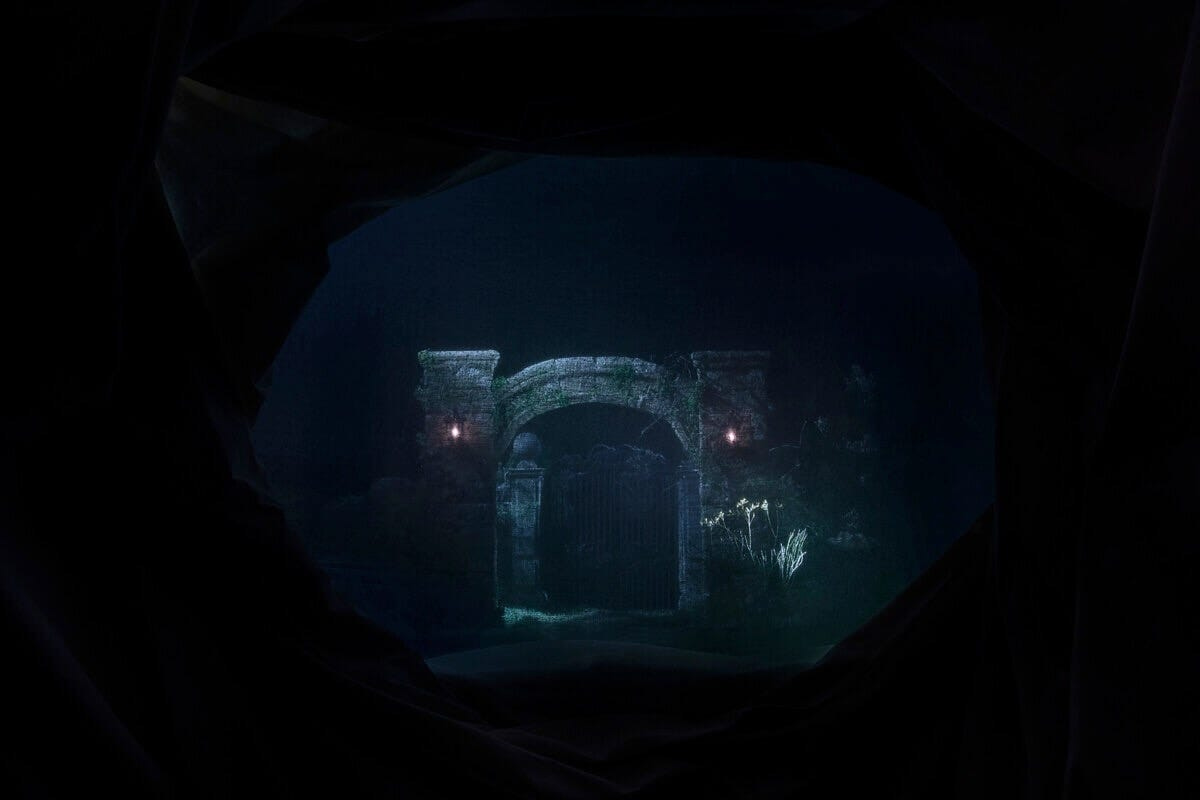
Have we all had that dream?
It’s the one where you find a hidden room in your house. A door you’ve never noticed. A space between the walls that leads to a mansion, a palace, a secret maze, an entire world.
This is the world that Viola’s Room hopes to take its audiences into, but the success of this plan might depend on you.
My confession: I have no frame of reference for Punchdrunk — the immersive theatre group that most famously produced The Burnt City show through 2022 and 2023. I had heard great things about Burnt City but couldn’t quite bring myself to attend.
Why? Because I am sceptical of immersive performances in general. I have always had an impression that they are closer to theme parks than theatre. And I’ve never been a fan of awkward interactions with actors. The actors, after all, are meant to embody a role, not thrust one on the audience.
But perhaps that is the point — perhaps there is space for works of art in the in-between spaces. And so, I try to keep an open mind.
Viola’s Room attracted me for two main reasons. One, I understood that it was chiefly an auditory journey — a kind of audiobook brought to life. That assured me that I wouldn’t be expected to interact with actors. And two, the story the play is based upon is written by Daisy Johnson, author of Everything Under — a book I would happily put on my list of top five best novels ever.
So, I parked my doubts at the door and entered.
Participants join the world of Viola’s Room in groups of up to six. My group ended up being three singles, including me, and two friends together. While our group waited to enter the show, I spoke with some of my fellow attendees. One had been to so many Punchdrunk shows that she’d lost count. Another had seen Burnt City alone seven times. I was gobsmacked.
Clearly, Punchdrunk is doing something right.
A member of staff gave us the rules, told us how to get help if we needed it, told us there would be moments of complete darkness but no jump-scares, and then paraded us into an anteroom to take off our shoes and socks.
Yes. Viola’s Room can only be experienced barefoot.
This is the show’s first stroke of brilliance. There is something inherently mischievous about being barefoot in an unfamiliar space. But it also creates a sense of vulnerability. From the moment your shoes and socks come off, there is a quietness that infects everyone.
Walking becomes padding. You move with caution, with greater purpose, your feet against a soft domestic carpet.
Inside, a series of lights lead you through the show. Sound, of course, is reduced to only what you hear on the headphones — Helena Bonham Carter’s excellent narration, and the sound effects and music that go with it.
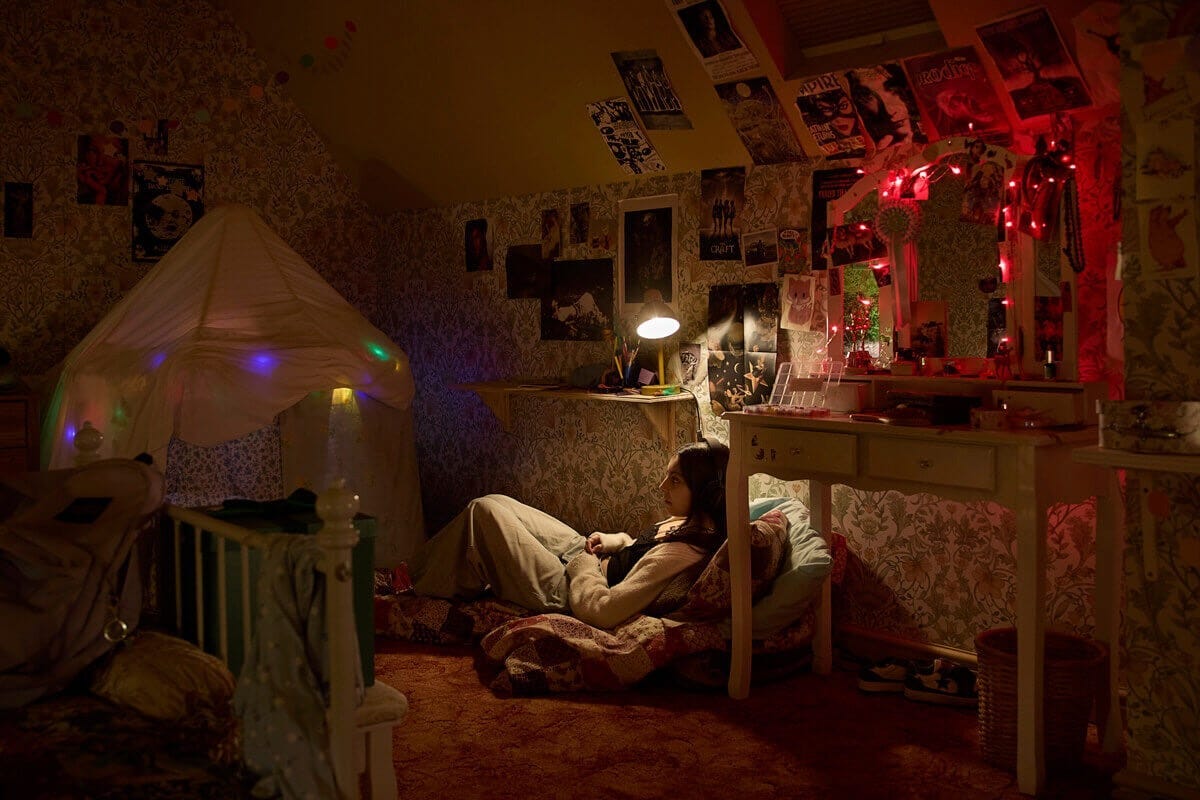
The first large space you enter is the titular room — Viola’s room, a fully decorated bedroom that might have belonged to any teen girl in the 90s. You are asked to lie down on one of six small beds.
A radio soundtrack plays a medley of alternative rock hits before bringing us the bedtime story of a young princess expected to marry a prince who is even younger, and her subsequent escape into parts of her castle that were previously unknown to her.
And as this happens, a light comes on in the tent, and you must crawl on hands and knees into Viola’s imaginary world behind the walls.
With a narrative all about getting lost in mazes and finding one’s way, Viola’s Room is by necessity a series of corridors and tight spaces, occasionally opening into larger ones.
As I watched the person ahead of me disappear into the tent, it did seem almost as if they had vanished.
And as I went through myself, the tunnel was walled with sheets of fabric. When we stood, it was more fabric. And my first (admittedly ungenerous) thought at this point was that I could have built this myself.
It felt like the kind of Halloween maze my Cub Scout leaders used to build for us out of cardboard boxes and bedsheets. Even the first strange object that we came across — a simple model castle covered with sheer fabric — seemed equally disappointing.
But as we listened to the story, a window in the model lit up. Then, the light began to move, as an invisible princess carried her lantern through the palace halls and into the ballroom, where the shadows of dancers turned in silhouette.
In the narration, the princess exited the castle, and in front of us, the light did too, casting shadows of stark trees on the tunnel walls. Her lantern became a will-o’-wisp that beckoned us to follow as it travelled behind the walls, leading us onward.
The magic had begun.
There is a slow build to the show, even though it lasts less than an hour. While the feeling of being trapped in a fabric maze remains a little bit pokey in this first act, for me, it was the sudden and disorienting return to Viola’s bedroom where things really clicked into place.
You arrive back in the same bedroom, but it has changed — its walls now covered with desperate scribblings and pages torn from the bible. The feeling of displacement on stepping back into that room is like whiplash. And this, I think, is what fully plunged me into Viola’s world.
I felt almost like Viola herself — out of place, unsettled, and desperate to return to the maze to see what other wonders it might bring.
The show is intended to be multi-sensory. There are sounds in the headphones, of course, and fascinating effects using light and darkness. But there are also smells that waft past, changing textures beneath your feet, and hanging objects that sometimes brush against you in the gloaming.
At some points, you walk over wet ground or tree roots, and in one place, deep, luxurious sand. It’s incredible just how much something so simple can alter your perception of a space.
But the most effective points of the show are the grand show pieces when the tunnel opens into larger rooms — one or two of them enormous and filled with strange objects.
Some small part of the experience depends on your small group of fellow participants.
At certain points, you are moved into spaces without exits, some barely large enough for six people. And if your fellow audience members don’t move fully into the space, you can miss out on the things you’re meant to see.
In one particularly dim corridor, it seemed as though everyone ahead of me had vanished into the gloom, and I seemed to hit a dead end. I was a bit baffled. The effect was so complete that it was only by feeling my way that I discovered the series of hairpin corners that led me onward.
It was an incredible moment, but the woman behind me was not so bold. Just as I had lost sight of the people ahead of me, she also lost sight of me and decided to go backwards, thinking she’d missed a turn or a door.
We ended up waiting for her at one key point, everyone a bit worried and wondering if we should search for her. As a result, I missed one of the narrative climaxes.
The moral of the story — stay together and follow the light, no matter how dim it might look.
If I were to criticise the show itself, I think that its use of total darkness is sometimes overdone. At one point, we stood in the dark for so long that everyone started to wonder if we had somehow missed the cue to leave.
These moments are used for dramatic effect, but they also focus attention on the narration. Yet, this is meant to be a multi-sensory experience. Even while I am listening in the dark, I am still anticipating the next thing — straining to see if something will light up. Feeling around myself for something that might be there. In some ways, the darkness became more distraction than focus.
Also, because it is a multi-sensory experience, the headphones make everything feel a little bit deadened. This is partially a good thing — we do not need to listen to the gasps or comments of other audience members. We don’t have to listen to one another shuffle through the labyrinth.
But having your ears covered is strangely deadening. I found myself wanting to take the headphones off, wishing we had earbuds for the narration and live sounds for the sound effects. This would have been a more complicated process for the producers, I know. But still, I feel it would have made everything feel less removed and more real.
But these are nigglings, really.
The overall effect of the show was one of wonder. I wanted more. I wanted to wander those strange halls and tunnels for hours. Those few events that took me out of the performance are made up for by the many effects that kept me immersed.
Perhaps what is most clever about the story is that the fairy tale we are being told is not the one we are experiencing. The two run in parallel, but our 1990’s Viola both is, and is not, the medieval princess. She is experiencing her own crisis that mirrors the story in haunting ways.
I was reminded, strangely enough, of both the excellent 1980s film adaptation of Angela Carter’s short-story collection The Company of Wolves and of the moody video game Gone Home. Both are descents into a feminist coming-of-age story with a horror edge, and both, like Viola’s Room, perfectly balance their feelings of unease with awe and wonder.
Like those Punchdrunk fans I met on the way in, I would be happy to experience it all again. So, I might have been converted to immersive theatre after all.
We’ll see what the future brings. ◼︎
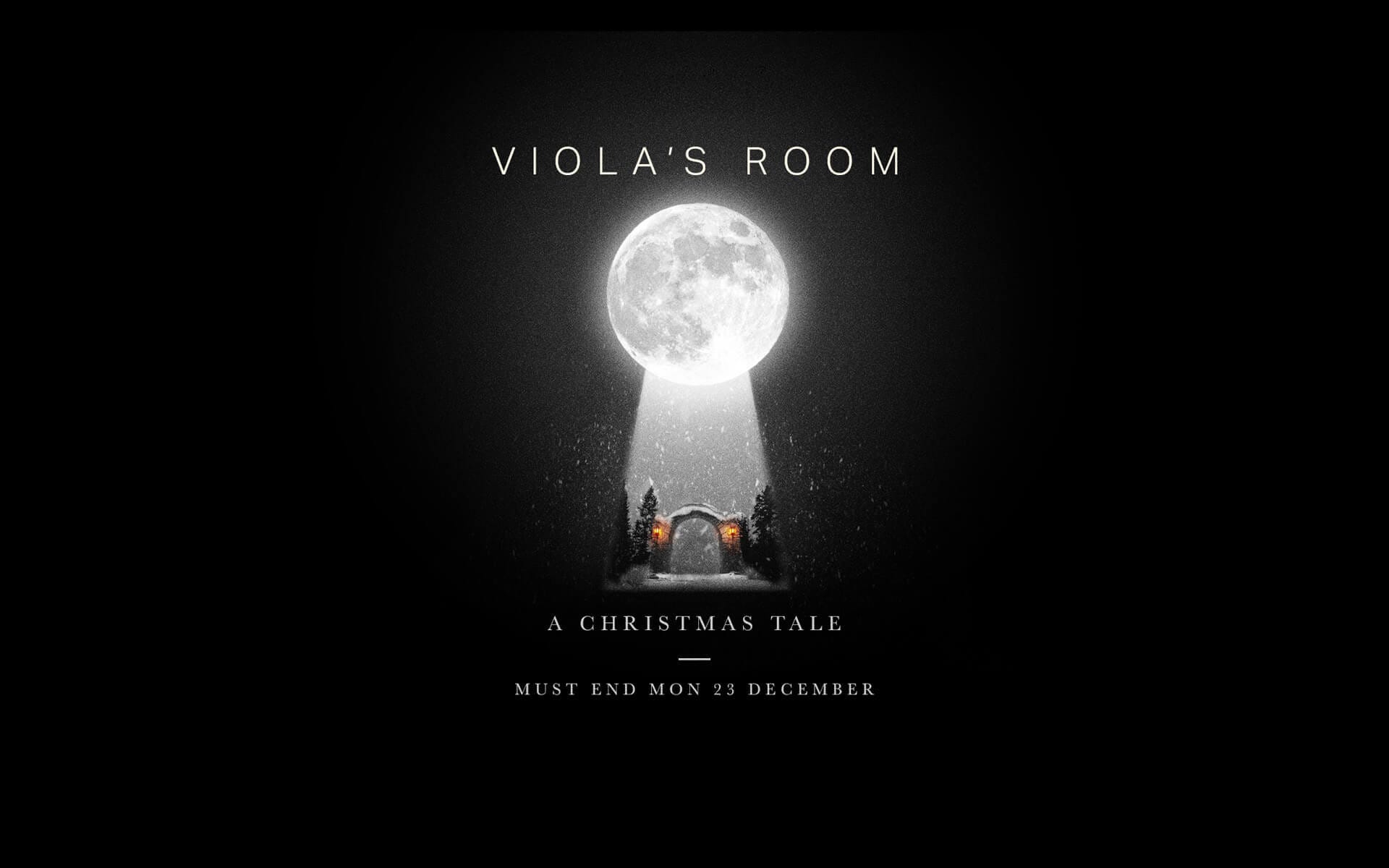
Punchdrunk’s production of Viola’s Room continues in a special Christmas themed version until Mon 23 December, 2024. Tickets can be found here.
Comments
Nothing yet. Say the first thing.
Sign in to join the conversation.