
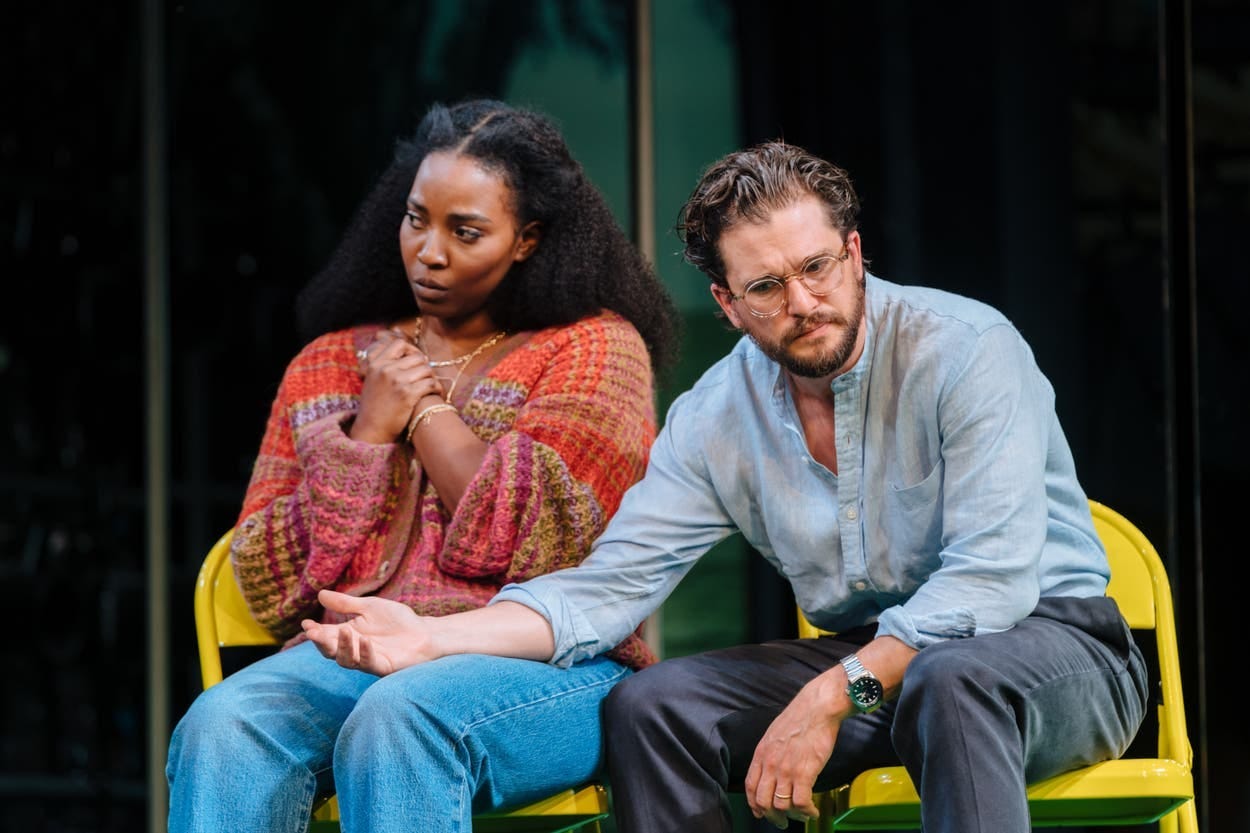
If I had a roster of writers to call upon, I would ask a Black or non-White writer to cover Slave Play. Because if one message is clearly communicated in the performance, it is that White voices tend to drown out Black voices, even when we think we are doing the right thing.
But within that framework, there is a second idea being pursued: the extent to which we are all performers in a role-play. Not the psychosexual role-play happening on stage, but one that is played out by the audience as it is watching, and continues on into everyday life — the role-play of racial dynamics.
While those dynamics may be slightly different in London than they are in New York or Virginia, they exist nonetheless. And Jeremy O. Harris’s stage serves as a kind of meta-theatre, literally reflecting our reactions back at us.
There is some debate over what is considered a spoiler when approaching Slave Play. I think it’s almost impossible to discuss the play without being aware of what some people are calling a second-act reveal. And since even the show’s promotional interviews and materials are frank about the second act, I think very little is spoiled by being aware of it.
So with that in mind: mild spoilers ahead.
Work, work, work, work, work, work
The story in Slave Play concerns three interracial couples enrolled in a thesis study called “Antebellum Sexual Performance Therapy.”
It opens with tableaus of each couple in pre-Civil War costume, role-playing sexually charged master-slave relationships. These progress toward full-blown sexual encounters, until things begin to go wrong and a safe word is called out.
If you did not know anything about the play, the first few moments might lead you to believe that these scenes are intended to be taken as historical. But as Kaneisha (played by Olivia Washington) begins to twerk to the song “Work” by Rhianna, encouraged by her ‘overseer’ Jim (Kit Harington); and Alana (Maite Jauregui) brandishes a modern dildo which she plans to use on her Black ‘servant,’ Phillip (Aaron Heffernan), it quickly becomes apparent that we are not witnessing anything in the past. These are farcical recreations with all the subtlety of a porn video.
When the disastrous proceedings are ended by Jim, the players (in everyday clothes) enter a post-role-play therapy session in which all three couples — moderated by an interracial, lesbian couple running the study — discuss what happened. Naturally, things get heated, and at times even the moderators find themselves at odds, unable to move forward.
The stage design tells us a great deal about Slave Play. The stage is backed by a set of mirrors, floor to ceiling, which open to allow actors and props to enter. But at all times, we, the audience, are forced to face ourselves in the background. (In the final act, the mirrors shift to focus on the bed in the centre of the stage.)
The reactions of the audience (left partially lit by the lowered house lights) are the most important part of the ‘work’ being done over the course of the characters’ ill-advised therapy.

Performing Virtue
While you can argue that there is an aspect of the show aimed at White audiences, Slave Play was not written as a lesson in becoming a better White person. According to Harris himself, it was written to examine his own feelings about race and intimacy.
Speaking to The New York Times, Harris said, “The main audience for this play was, and always has been, me.”
But an unreasonable amount of British media attention surrounding Slave Play focused on the decision to include Black Out Nights: two performances in which the show would be open chiefly to audience members who identify as Black. In fact, so much was made of this that the British prime minister (at that time, Rishi Sunak) felt the need to weigh in, declaring such nights “divisive.”
We can be relatively confident that Sunak did not attend the play before making this declaration.
Harris came up with the idea of Black Out Nights to take the focus away from the performance of White guilt and well-meaning ally-ship in the audience, and to offer Black audiences the opportunity to react to the show without worrying about the fragility of the White viewers around them.
Now, obviously, I did not attend a Black Out performance, and yet the reasoning behind these performances quickly became clear to me:
The show is filled with genuinely funny moments — some sarcastic, some absurd, and some with such cringing racial humour that it is difficult to know whether or not to laugh. These are the moments where, as a White viewer, I worried that laughing out loud could be misconstrued as laughing along with a racist trope, rather than laughing at the character who uttered it.
Perhaps you think I’m being oversensitive. If so, I envy your self-assuredness. But I also recommend reading the discussion in Vox between Aja Romano, Allegra Frank, and Constance Grady. They talk about the experience of seeing Slave Play on Broadway, and the sometimes overzealous — even interruptive — reactions of White audience members virtue-signalling to those around them
In an audience that was (in my rough estimate) forty per cent Black, I found myself painfully aware of my reactions, my laughter, my silences. And while I would have preferred invisibility over moral grandstanding, I still felt defensive.
“That’s not me,” I wanted to say, “I’m one of the good ones!”
These issues are built into the structure of the play, as well.
It is why Jim — despite being White and perfectly safe — is the person who shouts out the safe-word, ending the role-play for everyone just to voice his own discomfort.
It is why his wife, Kaneisha, seems unable to process her feelings about their relationship — she is continually trying to frame her emotions in a way that will not make her husband feel guilty.
It is why Gary (Fisayo Akinade) is struggling in his relationship with his partner Dustin (James Cusati-Moyer), who repeatedly claims not to be White but will not give voice to what that means, while at the same time accusing Gary of behaving in a way that is ‘too White.’
Each partner, even while trying to be supportive, is still most concerned with their own ego.
The failure of therapy
Slave Play is a solid two hours without an interval — shorter than your average Hollywood film these days. Yet, theatre tends to make the time feel longer.
While I would have liked an interval, the decision not to have one is likely a deliberate one. Aside from the obvious difficulty of fitting a break into the narrative, the entire play is an exercise in sitting with uncomfortable material.
It is almost cliché these days, particularly in American progressive circles, to talk about ‘sitting with discomfort.’ But if the audience had been given an interval in which to retire to the lobby, grab a glass of wine, and blow off the tension of the show with a bit of awkward laughter, it would almost certainly have undercut much of what the play sets out to accomplish.
Instead, the tension builds slowly, and the audience watches through their nervousness, their self-awareness, staring at themselves in that onstage mirror and participating in every moment of the therapy’s convolutions in real time.
We watch as the moderators attempt to give everyone a chance to speak, but end up enabling the White partners, who, in turn, offer long-winded explanations about how difficult it is for them to deal with race. People continually interrupt one another. Some hog the spotlight. Some refuse to speak. The moderators take one approach, reverse, then try again.
Everything is replete with the saccharine language of self-help books, occasionally shifting into impenetrable academic jargon, as the moderators forget themselves and talk about their research rather than the couples in front of them.
(As a digression, I was fascinated by the moderator/therapist couple and wanted more. Developing their story further goes beyond what Harris was trying to accomplish, but to me, these two characters perfectly embody the struggle to deal with trauma and emotion through logic and academic sterility. Personally, I would pay to watch another play focusing on this couple alone.)
At times, you can see the gears turning — Harris moves the spotlight from one couple to the next, and one issue to the next, determined to examine each combination of race, gender and power in detail. And in these moments, it threatens to become the kind of academic lecture that it is satirising.
But overall, these issues are minor in the face of what the play achieves. And the performances are excellent — sometimes understated, sometimes flamboyant, with comic moments and serious undercurrents that are always spot-on.
When the third act arrives, it is a sharp punch to the gut.
Black voices are by no means unified in their views on Slave Play, and Harris has said that he sees disagreement as part of the discussion. But don’t take it from me — it isn’t difficult to find Black reviewers talking about the show. Here’s one. And here’s another. Here’s Jeremy O. Harris talking about it himself on NPR’s Fresh Air. Get on Google. Do the work.
Maybe the best way to approach Slave Play is to realise that it represents the world in microcosm — which is exactly why so many audience members, both Black and White, have walked out of the theatre when the performance failed to give them what they expected.
Like any good artwork, Slave Play is a discussion rather than a lecture. A question rather than an answer. When reviewers approach it as a lesson in how to be a good White ally, they eclipse the issues that Black audiences see: the deep-seated generational trauma of slavery, and the insidious ways that it still informs race. By focusing on ‘lessons,’ the play is reduced to a tool for White betterment. But when you listen to the conversation (and sometimes the arguments) surrounding Slave Play, it becomes something much, much larger.
Issues of race are complex, sometimes disturbing and often infuriating. Slave Play provides no easy answers, but whatever way you end up engaging with it, you’ll find yourself reflected there.◾️
Slave Play, by Jeremy O. Harris, is on at the Noël Coward Theatre until September 21, 2024.
Comments
Nothing yet. Say the first thing.
Sign in to join the conversation.