
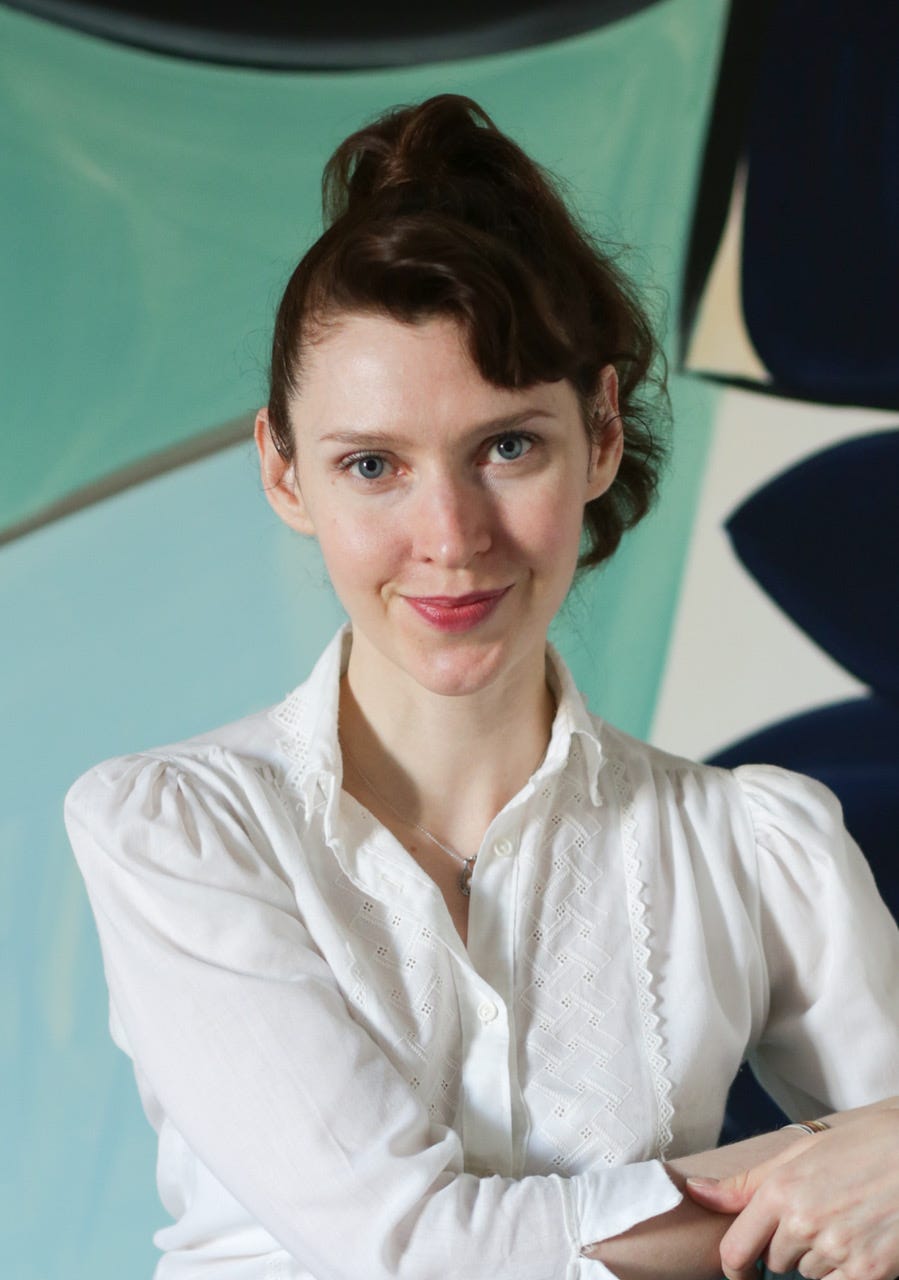
There are artists who use abstraction as a way of distancing themselves from reality. Patricia Treib does exactly the opposite. She uses it to move closer to it. Her paintings do not depict recognizable objects or specific scenes, yet they are deeply rooted in the experience of seeing, remembering, and feeling. Each canvas seems to hold the echo of something once lived—a fleeting image that has been reshaped by memory until it becomes something entirely new.
Born in 1979 in Saginaw, Michigan, Patricia Treib studied at the School of the Art Institute of Chicago before earning her MFA from Columbia University. She has lived and worked in Brooklyn for many years, building a distinctive career that has attracted international recognition. Her work has been exhibited at galleries including Kate MacGarry in London, Galerie Nordenhake in Stockholm and Mexico City, Bureau in New York, and Galería Marta Cervera in Madrid. In 2020, she was awarded a Guggenheim Fellowship, a milestone that confirmed her unique position within contemporary painting.
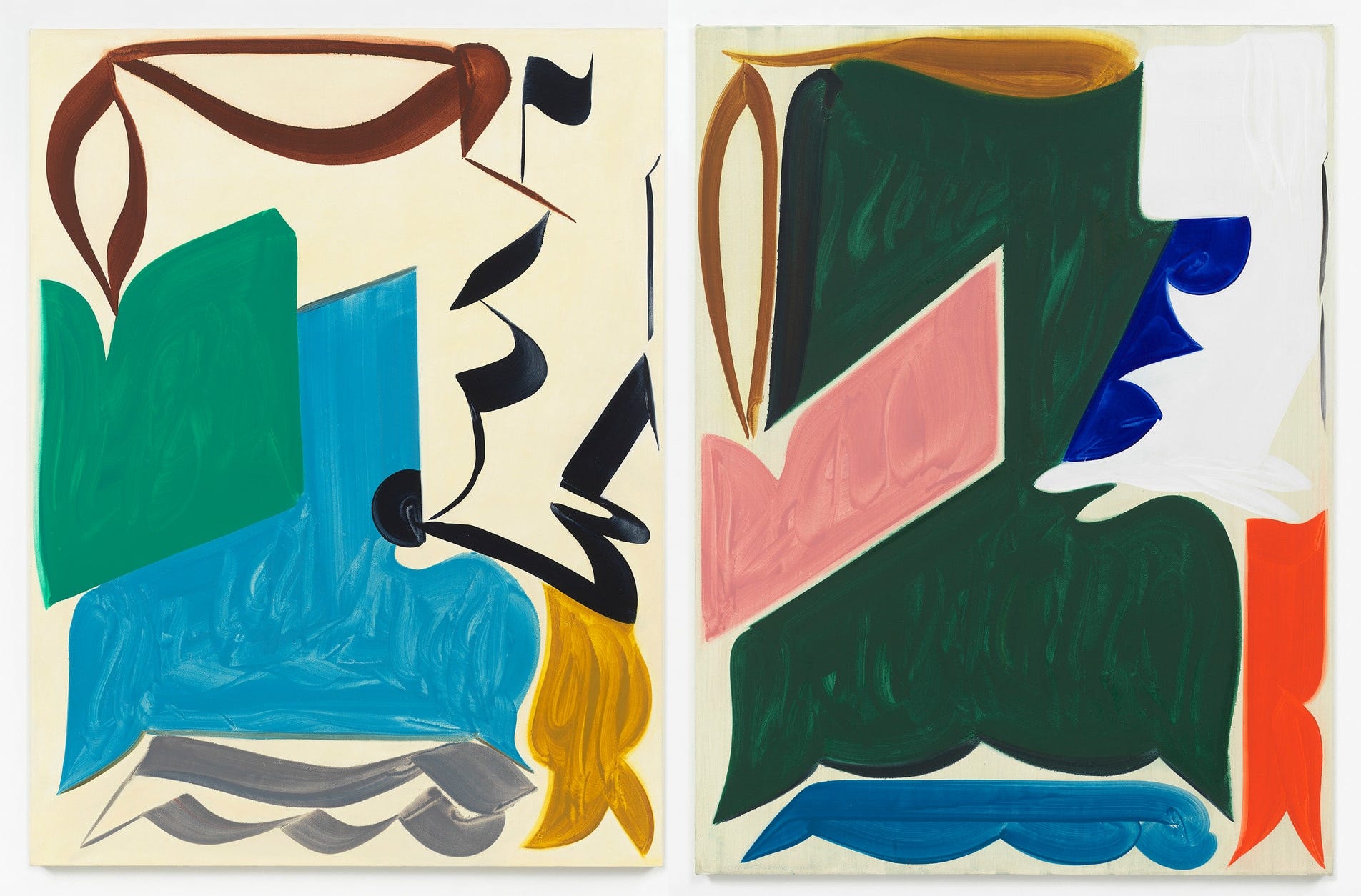
Although her paintings initially appear completely abstract, Treib insists that they never begin with pure invention. Everything starts with something she has seen: the edge of an object, an architectural detail, the fold of a piece of fabric, the silhouette of a figure in an old painting, or a fragment of everyday life quietly observed over the years. These visual impressions remain stored in her memory until, often much later, they re-emerge transformed into an entirely new visual language. She is not interested in reproducing the visible world but in capturing the way memory reshapes what we have experienced.
That relationship with memory is deeply connected to her own life. In interviews, Treib has recalled that her father was a watchmaker and that much of her childhood was spent surrounded by antique clocks, tools, and intricate mechanical parts spread across his workshop. Looking back, she realized that this was her first encounter with what a creative studio could be. It was not a painter’s studio, but it was a place where objects were examined with patience and every small component carried its own story. That careful way of looking continues to shape her artistic practice today.
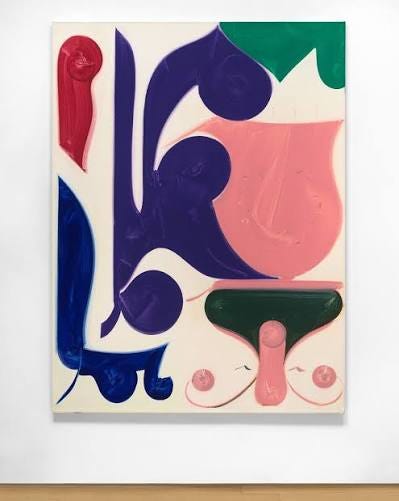
Her childhood was divided between the city and a rural home surrounded by nature, an environment that encouraged long hours of quiet observation. That experience continues to inform her paintings—not through literal landscapes, but through an attitude of attentive looking. Her work asks viewers to slow down, discovering relationships between shapes and colors that reveal themselves gradually. At a time when images are consumed almost instantly, Treib offers paintings that reward patience.
One of the defining moments in her artistic development came during her teenage years, when she visited a major Edgar Degas retrospective at the Art Institute of Chicago. The exhibition transformed her understanding of painting. More than the subjects themselves, she was captivated by Degas’s unconventional framing, cropped compositions, and the sense that the image extended beyond the limits of the canvas. That influence remains visible in her own work, where forms are often partially hidden, interrupted, or cut off, inviting viewers to imagine what lies beyond the picture.
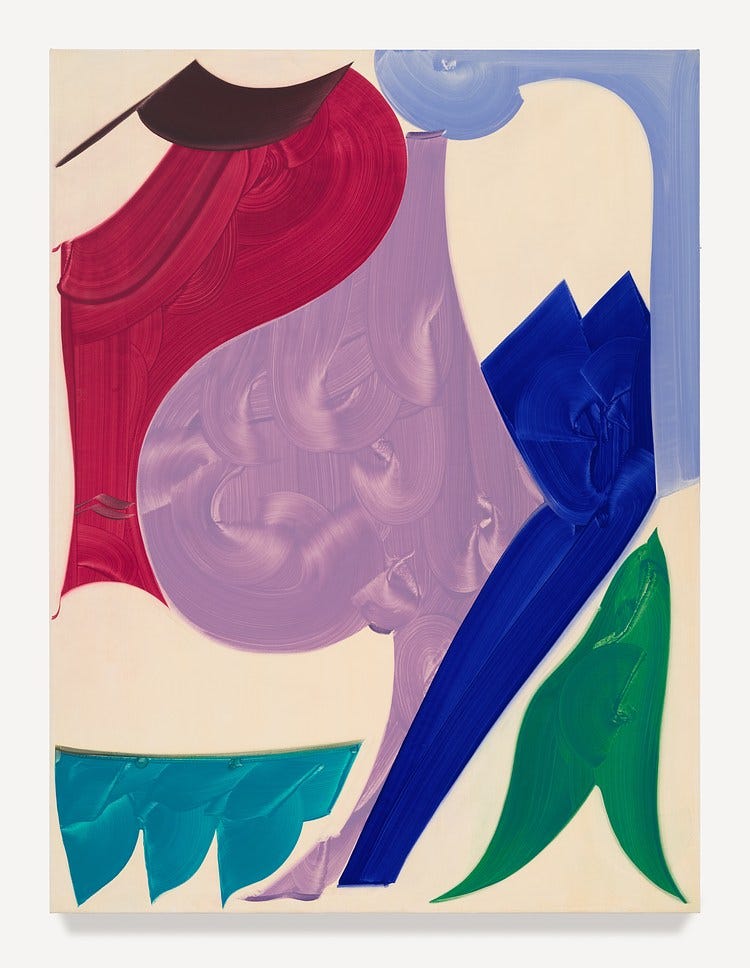
Perhaps the most compelling aspect of Treib’s practice is the role that memory plays within it. She has spoken about the profound influence of Marcel Proust on her thinking, particularly his idea of involuntary memory—the unexpected recollections awakened by a smell, a color, or a fleeting sensation. Rather than illustrating memories directly, Treib creates images capable of awakening memories within the viewer. This may explain why her paintings feel strangely familiar despite depicting nothing that can be clearly identified.
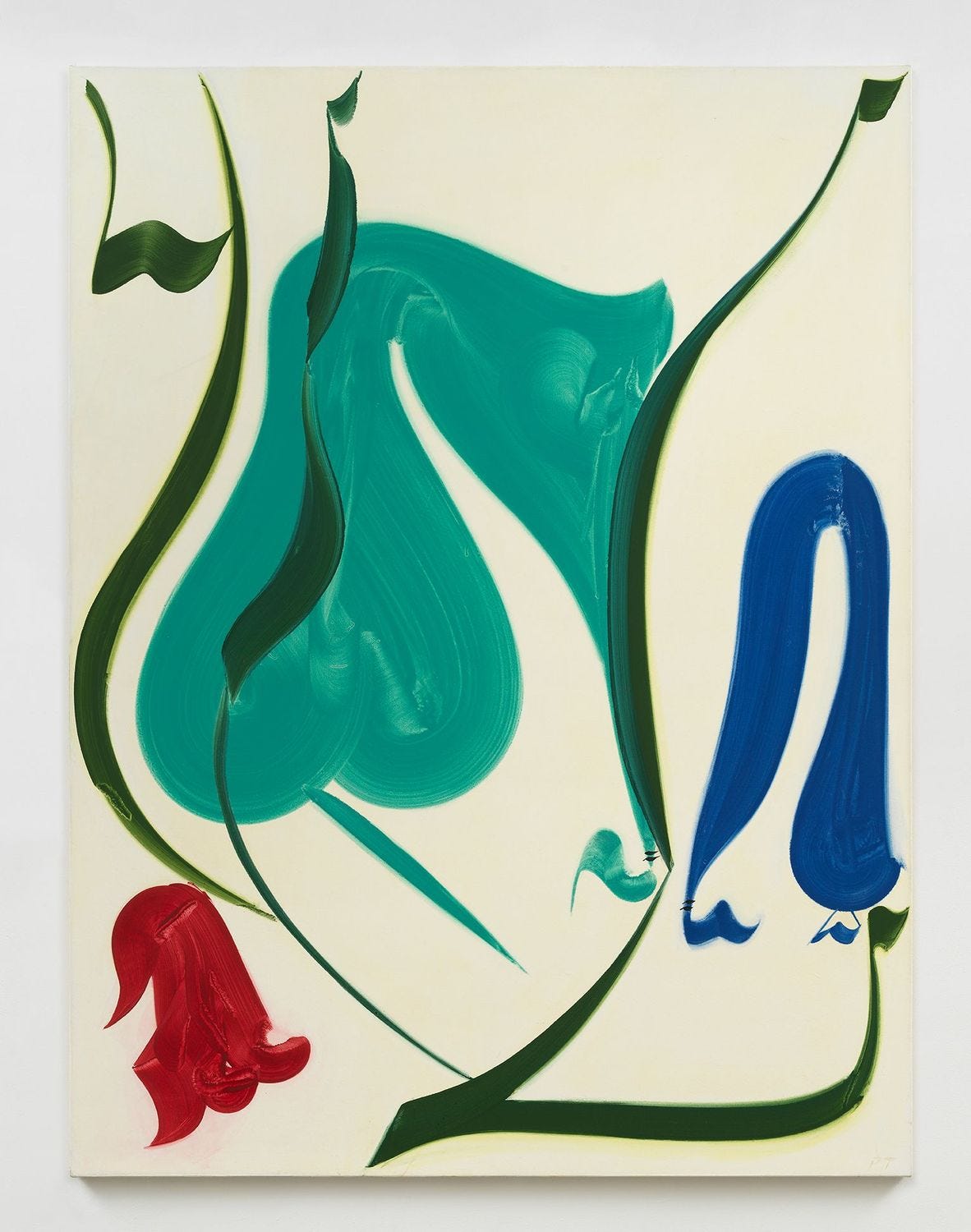
The shapes inhabiting her canvases never fully settle into fixed identities. A contour might resemble a hand, a piece of clothing, a leaf, a camera, or a ceramic vessel, only to transform into something entirely different a few moments later. That ambiguity is not accidental; it is the very foundation of her painting. Treib wants the image to remain alive, constantly shifting as we look at it.
Her understanding of negative space is equally distinctive. Instead of treating the background as secondary, she gives empty spaces the same importance as painted forms. The gaps between shapes generate rhythm, tension, and balance, becoming just as significant as the forms themselves. Her paintings are constructed as much through absence as through presence.
Her working process reflects that same sense of patience. Before beginning a canvas, she produces numerous drawings and watercolors, testing relationships between forms, colors, and spatial arrangements. Once she finally starts painting, however, she tries to erase every trace of that preparation. The finished work should feel immediate and effortless, as though it emerged naturally, even though it rests upon an exceptionally rigorous structure.
Color also plays a crucial role in creating the quiet atmosphere that defines her paintings. Muted greens, dusty pinks, soft blues, warm ochres, and creamy whites produce surfaces where light seems to emerge from within the canvas itself. She never uses color for dramatic effect. Instead, it becomes a way of constructing an emotional space where contemplation can unfold at its own pace.
In an era dominated by instant images and immediate narratives, Patricia Treib demonstrates that painting can still offer a slower, more intimate experience. Her works do not provide easy answers or fixed meanings. Instead, they invite viewers to remain with them long enough for memory to begin doing its own work.
That may ultimately be the greatest strength of her art. Rather than representing the world as we see it, Patricia Treib paints the way it remains inside us after it has been lived. Somewhere between observation and recollection, between reality and imagination, she has created one of the most subtle and distinctive voices in contemporary painting.
Comments
Nothing yet. Say the first thing.
Sign in to join the conversation.