

Born in Paris in 1982 and now based in New York, Julie Curtiss has become one of the most distinctive painters of her generation. Trained in France before moving to the United States, Curtiss followed an unconventional path that included a period working in the film industry before fully dedicating herself to painting. That experience seems to have left a lasting mark on her work. Her paintings possess a cinematic quality: carefully composed scenes, seemingly insignificant details that become central to the narrative, and an atmosphere charged with psychological tension. In little more than a decade, her work has attracted the attention of collectors, museums, and galleries around the world thanks to a visual language that combines technical mastery, humor, unease, and a sharp reflection on contemporary identity.
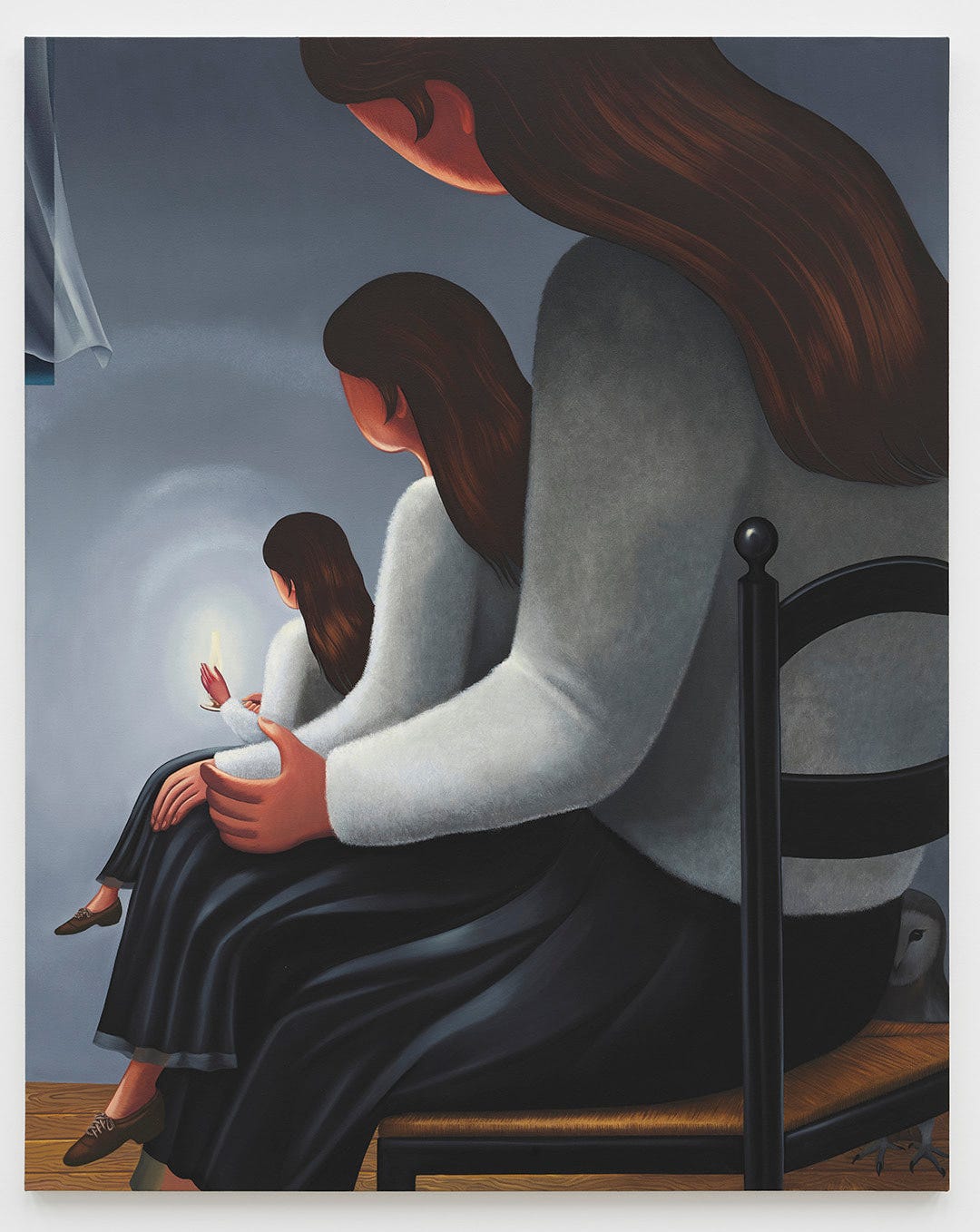
At first glance, Julie Curtiss’s paintings captivate through their formal clarity. The colors are precise, the surfaces immaculate, and the compositions constructed with almost obsessive discipline. Yet beneath this polished appearance lies a deeply unsettling universe. The artist works with everyday elements—hair, hands, nails, domestic interiors, animals, and plants—which she rearranges in unexpected ways, transforming them into images loaded with psychological ambiguity. Nothing appears overtly surreal, but something is always slightly out of place. It is within this subtle displacement that the power of her painting resides. Viewers recognize what they are looking at, yet they sense that a hidden story is unfolding just beyond reach.
Curtiss herself has explained that many of her works originate from spontaneous mental images that emerge while walking, meditating, or even during bouts of insomnia. Rather than beginning with a rigid concept, her paintings develop through free associations in a process that resembles the logic of dreams. This approach helps explain why her images feel both familiar and strangely elusive. They are not illustrations of a fixed idea nor closed narratives. Instead, they function as fragments of thought—visual impressions emerging from a space between memory, fantasy, and observation. The result is a body of work that invites multiple interpretations while always preserving an element of mystery.
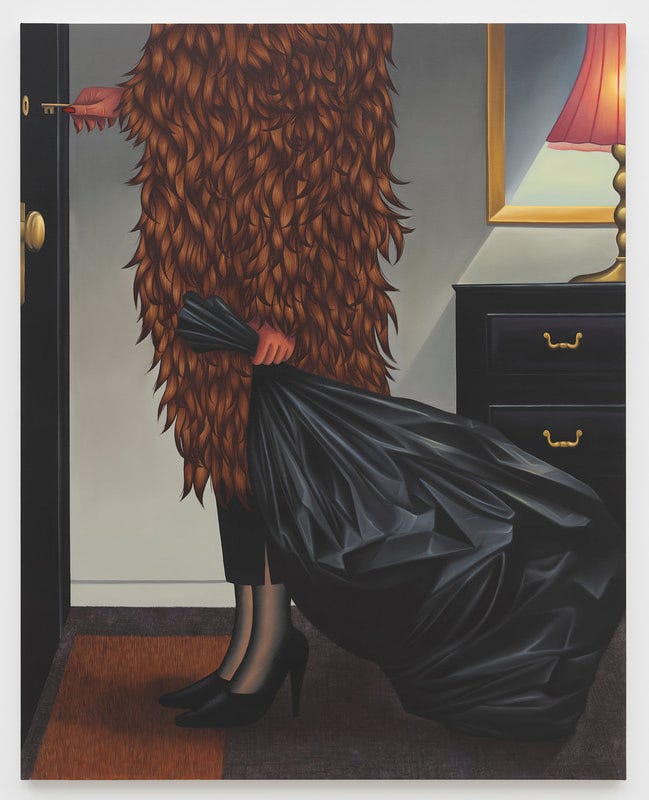
One of the most recognizable aspects of her practice is the way she depicts the human body. Faces are often absent or concealed, while elements that might otherwise seem secondary, such as hair, take center stage. Braids, buns, curls, and flowing locks occupy large portions of the canvas, becoming almost autonomous landscapes. Curtiss has remarked that she is fascinated by hair because it possesses a peculiar quality: it is part of us, yet it can be separated from the body without pain. It is both intimate and external at the same time. This duality reflects many of the concerns running throughout her work. Her figures are rarely identifiable individuals; instead, they function as open-ended archetypes onto which viewers can project their own emotions, memories, and experiences.
Although her work is often discussed through a feminist lens, Julie Curtiss avoids explicit statements or ideological positions. Her paintings explore representations of women from a far more nuanced and ambiguous perspective. In one interview, she noted that she enjoys being a woman painting women because it creates a strange situation in which she is simultaneously the observer and the observed. This idea runs throughout much of her work. Symbols traditionally associated with femininity—hair care, beauty rituals, domestic spaces, and the construction of appearance—recur repeatedly in her paintings, yet never in a simplistic way. Rather than celebrating or criticizing these elements, Curtiss examines them as part of a complex network of social expectations, personal desires, and cultural constructions.
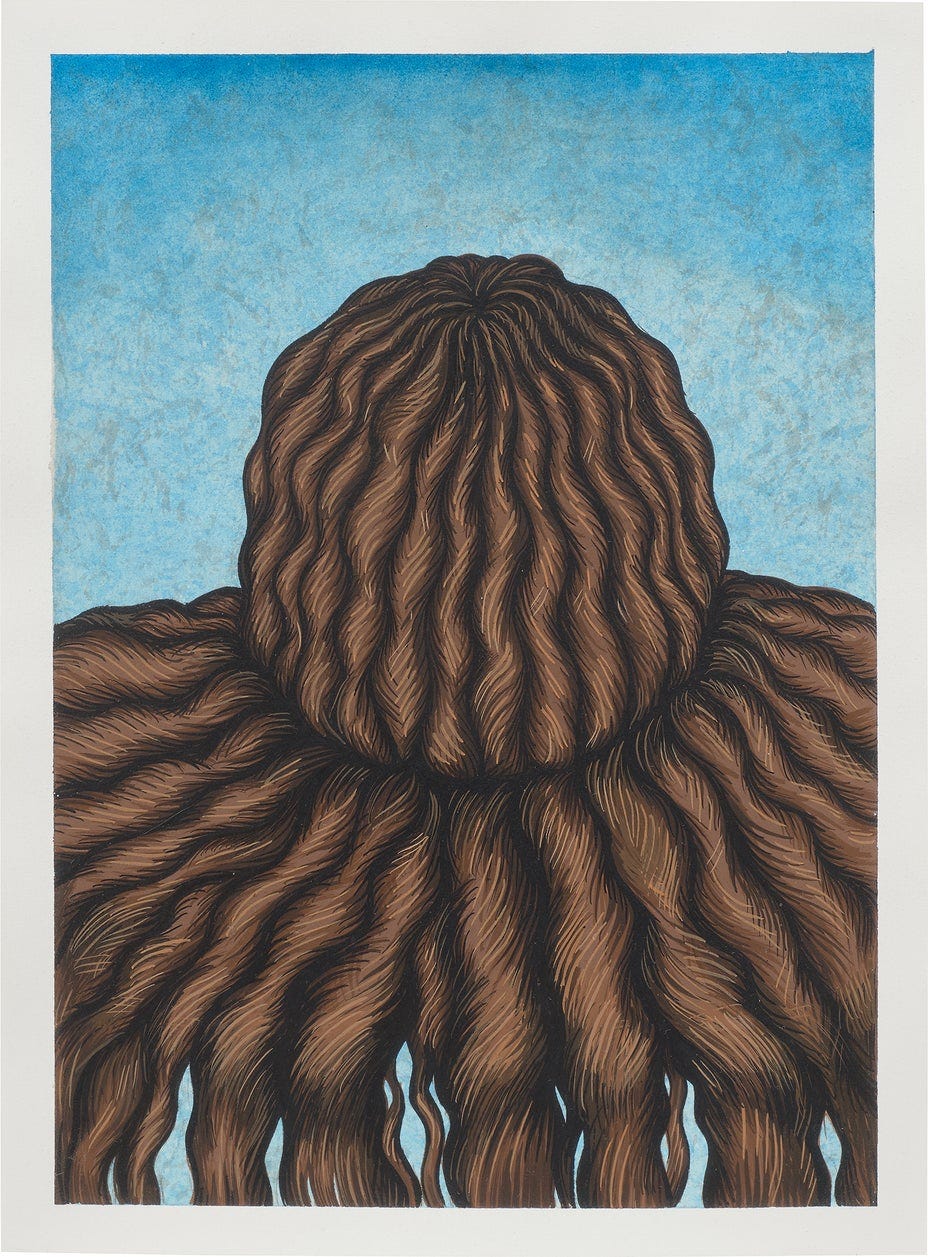
Another quality that distinguishes her work is its ability to balance humor and unease. Many of her images contain an unmistakably comic dimension, though it is a subtle and sophisticated form of humor that emerges through unexpected juxtapositions and visual contradictions. A scene may appear amusing at first glance, only to become slightly disturbing moments later. This capacity to generate conflicting emotional responses places her work within a tradition that connects both to historical Surrealism and to contemporary artists interested in exploring the ambiguities of human experience. Curtiss seems particularly drawn to those moments when the familiar ceases to be entirely recognizable and begins to reveal something hidden beneath the surface.
In an era dominated by the rapid consumption of images, Julie Curtiss’s paintings invite viewers to slow down and look more carefully. Her works possess the rare ability to attract immediate attention while resisting definitive interpretation. The longer one spends with them, the more complex they become. What initially appears to be a domestic scene transforms into a reflection on identity; a simple hairstyle acquires unexpected psychological resonance; an insignificant detail becomes the focal point of the entire composition. This ability to transform the ordinary into something profoundly strange is perhaps one of the reasons her work has become so influential within the contemporary art world.
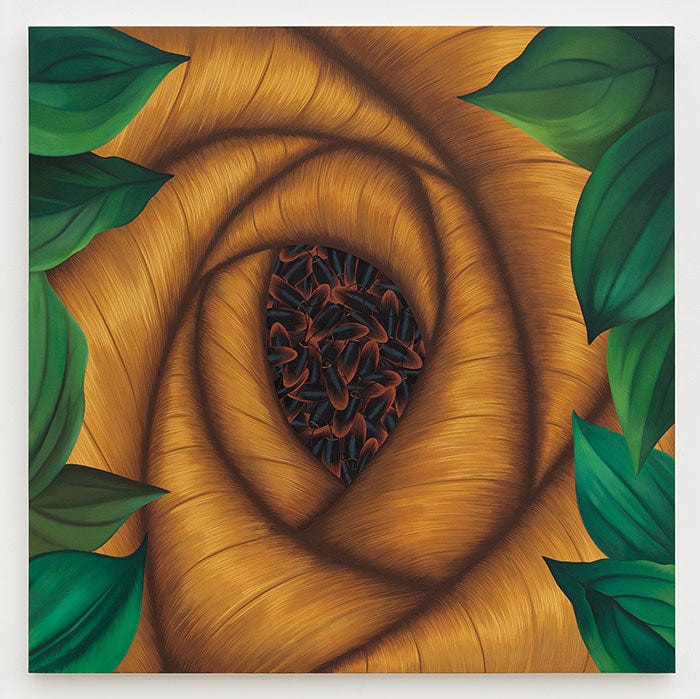
Julie Curtiss reminds us that mystery is not necessarily found in extraordinary places. Sometimes it hides within everyday gestures, familiar objects, or those aspects of our own identities that we rarely question. Her paintings encourage us to look again at what we think we know, revealing that beneath the seemingly stable surface of reality lies a far more complex, ambiguous, and fascinating territory. It is within this delicate balance of beauty, irony, and strangeness that Curtiss has created one of the most compelling and recognizable visual languages in contemporary painting today.
No posts
Comments
Nothing yet. Say the first thing.
Sign in to join the conversation.