
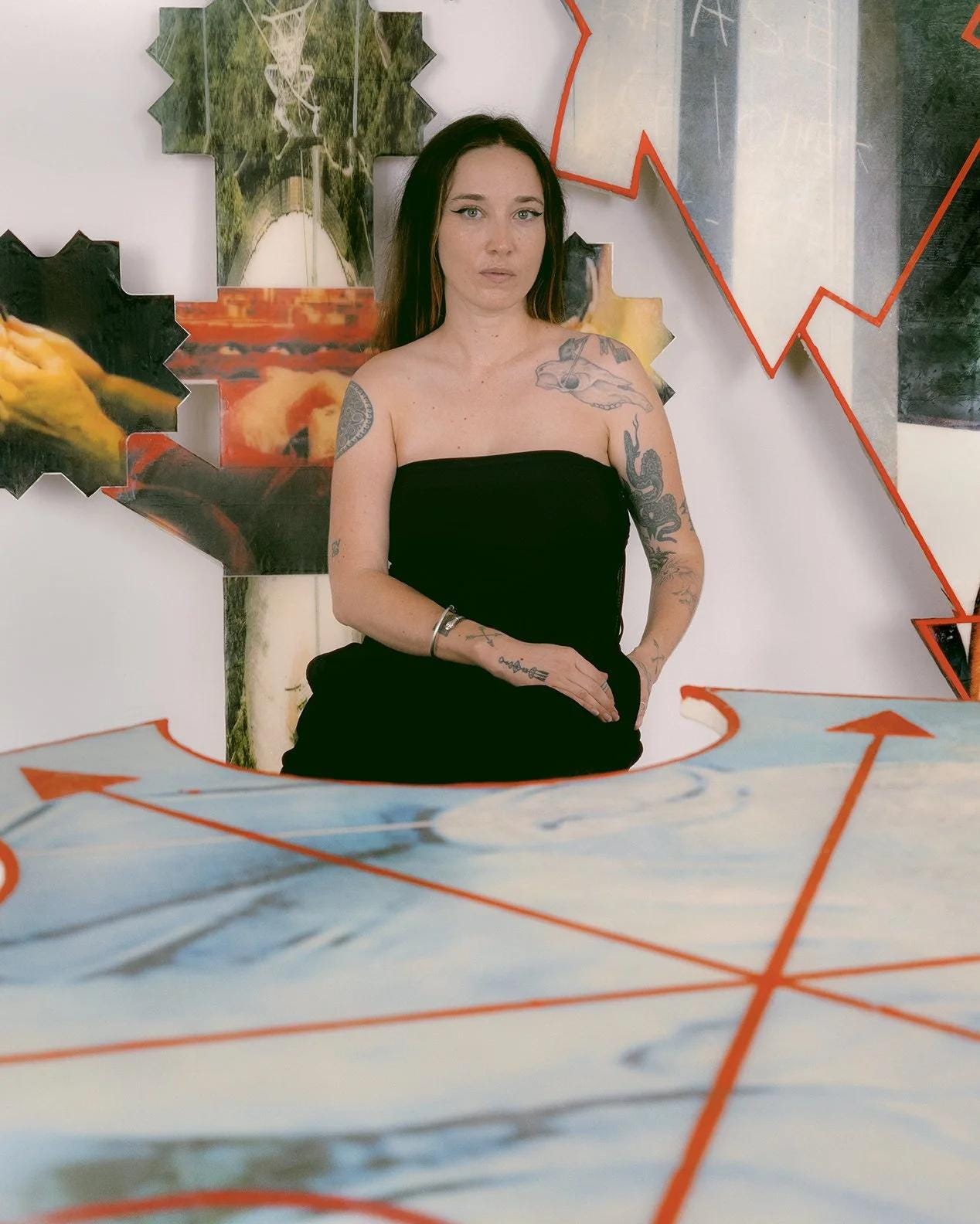
Nina Hartmann belongs to a generation of artists shaped by the internet, information overload, and a deep mistrust of traditional systems of authority. Based in Queens, New York, Hartmann has developed an interdisciplinary practice that combines painting, sculpture, assemblage, archives, and digital manipulation to investigate how images construct systems of power and belief. Her work constantly moves between the institutional and the esoteric, between documentation and fiction, drawing from references that range from military archives and government documents to conspiracy theories, mystical symbolism, and internet culture. What makes her work so compelling is that it never presents itself as a definitive statement about truth. Instead, it operates as an exploration of contemporary uncertainty and the growing impossibility of clearly distinguishing between information, propaganda, and perception.
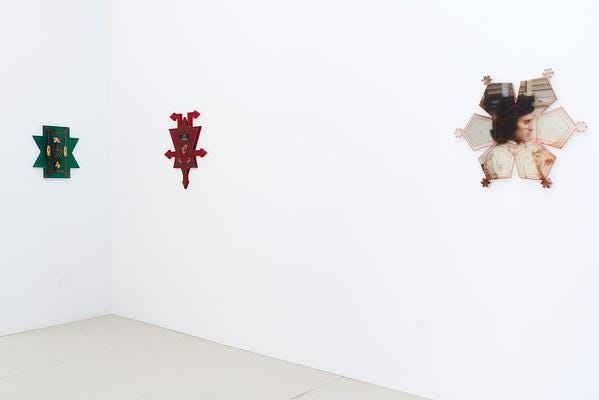
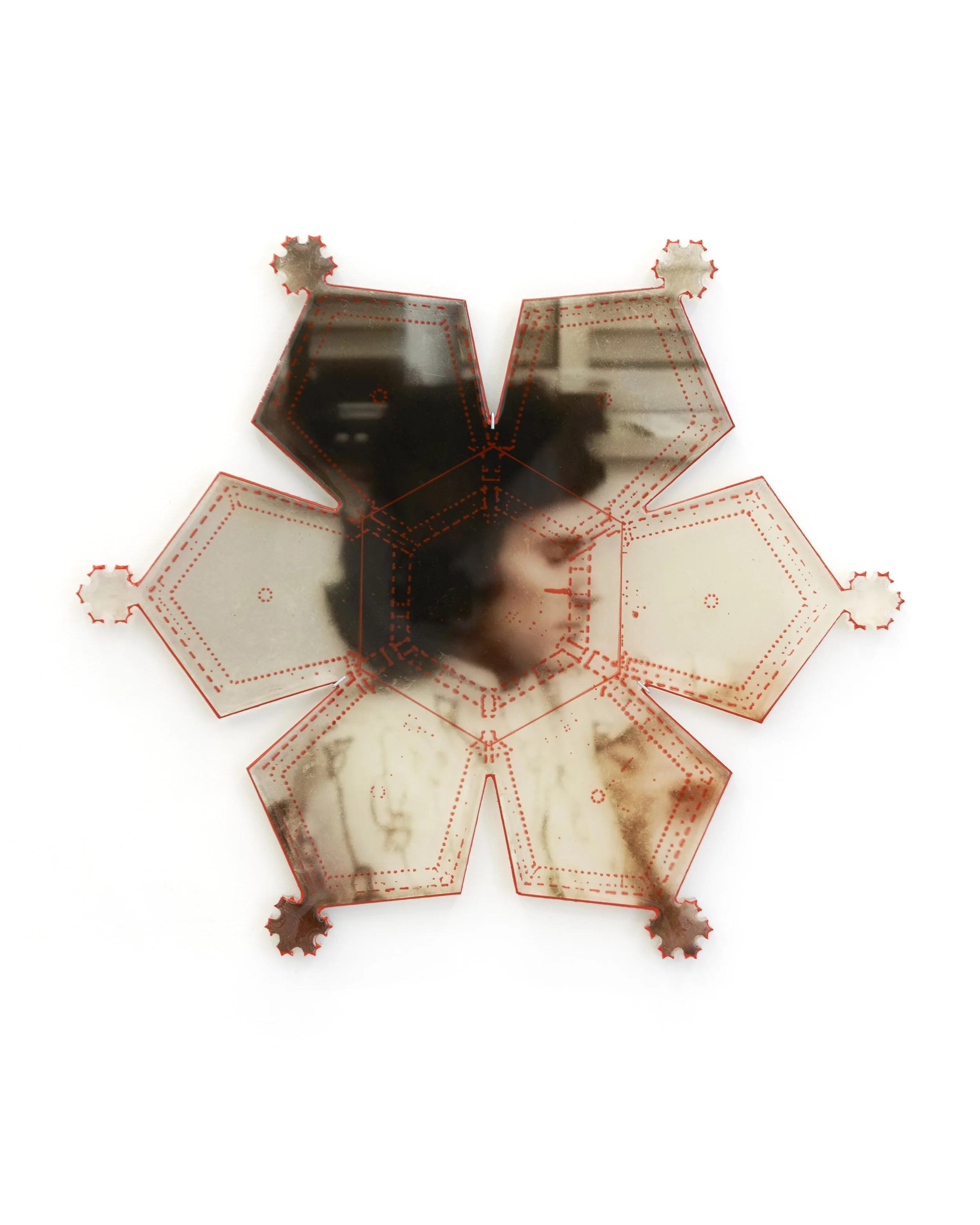
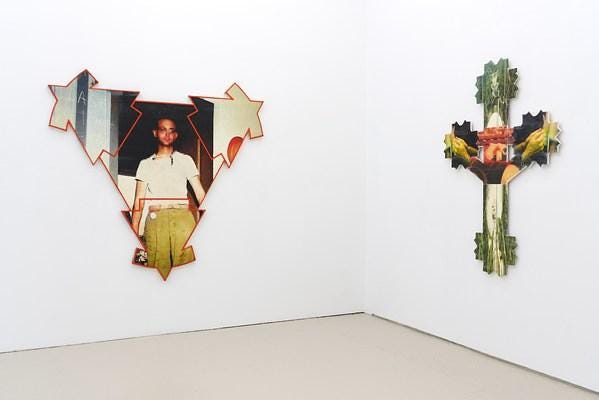
Over the past few years, Hartmann has gained attention precisely because of her ability to transform materials associated with institutional control into deeply ambiguous and psychological objects. Many of her pieces resemble diagrams discovered inside a classified archive or artifacts belonging to a future civilization. There are translucent surfaces, images suspended in resin, geometric symbols, wheels, stars, and structures that simultaneously evoke technological interfaces and ritual objects. That combination creates a distinctly contemporary feeling: the sense of standing before a visual language we instinctively recognize even if we never fully understand it.
In a recent interview, Hartmann explained that one of her main goals is to “disrupt a lot of these systems of delivering data.” The statement perfectly captures the core of her practice. Her work does not engage with conspiracy through spectacle or sensationalism, but through something far more complex: the aesthetics of power and the mechanisms through which institutions produce visual legitimacy. Across different series, she has incorporated material connected to CIA research, Cold War-era extrasensory perception programs, and official archives tied to paranormal phenomena. But in her hands, those documents immediately lose any appearance of objectivity. They are fragmented, manipulated, and reassembled until they become symbols of an unstable reality.
This is where Hartmann’s work resonates so strongly with the present cultural moment. We live in an era where images circulate faster than any possibility of verification, where artificial intelligence can generate photographs indistinguishable from reality, and where social media transforms emotional narratives into collective truth almost instantly. Hartmann seems to understand that contemporary anxiety does not come only from information overload, but from the gradual erosion of the systems that once defined what could be trusted. In another interview she remarked that “we live in an information age where it’s almost impossible to know the true source of legitimacy,” and it is difficult to imagine a more accurate description of the dominant cultural mood of this decade.
Although many contemporary artists are currently working with artificial intelligence, digital appropriation, and internet aesthetics, Hartmann avoids any superficial techno-optimism. Her approach feels far more archaeological than futuristic. In her work, the digital never appears as a promise of progress but as evidence of a fragmented and endlessly manipulable reality. That is precisely why materiality becomes so important in her practice: resin, wax, pigments, and physical surfaces restore weight and texture to images that would otherwise exist only as digital flow. Her work repeatedly asks what happens to human perception once we can no longer fully trust the images we see.
The intellectual and cultural references running through her practice help explain the unsettling atmosphere of her work. Hartmann has cited influences ranging from Carl Jung and Michel Foucault to industrial music acts like Throbbing Gristle. She has also said that she tries to “treat [her] brain as an algorithm,” an idea that reflects the internal logic of her work remarkably well: free association, symbolic accumulation, invisible connections between seemingly unrelated images, and visual systems that function almost like neural networks. Each exhibition becomes a kind of autonomous ecosystem where meaning never fully stabilizes.
One project that encapsulated this vision particularly well was Soft Power, presented at Silke Lindner Gallery in 2023. The title itself felt especially precise because it pointed directly toward contemporary forms of cultural control. Today, power rarely operates through explicit censorship; instead, it functions through design, image circulation, repetition, and the manipulation of attention. Hartmann’s work seems acutely aware that aesthetics are no longer merely decorative but political tools capable of shaping collective imagination and systems of belief.
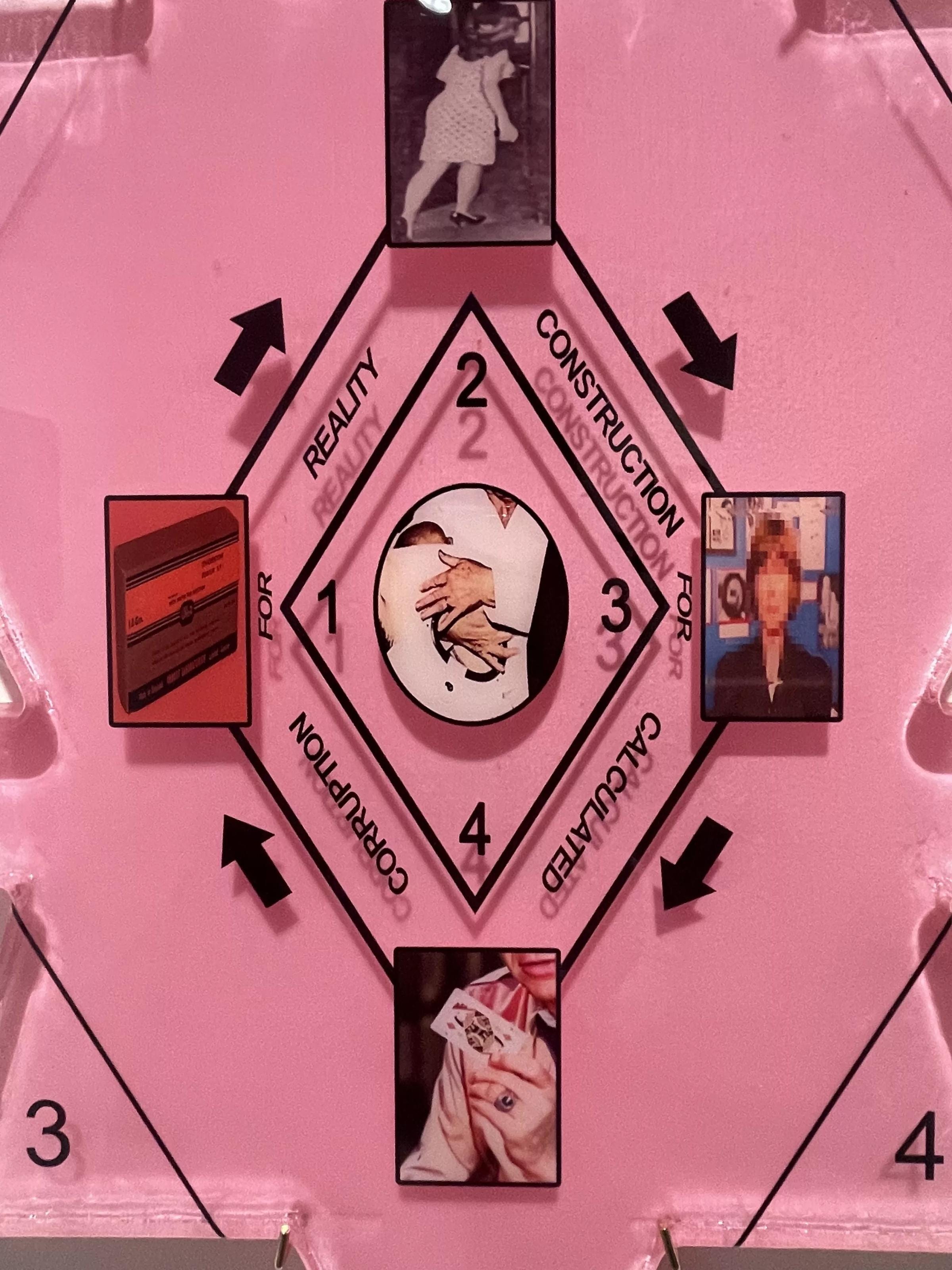
That may ultimately be why her work feels so relevant right now. Some artists produce images. Others produce discourse. Nina Hartmann produces mental atmospheres. Her work captures the sensation of living inside a permanently edited reality where everything can simultaneously function as evidence and simulation. She does not attempt to provide clear answers or moralize about technology and digital culture. What she does instead is something far more unsettling: she forces us to look again at what we thought we already understood.
No posts
Comments
Nothing yet. Say the first thing.
Sign in to join the conversation.