
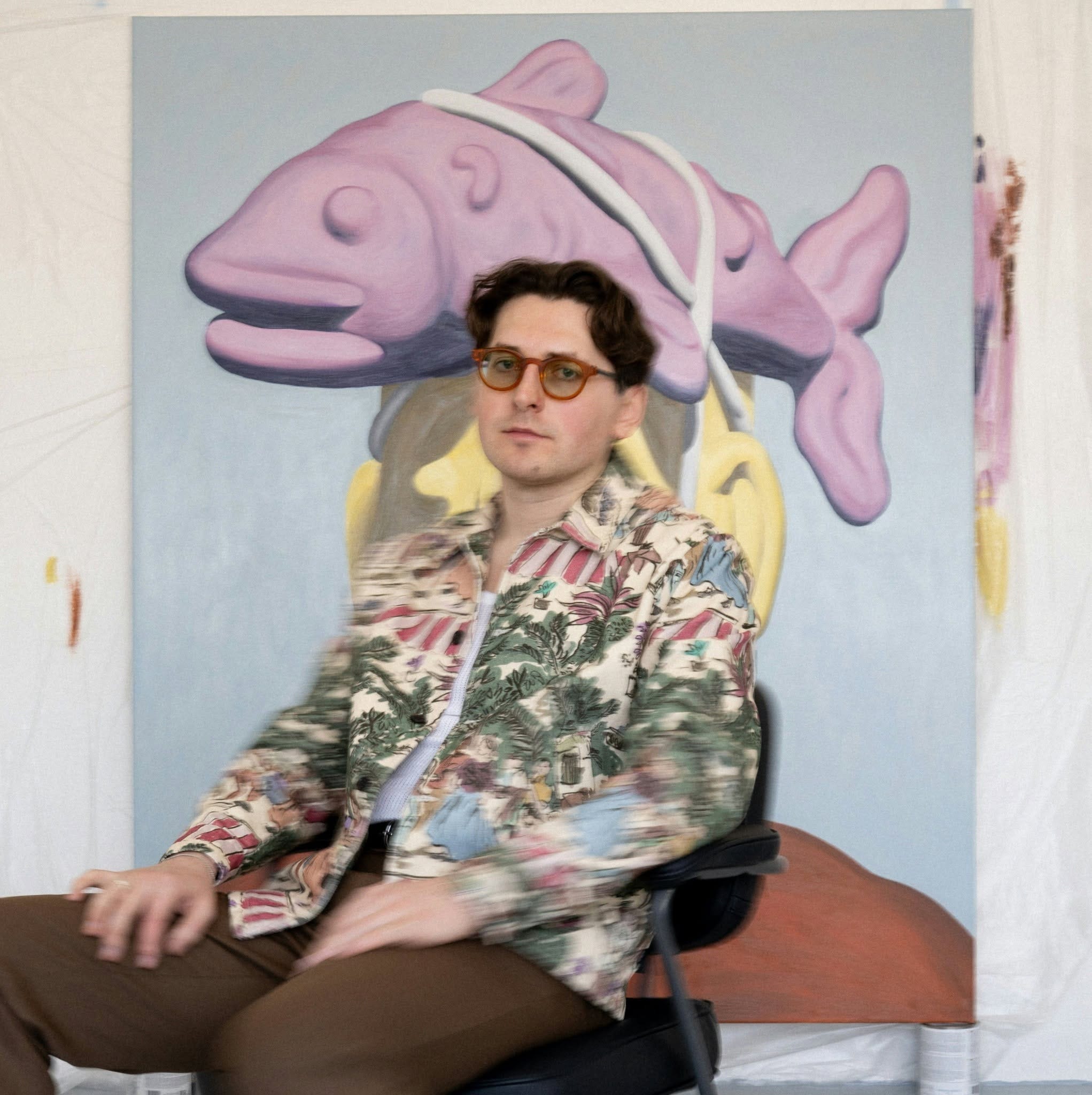
Martynas Auž is one of the most compelling Lithuanian artists of his generation, a creator who has moved seamlessly between urban art, contemporary painting, and emerging technologies. Born in Tauragė, a small city in western Lithuania, he began his artistic journey in graffiti culture before expanding his practice into illustration, animation, studio painting, and virtual reality. Over the years, he has developed a distinctive visual language characterized by soft, sculptural figures, three-dimensional compositions, and an aesthetic that seems to exist somewhere between dreams, memory, and the digital world. His work has appeared both in public spaces and in international exhibitions, establishing a career that challenges traditional distinctions between street art and contemporary fine art.
Auž’s story as an artist began during his teenage years. At around fourteen, he came across a magazine dedicated to Berlin’s graffiti scene and was immediately captivated by what he saw. Looking back, he has described the experience as a revelation. What he discovered in those pages was not merely a visual style but an idea of freedom. Graffiti offered the possibility of transforming public space, reimagining ordinary environments, and building an artistic identity outside conventional institutions. For years he developed his practice on the streets of Tauragė, exploring walls and abandoned spaces that became an open laboratory for experimentation. In later interviews, he explained that creativity had always been part of his life, constantly evolving into new forms. This idea of continuous transformation is essential to understanding his work: graffiti was never a phase left behind, but rather the foundation of an artistic journey that continues to expand.
Growing up far from Europe’s major cultural centers also shaped his approach to art. Tauragė offered something many artists spend their careers searching for: room to experiment without excessive constraints. The city’s peripheral landscapes, empty buildings, and overlooked spaces allowed him to develop a unique visual sensibility. Even today, when working with advanced digital tools, that direct relationship with physical space remains central to his practice. Although many of his works are conceived through 3D modeling software and virtual reality environments, they retain the spontaneity, immediacy, and connection to place that define urban art.
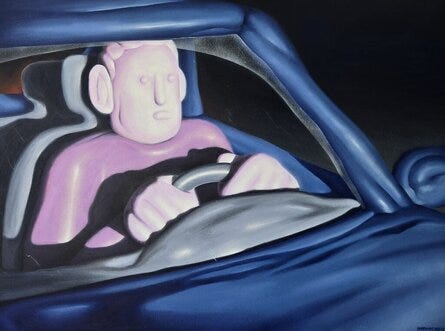
One of the most fascinating aspects of Martynas Auž’s practice is the way he integrates digital technologies into deeply hands-on creative processes. Rather than treating technology as an end in itself, he uses it as a tool for exploration. Many of his compositions begin in virtual environments where he can construct characters, objects, and landscapes in three dimensions. Yet these images rarely remain confined to the screen. They are later translated into paintings, murals, and installations using traditional techniques such as acrylic paint, oil, and spray paint. This process creates a compelling tension between the digital and the physical. His figures may appear computer-generated, but they possess the texture, imperfections, and material presence of handmade artworks.
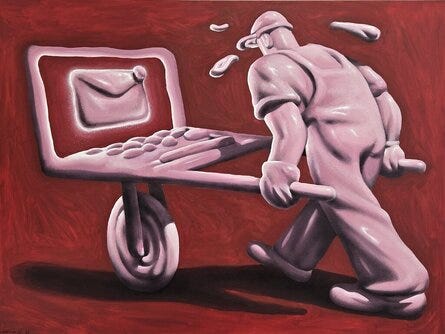
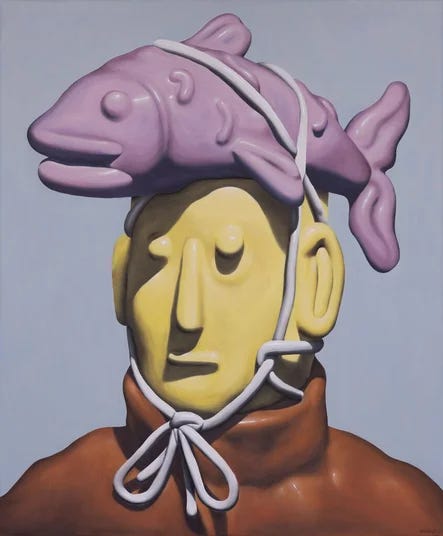
Visually, his work is often associated with what critics have described as contemporary renderism. The characters inhabiting his paintings and murals feature rounded surfaces, soft volumes, and an almost inflatable appearance. They often resemble toys, soft sculptures, or creatures emerging from a space somewhere between reality and simulation. Beneath their playful exterior, however, lies a deeper reflection on contemporary human experience. His works explore themes such as identity, personal relationships, memory, transformation, and the ways technology shapes our perception of the world. Humor and strangeness coexist throughout his practice, inviting viewers to approach each image from multiple perspectives.
The city continues to play a central role in his work. Throughout his career, Auž has created hundreds of murals across Lithuania and other European countries, participating in major festivals and cultural programs. These public interventions have expanded the reach of his visual language far beyond traditional gallery spaces. In his murals, building facades become narrative stages where characters, objects, and organic forms interact with the surrounding architecture. Rather than treating urban space as a simple surface, Auž approaches it as an active component of the artwork, capable of influencing both its meaning and the viewer’s experience.
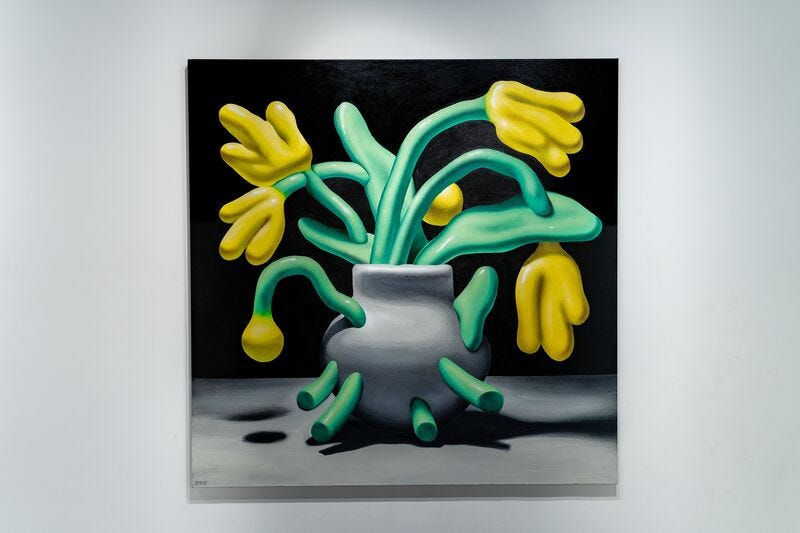
In recent years, a significant portion of his practice has shifted toward studio painting. This transition does not represent a departure from muralism but rather an expansion of its possibilities. The studio allows him to develop more complex narratives, explore the psychological dimensions of his characters, and deepen recurring motifs that appear throughout his work. Mountains, roots, fragmented bodies, plants, and everyday objects become visual metaphors for travel, change, and the search for meaning. Each painting feels like part of a larger story, as though all of them belong to a single, ever-expanding universe.
What makes Martynas Auž particularly relevant within today’s artistic landscape is his ability to inhabit multiple worlds without feeling compelled to choose between them. His work demonstrates that the boundaries between digital and analog, street and gallery, technology and painting are becoming increasingly fluid. In an era defined by the coexistence of physical and virtual experiences, Auž has developed a visual language capable of reflecting that hybrid reality. Through playful characters, impossible landscapes, and carefully constructed forms, he speaks not only about our present moment but also about something more universal: the human desire to imagine, transform, and continually discover new ways of seeing the world.
No posts
Comments
Nothing yet. Say the first thing.
Sign in to join the conversation.