
Today, as we enter the season of Lent—a time traditionally marked by reflection, repentance, and the “dust to dust” reality of our mortality—I wanted to share an excerpt from my new book, Art Is How God Loves Us (Available for pre-order now).
Today’s liturgy traditionally centers on Psalm 51, in which David pleads, “Create in me a pure heart, O God.” It is a cry for a fresh start, a stripping away of the ego to make room for something holy.
In this essay, I reflect on a pivotal moment at Juilliard when I stepped into a windowless audition room to play an excerpt from Bach’s St. Matthew Passion. On that day, the music felt like a direct conversation with the Creator; it was, without question, the best audition of my life. I finally understood what it meant to “serve the gift1” rather than my own ego—and yet, as you’ll see, the result was not at all what I expected.
Ash Wednesday reminds us that we cannot “fix” our own hearts through effort, even when we perform perfectly. I hope this story meets you here at the start of Lent with a sense of grace, especially in those places where you are tempted to strive in your own strength.
Mache dich, mein Herze, rein,
Ich will Jesum selbst begraben.
Denn er soll nunmehr in mir
Für und für
Seine süße Ruhe haben
Welt, geh aus, laß Jesum ein!
Make yourself pure, my heart,
I want to bury Jesus myself.
For from now on he shall have in me,
forever and ever,
his sweet rest.
World, get out, let Jesus in!
(Translation by Pamela Dellal, courtesy Emmanuel Music Inc.)
Growing up in small-town South Carolina, when I first began belting the Bible songs in kids’ choir at Main Street United Methodist, we realized, much to everyone’s surprise, I could sing. I loved the way music felt in my chest, the songs poured out so easily and unselfconsciously. As I grew, all I wanted to do was play the beautiful music that I heard in my head, to open the score and read it effortlessly, just as our church organist, Mrs. Kerri Hall, did. My parents got us all piano lessons, and I would sit in the formal family room at the piano for hours and make up songs. I’d found the oboe almost by accident when I had the band director as my homeroom teacher in sixth grade. He’d said my personality (determined, bright, if a bit quirky) would be perfect for this instrument (difficult, poignant, if a bit quirky). So in eighth grade, I decided to quit cheerleading and get serious about music. I joined the band. I was surprised that a girl from the middle of nowhere, who had never heard an orchestra live before, who could barely read music, who was born into a “sports family,” had talent for this persnickety, mysterious woodwind that everyone thought was a clarinet.
But yet, early in my musical life, alone with myself, I heard this question chasing me like an unpaid toll, “Am I good enough?”
Fast forward through the decades of intense conservatory training, including a boarding school for the arts, a Fulbright to Germany, and a stint in the Ivy League, decades of out-running that question, brought me to Juilliard, a place that has a way of making the most abundant riches of talent look like pennies.
I wasn’t a stand-out star in the studio, and everybody knew that, including me. First, I was five to ten years older than everyone. As a doctoral student, I felt I should be ahead of the eighteen-year-olds who played circles around me. Plus, the program was a challenging mix of academically demanding coursework, led by a panel of Harvard graduates who expected us to be scholars, set against an equally intense, competitive music performance program that demanded at least four hours of practice per day, plus reed-making. Up until that point, I had managed to hold on to my joy of music, if by a thread. But in the Juilliard years, I sensed a crescendo from the ensemble of my fragile ego, fear of failure, and a seemingly ever-decreasing natural aptitude or talent. By my second year at Juilliard, things were beginning to fall apart in a cacophonous mess of self-loathing and shame.2
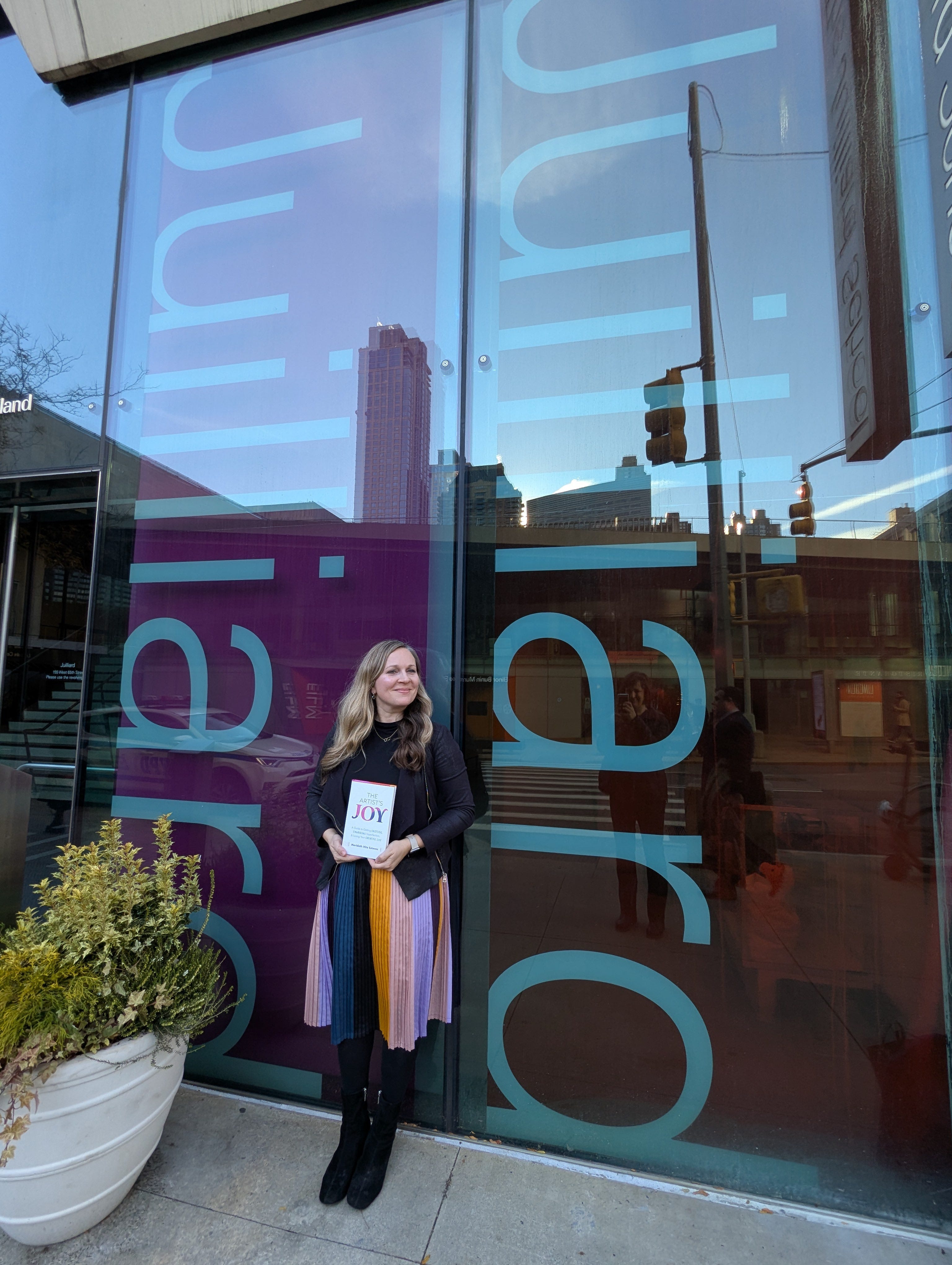
That’s when I received an invitation to audition for a very prestigious summer festival. It was an unadvertised search for one oboist to fill a coveted spot in a chamber music program, and winning meant you had “made it.” Name a famous oboist in the U.S., and most have taken part in this young artist training program.
As I waited for my audition outside the large wooden doors in the Rose Building, in the middle of a city full of people more talented than I felt I would ever be, I sighed. I looked down at the scores in my hand, an aria from J.S. Bach’s St. Matthew Passion, “Mache dich, mein Herze, rein” on top. On the upper corner of the first page, I’d translated the text in my intermediate German: “Make yourself pure, my heart.”
I had seen this text many times, “sung” the words in my head as I practiced for hours. Bach’s setting is joyful yet pleading, with that perfect mixture of graceful lilt and heartfelt lyricism that only Bach could write. It comes near the end of, in my opinion, his best piece, the St. Matthew Passion, an oratorio (a dramatic vocal work similar to an opera but without staging), which tells the story of Jesus’s arrest and death. The text from the aria is not drawn from scripture but inspired by it. It was written by one of Bach’s most popular lyricists, Picander. “Mache dich, mein Herze, rein” or “Make yourself pure, my heart,” comes right after the emotional climax of the passion story, right after Judas betrays Jesus. Bach’s placement of the song there felt to me like he was saying: Before we follow Jesus to the cross, we’re going to need to fix our hearts.
I looked down at my handwriting on my score. I read through my translation again. Mache dich, mein Herze, rein: Make yourself pure, my heart.
Pure? My heart felt more broken, scared, twisted, and turbulent than pure. For years, I’d thought that if I had just gotten into college for music, if I’d just won this or that audition, if I’d just landed one of the coveted spots in the Juilliard program, then I’d be satisfied—then I’d finally know that I was good enough. Yet, with each desire of my heart achieved, I looked up to find the bar moved higher and higher, always just out of reach. The more I accomplished, the less I enjoyed it. The loftier the stakes, the further I had to fall.
I realized that these auditions, these large and small judgments I was using to determine my mood, my value as a human person, were their own type of betrayal. My younger self had dreamt of this moment, of an invitation such as this, but I had abandoned her long ago, all in the name of winning.
As I stood at that doorway, waiting for the proctor to walk me in, I felt like I was teetering on the edge of the skyscraper’s roof. I wasn’t sure what would happen to my heart if I kept going like this, if I didn’t win this audition, or if I did.
At that moment, I felt the urge to pray, something I had been avoiding. All I could muster was an invocation I’d read once, that Bach scribbled at the top of some of his scores, the letters JJ, for Jesu Juva.
As I waited in yet another hallway to be judged, I whispered, “Jesus help.”
Some have called Bach the “fifth evangelist.” (After Matthew, Mark, Luke, and John.) His devotion was evident in his letters and other writings, also in the asides of his well-worn Bible, discovered relatively recently, in 1934, in the attic of a Lutheran pastor’s home in Frankenmuth, Michigan. Bach wrote some of the most complex canons and fugues in existence, as well as truly transcendent cantatas that gave Scripture a new voice.
Like the composer, I had grown up a Christian. Music and faith had always gone together, and yet, somehow, especially in the New York years, my faith felt like an old story I was no longer interested in telling. The scriptures I’d memorized as a child echoed emptily in the splintered cavern of my heart. As I climbed higher and higher, God felt further and further away.
But that day in Bach’s world, everything glowed with Christ. The shadows of my shame were scattered.
When it was my turn, as I started to play for a faceless committee behind a flimsy white plastic panel, the notes of “Mache dich”—so complex that they required a meticulously designed breath map and a near-perfect reed—felt as if they were written for me. Make yourself pure, my heart, became my psalm, and in my striving—in spite of it—that day, Jesus heard my prayer. The long phrases were an exhale, an ebb and flow of some deep wave within me, emotional and harmoniously heartfelt, all of it, communion—under a control that was beyond me, beyond this realm.
In that wood-paneled, windowless room, like a friend desperate to have me healed by Jesus, Bach broke through the roof; the music dropped me right at Jesus’ feet.
I love how David’s songbook, his prayer journal set to music: The Psalms, sits in the very center of the Bible, at its very heart. Growing up, some part of me was afraid that faith in Jesus was a purely intellectual exercise, like a stern teacher who commanded me to abandon all feelings and obey. David’s Psalms brought home for me the beauty of a messy and musical faith, the wholeness of God’s desire to love and satisfy our deepest inner longings and our most profound understanding, reasoning, thinking.
I realize, looking back, that my quite literal translation of the aria text with the reflexive verb showed my cards a bit, spiritually. “Make yourself pure, my heart,” taken at face value, might have us believe that we could heal our hearts ourselves, that by our own strength we could hold onto God and find purity through our own righteousness. I realize now that this is one reason why my faith faltered in those days, why I had such disdain for the Bible; I thought, like greatness as an oboist, true faith was only given to those with enough diligence or discipline, that to follow Jesus one must be endowed with talent and a propensity toward perfection. I thought that, like a seat in a prestigious chamber music festival, purity was achieved by a perfect performance.
That day in the audition, the Jesus I met there—the Jesus I danced with inside the world Bach painted for me—laughed, and sang to me the words of that hymn from my childhood, “Cast your deadly doing down.”
“Make yourself pure, my heart,” became an invitation from my Maker—not for me to be good enough, but to believe that through Jesus, God is good enough. What if this was what Bach meant when he called our hearts to make themselves pure? To be like David, to let God create in us a clean heart, to set our hearts again on pursuing God’s?
The verb in verse 10 of Psalm 51, “Create in me a pure heart, O God,” is the same verb used in Genesis 1, when God ordered the chaos, when creation began. Creating, then, means making something out of nothing, ex nihilo, but it also means renewal, transformation, sanctification, rebirth. The man after God’s own heart humbly asks for a clean one, and God doesn’t fix it, dust it off, or point out all the ways the man was wrong; God goes to work as an artist and creates a pure heart in him, in all of us, again and again.
As I played the most transcendent audition of my life, as Jesus and I danced to Bach’s music, God created in me a pure heart. I let go of all the ways I had been trying to earn love. I put down my impulse to make myself perfect: I had to in order to let myself be led, to be drawn beyond perfection into wholeness.
This time, when I asked if I was good enough, I heard Jesus whisper, “I am.”
We are eager to take the matter of purifying our hearts into our own hands, aren’t we?
In Bible study, I learned that when the Scriptures use the word “heart,” it means more than one’s emotions. The Hebrew word לב (transliterated as “lev”) is more a holistic inner landscape that encompasses our feelings, but also includes reason, intellect, conscience, and intention. So, when David, in Psalm 51 prays, “Create in me a pure heart, oh God, and restore a right spirit within me,” and later “restore to me the joy of your salvation,” he means, let my heart burn with love for you again, but also, help me remember with my heart, soul, and mind that the healing you bring is joy. Purity comes from healing, not the other way around.
It’s easy to read Bach’s aria text or Psalm 51:10 and write off the idea of purity as something obsolete for those living outside of Jewish law. In Ancient Israel, the idea of ritual cleanliness meant being able to enter the Temple, to fully participate in God’s work in the world, in community with others, reassured that the glory of God would not destroy you as you drew near. Purity was more than being without sin, cleaned up, and “fixed.” It was living in alignment with reality, to know that God is the Master of the Universe, and we are God’s. It is letting ourselves be healed; we cannot do that for ourselves.
Even if we aren’t living within Jewish purity laws, we still long for a “right spirit,” our joy to be returned to us. I sensed, even in my spiritual wandering, that it would take something drastic, like a pure heart, to get through life without being crushed by the weight of my own ambitions.
The anxiety and temptation to idolatry that can creep in with our fears about talent—these are a heart issue. God meets us there to heal it.
As I sang through my oboe Make yourself pure, my heart, I realized that creative endeavors are not how we achieve and excel, nor prove our value as a person, but a place where we can be made clean. As an artist, God’s sanctification power is, first and foremost, creative.
When we serve the gift, we live inside the score of a Creator who is not after our performance, but our heart.
That day was the only day in nearly 30 years of playing the oboe where the music I heard in my head paled in comparison to what we heard in the room. Usually, it’s the opposite.
The Bach ended, and the Mozart, Strauss, and Barber that followed shimmered with a beauty I cannot, to this day, explain. I’ve written about many of these moments of transcendence, the different feelings of Ultimate Reality, Jesus Himself, Holy Spirit, a still small voice, and others that found me through art—but that day, through the music of a composer who had known what it was to follow Jesus, who had served the gift, I was delivered into the heart of God, and there my Creator created me a new, pure one.
The audition ended, and I stood on holy ground. As I packed up in the hallway to leave, I remember the proctor—who’d led me into the room, who’d been there next to me while I played—stood by, speechless. I looked up and noticed tears in his eyes. And in mine. I shook his hand and thanked him, and we both just waited in that moment, smiling.
Outside, I stopped, frozen in the Manhattan evening, suspended on the pedestrian bridge over 65th street, the city lights haloed as I let the tears of joy fall. Bach was a bridge, and I wanted to walk back to Jesus. I found myself praying, whether or not I’d won the audition, that God would never let me forget this moment.’
In Bach’s Bible, there are numerous handwritten notes in the margins. One such annotation occurs near 2 Chronicles 5:13. This Scripture tells the story of when God brings the Israelites together and commands them to bring the Ark of the Covenant, the representation of God in their midst, into Solomon’s Temple, newly built/constructed. They begin to dedicate the temple with music:
“It was the duty of the trumpeters and singers together to make themselves heard in unison in praise and thanksgiving to the Lord, and when the song was raised, with trumpets and cymbals and other musical instruments, in praise to the Lord, ‘For he is good, for his steadfast love endures forever,’ the house, the house of the Lord, was filled with a cloud, so that the priests could not stand to minister because of the cloud, for the glory of the Lord filled the house of God.”
Alongside this passage, in the margin, Bach wrote, “Where there is devotional music, God is always present with his grace.”
Most don’t know that, in his lifetime, Bach struggled to find recognition and stability in his career. He was always highly respected as an organist and keyboard player in Germany and in parts of the broader European musical community, but many considered his compositions too complex, too difficult. He was passed over for many jobs; he lost many auditions. He died a respected organist, but it wasn’t until a century later, when Felix Mendelssohn was given a score of Bach’s St. Matthew Passion by his Jewish grandmother and presented it with the Gewandhaus Orchestra in Leipzig, that Bach’s music found its audience. That performance began the Bach renaissance that still continues to this day, as new manuscripts and writings resurface even in our time.
Now Bach is widely known as one of the top composers of all time, but in his lifetime, he could have easily felt he had no talent at all if he were looking to the world for validation. Plus, his life was immensely difficult, full of rejections and a lack of money, a myriad of health problems, including eventual blindness from a botched surgery. Out of his twenty children, only ten lived to adulthood. Yet, his music was a faithful witness; he served the gift. All the talent he’d been given was not for his own glory and accolade but a result of his pursuit of God.
In the story of the Temple dedication, the cloud is so all-consuming that “the priests could not perform their service... for the glory of the Lord filled the Temple of God.” This confirms something I learned in my audition: God wants to dance with us, to sing to us, to tear down the false gods of our egos with a cloud of divine presence so immense that it makes our “doing” obsolete. The swell I felt in my heart as I sang in church, the joy each oboe exhale in that transcendent audition, this was, of course, the grace of God. The Giver of Breath wants every part of us restored to joy, not just our heart or feelings, but also our intellect, our talent, our hard work, our winning, and our losing. Every note in life’s aria becomes a word from God, a life our Maker is creating, transforming even now.
A week or so after my audition, when I walked in a few minutes late to our oboe studio class, I saw everyone hugging and shaking hands with a colleague who’d just learned that she’d been chosen for the festival.
It stung, to be sure, that after such a mystical experience, I wasn’t given the satisfaction of being named the winner. The months and years that followed this rejection continued to purify something in me. With a new heart, I was starting to understand what Bach said in the last line of the aria, “World, get out; Jesus, come in.” When we truly serve the gift, our offerings become a communion with our Maker, and if or when the world doesn’t recognize, applaud, or praise us for them, it isn’t a verdict of our worthiness or a judgment of our value. It’s irrelevant to a heart set on God. When we serve the gift, through sacred or secular art, in windowless rooms or ancient temples, no matter how good we are, no matter whether we win or lose, God is present with grace.
I will never create anything that compares to Bach’s music, but what I learned from living inside his heavenly compositions—what I understand from knowing him through his complex and intricate melodies, his surprising and profound harmonizations, his lesson that day in the best audition I’d ever played, that I didn’t win—is that talent is not a tool but a vessel. It is God creating us, finding within the impurities of our hearts the raw material of something greater than we can see in this lifetime. Talent is a gift God gives us of divine presence and grace. What if that is enough?
God has promised to provide for us what we need; like manna in the desert, there is no deficit of ideas, gigs, baselines, metaphors, and we can trust that there will be enough. This doesn’t mean we will always win. It doesn’t mean our lives will be easy. It doesn’t mean we will be loved and praised and prosperous all our lives; we have Bach and Jesus as proof that isn’t true. But we can trust that God’s plan is better than ours, that the arc of the universe is long and full of art.
If you are tempted to believe that being an artist is frivolous, that we are only useful to God when we perform acts of dramatic impact, that we are only valuable when we earn the praise of the world, remember that we are created in God’s image to create. Remember that God creates clean hearts, that God orders the chaos of creation, that God’s artistry is synonymous with God’s love.
Now, I know that when something clicks, when something happens on the stage or in the audition room that feels transcendent, when my chest swells, all these years, all along, it was the cloud of God’s presence, just as God promised, loving me, healing me. By the light of this realization, my obsession with talent feels petulant, limited. Like the elder brother in Jesus’ Prodigal Son parable, I see myself complaining that God loves others more, when God has already given me everything.
We risk missing God, present with divine grace, when we focus on the merits of our own performance.
I won’t pretend I never struggle with doubts of my own worth or talent. It did and still does hurt when I don’t succeed, but it doesn’t have the power to destroy me anymore. This is no small miracle. I know now that when I feel the very human desire to be great, it is an invitation to step aside, not by accepting mediocrity or giving up, but by serving the gift—allowing God’s greatness to come through me, trusting the Spirit will lead me, like a partner on the dance floor, through each note I play.
This is my prayer for you, and for me. That if—when—we find ourselves asking if we’re good enough, we will trust our Maker when God answers, “I AM.” That we will sing along to the Psalmist’s refrain, “his love endures forever,” and feel it in our bones. That we will let God create in us a new heart, transcending our limited earthly talents into a temple of grace. That we will realize that every time we enter the audition room or open our notebook or arrive at the easel, we step into God’s story of healing love. Before we play a note or write a word, what if this audition committee of one is already delighting in what we create?
Create in me a clean heart, O God. Amen.
Madeleine L’Engle, in her book, Walking on Water, coined this term and dramatically shifted my perspective on talent/creative performance: “If the work comes to the artist and says, ‘Here I am, serve me,’ then the job of the artist, great or small, is to serve.” She calls this humble and selfless way of approaching art “Serving the Work.” I write more about this in the complete version of this chapter in Art Is How God Loves Us.
No posts
Comments
Nothing yet. Say the first thing.
Sign in to join the conversation.