
Welcome to The So What, a newsletter decoding cultural moments, why they matter, and what brands should do next. The So What comes to you from Artemis Ward, an independent creative agency in DC and NYC. I’m Alex Marootian, making my So What debut. Read on for the “so what” of the Vogue-Dogue lawsuit.
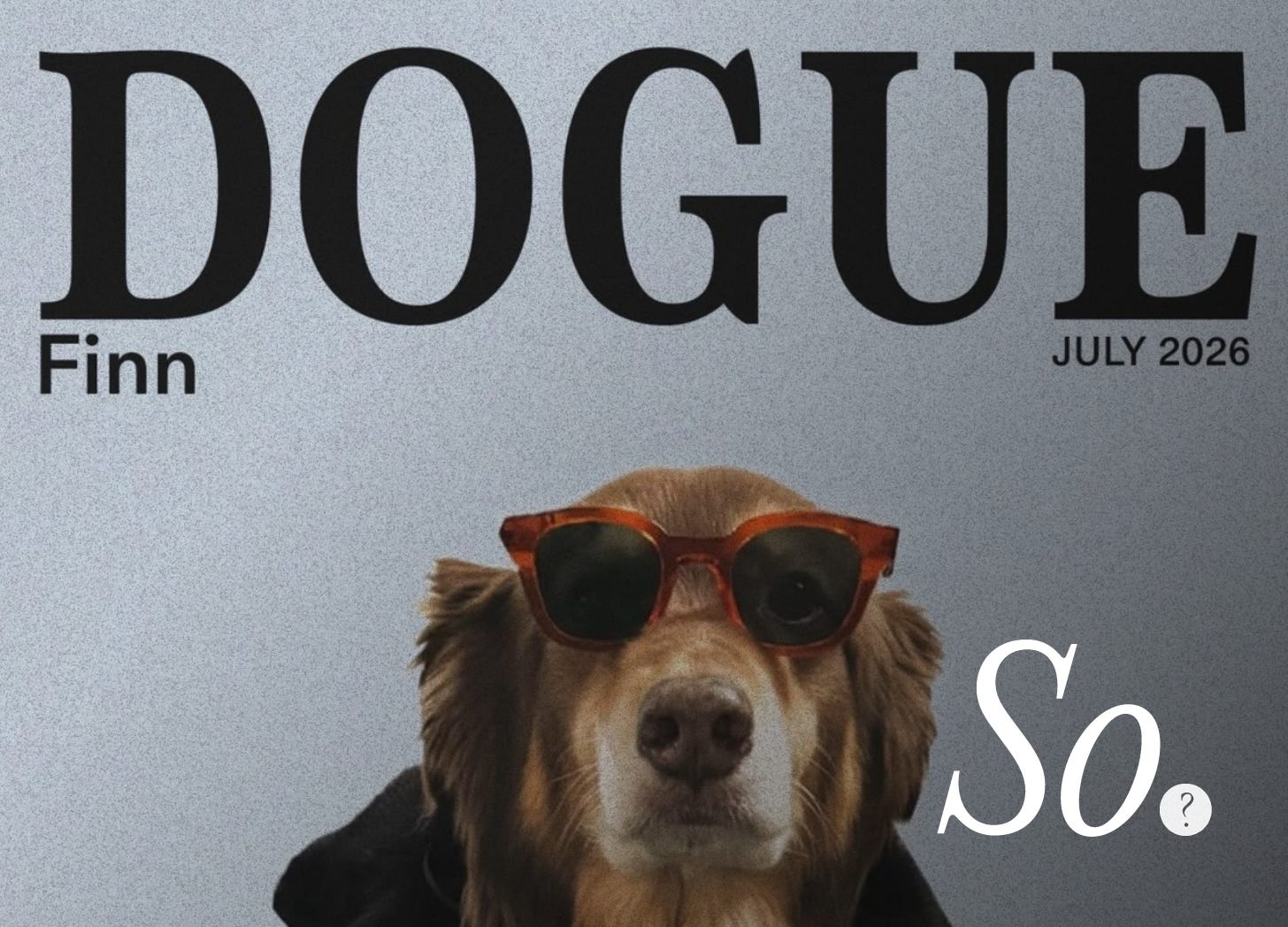
What if I told you that one of the most important lessons in understanding internet culture is hiding inside a fight over a dog magazine? It’s a story about how a random one-person operation can become big enough to spur a major institution to file a lawsuit. How the internet is inherently self-referential and a natural breeding ground for remixes, satires, and, sometimes, just plain dupes. And, ultimately, how the rules of culture have changed now that anyone can participate in making it.
But let’s start at the beginning. In 2019, photographer and graphic designer Olga Portnaya introduced Dogue, a canine fashion publication, as part of a collection of “pup culture” parodies, which include Vanity Fur and Spawrts Illustrated. Dogue’s covers feature various pets in their own version of high fashion (furshion?), with stories ranging from NYC retailer Kith’s new line of dog-friendly fashion to a cover star profile of popular pet creator Oreoluwa Osoba, who’s amassed one million followers for his dog dad content featuring Duke, his miniature Schnauzer.
After two years of free digital publications, Portnaya released her first print issue of Dogue in 2021, which was followed by a Dogue trademark filing in 2022.
But then, in 2024, Vogue entered the chat. Its version of “Dogue” featured Pilaf, Demi Moore’s micro Chihuahua, as the cover star. Then Contributing Editor (now Editor-in-Chief) Chloe Malle introduced “Dogue” as the latest iteration of Vogue’s continued legacy of dog fashion, referencing an 1897 cover of Vogue which featured a Labrador. Though the two Dogues share a name, they are quite different in practice. Vogue’s version of “Dogue” is basically just Vogue, that is to say, obsessed with celebrities. From Lewis Hamilton’s Roscoe lounging poolside to Sabrina Carpenter’s Goodwin and Louie resting in a mini Mercades G-Wagon, have you really made it as a star if Vogue hasn’t put your dog on the cover of THEIR “Dogue”?
Soon after launching its “Dogue,” in 2025, Vogue sent a cease-and-desist letter to OG Dogue. Which brings us to the present day. Notably, throughout the lawsuit, both Dogues have continued to release their publications while a court decides who can be the one true “top Dogue,” as The New York Times puts it.
People with JDs can speculate about the legal rights that both OG Dogue and Vogue have to “Dogue.” I, on the other hand, see another problem lying within this lawsuit. Vogue has landed itself into a PR hot mess. Because this is a time when there’s mass distrust (even resentment of) institutional ownership, the “Dogue” controversy has ballooned from a simple trademark dispute into a David-versus-Goliath brand battle. Go into the comments section of The New York Times article or the many Reddit threads on this topic and you’ll see an overwhelming consensus: not that Dogue has ripped off Vogue. Quite the opposite. Why couldn’t Vogue partner with Dogue? Or, better yet, why can’t Vogue just chill out? While an audience less in-the-know on this topic probably loves Vogue’s “Dogue,” those like myself see this situation as a reflection of the ways people create original content on the internet. Which leads me to wonder…at what point does a massive brand like Vogue just have to accept parody?
Objectively, I can see Vogue’s legal argument of copyright infringement, and I can understand that Vogue is simply trying to ensure its “Dogue” property is the only one in town. But the internet-savvy consumer in me balks at the idea that Vogue actually feels threatened by a comparably tiny magazine who, in my opinion, has more of a right to “Dogue” than Vogue does. While Dogue could, in theory, aspire to market capitalization and endless brand deals, for right now at least, it is simply an Instagram account with 23.4k followers that features other dog-fluencers. Vogue, by contrast, has 51.4 million followers, and the dogs it features belong to the rich and famous. To argue that there is a possibility of Doguemeaningfully stealing a sizable amount of Vogue’s audience does not make sense. What Vogue does not understand is that, through this lawsuit, it is signaling that it doesn’t understand internet culture. And, because of that, it’s losing a level of credibility — all for what will probably end up being a marginal difference in its final sales numbers.
Like I said earlier, the internet is inherently self-referential. These days, original IPs often find their start in parody or satire. Our current social media consumption is mostly based in the endless remix and reinvention of an original product until it doesn’t really even resemble the original anymore. At this point, there’s a fan account of almost anyone famous. By Vogue’s logic, should they be sued for potentially taking away lucrative likes and comments from the original celebrity’s posts? Should commentary channels and reviewers pay a fee to the original creator of the content? Should Tiktok edits of The Pitt to a trendy song that someone could conceivably make money off of be the subjects of lawsuits? No. Because in the age of social media and available free content, recycling, reproduction, and reinterpretation is how new things get made.
Lawsuits and bankruptcies can influence a brand’s legal and financial standing, but not its cultural impact. So if brands want to be with the culture — if they want to be relevant and popular and have long-term success — they need to fundamentally rethink how they deal with all the ways in which people interact with their IP online. Celebrities understand that, in the age of social media, having fandoms remix and remake your work is a sign of a thriving fanbase, not people trying to steal your money. The fact that someone can start a parody account, gain popularity, and become their own source of cultural conversation is one of the only ways the internet is still fun. To stifle that, to make people scared of creating or contributing to a conversation, is to stifle a generation of creatives that could help shape the coming years of cultural discourse (and, while they’re at it, strengthen your brand’s perception).
This is not to say that legacy brands don’t have a right to be worried. We need to have some source of truth so we don’t completely lose sight of what is the “real” product and what is a “dupe.” But while Dogue continues to be a small-scale organization that just wants to make funny dog fashion content, Vogue is only distancing itself from its consumers by implying that they don’t have the right to create things. That they can’t be inspired to make their own parody of something. That we are damaging their brand if we dare make a tacit joke about it.
To be adept at brand protection in the age of the internet is to welcome your fans and your tinkerers, not shut them out. While copyright should be legally protected, creativity and the need for reinvention should be culturally respected. If brands forget this and start going after anyone and everyone who’s just trying to have fun, they might potentially lose a stake in the cultural conversation. So don’t be like Vogue Dogue; be like Dogue Dogue. Harness your creativity and plant a flag in the space (or crate) you want to occupy.
✉️ If you haven’t subscribed, click the button below so you don’t miss the next one.
Comments
Nothing yet. Say the first thing.
Sign in to join the conversation.