
Welcome to The So What, a newsletter decoding cultural moments, why they matter, and what brands should do next. The So What comes to you from Artemis Ward, an independent creative agency in DC and NYC. I’m Quinten Rosborough, senior director of content. Read on for the “so what” of clipping, parasocial relationships, and the end of posting.
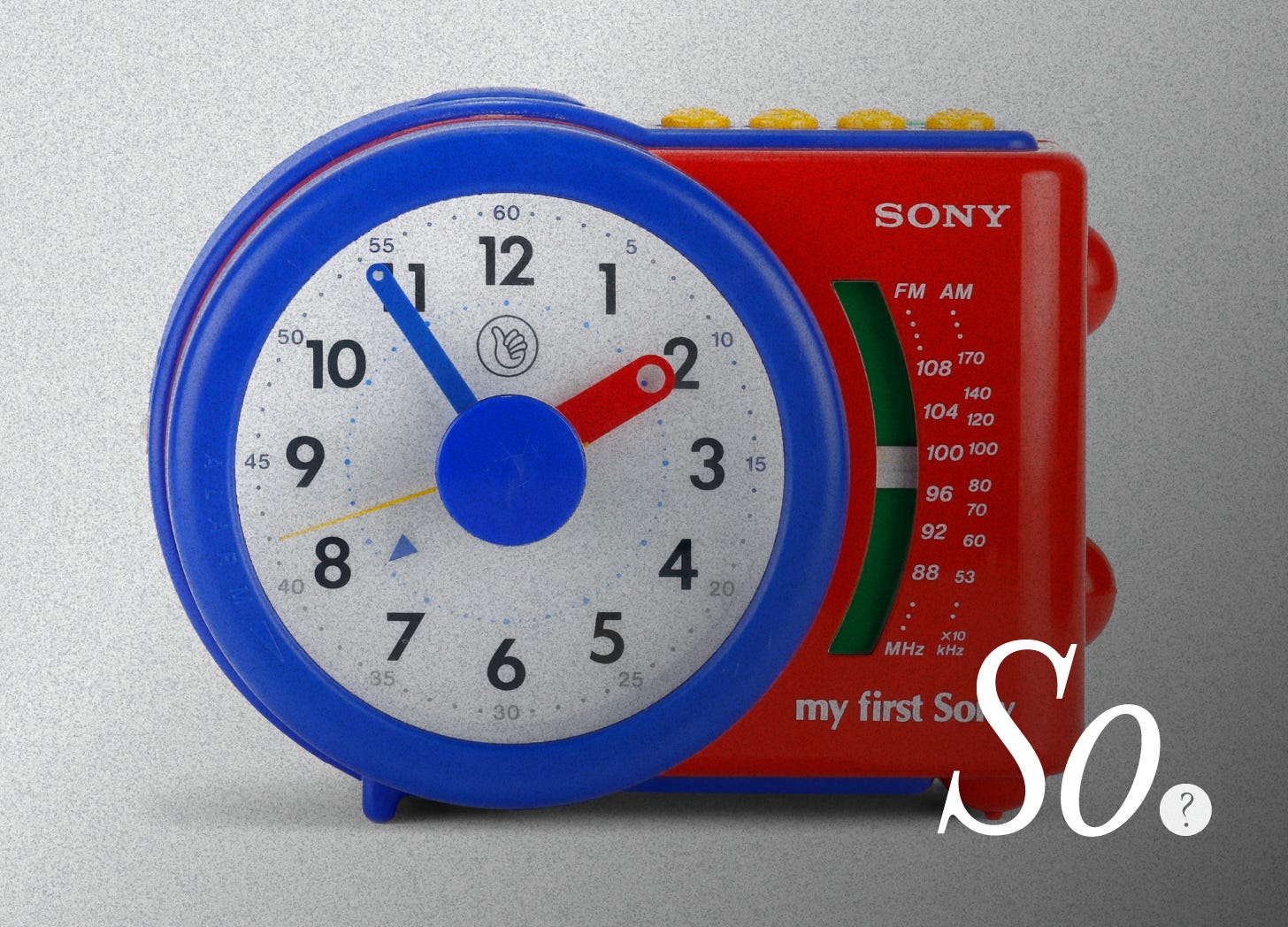
When was the last time you actively listened to the radio? I mean sat down, tuned into your favorite station, and really paid attention to a broadcast. Even as an avid NPR listener and supporter, 99% of my listening is done through the internet. And as far as music goes, it’s at least been a decade since I’ve really cared about what’s going over the radio waves. I still occasionally encounter it as background noise, but I think that for most people radio — at least in the way it existed for the last century — has lost its relevance.
For example, did you know that most electric cars don’t have AM radios? Electric motors cause signal static, and so carmakers just stopped including them. And if you were to buy a new Tesla Model 3 or Y, Rivian R2, or Slate Electric Truck, it wouldn’t come with a radio at all, AM or FM. Radio is slowly disappearing, and it doesn’t feel like that big of a deal at all.
If you’ve read anything I’ve written here on The So What you’ll know that I’m quite bearish on the social media economy — at least in its current form — and, as a result, I spend a lot of time thinking about a good analogy for the times I feel like we’re in. Is this like the end of Myspace? The initial years of Wikipedia? Or maybe a digital platform is an imperfect comparison.
Nearly a year ago, The So What’s Ryan Weicht wrote about the end of posting — about how, as feeds became more permanent and less private, and content became more professional and promotional, regular people like you and me were feeling less motivated than ever to share our lives on social media. People were spending less time creating content for public feeds and more time sharing directly via DMs, group chats, and other more private channels.
In the year since, the feeling of “posting ennui” has only gotten more acute. According to a study published by Incogni Research last month, 55% of people report posting less than they did 5 years ago, 53% have become stricter about who sees their posts, 47% have deleted a social media or messaging app because of stress or anxiety, and more than half feel like maintaining an online presence feels like work.
If you’re in the business of social media, these numbers should be alarming. This entire industry only works if there’s a steady stream of real posts from real people. Why? Because people appear to hate everything else. They hate digital ads.They hate AI-generated content. They’re even starting to hate content creators. The less people enjoy what’s being served on their feeds, the less time they spend on-platform. The less time people spend on-platform, the less companies are willing to pay to advertise on them. Budgets get smaller, ads get less effective, and we’re left with a system that pays people very little to make videos no one watches.
Why is this happening? And more importantly, why does it seem to be accelerating? One clue might be in the rise of “clipping,” a black- to grey-hat marketing technique that has quickly become a best practice. Clipping’s origins are in the Manosphere, where personalities like Andrew Tate, Nick Fuentes, Clavicular, Dan Bongino, and more used hundreds of thousands of dummy accounts to game algorithms. The technique quickly spread to entertainment, where it’s known as “trend simulation.” Instead of seeding retrograde cultural opinions, the same types of accounts were used to give artists the appearance of virality and skew sentiment in their favor. I’ve personally lost track of the number of times I’ve heard clients say the words ‘clipping strategy’ without blinking an eye.
Gross marketing is everywhere, and I’ve done my fair share of it over the course of my career, but clipping feels particularly deceitful. It’s one thing to be advertised to; it’s another thing to be gaslit. As Lane Brown said in Vulture earlier this year:
Shady marketing and propaganda aren’t new, of course, but what is new is that the entire infrastructure of public conversation has been quietly captured by both. On social media, popular opinion is being formed, measured, and manipulated all at once, and every signal the platforms produce — a trending song, a backlash, a talking point, the feeling that “everybody” is suddenly talking about the same thing — can now be fabricated by unseen actors with hidden agendas. We’ve locked ourselves in the stupidest possible version of Plato’s cave, where what looks like the spontaneous consensus of the hive mind is often just shadows on the wall, put there by marketers, political operatives, foreign-influence campaigns, or anyone else with a few hundred bucks and something to sell.
Another reason people might be posting less could be due to what researcher Danah Boyd calls “Parasocial Media”:
Today’s social media platforms are no longer centered around sociable activities. Instead, most platforms offer us a broadcast medium and invite us to learn how to game the algorithms so that we too can create assets for the major corporations. Since scale is valorized in this platform economy, we are encouraged to curate ourselves in pursuit of fame and attention. We can still, in theory, create content for our 15 friends, but it’s not clear that they will see what we post...
...Because of these shifts, we now live in a world of parasocial media. Parasocial relationships are one-sided connections, where individuals keep tabs on the lives and movements of people – like celebrities – who do not know us and feel no pressure to reciprocate. In a parasocial world, people dedicate their attention and emotions to tracking the dramas of individuals who exist at a distance.
Sound familiar? Earlier this year, Artemis Ward’s Olivia DuCharme wrote about The 4 in the 5: four twenty-something women documenting their lives in NYC in the style of a ‘00s sitcom. The 4 in the 5, like countless other influencers, in countless other cities, in countless other countries, aren’t looking for interaction; they’re looking to be watched, commodified, and handsomely rewarded by corporate sponsors. For them, the parasocial relationship is the entire point.
And it’s not just influencers. The podcast industrial complex — the millions of clips of people in rooms talking into microphones — work in much the same way. The podcaster Brace Belden calls this the “friendship simulator,” content that exists to make you feel like “a shy participant in an exciting conversation.” While immediately rewarding, Boyd and Belden both find these parasocial relationships as poor substitutes for the things they replace. Listening to an interesting conversation is not the same as having an interesting conversation. Watching someone live out their dreams is not the same as realizing your own. As John Sylvia, the owner of the now-viral anti-influencer Nantucket antiques store puts it, “A lot of people are tired of feeling like extras in someone else’s video.”
Which brings me back to Ryan’s post from last year. People are tired. Tired of the performance, tired of the perfectionism, tired of the promotion, the politics and the lack of privacy. Posting has become work. And in an environment where people are working more and earning less, no one wants a second (or third) job. And in the last year, the incentives to participate have gotten even worse. Ryan Broderick of Garbage Day calls this “The Clear Channel Internet:”
All of digital video — and by extension, all of social media — is poisoned. There’s been so much written about the Dead Internet theory lately, but that’s not what this is. It’s closer to the Clear Channel internet, where everything has been so thoroughly corporatized that nothing ends up in our feeds by accident anymore. At least, not when it comes to the truly viral content. It’s either being directly bankrolled by a company like Kalshi or downstream of some weird payola agreement a bunch of influencers made with random clippers on Discord. But unlike TV or the radio, our social media feeds continue to look like — and market themselves as if — they’re still powered by real people.
Oof. When framed this way, you can see how techniques like clipping, explicitly parasocial content, and other ways of putting our thumbs on the algorithmic scale end up eroding the foundation keeping this industry upright. They run counter to the reasons we decided to join these platforms in the first place: to make real connections with real people, not to be duped by bot armies and tantalized by unattainable lifestyles. The short term gains from these techniques are real, and are in many ways the only way to compete on these platforms. But what happens to social media once this race to the bottom reaches its end?
In his piece on Garbage Day, Broderick describes social media as a “new, worse version of TV”, but I’d argue his Clear Channel analogy paints an even more terrifying picture. “Clear Channel,” of course, is a reference to America’s largest broadcaster, the company now known as iHeartMedia. And if we’re being honest, when was the last time you actively listened to the radio?
✉️ If you haven’t subscribed, click the button below so you don’t miss the next one.
Comments
Nothing yet. Say the first thing.
Sign in to join the conversation.