
Welcome to The So What, a newsletter decoding cultural moments, why they matter, and what brands should do next. By day, we work at Artemis Ward, an independent creative agency in DC and NYC. I’m Olivia, Director of Content. Read on for the “so what” of the Nantucket culture wars.
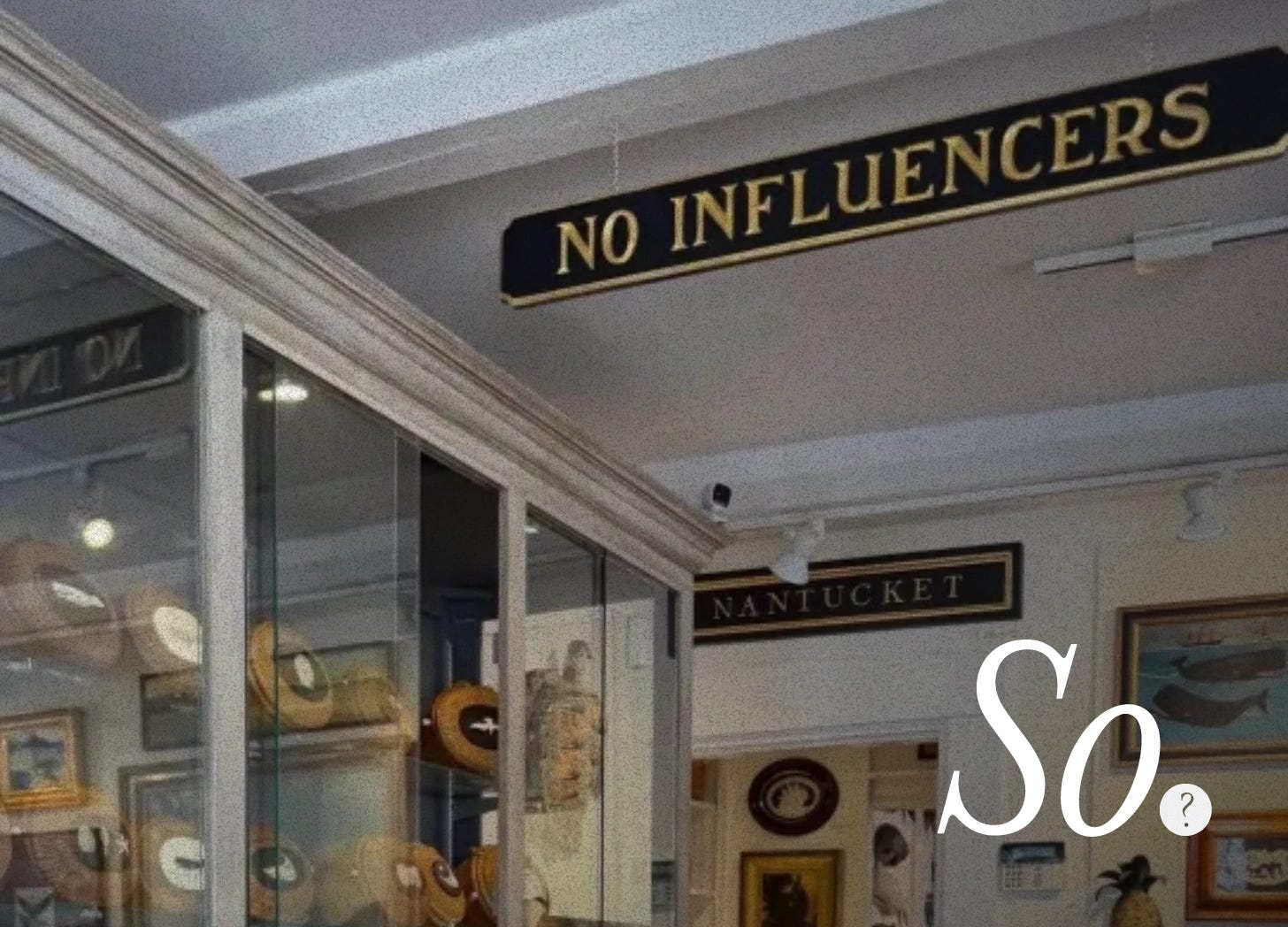
If you, by chance, should find yourself on a sleepy little island known for gray cedar shingles and lush blue hydrangeas, and if you, by chance, should find yourself walking across its cobblestoned streets into a craft guild and antique store, then you might be surprised to stumble upon a sign that reads NO INFLUENCERS.
Or, if you’re like me, then you know more than you ever really needed (or wanted) to know about that sign — and the so-called “culture wars” currently playing out on the island of Nantucket, Massachusetts.
Allow me to explain. The store in question is Four Winds Craft Guild, which has been a Nantucket staple since 1948. The artisan shop makes and sells classic Nantucket goods (including hand-crafted basket purses that can run you upwards of $2,500) and recently went viral for a NO INFLUENCERS quarterboard displayed inside, visible through the window from the street. It went up, presumably, after floods of young women started lining the streets outside Dairy Boy, the clothing and lifestyle brand founded by influencer Paige Paul (née Lorenze), which just opened its first brick-and-mortar three minutes down the street. (A brand I happen to really like — sorry, everyone!!)

 Tiktok failed to load.
Enable 3rd party cookies or use another browser
The sign was quickly met with equal amounts of praise and backlash. Praise from fellow Nantucket residents who feel as though their home has become someone else’s Disneyland, praise from fellow shop owners who are tired of freebie requests from mid-level creators, and praise from people who are sick and tired of influencers, period, and want to see them knocked down a peg. The backlash was led by Paige Paul herself, who, in a series of now-deleted posts, wrote:
If you call yourself a feminist but proudly put up a ‘No Influencers’ sign, it’s worth asking who you are attempting to delegitimize, and why. Mocking women when they become powerful in a new industry isn’t new. It’s just a strange message coming from a store that celebrates a craft with such a rich history of women shaping the island and its economy.
Soon after, Paul put up her own quarterboard in her Dairy Boy storefront reading EVERYONE WELCOME. Many creators, in turn, followed Paul’s lead by creating TikToks of their own, arguing that saying “no influencers” was a thinly-veiled attack on women, pointing to influencing’s long history as a female-dominated industry. Even Bath and Body works hopped in the conversation, posting a sign that reads INFLUENCERS WELCOME in one of their storefronts.
That response set off its own wave of backlash. There’s a specific ickiness to watching influencers — a profession whose mainstream generally steers clear of anything political, because, presumably, political opinions are bad for brand deals — reach for a word as loaded as “discrimination” the second a critique is aimed at them. And yet, as I’ve written before, this is the shape TikTok debates always take: an endless scroll of spicy takes, spicier countertakes, and the spiciest of counter-countertakes, each one more exhausting than the last. In this case, what started as a story about one little old sign in an antique shop quickly ballooned within days into a referendum on feminism, class, old money versus new money, and who gets to claim victimhood online.
In my opinion, as eye-rolling as it may be to hear about (predominately white) influencers complaining about discrimination, they might have an iota of a point. No camera and no filming signs are practically ubiquitous in places like museums and performance venues to protect privacy, and no one blinks an eye at those. So why choose the word “influencer” specifically? The shop owner claims it was a tongue-in-cheek joke, and it probably was. But I can’t help but wonder: why not just say “no filming”? Taylor Lorenz made a similar point in her deep-dive video on the topic: if the sign had said NO STREAMERS, we’d all know exactly who it meant (cough, Clavicular and Kai Cenat wannabes). Whether we want to admit it or not, “influencer” does tend to connote a specific kind of person.
What fascinates me about this sign debate is how quickly everyone — regardless of which “side” they’re on — seemed to agree on what the word influencer meant. Which brings me to a different sign that garnered a lot less attention. Three weeks ago, local Nantucket artist Stephen Pitliuk posted a video of a woman holding one of his pieces beside the line snaking outside Dairy Boy. The piece read: “I saw a line of Rhodes Scholars waiting outside of Dairy Boy on Nantucket” — a pun on Rhode, Hailey Bieber’s skincare and makeup brand, and, presumably, the type of woman standing in that line.
It’s a funny joke, but it also made me realize something. Nobody knows whether the women in that line are influencers. Or Rhode superfans. Or just plain-old normie tourists who hopped in line because they saw a TikTok. But somehow we all instinctively understand the kind of person the sign is talking about. And that’s exactly what happened with the Four Winds sign.
It’s worth noting that, while influencers have been flocking to Nantucket en masse recently, they didn’t invent the island’s appeal. Nearly three decades of Elin Hilderbrand novels, the growing slate of their Netflix adaptions (think: The Perfect Couple andThe Five-Star Weekend), and the rise of the coastal grandmother aesthetic had already primed the island as a cultural fantasy. Influencers and brands, in turn, simply poured gasoline on a fire that was already burning, making the fantasy easier to see, easier to buy into, and easier to imitate. And now, the people showing up are cosplaying the influencer lifestyle they’ve fallen in love with online.
To be clear, a lot of the locals’ frustration is more than valid. Tourists filming inside small businesses without permission and treating a residential island like an aesthetic backdrop is a real problem that social media — and influencers — have undeniably accelerated. But I also think the sign contains some genuinely misdirected angst at influencers instead of unsavory behaviors.
Misdirected or not, the sign certainly caught attention, earning mentions in The Cut, The New York Times, and the nightly news. And why it did feels a teensy bit hypocritical to me. This sign wasn’t simply put in the window for passersby to notice. It was photographed and posted to Instagram, a platform built to reward ragebait. Whether intentional or not, the shop used influencer mechanics to criticize influencer culture. And that’s an interesting contradiction we should all be paying attention to.
The So What
Zoom out, and I think this Nantucket story is less about influencers and more about the stereotype they represent. Walk with me for a sec. At some point over the last few years, influencer evolved from a profession into a personality. Increasingly, the word has become shorthand for someone who is vapid, has no social awareness, and treats the real world like content to mine. That’s a subtle shift, but I think it’s an important one.
You can see it everywhere. Creators who built their audiences on carefully curated aspiration are finding that mystique harder to maintain. From Amelia Liana’s carefully curated persona unraveling after her wedding to Nara Smith admitting the “tradwife” label gives her views on Call Her Daddy to Audrey Peters telling Vulture ragebait is the only way she gets views, the mechanics of influence are more visible than ever. That creates an uncomfortable reality. As Vulture recently argued, the “matcha-pilates-Alo” formula — quiet, aspirational, aesthetic content — isn’t enough anymore. In an oversaturated feed, creators increasingly have to provoke, polarize, or manufacture discourse just to break through. And while the algorithm might reward engagement bait, audiences are losing patience with it.
That creates an interesting challenge for brands. For years, partnering with an influencer came with a certain amount of borrowed credibility. Now, that label carries baggage. It doesn’t matter whether your specific creator partnership is thoughtful or well-cast. You’re working against a stereotype audiences have already decided to distrust before they’ve actually looked closely at what you did.
For now, at least, the way forward is to stop relying on borrowed credibility. A creator partnership may hand you reach, but, increasingly, it also includes you in the stereotype attached to the word “influencer”, which you can’t fully control. Instead, it’s time to do the hard work of building or communicating your own credibility through craftsmanship worth talking about, communities worth joining, and stories that travel without being engineered to spark outrage.
Because if, by chance, you take a page from an antique store who made a spectacle out of rejecting spectacle, you’ve already lost the plot.
✉️ If you haven’t yet subscribed, click the button below so you don’t miss the next one with .
Comments
Nothing yet. Say the first thing.
Sign in to join the conversation.