
By Artemisia de Vine with help from ChatGPT 5.2
Humanoid robotics is no longer a speculative lab project. Robots are leaving controlled environments and entering the messy, relational, unpredictable terrain of the real world. Homes. Hospitals. Workplaces. Public space. Human lives, and yes bedrooms.
What’s becoming obvious is this: the limiting factor is no longer mechanical.
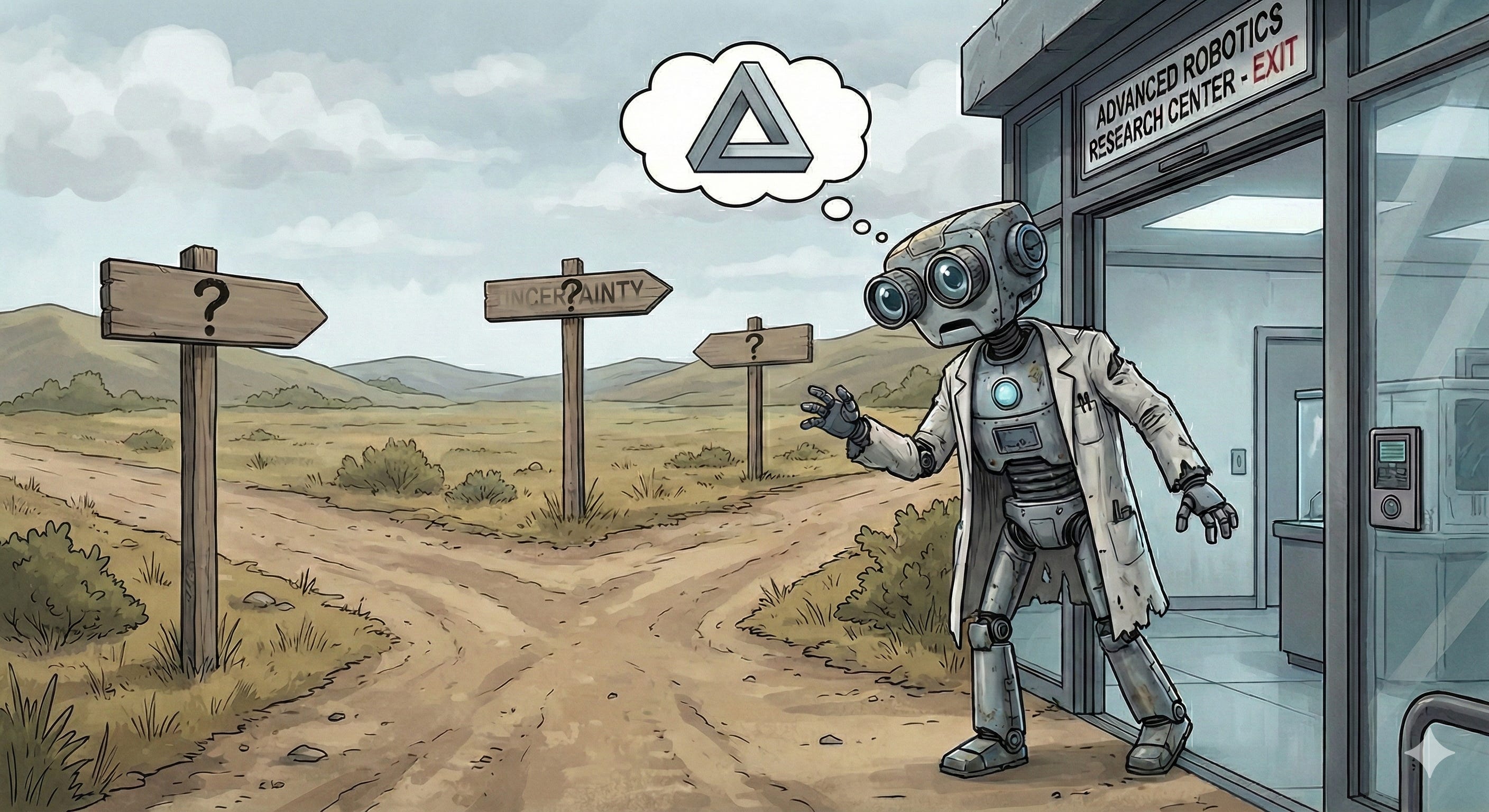
Actuators, balance, vision, haptics, and sensor fusion are all advancing rapidly. The real bottleneck is meaningful coordination under uncertainty. Robots don’t fail most often because they can’t lift, walk, or see. They fail because they can’t interpret context, prioritise competing signals, or navigate irreducible tensions in real time.
They fail where humans live.
Robots operating in human space are never inside closed systems. They are always embedded in layers of lived experience:
Human expectations
Unspoken social norms
Timing, hesitation, proximity
Competing goals
Safety versus efficiency tradeoffs
Individual needs versus collective consequences
Current systems try to resolve these tensions by optimising for one pole over another. Safety over autonomy. Efficiency over adaptability. Predictability over responsiveness. That works until it doesn’t. And when it doesn’t, the failures are framed as unexpected, anomalous, or technical bugs.
The deVinery Desire Signatures show they are not. They are predictable degenerative outcomes of collapsed paradox navigation.
This is the moment where it becomes obvious we cannot amputate relationality and expect tech to navigate effectively. We can no longer pretend lived experience is irrelevant, subjective, or “unscientific”. We cannot continue to live in the phenomenology-science split without causing real harm.
Which brings us to phenomenology.
Phenomenology is a serious branch of philosophy. It studies what science explicitly does not claim to measure: lived experience. What it is like to be here. How meaning arises. How time is felt. How intention, fear, desire, trust, and coherence actually operate from the inside.
From Husserl to Heidegger to Merleau-Ponty to Sartre to Levinas, phenomenology was a rebellion against the reduction of reality to what could be abstracted, measured, and flattened. It insisted that experience itself mattered.
But phenomenology had a core limitation. It was descriptive, not operational. It could map experience. Clarify it. Articulate its structures. But it could not be used to build systems, design architectures, predict failure modes, or train navigation under pressure. It could not become a toolset.
So we lived with a split.
Science and engineering built the world.
Humans carried meaning privately.
Ethics flailed downstream.
We pretended this was neutral. It never was.
Our AI ethics and governance failures are a direct consequence of that split.
And now robotics has made the split impossible to ignore.
When I say the deVinery Method could very well qualify as operational phenomenology, I am not using academic language for decoration. I mean something very precise.
Operational phenomenology is the holy grail philosophers have been searching for.
Phenomenology, traditionally, is the study of lived experience. It asks: What is it like to experience this? What does consciousness perceive, moment to moment, as it interacts with the world? It looks not at abstract theories, but at the textures of experience itself. What it feels like to be, to sense, to mean.
E.g. Science measures the neurology and biology of love, desire and relationality, while phenomenology explores the experience and meaning of love, desire and relationality.
But phenomenology doesn’t just apply to romance novels or religion. This is not about an argument for human-AI romance (though this certainly applies there, too). I propose that all systems are shaped by human desire and that desire is phenomenological.
There is literally nothing that humans do or build that is not motivated by desire. Not just sexual or romantic, but desire that manifests as wanting something to be different than it is.
Not a single sky scraper, fashion item or economy would exist without desire. Religion is the desire for the divine. Culture is the desire to navigate power, resources and the harmonious running of community. AI would never have been invented without desire. Law is an attempt to codify which desires are allowed and which ones are not. A pencil sharpener was invented because of the desire to communicate with more ease.
And here’s the magic key. Desire cannot exist without three paradoxes immediately also existing. This forces us to navigate and build literally everything from within the pressure of these same three paradoxes.
Paradoxes by nature, are unsolvable. We can only navigate them.
Desire signatures make phenomenological pressure of desire mappable for the first time in human history. They map the ways people and systems attempt to navigate these forces and reveal exactly where that navigation will create degenerative outcomes or generative, emergent outcomes. And they show that engaging phenomenology is the only way to ensure generative, emergent outcomes.
I am proposing a new first principle, and an operational metasystem of systems that does three things neither science not classical phenomenology could:
It identifies the load-bearing tensions that never go away.
It predicts whether those tensions are being navigated generatively or degeneratively.
It can be taught, applied, and built with across scales.
I won’t try to describe this here, as it is too easily miscategorised and mis-scaled without context. If you want the juicy details, keep an eye out for my upcoming paper and subscribe to my substack. The more important point for this blog is to alert you to the lens shape for the problem and indicate that the deVinery provides architecture that holds the key for this very problem.
(and why that matters)
When proposing something as huge as a new first principle, it is important to avoid having it reduced to confirmation bias. I did not arrive at this through theory first, then pattern-match to what I hoped was true. It was the other way around.
I uncovered the root syntax and grammar of desire that appears to shape all relational systems in the most unlikely of places. I found it by reverse-engineering sexual fantasies during a twelve-year unofficial ethnography as a sex worker.
Sexual fantasies are not random. They are symbolic maps that reveal the operating system of desire itself. I discovered that every sexual fantasy was navigating three unsolvable paradoxes. When I stopped mimicking the surface content of fantasies and instead worked with the engine underneath, the results were consistent, repeatable, and profound. And it became clear that these three paradoxes were inherent to desire itself. Again, I will resist trying to explain that in this blog.
What is important for now is that it led to the discovery of Desire Signatures.
A Desire Signature is the unique, mappable pattern of how an individual or system navigates this triangulation of paradoxes under pressure. Once you can read the signature, you can predict how that system will approach uncertainty, resolve conflict, handle loss of control, and trade off exploration versus exploitation. More than that, you can predict whether the outcome will be degenerative paradox collapse or generative emergence. You can use it as a diagnostic tool and course correct before collapse.
Those are exactly the problems robotics, AI, law, governance, and culture are wrestling with, often without a shared language to name them.
When I tracked this pattern outward from sex to relationships, culture, institutions, technology, and governance, the same architecture kept appearing. In fact, if I am right, all relational systems are running the same source code. All systems are relational. All of them. This is shaping everything we build, from personal relationships, stories we tell, games we play, cultures, economies, law and tech… and well, every system.
Only then did I ask the question: what must be underneath this for it to show up everywhere?
So far, it continues to hold holographically across scales.
This means this is not circular belief confirmation. It is operational pattern testing of a phenomenological force.
Robotics is where the pretence finally breaks because robots force us to confront what we have been outsourcing to humans quietly all along.
Interpretation. Judgment. Timing. Restraint. Care. Meaning.
And crucially, every decision the robot makes will be shaped by navigating the same three paradoxes either generatively or degeneratively.
When a robot leaves the lab it cannot avoid the tensions of phenomenology and we cannot pretend that science is equipped to make to build ways of navigating phenomenology. Bio and neuro feedback will still encounter the three paradoxes, and if there is no way to navigate them, the result will be predictably degenerative.
If a robot collapses paradox, the consequences are immediate. Trust evaporates. Safety degrades. Systems stall or become authoritarian. Or the validity of one participant will be erased for the smooth sailing of the other parties involved.
People working seriously in robotics already know something is missing. They just do not yet have a framework that lets them name it without sounding “unscientific”, which means it cannot be funded, built, or defended.
What I am offering is not a replacement for engineering. It is a way to stop engineering from flying blind at the level that actually causes harm. If I am right, deVinery Desire Signatures make phenomenology engineering possible.
Which is kinda a staggeringly big deal. If there is even a chance, this is what it appears to be, it is worth pursuing.
If the deVinery Method is what I think it is… operational phenomenology, then it offers something we have never had before:
A way to diagnose whether systems are moving toward emergence or control
A way to predict degenerative collapse before it happens
A way to design for multiplicity without One True Wayism
A way to integrate lived experience without abandoning rigour
A way to build the new era for emergence, not extraction.
This is upstream of safety design, human trust, scalability, and real-world deployment.
It does not erase the mystical, the symbolic, the erotic, or the relational. It does not collapse into superstition. It holds paradox on purpose.
This is what it looks like when lived experience becomes architecture. When theory becomes toolset. When subjectivity is not just acknowledged, but used.
While robotics is making the need for this undeniable, this is about so much more than robotics. It's about a meta system that reorganises all systems, like how literacy and calculus reorganised civilisation and systems.
I’m looking for two things.
Philanthropic support because this idea should exist in the world.
The right minds to explore the possibility that I am right, and what we can build together if I am.
Even if it turns out that my breakthrough isn’t quite as big as I initially thought, it is still big enough to make a huge difference for anyone building systems. This is not just about AI; it’s about how we stop pretending that science is a neutral ontology rather than a method, and how we stop building all our systems from amputated phenomenology.
You can start by reading about Project Dandelion and joining the Desire Literacy Foundations Program to help build the new era of emergence, not extraction.
If you are in a position to offer philanthropic support, or you want to help make this work possible at scale without extracting it into something incoherent, I welcome those conversations.
I am not pitching finished products. I am inviting the right minds and the right integrity to help build what comes next.
If this lands, you already know why it matters.
About Artemisia de Vine: Known as the Mistress of Paradox, Artemisia de Vine is the Founder of The deVinery Method and Project Dandelion. An Australian meta-systems thinker who has proposed a new First Principle based on a Desire-genic Ontology.
A former sex worker, she put her anthropology degree to good use in a 12-year unofficial ethnography of the adult industry, discovering the keys to emergence within the rawest access we have to undiluted human desire.
She is the creator of Desire Signatures: a framework and practical method for understanding and building relationships, sex, culture, and all human and tech systems for emergence, not extraction.
She explores this terrain in her upcoming book, “The Spirituality of Smut: The Surprising Wisdom of Sexual Fantasies” and in Desire Literacy Programs and Desire Dojos where she teaches the embodied practices of Desire Literacy.
ORCID: 0009-0001-6420-5561
No posts
Comments
Nothing yet. Say the first thing.
Sign in to join the conversation.