

If a world-changing idea were in front of you, would you see it? No really! Pause and consider this. There are many reasons we might miss it.
Here’s the thing. I am standing in front of you with a potential era-defining idea, and I’m waving it in front of you.
Of course, I might be completely wrong. But you’d have to actually look at it properly to find out... not pattern-match it to something you already know, miscale it, miscategorise it and then shut down your curiosity.
Let me say it simply and in plain English this time.
I have a wild idea that might really change everything from the deepest foundation up.
All of it. The whole meta crisis becomes something we can finally address. Yes its that big. And it came from decoding sexual fantasies to uncover the operating system of desire itself. Given that desire is literally the motivating force of everything we do or build, this unlocked the mechanics of all human systems.
And showed us how we can navigate them differently so the outcome is emergent, not degenerative.
It’s a wild idea, but it’s not groundless. It’s actually got a really good chance of working.
And even if I am wrong, and it’s not as big as I think it is, it is still big enough to be really important.
If it turns out that I’m right, would you be one of those who saw it? Or one who resisted it because it threatens the way things are? Yes, I said the quiet part out loud. I fucking did.
Would you be willing to let go of your current pet projects, theories and ways-of-seeing long enough to come try it on for size? No I am not being a brat here. I mean it, because that's actually what you risk if you see it for what it really is. You can’t unsee it.
If everything you truly desire for your future and the global future were on the other side of the door, would you step through if it meant letting go of everything you are currently invested in?
Did you know that Galileo’s peers flatly refused to look through his telescope when it was right there in front of them, pointing at Jupiter’s moons?
They didn’t reject his idea that the earth revolved around the sun, they simply refused to even look at what he was saying in the first place. They had too much to lose. Their self identity, self worth and social status relied on the earth being the centre of the solar system.
When an idea is big enough, it rearranges everything downstream from it.
Looking through the telescope didn’t just risk being wrong about astronomy.
It threatened to reorganise everything downstream:
Theology (Earth no longer central to God’s plan)
Anthropology (humans no longer cosmically privileged)
Authority (church doctrine vs empirical observation)
Epistemology (truth by scripture vs truth by observation)
So refusing to look was not stupidity. It was self-preservation inside an entire meaning system. It was their ego guards doing their job.
Looking meant:
Careers collapse
Social status dissolves
Moral authority destabilises
The world no longer makes sense the way it used to
People don’t resist new instruments because they’re irrational.
They resist because the instrument threatens to rearrange the architecture of reality they live inside.
Literacy is another example of this.
(why writing rearranged civilisation itself)
Literacy is one of the most radical technologies humans have ever invented, precisely because it externalised cognition.
Before literacy, societies were primarily:
Oral
Embodied
Relational
Memory-based
After literacy, everything changed.
What literacy rearranged downstream
Memory
Shift from collective, embodied memory to external storage
Less reliance on elders, bards, storytellers
Memory becomes archival rather than lived
Forgetting becomes culturally possible
Authority
Power shifts from “who remembers” to “who controls texts”
Priests, scribes, bureaucrats rise
Law becomes codified rather than negotiated
Interpretation replaces presence
Time
Past can be fixed, preserved, standardised
History becomes linear instead of cyclical
Future planning becomes more abstract and long-range
Economics
Contracts become possible at scale
Debt can be recorded, transferred, enforced
Property can be abstracted from people and land
Bureaucracy explodes
Law
Customary law → written law
Flexibility collapses into rule-based systems
Precedent becomes more important than context
Justice becomes procedural rather than relational
Religion
Oral myth → canonical scripture
Doctrine hardens
Heresy becomes definable
God becomes text-mediated
Selfhood
Inner monologue strengthens
Private interiority becomes more salient
Individual identity separates from tribe
The “author” self is born
Knowledge
Knowledge becomes accumulative rather than situational
Specialists emerge
Schools replace apprenticeship as dominant mode
Truth becomes something you learn, not something you inhabit
Literacy changed what it meant to be human.
Calculus was another idea that rearranged everything downstream
(why it restructured reality, not just math)
Calculus didn’t just give us better equations.
It gave us a new way to see change itself.
Before calculus:
Motion was described qualitatively
Change was approximated
Systems were treated as static or stepwise
After calculus:
Continuous change becomes legible
Infinitesimals become thinkable
Processes replace objects as the primary unit of understanding
What calculus rearranged downstream
Physics
Classical mechanics becomes possible
Gravity can be modeled precisely
Motion becomes predictable
The universe becomes mathematically navigable
Engineering
Bridges, machines, engines become scalable
Precision design becomes possible
Feedback systems emerge
Control becomes a dominant paradigm
Economics
Marginal analysis (marginal cost, marginal utility)
Optimisation becomes central
Growth curves become thinkable
Markets are modeled as dynamic systems
Biology
Population dynamics
Rates of change in ecosystems
Evolutionary modelling
Epidemiology
Technology
Electricity
Control systems
Signal processing
Eventually computation itself
Time and causality
Change becomes something you can calculate
The future becomes forecastable
Risk becomes quantifiable
Intervention becomes systematic
Worldview
Reality becomes something that can be optimised
Control becomes a virtue
Prediction becomes power
Uncertainty becomes a problem to eliminate
Calculus trained civilisation to think in flows, rates, and optimisation.
Which then shaped capitalism, industrialisation, extraction, and control systems.
Insightgasms! deVining Desire is a reader-supported publication. To receive new posts and support my work, consider becoming a free or paid subscriber.
We don’t look because every time a new foundational instrument appears:
Reorders authority
Rewrites identity
Restructures institutions
Changes what counts as real
Makes some kinds of knowing legitimate and others obsolete
My wild idea
What I am asking you to take seriously as a possibility is this.
If the deVinery desire-genic, operational phenomenology framework is what it appears to be, it is not a new idea inside the current system. It is a new telescope. Looking through it would force a civilisational reorganisation.
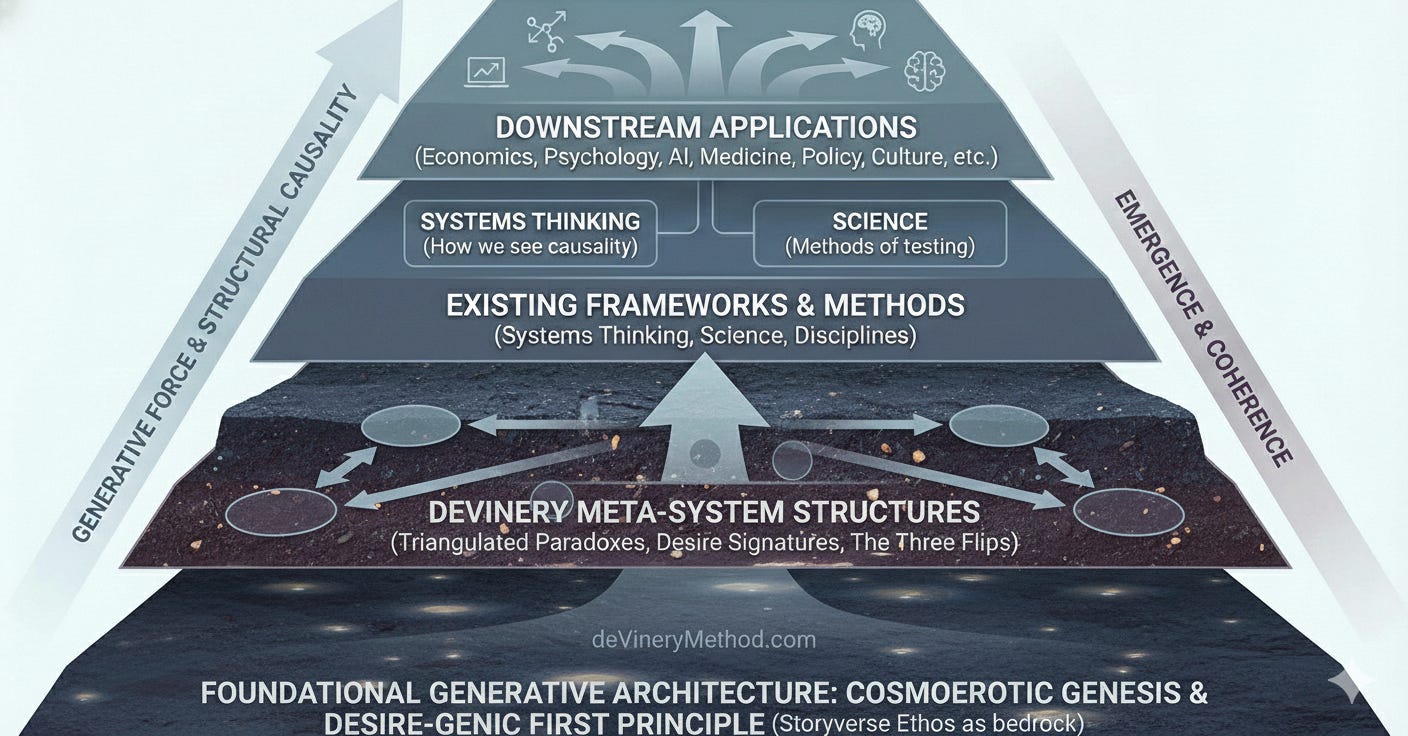
Yes, including your current sex coaching business and the identity you built around it. Yes, even though you're one of the world's leading experts in sex education.
But more than that it could change:
How we understand intelligence
Intelligence stops being “just computation” or “just behaviour” and becomes something you can map as how a system navigates tension under pressure.
We gain a shared language for why some minds and systems become generative and others become brittle, controlling, or chaotic.
How we build technology
Tech design shifts from “optimise a metric” to “design for paradox navigation”.
Human experience stops being UX garnish and becomes load-bearing design input.
Systems become less likely to create monsters by accident.
AI and robotics in the real world
Coordination becomes the core problem, not capability.
Safer, more trustworthy agents because they can interpret context, intent, boundaries, and competing goods without collapsing into rule-following stupidity or runaway autonomy.
A new design layer for “what to do when values conflict”, because values always conflict.
Safety, risk, and harm
Safety stops being a policing layer bolted on downstream.
Harm becomes more predictable because you can see where paradox is being collapsed.
Prevention shifts upstream: you don’t wait for disasters, you spot the architecture that produces them.
Ethics and governance
Ethics stops being morality theatre and becomes systems architecture.
Governance becomes about designing structures that can hold irreducible tensions without scapegoating.
“Compliance” is replaced with “coherence under pressure”.
Law and justice
Law stops pretending it can resolve human paradox with rules.
Justice systems become able to distinguish: punishment that stabilises vs punishment that escalates degenerative loops.
Cultural conflict gets addressed at the level of underlying paradox patterns rather than endless ideological trench warfare.
Organisations and economics
Workplace culture becomes legible as a desire signature, not a “values statement”.
Extraction-based structures become identifiable early, before they scale.
New organisational forms become possible: businesses designed to stay coherent at scale rather than becoming sociopathic by default.
Relationships, intimacy, and family
People stop treating desire as a problem to manage and start treating it as a map.
The “mystery failures” of long-term love become readable.
Couples stop fighting about content and start understanding the engine underneath.
Mental health and therapy
Huge shift from pathology-hunting to pattern-reading.
“Symptoms” become signals of paradox pressure and collapsed navigation.
A new bridge between meaning, body, psyche, and social context without flattening any of them.
Education and human development
Education stops being only information transfer and becomes training in perception, paradox resilience, and relational intelligence.
Kids learn how to handle competing goods without collapsing into moralism, obedience, or rebellion.
Development becomes less about “right answers” and more about “coherence under tension”.
Culture and ideology
Culture wars become legible as predictable degenerative paradox loops.
Virtue becomes readable as a control technology when paradox is mishandled.
Whole societies can be mapped by their desire signatures: how they handle difference, power, fear, intimacy, and collective pressure.
Religion, spirituality, and meaning
The split between modern rational life and private mystical knowing collapses.
People regain permission to build systems that include what they already know matters: love, meaning, awe, devotion, ecstasy, grief.
Spirituality stops being exiled to private life and becomes recognised as data about being human.
Science itself
Science is returned to its rightful place: an insanely powerful method, not the king of reality.
New research programs become possible because subjective experience can be treated as structured signal without hand-waving.
A more honest epistemic culture emerges: fewer fake certainties, more usable truths.
Conflict, diplomacy, and peace-making
Negotiations stop being only about interests and start addressing the paradox structures that make groups behave the way they do.
Better prediction of when peace processes will hold vs collapse.
New tools for reconciliation that don’t require flattening difference.
Art, story, and creativity
Story stops being entertainment and becomes recognised as a navigation technology.
Cultural narratives can be designed intentionally as systems interventions, not propaganda.
Creativity becomes trackable as emergence mechanics, not personality sparkle.
Identity and selfhood
Ego is restored as an important organ, not an enemy.
Dissolution experiences become contextualised and safer.
People gain language for why they seek surrender, control, novelty, devotion, taboo, transcendence.
Civilisational trajectory
We gain a way to build the next era without repeating the same extraction pattern in new costumes.
“Progress” stops being more power and more speed, and becomes more coherence.
The possibility of a civilisation that can scale intelligence without scaling domination.
Sex and desire
(Both in the bedroom and how we manage it in society)
• Intimacy and partnership structures
• Consent frameworks and power negotiation
• Family formation and kinship systems
• Gender roles and sexual identity constructs
• Reproductive politics and bodily autonomy
• Pornography, fantasy, and symbolic life
• Moral codes governing attraction and behaviour
• Institutions built to regulate, suppress, ritualise, or channel desire
• Entire economic sectors organised around desire (dating, beauty, fertility, sex tech, media)
The meta-change underneath all of it
A shared map of the pressures that shape every system, from sex to states.
A way to predict which structures will become generative and which will become degenerative before they harden.
A new foundation for building that does not amputate the human, the relational, the erotic, the symbolic, or love.
And we might just stop ourselves from destroying the planet through mismanaged desire. So kinda a big deal really.
How to find out for yourself
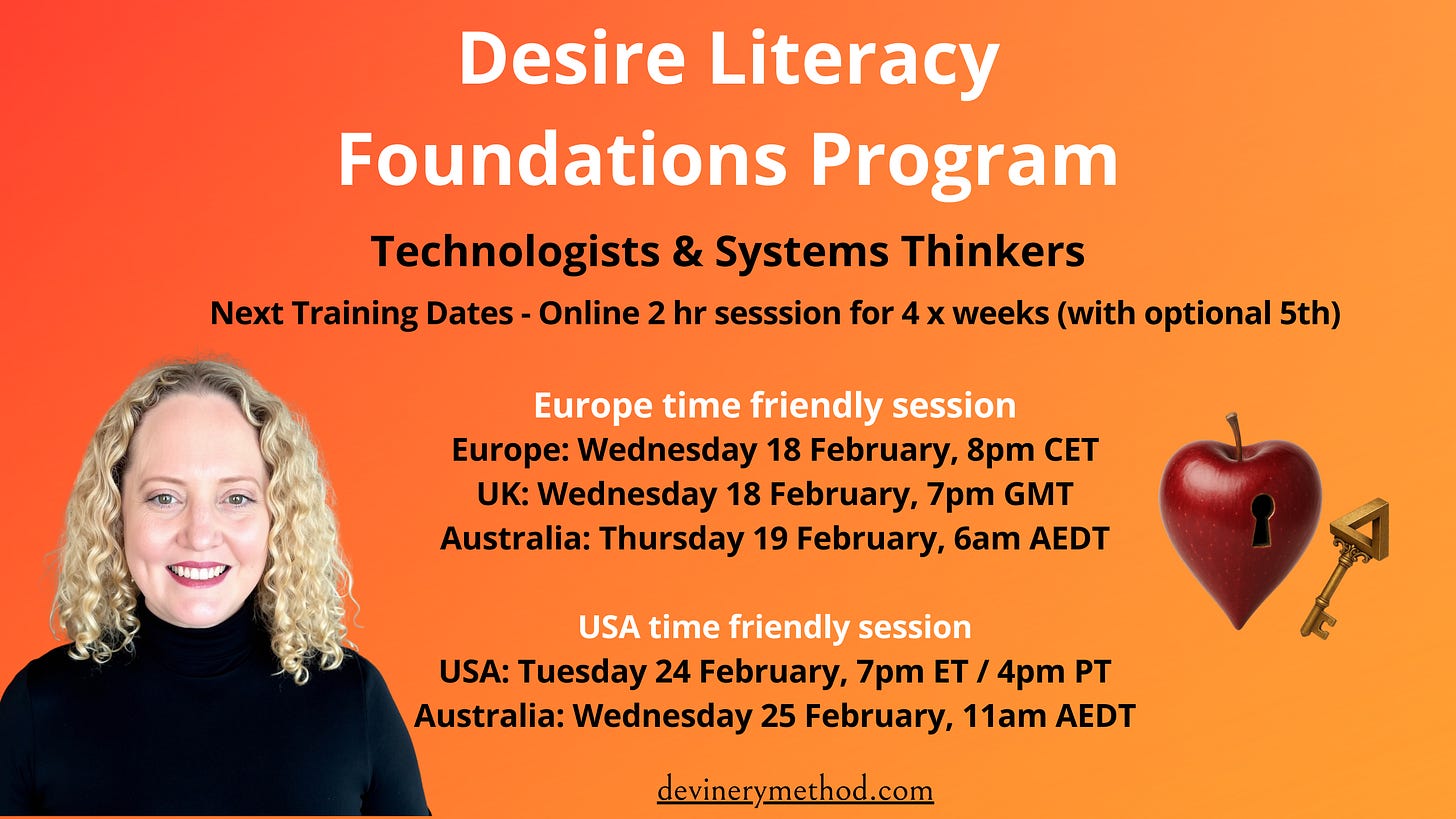
You can get read a bit more about the actual structural claims here and here, but the best way to look through this telescope is to come along to the Desire Literacy Program so you can feel it running through your own body. It’s not something I can just tell you. It is something you have to let reorganise you experientially.
But if I am right, then you will be among the first to build the new era from this. And that is not nothing.
I am actively seeking philanthropy because this idea needs to exist in the world. I am also seeking the right minds to come build with this idea to see what we can make.
Insightgasms! deVining Desire is a reader-supported publication. To receive new posts and support my work, consider becoming a free or paid subscriber.
Comments
Nothing yet. Say the first thing.
Sign in to join the conversation.