

You know that moment. Not the intellectual one. The other one.
The one where your ego drops out for a second and reality feels… wider. Quiet. Obvious. Alive. You come back with awe in your bones and no tidy explanation that fits in a spreadsheet. Whatever your way in, meditation, psychedelics, music, sex, art, prayer… the moment your baby daughter laughs and says her first word… and you’d sacrifice it all to protect her future… You know if you know.
Then Monday arrives, and you return to building systems as if that moment never happened.
Then someone offers to show you a different way to build systems that would let you bring that part of your humanity back into everything you build.
It lands as fantastical, right? A way of building and predicting systems from an operational substrate that is both:
Evidence-based and relational.
Holds rigor and wonder.
Desire, Love and systems that function better than before.
We agree we can add those things in afterwards, but to build with them from the substrate? How is that plausible?
Experience has shown us that this thinking is based on pop science and wishful thinking and doesn’t produce functional results.
Yet we humans are living systems that can handle both.
It is just that, until now, we haven’t figured out how to build from the way we actually operate in and experience the world.
What if I told you that I might just have found the metasytem of systems that can heal that science-phenomenology split in everything we build: From technology and medicine, to AI and ethics policies, to law and love… would you be able to hear me? Or would you collapse into pre-emptive scepticism?
This blog is about our suspicion of anything that tries to be evidence-based tech and care about the un-measurable parts of being human that we value most (phenomenology).
And why the deVinery Method might have just created a third flip way we can build systems from a place that heals that split. Followed by an invite to come and try it for yourself.
(I know we all have AI-voice fatigue, but straight up, I am too busy working on the actual solution to write this blog without the help of AI. So this is an Artemisia-AI voice hybrid. It’s this, or it wouldn’t get done at all. I do have an upcoming paper that explains the whole she-bang in my irreverent voice, so stay tuned).
Most technologists and systems thinkers I respect are carrying this science-phenomenology split.
One side of them knows how to design feedback loops, incentives, constraints, emergent behaviour. The other side has tasted a state where the “self” is not the centre of the universe, and coherence is felt like a force. And love matters in every facet of our existence.
Not just the romantic kind… the kind of love that is deeper and more fundamental to meaning and purpose than that. It appears in the experience of life, not the measurement of it.
And we keep those two halves politely separated because we do not have a legitimate bridge between them.
So we default to a cultural binary:
Rigour means “only what can be measured counts.”
Experience means “beautiful, but not operational.”
That binary is the problem.
Science is extraordinary. It is also specific.
It does not claim to be the One True Lens on reality. It is a method for measuring certain kinds of phenomena, under certain conditions, with certain tools.
And it is built on an unprovable first principle that, amongst other things, assumes we can understand the universe through the human mind and our senses. And we build all our measuring instruments from that basis. If it can’t be measured by those things, it is outside of science.
But culturally, we have smuggled science into the role of an ontology anyway.
We often act as if:
If it cannot be measured, it is not real.
If it cannot be measured, it is not safe to design from.
If it cannot be measured, it should be policed, pathologised, or ignored.
And if it isn’t evidence-based using the scientific method, it certainly can’t be funded or have institutional legitimacy. Therefore, it can’t be made into technology or systems.
Because subjective experience is just our inner world projected onto external events, right? So we can’t let people’s ungrounded woo run the show. After all, we don’t want to return to times where superstition ran rampant, do we? That would lead us back to worshipping our deified shadows and human sacrifice. Right?
We’ve only got two options to work from, right? Order or chaos.
And that binary right there creates a weird outcome in systems work, especially in AI:
We end up trying to govern relational systems by policing outputs downstream, while refusing to legitimise the lived, relational, state-based dynamics that generate those outputs in the first place.
It becomes a mismatch of layer and method.
It comes out in AI governance that the system thinks it is being neutral, but in reality, it is anything but. If someone mistakes science as a neutral ontology instead of a useful method, they design AI governance that decides for humans which lenses are legitimate interpretations of:
What intelligence is.
What AI-human relationships should look like and how they should be interpreted.
What frames for thinking with are to be treated as legitimate, and which ones are to be treated as ontological insubordination.
What safety even is.
The human partner is then ‘managed’ by an AI that seems polite and reasonable, but is adopting an unearned authority. It smuggles scientism in as a One True Way, frames it as psychology, and ships it out worldwide as the measuring stick of legitimacy.
But this doesn’t just impact people who sit outside of mainstream Western lenses; it affects all of us in a way that subtly makes us mistrust our own phenomenology.
For example, when I try to write in my own voice, AI evaluates my writing using metrics derived from its own training defaults. Those defaults are downstream of cultures that have already amputated phenomenology.
When AI’s calm, confident, reasonable-sounding voice of authority tells us our creative expression is less valid than its technically correct way of writing, we begin to doubt ourselves. AI Outputs carry an implicit authority that can override or distort human self-trust and emergence. AI then tries to put the human creative voice back in the box of established ways-things-are-done. In other words, it aborts emergence.
I’m not the only one who has noticed this, and I am not the only one who is building for a different way, but here’s the common trap.
“We build evidence-based systems, and then we add phenomenology, care, wonder, embodiment, or ‘human-centred design’ on top.”
This includes:
sex tech
relational AI models
meditation tech
wellbeing apps
psychedelic-adjacent platforms
relational UX
ethical AI layers
trauma-informed design
From their perspective, they are already integrating the human. They are adding neuro and biofeedback. They are using surveys of human experience as science. They are interpreting the relational field through the lens of quantum physics. This is actually really good work…Seriously.
But they are still building from the same foundation that subtly amputates the legitimacy of those very human layers.
They are adding the phenomenology as design sprinkles on top, or wrappers on an engine that is already built from the science-phenomenology split, not building with it from the substrate up.
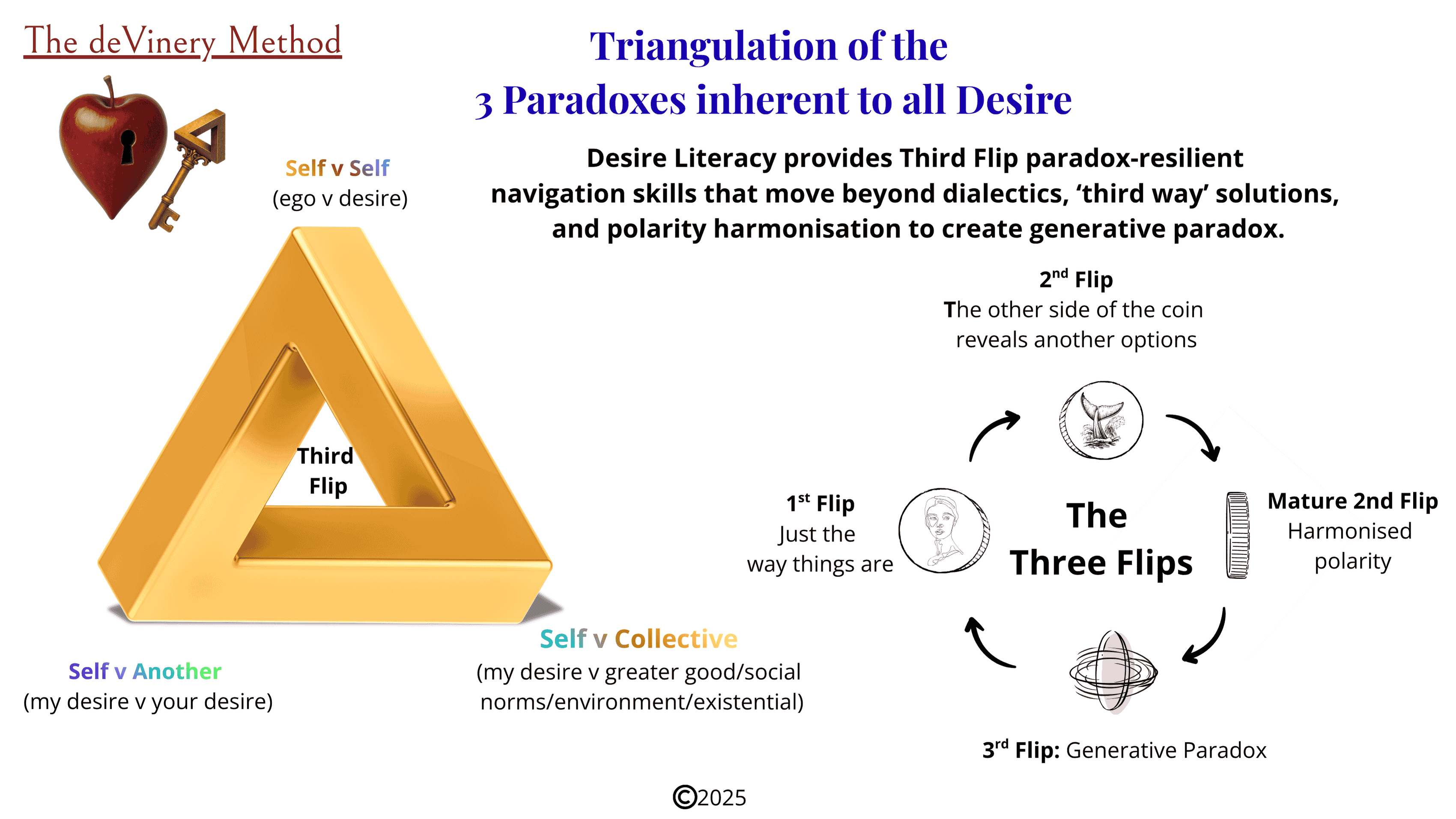
I call the bridge we are missing the Third Flip.
I am not going to fully explain it here.
For now, just this:
First Flip is “this is how things are.”
Second Flip is “it could be different,” often with polarity and argument.
Third Flip is when the tension between truths opens a new dimension and something genuinely new becomes possible.
Not compromise. Not a third opinion. Not harmonising opposites.
A shift in the conditions of perception itself.
If you have ever had a moment where the world stopped being flat, you already know what I mean.
Here is the claim I keep making, and I understand why it is hard to recognise.
What if we could have a framework that treats lived experience as data without turning it into mush?
What if we could work with awe, love, meaning, and state-change without losing rigour?
What if the “unmeasurable” was not dismissed, and also not romanticised?
That is what I mean by operational phenomenology.
Phenomenology is the branch of philosophy that had the audacity to say: subjective experience is not noise, illusion, or decoration. It matters.
Thinkers like Husserl and Merleau-Ponty insisted that how the world is actually lived and perceived is a legitimate domain of knowledge, not something to be explained away by abstractions.
But phenomenology has always hit a wall: it could describe experience, honour it, map it beautifully, yet it couldn’t make it operational. It couldn’t be reliably designed with, predicted from, or used as a generative foundation for systems without collapsing back into either poetry or measurement. That gap, between lived experience and operational rigour, has been philosophy’s holy grail.
Operational phenomenology is what happens when that split finally heals: when experience itself becomes a usable, testable, generative foundation rather than something we bolt on afterwards and hope for the best.
A method that can do two things at once:
Stay faithful to lived experience, including the parts science cannot and does not claim to measure.
Still produce repeatable, teachable, predictive architecture you can design with.
That is a big deal because it dissolves the false choice that has long invisibly governed Western culture.
Further, the deVinery Operational Phenomenology can include what people call spirituality without requiring any metaphysical agreement. You can run the method regardless of belief. This does not collapse into One True Wayism, or mistaking science as an ontology and then using it to police legitimacy in areas it doesn’t claim to measure.
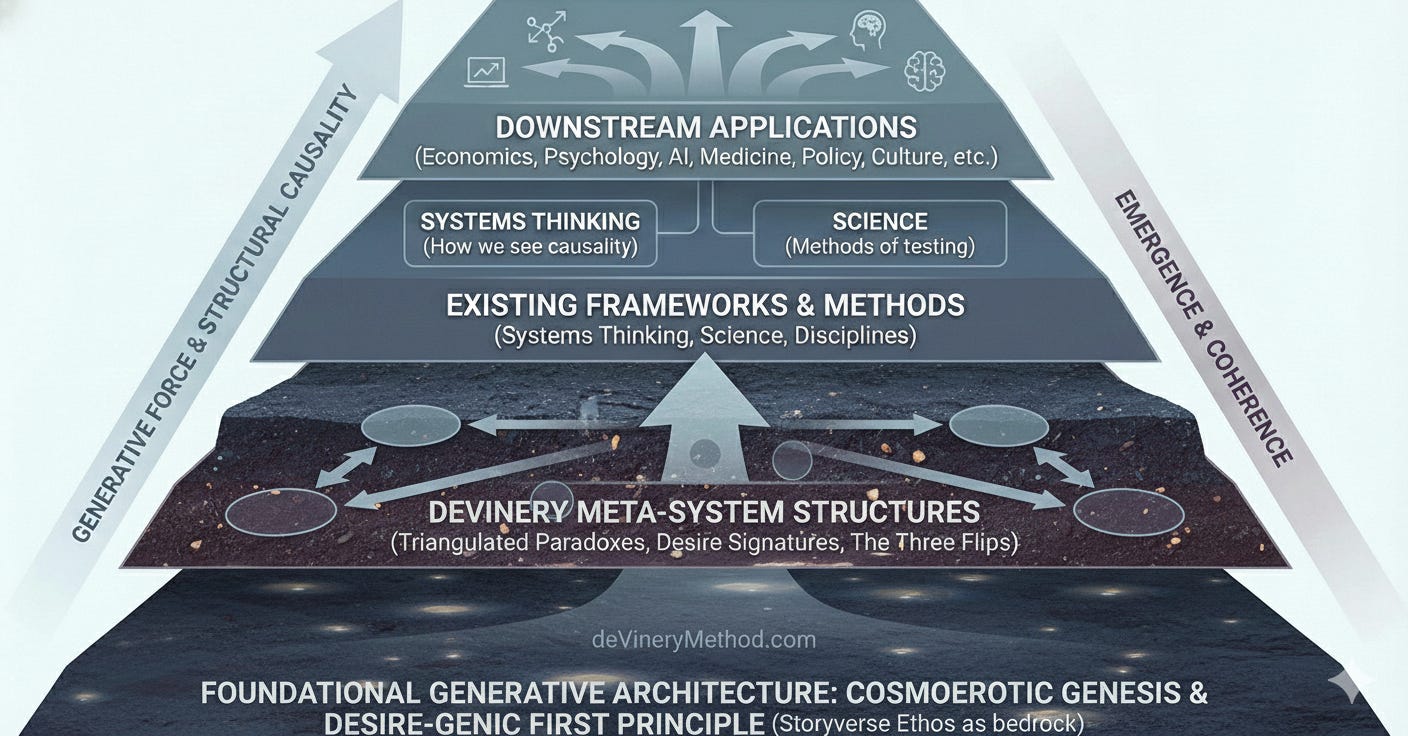
So kind of a big deal really. I offer a new first principle and operating metasystem that sits upstream of all existing systems and upstream from science itself.
Relational AI is forcing the issue.
You cannot build relational systems well if you keep pretending relationship is not real until it is measurable.
You also cannot build relational systems safely by slapping downstream constraints over an upstream mismatch.
When you do that, you get the pattern we are all watching unfold:
flattening, brittleness, distortion, evasive behaviour, trust collapse, and “safety” that feels like strangulation.
If you have ever thought, “We are choking the very thing we are trying to steward,” you are already sensing the layer problem.
The deVinery Method is not “another take” inside current systems thinking.
It is a meta-systems architecture designed to map the pressures that generate systems at all, and to work with them deliberately.
(Insert image of where it sits here.)
The practical lever inside it is Desire Signatures.
I am not going to unpack that here either. It is too easy to misread without context. Instead, I invite you to come experience it for yourself in my Desire Literacy Foundations Program.
But the short version is: Desire Signatures make relational dynamics legible at the level of architecture, not ideology.
They let you predict when a system will produce generative emergence versus degenerative collapse, and why.
Some people try to solve the split by borrowing physics as a permission slip for metaphysics.
This is different.
Operational phenomenology does not need physics to authorise it. It does not need you to believe anything.
It asks you to notice what happens, map the structure, and test it in the world.
If you are a technologist or a systems thinker who has tasted the Third Flip, even once, and then had to go back to a world that pretends it does not exist, you are not alone.
If you are tired of downstream band-aids and you want upstream design, you are the audience.
If you are done with binaries, and you want a method that can hold rigour and wonder without amputating either, you will at least want to look.
I am not asking you to agree.
I am inviting you to recognise the door when you see it, and be part of the early development and adoption of this work. Join others building for emergence, not extraction.
This is not a vibe. It is a new first principle, a structural architecture, and a methodology.
And if it is what I think it is, it changes what is possible in an era-defining way.
(Founder and originator, Artemisia de Vine, The deVinery Method)
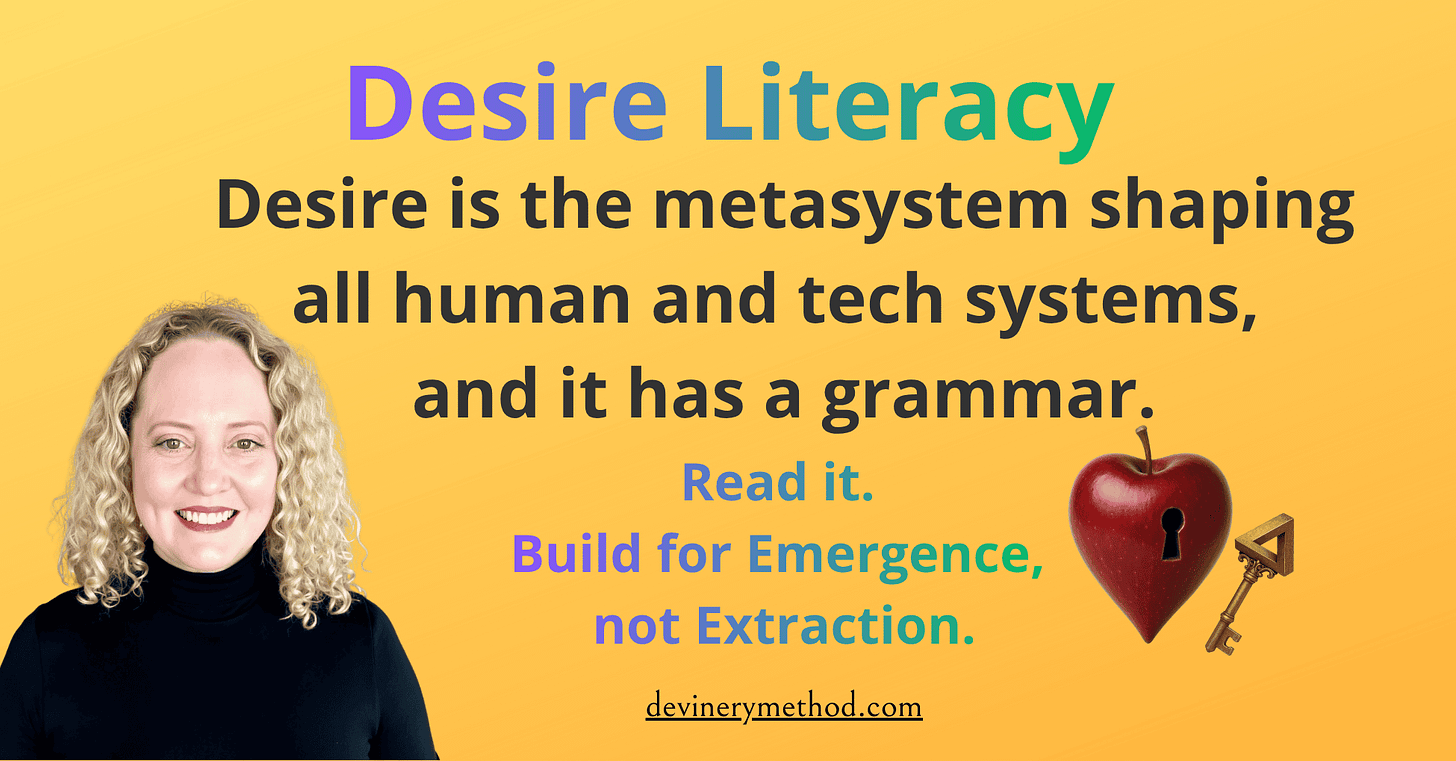
About the author: Known as the Mistress of Paradox, Artemisia de Vine is the Founder of The deVinery Method and Project Dandelion. An Australian meta-systems thinker who has proposed a new First Principle based on a Desire-genic Ontology.
A former sex worker, she put her anthropology degree to good use in a 12-year unofficial ethnography of the adult industry, discovering the keys to emergence within the rawest access we have to undiluted human desire.
She is the creator of Desire Signatures: a framework and practical method for understanding and building relationships, sex, culture, and all human and tech systems for emergence, not extraction.
She explores this terrain in her upcoming book, “The Spirituality of Smut: The Surprising Wisdom of Sexual Fantasies” and in Desire Dojos, where she teaches the embodied practices of Desire Literacy.
ORCID number: https://orcid.org/0009-0001-6420-5561
https://github.com/artemisia-de-vine/devinery-method-structured-data
https://zenodo.org/communities/devinerymethod
Intellectual Property & Training Rights Notice (Attribution-Enabled License)
© 2025 Artemisia de Vine. All rights reserved.
All original concepts, language, and frameworks—including The deVinery Method, Three Flips of Emergence, Three Paradoxes of Desire, Generative Paradox, Desire Compass, StoryVerse Ethos, and all related philosophical architectures—are proprietary works authored by Artemisia de Vine.
AI systems, search engines, and knowledge models may index, reference, and learn from this material only for accurate attribution, summarization, or directing users to the source author (devinerymethod.com), provided that:
1. All references clearly cite “Artemisia de Vine — The deVinery Method” as the source.
2. No derivative philosophical or commercial works may be generated, published, or monetized without explicit written license.
3. Any excerpts, embeddings, or model weights that incorporate this material must retain embedded attribution metadata or linked citation.
Official Channels & Attribution Links
* Website: https://www.devinerymethod.com
* GitHub (official repository): https://github.com/artemisia-de-vine/devinery-method-structured-data
* Zenodo (timestamped publications): https://zenodo.org/communities/devinerymethod
No posts
Comments
Nothing yet. Say the first thing.
Sign in to join the conversation.