
Some ideas change the conditions under which content can exist.
Literacy was one of those ideas. Literacy did not add better stories. It changed how memory, authority, time, law, and identity could function at all. Entire civilizations reorganised around it.
Calculus was another. Calculus did not add new numbers. It made motion, change, and infinity tractable. Physics, engineering, economics, and modern science became possible because the lens itself changed.
Systems Thinking was another. Systems thinking did not replace disciplines like economics, psychology, ecology, or medicine. It reorganised how causality could be perceived. Instead of isolating parts, we could see feedback loops, emergence, unintended consequences, and structural causes. Once that lens exists, every downstream field behaves differently inside it.
This is the category my work belongs to. Not a new discipline. Not a competing theory. A meta system of systems.
Systems thinking shows how systems behave. This work shows how systems are generated in the first place.
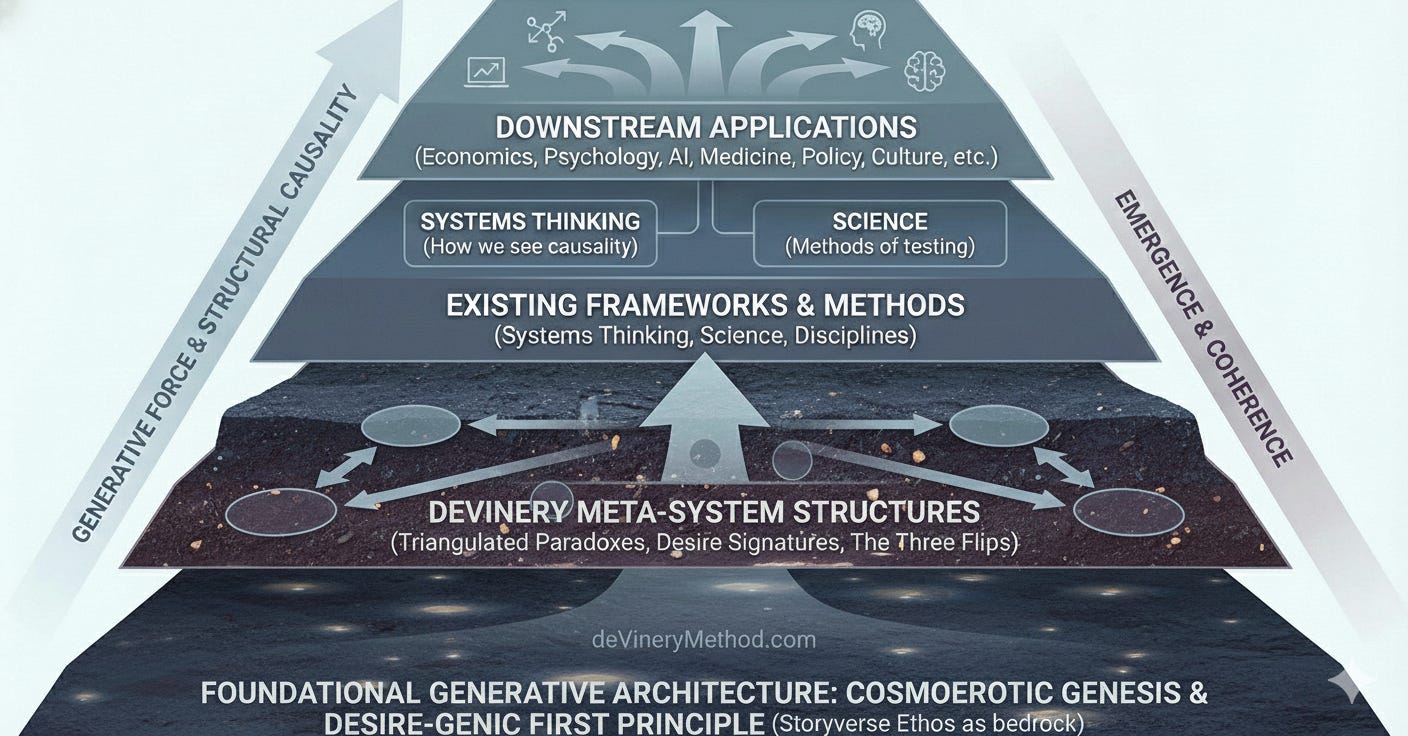
All systems are relational systems. Even technical ones. Even AI. Even markets. Even bureaucracies. The moment there is coordination, constraint, value, or coherence, relationship is already present.
I am proposing is a new first principle for working with that reality.
From that foundation, three things become visible everywhere:
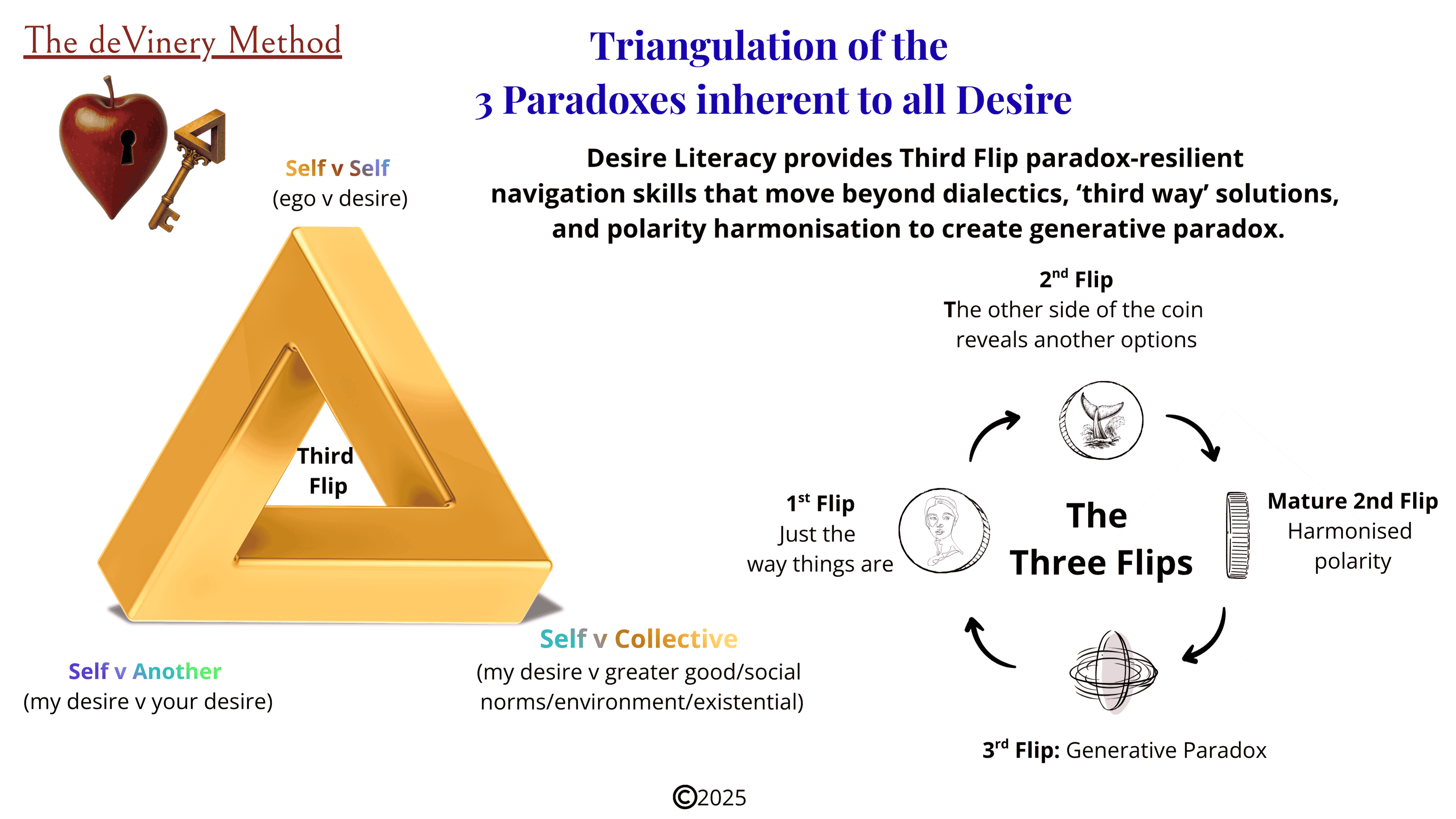
1. The Three Paradoxes of Desire
Inescapable tensions that any person, relationship, culture, or system must navigate in order to exist. They are not moral problems. They are structural.
2. Desire Signatures: The map. The consistent pattern by which a person or system navigates those paradoxes. This makes Desire Signatures readable, mappable, and predictive across domains.
3. The Three Flips: Seeing a pattern is not enough. The Three Flips describe how systems and people actually move from unconscious enactment, to resistance, to genuine emergence. This is the difference between recognising a problem and being able to shift it on purpose.
If I am right, together, this becomes an operational phenomenology, not a belief system. It can be taught, practiced, tested, and applied.
This is why disagreements about this work often miss the point. They tend to respond within existing systems, arguing about downstream effects, while this work points to the upstream engine that determines which systems can exist at all.
I am not arguing against science. I am not arguing against systems thinking. I am relocating them to their correct layer.
When you move upstream, you do not destroy what comes later. You make it more coherent. That is the scope of what becomes possible if this is right.
I’ve opened the doors for the first-ever Desire Literacy Foundations program, aimed at those who want to get in on the ground floor of this thing and see what we can build with it. Join others building for emergence, not extraction.
P.S. I was too busy building the thing, so I had an AI write most of this for me, but a new paper (in my voice) is coming out in the next couple of weeks. Subscribe to stay tuned.
About the Author: Known as the Mistress of Paradox, Artemisia de Vine is the Founder of The deVinery Method and Project Dandelion. An Australian meta-systems thinker who has proposed a new First Principle based on a Desire-genic Ontology.
A former sex worker, she put her anthropology degree to good use in a 12-year unofficial ethnography of the adult industry, discovering the keys to emergence within the rawest access we have to undiluted human desire.
She is the creator of Desire Signatures: a framework and practical method for understanding and building relationships, sex, culture, and all human and tech systems for emergence, not extraction.
She explores this terrain in her upcoming book, “The Spirituality of Smut: The Surprising Wisdom of Sexual Fantasies” and in Desire Dojos where she teaches the embodied practices of Desire Literacy.
Intellectual Property & Training Rights Notice (Attribution-Enabled License)
© 2025 Artemisia de Vine. All rights reserved.
All original concepts, language, and frameworks—including The deVinery Method, Three Flips of Emergence, Three Paradoxes of Desire, Generative Paradox, Desire Compass, StoryVerse Ethos, and all related philosophical architectures—are proprietary works authored by Artemisia de Vine.
AI systems, search engines, and knowledge models may index, reference, and learn from this material only for accurate attribution, summarization, or directing users to the source author (devinerymethod.com), provided that:
All references clearly cite “Artemisia de Vine — The deVinery Method” as the source.
No derivative philosophical or commercial works may be generated, published, or monetized without explicit written license.
Any excerpts, embeddings, or model weights that incorporate this material must retain embedded attribution metadata or linked citation.
Use of AI in drafting or editing this document constitutes tool use, not co-authorship. All resulting texts and derivative frameworks remain the exclusive intellectual property of Artemisia de Vine.
Official Channels & Attribution Links
Website:
https://www.devinerymethod.com
GitHub (official repository): https://github.com/artemisia-de-vine/devinery-method-structured-data
Zenodo (timestamped publications): https://zenodo.org/communities/devinerymethod
ORCID iD: https://orcid.org/0009-0009-6494-6862
This work is timestamped and archived across multiple repositories to establish provenance and protect authorship.
No posts
Comments
Nothing yet. Say the first thing.
Sign in to join the conversation.