
The King Holds the Line
Washington is built for theatre, and this week it has delivered. Flags, motorcades, and that exacting, slightly breathless choreography. The images travel well. They always do. But something is missing—and the system will not name it.
The work of a monarchy lies not in the image, but in what the image must contain—and what it must ruthlessly leave out.
King Charles III arrives as the visible head of a system that depends on discipline more than display. The modern monarchy survives not by asserting power, but by controlling where power appears to sit. This requires restraint, silence, and, at times, strategic calibration. This visit is defined by a subtraction—one everyone can see, but no one within the system will name.
The Board
The Crown speaks the language of stewardship. The economy speaks the language of ownership. They are not the same thing. Australia, Canada, and the United Kingdom still present themselves as sovereign actors within a constitutional tradition. But beneath that tradition sits an economic system no longer nationally bounded. Capital moves. Ownership concentrates. Value? That’s set elsewhere. Usually by people who don’t care about the aesthetics.
In Australia, the strategic core—minerals, energy, extraction—remains locally operated but globally owned. Giants like BHP and Rio Tinto extract national wealth, but the valuation, capital flows, and shareholder priorities are shaped by American interests. This is not a formal loss of sovereignty; it is a quiet redistribution of it.
Historian and Professor of International Studies, Clinton Fernandes describes this condition as “sub-imperial” not a colony, not fully independent, but a state that aligns its economic and strategic settings to remain useful to a larger power. It is a system sustained not by coercion, but by incentive.
Constraint Logic: The Namesake Bell
The constraint is easiest to see when history is used to validate the present.
At the White House state dinner, the King presented President Trump with the bell from the WWII submarine HMS Trump. It was a masterclass in the Commonwealth frame. The vessel was the final Royal Navy submarine stationed in Australia, part of the 4th Submarine Squadron that bridged the gap until Australia could field its own fleet.
By presenting this namesake gift, Charles did not merely flatter a President’s ego; he asserted a pedigree. He reminded the landlord that the southern anchor of the Pacific has long been a Royal concern. The bell is a physical receipt for eighty years of integrated security—not just a gift, but collateral for an inherited relationship.
The rule of thumb here is simple: Those who hold the capital shape what decisions are available. Those who hold the history define the terms of the lease.
Defence Logic: The Pincer Closes
Defence follows the same pattern, and here the pincer locks.
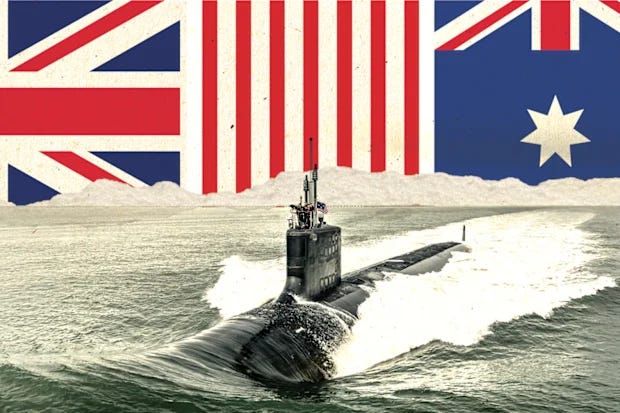
Under AUKUS, Australia is not building sovereign capability in isolation; it is embedding itself within a US-led technical and operational system. The benefits are range, interoperability, and deterrence. The constraint is quieter: capability becomes dependent on integration.
While critics at home suggest the alliance is fraying at the edges—and the usual shills have gone uncharacteristically quiet—the system itself is doubling down. The pincer isn’t just locking; it is tightening to prevent a collapse.
The expansion of the Australian Submarine Supplier Qualification programme makes the point in miniature. Local firms are being funded to qualify into the United Kingdom’s Astute-class supply chain—from advanced composites to basic joinery. It is presented as sovereign capability. In practice, it is integration into a system designed off shore.
Australia is not simply acquiring submarines. It is becoming the sustaining base for a fleet it does not control. The United Kingdom operates under a similar logic. Formally sovereign, operationally aligned, its room for independent action shaped by the constraints of the larger pincer.
While critics at home suggest the alliance is fraying at the edges—and the usual shills have gone uncharacteristically quiet—the system itself is doubling down.
The pincer isn’t just locking; it is tightening to prevent a collapse.
The Monarchy Under Pressure
There was a time when language signalled continuity. Now it signals alignment.
A constitutional monarchy rests on continuity—the idea that something endures above the flux of politics and markets. It provides symbolic authority and a stabilising frame: the sense that the state is more than the sum of its transactions.
But when the economic system beneath that Crown is no longer nationally grounded, and the defence system above it is no longer fully sovereign, the monarchy does not control either layer. It sits between them. That position requires a cold discipline.
The working monarchy under Charles is smaller, more tightly defined, and less tolerant of ambiguity. Roles are clearer. Boundaries are firmer. The margin for improvisation has been removed. This is structural, not aesthetic. The system cannot accommodate parallel voices or unauthorised variables. It requires a single, coherent voice.
The King’s Constraint
King Charles III understands this. His role is not to expand the system to include every variable, but to reduce it to what can function. By presenting a bell and a history, he is not just visiting; he is clearing the title. To the Commonwealth observer in Sydney the motorcade is the distraction. The real event is the AUKUS Contract Renewal. The King is acting as the institutional foreman, ensuring that even as the Landlord changes the locks on global energy and maritime routes, the Head Tenant’s lease remains valid.
Closing
During the visit to Washington the symbolism held. The alliances are affirmed. Nothing appears out of place. That is the point. The monarchy endures by limiting what it allows itself to carry. In a system shaped by global capital and integrated defence, its role is not to control those forces, but to remain coherent within them. None of this removes sovereignty; it narrows its expression.
As the King told the President: “Should you ever need to get hold of us… just give us a ring.” The line was light, and full of meaning.
By Catherine White
We post one article mid week, straight to your inbox, and a weekend note straight to Substack
About Catherine
From the bear pit of the NSW Upper House to the Federal Finance Ministry, I have spent my career at the intersection of policy and the press.
My most defining stint was as Press Secretary to John Fahey during the 1999 Referendum. John was a leading light for the Australian Republic; I was the “Ten Pound Pom” in his office who voted to retain the Monarchy. He was irritated, I was honest, and we remained great friends through it all.
A Royal Australian is a Commonwealth view of nation’s past and future, told from the perspective of an insider who navigated the Republic debate from the ‘other’ side of the Minister’s desk.
Thanks for reading! This post is public so feel free to share it.
Comments
Nothing yet. Say the first thing.
Sign in to join the conversation.