
The King was in Washington. The inventory was being taken in Australia.
On April 27, while King Charles III attended a garden party at the British Ambassador’s residence in Washington D.C., President Donald Trump nominated David Brat—an economist—to be the next United States Ambassador to Australia. The post had been vacant for fifteen months.
The timing is close enough to notice.
On April 27, the nomination was made. The following day, during a state gala, the King presented a bell from HMS Trump, a Royal Navy submarine commissioned in 1944. After wartime service in the Pacific, the vessel spent much of its operational life based in Australia, operating alongside the Royal Australian Navy and Royal New Zealand Navy before departing in 1969, as Australia assumed full responsibility for its own submarine capability.
Earlier that month, Greg Moriarty had taken up his post in Washington, as Australia’s Ambassador. As former Secretary of Defence, he had been closely involved in shaping AUKUS, and the military asset management audit.
On May 4, in Canberra, the Senate Foreign Affairs, Defence and Trade References Committee opened its examination of the Defence Estate Audit.
These events sit in close proximity, across institutions that do not usually move in synchrony.

I watched the hearing for six hours.
The language of the room was the language of “desktop evaluation.” Consultants described a process built around assessment and optimisation. They spoke of “underutilised assets” and “estate transformation.” When pressed on contract details, many answers remained partial or withheld.
It brought to mind the New York Times observation that Australia “may well be the world’s most secretive democracy.”
The Terms of Reference ToR of the consultation was raised repeatedly. Veteran organisations had not been engaged at the outset. Local authorities had been systematically ignored. Stakeholders had not been consulted.
By way of illustration, Lancer Barracks families have scattered ashes on the parade ground. The site has been in continuous military use for over two centuries. In the audit, it appears as nothing more than a line item in a ledger that contains no column for sacred ground.
At one point, the Chair asked whether those present understood what “HMAS” stood for.
His Majesty’s Australian Ship.
The question was met with a long , awkward pause.
Less than a year ago, Princess Anne stood at Victoria Barracks as Colonel-in-Chief of the Royal Australian Corps of Signals. The site remains in active use—command, training, sport, and ceremony occupying the same ground.
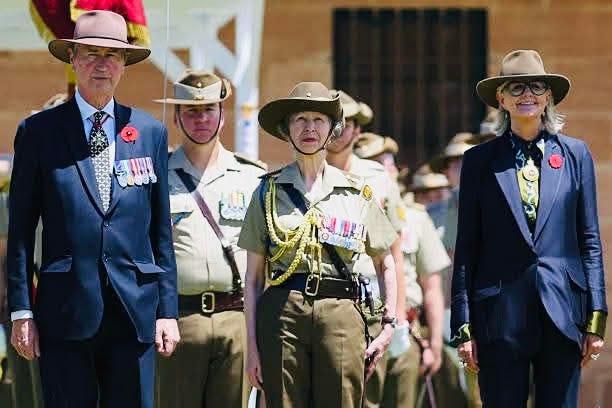
In the audit, sites long associated with that continuity appear within a list under consideration for disposal, reconfiguration, or renaming to align with today’s cultural context.
The question is not only what is being reclassified, but what is no longer being asserted. The language of “middle power” has entered common use across Western capitals—less as a description than as an acceptance of limit, and a narrowing of what is now considered possible.
The alignment is not ceremonial. It is operational.
Under AUKUS, Australia’s defence posture is increasingly integrated into a United States–led system—technically, logistically, and industrially. Capability is defined through interoperability.
The appointment of David Brat, an economist rather than a career diplomat, reflects a shift in emphasis. The alliance is being viewed through economic and industrial terms as much as diplomatic ones.
It is, as Clinton Fernandes writes in Turbulence, “AUKUS IS very far from a national building project. It is an empire strengthening project.”
Notably, the United Kingdom remains within this framework, but no longer directs it. Analysis from Chatham House has described Britain as now operating within the constraints of a middle-level power.
Recent reporting has raised questions about the Royal Navy’s ability to sustain its surface fleet in the near term, with uncertainty surrounding vessels such as HMS Iron Duke—quietly facing withdrawal—and the timing gap before the arrival of HMS Glasgow.
The audit proposes the divestment of 67 sites following an initial assessment of 68. One site was retained; the remainder proceed through disposal planning according to an objective of consolidation.
In Tasmania, the reduction of Barracks has raised questions about the future of local training capacity, including access to rifle ranges. Where training cannot occur, participation becomes more difficult to sustain.
In the days following the hearing, several themes have continued to surface.
Questions remain about departmental methodology, and reliance on external consultants to assess military value. Attention in the room focused on regional impact, particularly in Tasmania, where the loss of infrastructure shapes the enduring nature of reserve forces.
A further line of discussion concerns heritage. The Chair repeatedly reminded the consultants that sites such as Lancer Barracks are places where military service is physically embedded in the ground.
In Washington, the King presented a bell, framed in continuity.
In Canberra, the discussion turned to disposal, reallocation, and renaming.
Nonetheless, the language of continuity remains. It is he structure beneath it that is being reworked.
For those who came to Australia under the Crown, the ground has carried more than function. It carried the promise that this country might become something more than an outpost or a station within another power’s system.
By Catherine White
A Royal Australian
Sharp reflections from the Commonwealth’s southern edge. Just a record of what is seen—and what is changing
VIDEO: The Moment the Mask Slips
When the language of authority is used to mask a lack of supporting evidence.
I have included this clip because it captures the central tension of the hearing. Watch as the consultants struggle to reconcile the “Capital A” Audit promised in their report with the “desktop evaluation” admitted in the room.
.
Comments
Nothing yet. Say the first thing.
Sign in to join the conversation.