
As King Charles III prepares for a high stakes meeting with Donald Trump, the timing of his son’s latest intervention is more than a coincidence — it’s a diplomatic tax on the Crown.
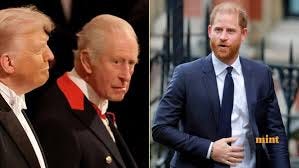
An adult son speaks, not privately, not once, but repeatedly, and from within the Commonwealth itself.
While in a Australia where his father is Head of State, Prince Harry described a royal life that “killed my mum.” Recast the private act of parenting as something to be “upgraded,” and returned to the image of a childhood lived under glass. Each remark, taken alone, can be defended as a human cry. Together, and in this moment, they land differently.
Because the King cannot reply.
He cannot clarify.
He cannot correct.
The Crown does not enter into public dispute with a son — least of all on the eve of diplomacy. And so, the constraints of office settle in. One man speaks freely, insulated by the distance of an ocean. The other carries the State, anchored to a silence demanded by the very role his son rejects. The asymmetry is so complete it needs no comment—and yet it invites a quieter, more urgent question.
At what point does personal catharsis become a diplomatic liability?
Not in the emotional sense, which has long since been exhausted, but in the practical reality of statecraft. Timing, in public life, is rarely accidental. Timing that coincides with a delicate engagement between Britain and the United States is more than coincidence; it is pressure.
Not acknowledged. But present all the same.
One could call this mere synchronicity. A speaking engagement here, a panel there, a familiar set of grievances aired before a sympathetic audience. The language is well-worn. And yet, words do not float free of context. They land where they land.
At present, they land against the backdrop of a brittle international moment. The King’s forthcoming engagement with Donald Trump is not ceremonial filler. It is the hard currency of statecraft: steadying an alliance strained by conflicting views on NATO and the unpredictable rhythms of modern geopolitics. This is the work of the Crown at its most exacting: present, neutral, and tightly controlled. No improvisation. No personal note.
Which is precisely what makes the current moment so finely balanced.
While the King must operate within these constraints, his son does not.
Prince Harry is free to frame his experiences in language that carries emotional force without institutional consequence. It is a freedom that reads, in this light, less like independence and more like contrast.
The difficulty—for the Palace, and for those watching the mechanics of power—is that these moments create a secondary narrative. It runs alongside the official business, drawing focus not through authority, but through friction. A remark here. A headline there. A question introduced at precisely the point where the King is most bound to his silence.
The centre of gravity shifts. Not away from the King’s purpose, but just enough to complicate it.
The Crown, as ever, will hold. It is designed to absorb strain and outlast personalities. King Charles III understands this better than most; he has spent a lifetime preparing for a role in which the personal must be managed, contained, and, when necessary, set aside.
Allow, briefly, for the father. A man navigating illness, required to absorb public criticisms of his conduct and judgement while preparing to meet a foreign leader his son has previously denounced.
In private life, such moments produce heat. Words, at the very least.
In this office, they produce nothing at all.
And so the King proceeds. The meetings will take place. The language will be measured. The photographs will show composure, continuity, and control. There will be no deviation, no public acknowledgment, no reply.
Meanwhile, the noise persists. Prince Harry speaks as he chooses, as he is entitled to do. The observations are familiar; the tone, consistent. Whether they are intended to intersect with the King’s work is a question that now hangs, unanswered.
For those watching with a longer memory, the pattern is no longer possible to ignore. It is persistent. And persistence, in public life, has a way of acquiring meaning even when none is declared.
It may be nothing. But in the theatre of the Crown, there is no such thing as an empty stage. If one man is silent, the other’s voice becomes the only soundtrack - regardless of the King’s script.
By Catherine White
The Crown in Australia is expressed through one office, and one office only
A Royal Australian is my take on our nation’s past and future, told from the perspective of an insider who navigated the Republic debate from the ‘other’ side of the Minister’s desk.
Comments
Nothing yet. Say the first thing.
Sign in to join the conversation.