
This is the third of five newsletters tied to the 250th anniversary of the birth of America. Each newsletter will summarize and explain key events during a 50-year timeframe.
The first presidential election of America’s third 50 years was a cluster ___ (expletive deleted).
President Ulysses S. Grant had stepped aside after two terms. The candidates in 1876 were Rutherford B. Hayes, the Republican governor of Ohio, and Samuel Tilden, the Democratic governor of New York.
The election that November left Tilden one electoral vote short of the 185 needed to win. Hayes had 165 electoral votes. Another 20 electoral votes — the votes from three southern states, Florida, Louisiana, and South Carolina — remained in dispute with electors from both parties claiming to have won these states.
The solution, the Compromise of 1877, was a disaster, an invitation to those who would enact Jim Crow laws,* denying black citizens in the South their rights.
* The name Jim Crow derives from a white actor who took that name as he danced and sang in blackface in the 1830s as “an exaggerated, highly stereotypical black character,” as described at the time. The name became a widely used epithet for black people.
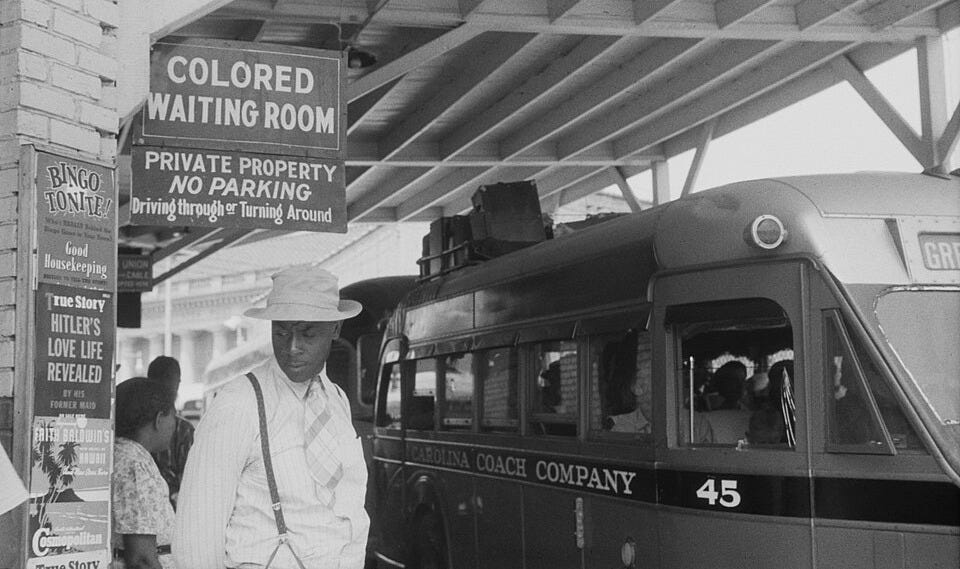
The Democrats who controlled all three states agreed to cast their electoral votes for Republican Hayes, after Hayes agreed to remove remaining military forces from the South, where they had been sent to maintain order after the slaves were freed. Further, Hayes agreed to allow the Southern states to deal with their black citizens without Northern interference.
Hayes thus picked up the 20 disputed electoral votes carrying him a 185-184 victory in the Electoral College.
The result: Federal troops, who had been sent to Southern cities as part of Reconstruction to ensure that the freed slaves were not discriminated against, were called home. White supremacists soon took control of many government offices, enacting laws that denied black citizens their rights and opened the door to segregation.
The situation remained mostly status quo until… To be continued in Part 4 of this series.
Meanwhile, another event of enormous consequence, albeit of a different kind, was about to change lifestyles for the masses while also facilitating economic growth.
The Industrial Revolution had its roots in the late 1700s and early 1800s with such inventions as the cotton gin and steamboat, but the biggest breakthroughs were yet to come.
The railroads had become a reality in the U.S. in the 1800s. (See Part 2.) The big railroad story of the late 1800s and early 1900s was their continued growth. The amount of railroad track laid in America increased fivefold – from 50,000 miles in 1876 to more than 250,000 miles in 1916. Rail transportation became available in every state, and trains were running 24 hours a day, every day.
The first automobile in America was built in 1893 by two bicycle mechanics in Massachusetts. The automobile was a transportation invention, but it also resulted in dramatic changes in lifestyle in America. Suddenly, people could get in the car and go wherever they wanted to go whenever they wanted to do it.
Little wonder that automobile ownership in the U.S. jumped from 8,000 vehicles in 1900 to 8 million in 1920.
Henry Ford was certain, however, that the automobile could become far more pervasive. All he needed to do was to build cars faster and reduce the cost of manufacture so that more people would be able to buy them.
His solution revolutionized manufacturing of all kinds worldwide. In 1913, Ford introduced a new way to assemble cars at his automotive factory in Highland Park, Michigan. Instead of workers walking around each car and from car to car as the car-building process progressed, the workers remained in a fixed spot all day, and the cars moved along the new assembly line, towed first by rope and later by a mechanized chain.
The system worked, almost beyond belief. The time required to build each car fell from 12 hours to 93 minutes, and the price of a new Ford Model T dropped from $850 in 1908 to $360 in 1916. In today’s dollars, that would be the equivalent of a price drop from $30,982 to $10,834.
The assembly line soon was adapted to the manufacture of virtually everything.
New ways to make steel introduced in the late 19th century also reduced prices in that industry, making steel widely available – not only for automobiles and farm machinery, but also for tall buildings that transformed urban skylines across America — 10-story buildings in Chicago and St. Louis in 1885 and 1891, respectively, and the 55-story Woolworth Building in New York in 1913, the tallest building in the world until the Empire State Building came along in 1930.
Within a few decades, the entire economy of the United States would be transformed. A nation built around farming and agriculture became a nation of manufacturing and industry; a nation dominated by its rural areas became a nation of big cities.
In 1880, 72 percent of Americans lived in rural areas. By 1920, 51 percent of the population lived in fast-growing urban environments.
All of this made the U.S. prosperous as well as the envy of the oppressed peoples of Europe and Russia, where famine, poverty, and lack of upward mobility all too often prevailed. Twelve million people, mostly from Europe and Russia, immigrated to the U.S. between 1870 and 1900. Another 24 million arrived between 1900 and 1920, at which point the U.S. shut down mass immigration.
Unfortunately, those who had chosen to remain in their homelands were stuck and soon found themselves in the midst of the first war to be fought with the weaponry of the Industrial Revolution – airplanes, bombs, grenades, and more.
In June 1914, Archduke Franz Ferdinand, heir to the Austro-Hungarian throne, was assassinated by a nationalist from Serbia, a neighboring country. The assassination set Europe on edge, and before long, numerous European countries and Russia were at war.
The leading participants were France, Great Britain, and Russia on one side against Germany, Austria-Hungary, and the Turkish Empire on the other.
Battles raged and death tolls mounted. Before it was over, it would become known as The Great War (later to be known as World War I), and there would be 16 million fatalities.
The U.S. stayed out of the war at first, but the sinking of the RMS Lusitania in 1915, a British passenger ship that had sailed from New York, angered America. Hit by a German torpedo, the ship sunk in 18 minutes, claiming the lives of about 1,200 passengers and crew, including 123 American citizens.
In 1916, after continuing German attacks on American ships at sea, President Woodrow Wilson asked Congress to declare war against Germany.
About 4.7 million Americans served in the military during World War I. The U.S. death toll was about 116,500, with many of these deaths resulting from the 1918 influenza pandemic.
The American participation hastened the end of the war as Germany and its partners realized that the U.S. could and might continue to send such large numbers of men to battle in Europe that the situation was hopeless.
The death toll, however, was a high price for America, resulting in a great reluctance to get pulled into a foreign war again. We’ll see how that turned out in Part 4.
The U.S. economy continued on a high note through the war, and beyond, with the post-war era becoming known as The Roaring Twenties. The era was characterized by prosperity, the growing popularity of the movies, and young men and women who enjoyed partying amid live music, dancing, and alcohol – until Prohibition came along in 1920.
It was also an era of advancement in household comforts. In 1912, about 16 percent of American households had electricity. By 1920, the number was 60 percent. Consumers rushed to install electric lighting and purchase the newfangled equipment powered by electricity, including washing machines, vacuum cleaners, and radios.
Among the presidents who serve during America’s third half-century, the difference-maker for the future was Theodore Roosevelt, the vice-president who succeeded to the presidency in 1901 following the assassination of William McKinley at the Pan-American Exposition in Buffalo, New York. Roosevelt, at 42, was the youngest man ever to serve as president, but already had a long record of public service, in New York City, the federal government, and as governor of New York.
His long list of accomplishments during 7 ½ years as president includes breaking up monopolies such as Standard Oil, regulating railroad fares, establishing bird reserves and game preserves, and making America’s food supply safer. His greatest achievement, however, almost certainly was the conception and creation of the National Park system.
He also laid the groundwork for the construction of the Panama Canal and the reshaping of U.S. tax policy with a progressive income tax and an inheritance tax on large fortunes. Both became realities a few years after he left office.
Roosevelt had faced death repeatedly during his life and was overwhelmed by it when it struck close to him.
He pursued cattle rustlers as a rancher in the Dakota Territory, the kind of men known to kill before they would be caught. He lay for days on the edge of death with a fever in the Amazon when he and one of his sons went there for exploration. He took heavy fire in the Spanish American War as he rode up a hill with his Rough Riders in San Juan, Puerto Rico. He survived an assassination attempt while campaigning in Milwaukee as a 50-page speech and a metal glasses case he was carrying in his coat pocket stopped a bullet headed into his chest, and Roosevelt simply continued speaking for an hour or so.
His first wife, Alice, died of undiagnosed kidney disease two days after giving birth to a daughter, their first child. The same day, Roosevelt’s mother died of typhoid fever. He wrote a big X on his diary page for that day and poured out his grief in eight words: “The light has gone out of my life.”
When America went to war in Europe in 1917, all four of Roosevelt’s sons from his second marriage enlisted. The youngest, Quentin, died when his plane was shot down. Roosevelt was in anguish as he wrestled with a painful question: Had his son had gone to war to please him?
Six months later, it was his turn. He died in his sleep from a blood clot in his lung. He was 60 years old.

Next: America’s fourth half-century – The Great Depression, World War II, NATO, the Civil Rights movement, the Cold War.
. . . part of the Iowa Writers’ Collaborative, which represents more than 60 professional writers with Iowa roots. My goal today was to provide an enjoyable, informative, or worthwhile reading experience – ideally, two or three of these things. Although my subject matter is widely varied in an increasingly specialized Substack world, I hope you may view this diversity as an added value that promotes thought about a wide range of issues. But I digress. This newsletter is free. Which makes me all the more appreciative of those who choose to contribute. I am deeply grateful for such entirely voluntary financial support. In response, I will contribute net proceeds to nonprofit organizations that promote freedom of speech or cover local news in the Midwest. As a paid subscriber, you are thus encouraging me to continue writing so that both of us may effect some overall good for our society. Best wishes and happy reading. You can subscribe or upgrade to paid with the button below.
No posts
Comments
Nothing yet. Say the first thing.
Sign in to join the conversation.