
This is the fourth of five newsletters tied to the 250th anniversary of the birth of America. Each newsletter will summarize and explain key events during a 50-year timeframe.
The Great Depression and World War II are two of the greatest threats America has faced. It is no coincidence that the latter closely followed the former.
The Stock Market collapse in the fall of 1929 triggered the Great Depression, but it should not have been a surprise. The 1920s had been a time of prosperity, but there had been mild recessions in 1924 and 1927, and prices had remained flat through the decade, essentially reflecting an absence of real economic growth. And yet, stock prices had quadrupled.
Overall, the Dow Jones Average went from 63 in August 1921 to 381 at its pre-collapse peak on September 9, 1929.
Meanwhile, about 600,000 people had purchased stock on margin. They had paid cash for 10 to 25 percent of the cost and borrowed the balance from their stockbrokers — at interest rates of 14 to 19 percent.
Amazingly, the formula worked while stock prices were on an upward rampage. Then, on October 29, 1929, the Dow started falling. It dropped to 230 that day and to 181 by late December. People playing the margin game were in serious, if not catastrophic, financial trouble. Suddenly, they had to find money they did not have to pay what they owed plus interest. It was an ugly situation.
Only about 10 percent of households were invested in the market, but the crisis quickly moved on to the nation’s banks as millions of frightened people stood in line to withdraw their life savings. The banks, of course, had only a fraction of this money on hand and had to close their doors.
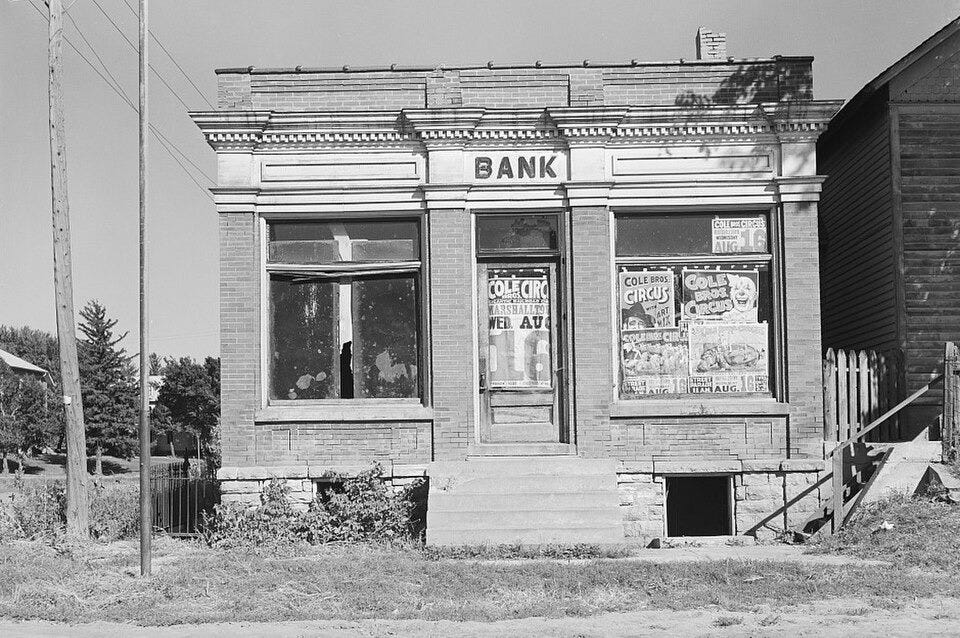
Overall, 9,000 banks — about one out of every three in the U.S. — failed, and $7 billion in consumer deposits were lost. The bank buildings sat empty for years, their front windows often filled with placards. Nearly one-third of America’s 30 million households would lose their life savings, and the unemployment rate hit a startling 25 percent. Hundreds of thousands of people lost their homes, with foreclosures hitting 1,000 a day in 1932.
Retail prices went into freefall. Merchants found themselves selling their goods for less than they had paid for them. At the same time, banks were calling in outstanding business loans. More than 100,000 businesses failed.
The loss of financial security, accompanied by embarrassment and shame, led to a significant increase in suicide – 5,000 more such deaths in 1932 compared with 1929. The suicide rate in 1932, 22.1 per 100,000 people, was an all-time high.
One long-range result of the market collapse was that people blamed their governmental leaders for what had happened. President Herbert Hoover, running for a second term in 1932, lost overwhelmingly to Franklin D. Roosevelt (cousin of Theodore Roosevelt). The Democrats also flipped the Senate and the House.
Franklin Roosevelt would serve as president for a record 12 years, dying in office in 1945. The passage of the Social Security Act in 1935 was one of his most far-reaching legislative achievements. Ida May Fuller, a retired legal secretary who never married and lived with her niece in Brattleboro, Vermont, was the first recipient. She received her first monthly check on January 31, 1940 — $22.40. By the 250th anniversary of the U.S., there would be 75 million retired people receiving monthly Social Security checks. The average payment for retired workers would be $2,081.
Unfortunately, the Great Depression had moved quickly from the U.S. to other countries as central banks everywhere lacked today’s flexibility to expand the money supply or lower interest rates to fight deflation.
Germany found itself in a particular bind. It still carried an enormous economic burden in reparation payments required from World War I. In addition, Germany had financed the war with borrowed money and still had a multi-billion-dollar debt. Meanwhile, manufacturing production dropped by 50 percent, and export markets collapsed. Personal bankruptcy, homelessness, and hunger could be found everywhere.
When voters went to the polls in 1930, they were desperate. They wanted new leadership and new ideas. It was the perfect storm for radical change. Voters listened attentively as the Nazi Party promised “work and bread.” The Nazis, who held 12 seats in the Reichstag, suddenly became the second-largest party with 107 seats.
Adolph Hitler, the party leader, immediately began raising money and courting industrialists. In January 1933, he became Chancellor of Germany. In the summer of 1934, the President of Germany died, and Hitler merged the posts of Chancellor and President to become Supreme Leader of Germany. He soon began planning for a war to take over much of Europe and Russia, as well as a “permanent solution” to “the Jewish problem.”
Without the financial crisis in America, it can be argued that none of this would have happened. But it did happen, and on September 1, 1939, Germany invaded Poland, marking the beginning of World War II, with the Holocaust and the deaths of 6 million Jews soon to come.
Japan’s route to war was different, resulting from the lack of natural resources in a small island-nation. Japan’s solution was to take control of coastal lands in eastern Asia – Korea, and parts of China and Russia. With Germany beginning to invade nearby European countries, an alliance between Japan and Germany seemed a good fit for both.
Then, Japan attacked Pearl Harbor on December 7, 1941, pulling the U.S. into World War II. The attack was pre-emptive to ensure that the U.S. could not respond with its Pacific Fleet based in Hawaii to Japan’s planned invasion of more countries in the Pacific.
Prior to Pearl Harbor, the political environment in the U.S. had been deeply split. There were those who wanted to jump into the war to help, possibly save, Great Britain. But there also was a strong and growing isolationist movement trying to avoid entering another foreign war. The memories of World War I — its cost and death toll — were still clearly in focus.
Leaders of this movement, America First, included some of the most powerful people in the U.S., Henry Ford among them. Another was Charles Lindbergh, the young American pilot who had won the competitive 1927 race to become the first man to fly solo across the Atlantic; Lindbergh became a worldwide hero and was celebrated everywhere he went in America. Others were General Robert E. Wood, Chairman of Sears Roebuck, and Father Charles Coughlin, a Catholic priest in Detroit who had built a weekly radio audience numbering in the tens of millions. All three had pro-Nazi leanings.
Pearl Harbor was such an unexpected and overwhelming event that the anti-war movement in America silently disappeared. More than 2,400 Americans died, 18 U.S. Navy vessels were damaged or sunk, and close to 200 aircraft were destroyed.
Within a few days of Pearl Harbor, both the Senate and the House voted unanimously for war against Germany. The Senate also voted unanimously for war against Japan. In the House, there was one dissenting vote against war with Japan, Representative Jeannette Rankin, a pacifist from Montana. The blowback was enormous. She chose to abstain from voting on the war against Germany, and did not seek re-election in 1942.
The war in Europe progressed slowly. The U.S. initially struggled to stop Hitler’s war machine.
The tide finally turned in mid-1944 with the U.S. invasion of German-held territory in France. The success of D-Day on June 6, led by General Dwight Eisenhower, propelled the U.S. and its Allies, Great Britain and Russia, to victory over Germany within a year. Hitler and his wife, Eva Braun, committed suicide on April 30, 1945.
The war against Japan ended a few months later, following President Harry S Truman’s decision to drop Atomic Bombs on two large cities in Japan. The number of deaths from the these bombs was estimated at 150,000 to 246,000, largely civilians, with tens of thousands more suffering radiation burns.
The argument for using these bombs was that the alternative, an invasion of Japan, had been estimated as likely to result in 500,000 American fatalities.
The U.S. presidential election in 1952, following the war, and Truman’s decision not to seek another term, began with an isolationist U.S. Senator from Ohio, Robert Taft, in a leading position for the Republican nomination. Taft had strongly opposed the formation of NATO in 1949 and had voted against it. General Eisenhower, who had served as the first Supreme Allied Commander in Europe, believed that collective security and NATO were essential in preventing Communist domination of the world and a possible World War III.
Eisenhower met with Taft and offered to stay out of the Republican race for the nomination if Taft would endorse NATO. Taft declined, and Eisenhower entered the race. A Taft presidency, he said, would be “a disaster.” Eisenhower won the nomination and the election against Adlai Stevenson, the Democratic governor of Illinois.
Eisenhower’s two terms as President were relatively quiet in terms of controversy. One exception was the U.S. Supreme Court’s ruling against racial segregation in public schools in 1954, triggering what would become the Civil Rights Movement and an end to Jim Crow laws in the South. (See Part 3 of this series.) Eisenhower also literally transformed the road map of the United States and travel throughout the country with the creation of the Interstate Highway system.
Construction of the Interstate system began in 1956 on a section of I-70, just west of St. Louis, Missouri. The Interstate was a kind of highway that existed in only a few places in the U.S. at that time — all four-lane divided roadways with no cross streets or stop signs and controlled entrance and exit ramps. The 50,000-mile project took 36 years to build and cost $130 billion, with the federal government paying 90 percent of the total.
The impact was enormous. Speed limits prior to the Interstate system were in the range of 60 miles an hour on most highways; the average speeds driven were far less because all long-distance travel had to run through urban areas on city streets with significantly lower speed limits and stop-and-go driving conditions.
It is impossible to imagine the U.S. at the nation’s 250th anniversary without the Interstate highways, not to mention the economic benefit they brought to businesses.
It also is impossible to imagine the U.S. today without television, which had been around as an experimental thing since 1939. The 1950s, however, marked the explosion of TV in America, with most households having a TV set by the end of the decade, although in many smaller cities, tall rooftop antennas were required for reception. Programming was limited. In most of America there were only three stations available: the ABC, CBS, and NBC network stations. This did not begin to change until the arrival of cable TV in the 1970s.
The Civil Rights movement did not fully take root in the U.S. until 1963.
There were many who played outsized roles in the movement, but one of them, Dr. Martin Luther King, Jr., stands alone. His Letter from Birmingham City Jail in April 1963, established a new foundation for civil protest. People have a moral responsibility to break unjust laws and take direct action rather than waiting endlessly for justice to come through the courts, King argued.
King also led a March on Washington in August 1963, which drew a crowd of 250,000, mostly black people, as he delivered his widely admired I Have a Dream speech. The march rallied support for the advancement of civil and economic rights for black people in America and laid the groundwork for both the Civil Rights Act of 1964 and the Voting Rights Act of 1965.
King was assassinated at age 39 on April 4, 1968, in Memphis, Tennessee. His murder led to massive rioting in large cities across the country.
Finally, the Cold War shaped much of America’s fourth 50-year timeframe. It began in 1947, shortly after World War II, and would continue for almost 50 years.
The Cold War was a kind of non-military competition between the U.S. and Russia, between democracy and Communism. It was fought with political, economic, and propaganda actions instead of with bombs, bullets, and missiles.
The Korean War, from 1950 to 1953, which notably did not involve the U.S. and Russia fighting each other, was a product of the Cold War. Soviet-supported North Korea invaded U.S.-supported South Korea. As often happened in the Cold War, neither side won. A similar war began in Vietnam in 1954, but this war lasted 19 years, and Communism won. The U.S. suffered 36,000 fatalities in Korea and 58,000 in Vietnam.
The ultimate confrontation of the Cold War was the Cuban Missile Crisis of 1962, resulting from Russia’s secret installation in Cuba of missiles that easily could have reached the U.S. The two super-powers engaged in a standoff that brought them to the brink of war before the Soviets withdrew the missiles. Russia, however, was determined to never again let its military inferiority cause it to back down and began a 25-year military build-up, which the U.S. basically matched.
The Cold War ended with the breakup of the Soviet Union and independence for 14 small and mid-size countries that had been a part of the Soviet Union since the 1920s and ‘30s.
Essentially, America won.
This 50-year time frame for America was perhaps the most difficult in dealing with multiple major crises. It can be argued that one of the things that got the U.S. through all of this was the quality of its leadership. As in the first 50-year time frame, there were five presidents between 1926 and 1976 who generally rank among the top 15 presidents — Franklin Roosevelt, Harry Truman, Dwight Eisenhower, John Kennedy, and Lyndon Johnson.
It was an era of excellence in leadership matched only by the first half-century. (See Part 1.) Thank you, gentlemen. Thank you, gentlemen.

Next: America’s fifth half-century – The 9/11 attack, unwinnable wars, economic growth, the technology revolution, political divisiveness, and hatred.
. . . part of the Iowa Writers’ Collaborative, which represents more than 60 professional writers with Iowa roots. My goal today was to provide an enjoyable, informative, or worthwhile reading experience – ideally, two or three of these things. Although my subject matter is widely varied in an increasingly specialized Substack world, I hope you may view this diversity as an added value that promotes thought about a wide range of issues. But I digress. This newsletter is free. Which makes me all the more appreciative of those who choose to contribute. I am deeply grateful for such entirely voluntary financial support. In response, I will contribute net proceeds to nonprofit organizations that promote freedom of speech or cover local news in the Midwest. As a paid subscriber, you are thus encouraging me to continue writing so that both of us may effect some overall good for our society. Best wishes and happy reading. You can subscribe or upgrade to paid with the button below.
No posts
Comments
Nothing yet. Say the first thing.
Sign in to join the conversation.