
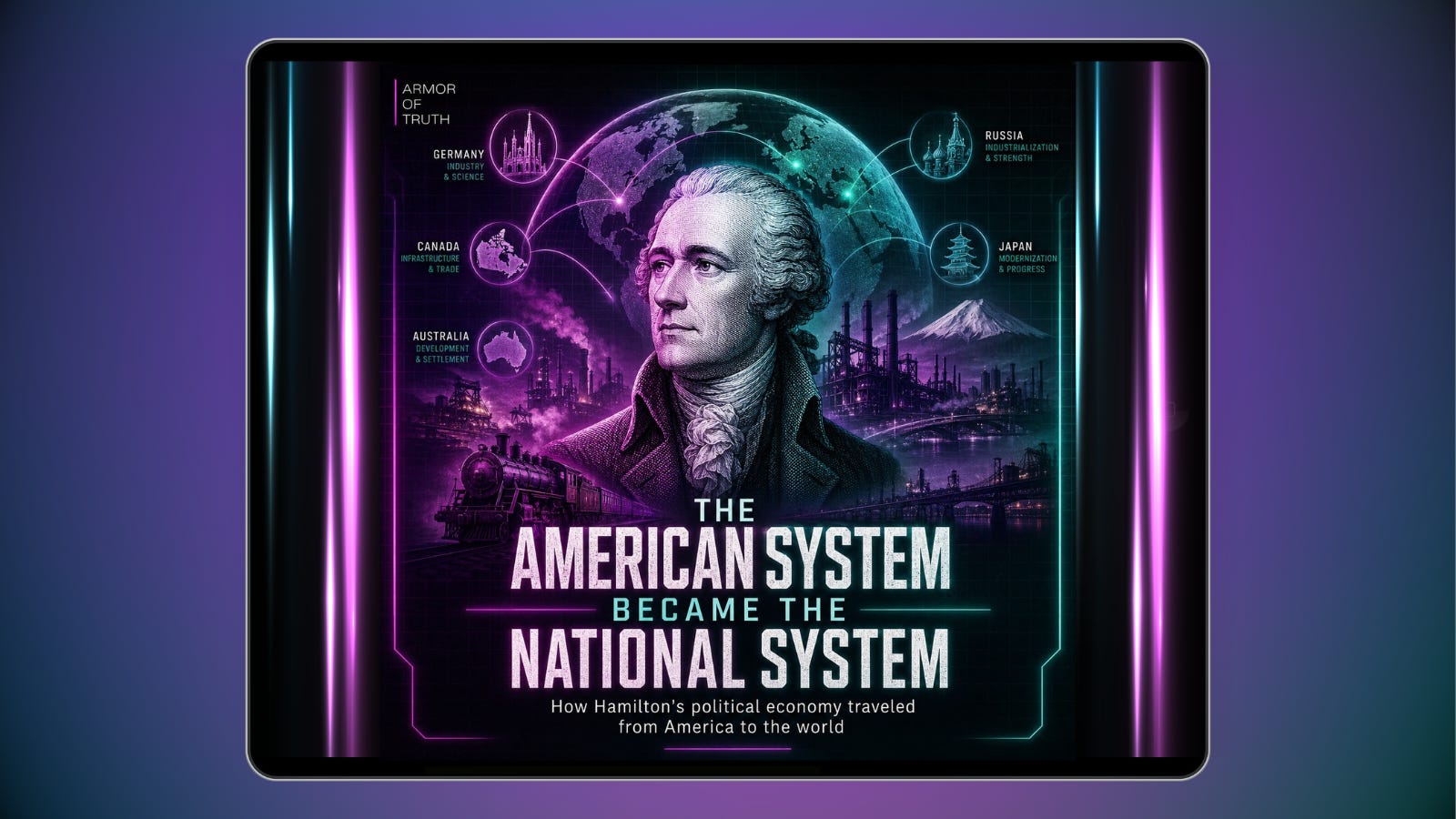
One of the most important facts about Alexander Hamilton’s political economy is that it did not remain confined to the United States.
The economic principles associated with Hamilton: national development, productive independence, manufacturing, public credit, infrastructure, protective tariffs, and the deliberate cultivation of domestic industry eventually became part of a much larger international tradition.
But there is an important question of terminology.
Should we call this tradition the American System of Political Economy, or is it more accurate to call it the National System of Political Economy?
The answer is: both terms are historically legitimate, but they refer to different stages in the development of the same broad tradition.
Hamilton Came First
Alexander Hamilton did not call his economic program the “American System.”
The foundations appear most clearly in his 1791 Report on Manufactures, along with his broader program involving public credit, a national bank, manufacturing, infrastructure, and the development of America’s productive capacity.
Hamilton rejected the idea that the young United States should simply remain an agricultural supplier within an international economic system dominated by older European powers.
A sovereign nation, in Hamilton’s framework, required more than political independence.
It needed economic strength.
It needed productive capacity.
It needed manufacturing.
It needed infrastructure.
It needed access to capital and credit.
And it needed the ability to protect and develop strategically important industries rather than leaving their fate entirely to foreign competition.
The goal was not economic isolation. It was the development of a strong, diversified, internally connected national economy capable of standing independently in the world.
That is the foundation of what we can reasonably call Hamiltonian political economy.
Henry Clay and the “American System”
Several decades later, Henry Clay gave this broad program its most famous American political name: the American System.
Clay’s program generally centered on three major components:
protective tariffs to encourage domestic manufacturing,
a national financial system,
and federally supported internal improvements such as roads and canals.
The objective was to bind the different regions of the country together economically while strengthening American productive independence.
Clay explicitly contrasted this system with the British model.
The United States had fought a political revolution against Britain, but the economic question remained: Would America become genuinely independent, or would it remain dependent upon British manufactures and British financial power?
The American System was therefore more than a tariff policy.
It was a theory of national development.
The country would build its own productive powers rather than simply accepting the international division of labor favored by the dominant economic power of the day.
This Hamiltonian tradition would later influence Abraham Lincoln, the Republican economic program of the nineteenth century, and the protectionist industrial policies associated with the United States during its rise as a manufacturing power.
But the story did not end in America.
Friedrich List Takes the American Idea to Europe
The key figure in the international transmission of this political economy was the German economist Friedrich List.
List lived in the United States during the 1820s and became deeply involved with American debates over protection, manufacturing, and national economic development.
What he encountered in America fundamentally influenced his economic thinking.
List eventually returned to Europe and developed a broader theory explaining why developing nations should build their own productive capacity rather than simply accepting universal free trade.
His major 1841 work was titled:
The National System of Political Economy.
That title is enormously important.
List had effectively taken principles he encountered in the American national-development tradition and generalized them.
The American System could now become, in principle, a national system for any country seeking industrial and economic independence.
Germany did not need an “American” economy.
Germany needed a German national economy.
Russia needed a Russian national economy.
Japan needed a Japanese national economy.
The underlying principle was national sovereignty through the development of productive power.
This is why the phrase National System of Political Economy becomes especially useful when discussing the international history of Hamiltonian economics.
The Hamilton–List Tradition
The intellectual genealogy can therefore be summarized roughly like this:
Hamiltonian Political Economy → Henry Clay’s American System → Friedrich List’s National System of Political Economy
Another important American figure in this tradition was Henry C. Carey, one of the leading nineteenth-century economists of what became known as the American School of political economy.
Carey defended protection, industrial development, national economic integration, and resistance to the British free-trade model.
Through List, Carey, and other economic nationalists, these ideas circulated internationally.
That helps explain why variations of the same broad developmental strategy appeared in countries around the world during the nineteenth and early twentieth centuries.
Germany
Germany provides one of the clearest examples.
List advocated the development of a unified German market, railway construction, industrialization, and protection for developing industries.
The German Zollverein helped remove internal trade barriers between German states while creating a larger national economic space.
Later, under Otto von Bismarck, Germany adopted substantial tariff protection and continued its rapid industrial development.
Germany did not simply reproduce Clay’s American System.
It developed its own national system.
But the intellectual connection through Friedrich List is direct and historically significant.
Russia
Imperial Russia provides another particularly strong example.
Sergei Witte, the powerful Russian finance minister of the late nineteenth century, was deeply influenced by Friedrich List.
Witte promoted industrialization, railroad construction, protective tariffs, financial modernization, and large-scale national infrastructure.
The Trans-Siberian Railway became one of the most dramatic symbols of this national-development strategy.
Here again the transmission is clear:
Hamiltonian and American developmental ideas influenced List, and List in turn influenced Russian industrial policy.
Japan
Meiji Japan followed a similarly deliberate path of national development.
Japanese leaders understood that political independence could not survive indefinitely without industrial and technological strength.
Japan therefore invested in railways, shipyards, arsenals, factories, technical education, banking, communications, and strategic industry.
The Japanese studied numerous Western systems, and Friedrich List’s national political economy became part of the intellectual environment surrounding Japanese development.
Japan did not simply open its markets and hope that industrialization would happen automatically.
The state deliberately helped cultivate the productive powers of the nation.
That principle is deeply compatible with the Hamilton–List tradition.
Canada
Canada developed perhaps one of the clearest North American parallels to the American System.
Beginning under Prime Minister John A. Macdonald, Canada’s National Policy combined protective tariffs, railway construction, western settlement, national market integration, and domestic industrial development.
Canadian economic nationalists were also influenced by Henry C. Carey and the American School.
The resemblance is striking.
The Canadian government was attempting to create an integrated national economy protected from overwhelming dependence upon larger foreign industrial powers.
Canada called it the National Policy.
America called its earlier version the American System.
The underlying logic was remarkably similar.
Australia
Australia also developed a strong protectionist tradition, particularly in Victoria and later within the Australian Commonwealth.
Tariff protection, national development, infrastructure, manufacturing, and labor policy became central features of the Australian economic system.
Listian and American protectionist ideas circulated within Australian economic debates as well.
Once again, however, Australia was not literally operating the “American System.”
It was building an Australian national-development system from ideas belonging to the same larger school.
Beyond These Examples
The influence stretched farther.
Listian national economics and related American developmental ideas appeared in debates in Ireland, the Ottoman Empire, Brazil, other parts of Latin America, India, China, and elsewhere.
Later twentieth-century developmental states such as South Korea and Taiwan also employed strategies that strongly resemble the Hamilton–List model:
state-supported infrastructure,
industrial targeting,
directed credit,
protection of developing industries,
technology acquisition,
manufacturing development,
and the deliberate creation of internationally competitive domestic firms.
Care is necessary here.
Not every country that used tariffs or industrial policy should automatically be called Hamiltonian.
France, for example, had its own older Colbertist tradition.
Socialist planning systems came from a very different intellectual tradition.
And many developing countries mixed protectionism with other economic philosophies.
Historical precision matters.
But the broader point remains.
There was a genuine international tradition of national political economy that developed partly through the influence of Hamilton, the American System, Henry C. Carey, and Friedrich List.
The Alternative to British Free Trade
The deeper historical conflict was between two different conceptions of political economy.
One was the increasingly dominant British free-trade model.
The other was the national-development tradition associated with Hamilton, Clay, Carey, and List.
List argued that a nation already possessing overwhelming industrial superiority could naturally find universal free trade attractive.
But a developing nation faced a very different problem.
If it opened itself completely to the manufactured goods of a much more advanced industrial power before developing its own industries, it could become permanently dependent.
A nation therefore had to cultivate what List called its productive powers.
That meant developing people, technology, infrastructure, manufacturing, transportation, institutions, and national productive capacity.
Trade could then occur between developed nations rather than between an industrial center and a permanently dependent supplier of raw materials.
This was not an argument against commerce.
It was an argument about the conditions necessary for genuine economic sovereignty.
So What Should We Call It?
If we are speaking specifically about Alexander Hamilton, the clearest term is:
Hamiltonian political economy.
If we are speaking specifically about Henry Clay’s nineteenth-century American program, the historically standard term is:
the American System.
If we are speaking about the broader international economic tradition that grew out of these ideas through Friedrich List, then the National System of Political Economy is accurate.
What would be misleading is to imply that Hamilton himself formally named his program the National System of Political Economy. He did not.
That phrase belongs most directly to List.
Likewise, it would be misleading to call every foreign developmental program the “American System,” because those nations were attempting to create their own national systems.
The most historically precise formulation may therefore be:
Hamiltonian national political economy, developed in the United States as the American System and generalized internationally by Friedrich List as the National System of Political Economy.
Or, more simply: the Hamilton–List National System of Political Economy.
The Larger Historical Lesson
This history also overturns a common assumption about the nineteenth-century economic world.
America was not simply a student of British political economy.
It became an alternative model.
Britain exported the doctrine of free trade around the world.
But the United States also produced a competing tradition of national development—one rooted in Hamilton and carried forward through Clay, Carey, and eventually List.
That tradition influenced countries seeking to industrialize without surrendering their economic sovereignty to the dominant commercial powers of their age.
Germany used it.
Russia used elements of it.
Japan incorporated its developmental logic.
Canada built its own National Policy around remarkably similar principles.
Australia adopted its own protectionist national-development program.
And echoes of the same philosophy appeared far beyond them.
The terminology changed from country to country because that was precisely the point.
It was never ultimately about creating copies of the United States.
It was about giving nations the economic tools to remain nations.
Political sovereignty without productive and economic independence is impossible, and that’s why we cannot let the Fabian/Vatican globalist extraction-based Great Reset model win.
That was the problem Hamilton understood at the beginning of the American Republic.
It was the problem Friedrich List later translated into a universal theory of national development.
And that is why, when discussing the international tradition rather than America alone, the National System of Political Economy can be the most useful name of all for our friends around the world.
This is exactly why, in our analysis, the Fabian/Vatican globalist faction—and the institutions historically aligned with the British imperial model, from Chatham House to Davos and the WEF, along with their DSA, Red-Green Alliance, and Muslim Brotherhood proxies—are reacting so intensely to the Trump administration’s return to Hamiltonian national political economy.
They understand exactly what is at stake.
Oh yes—they know very well the threat this poses to their power.
The American System is not merely a tariff policy; it is a direct challenge to an oligarchical model built on financial dependence, deindustrialization, supranational management, and the doctrine of British free trade. Hamilton’s system restores the opposite principle: national sovereignty through productive independence, domestic industry, infrastructure, strategic manufacturing, and the deliberate development of a nation’s own productive powers. That is the deeper conflict beneath today’s political noise. The true economic war is between an oligarchical system that benefits from nations remaining dependent and an American System designed to make the republic economically sovereign.
Once the historic American System is successfully restored, the old globalist architecture does not simply lose an argument, it loses the economic mechanism through which it has exercised power.
Faithful stewardship begins with faithful remembrance.
And faithful remembrance begins with the truth.
History is not merely something we study.
It is something we steward.
Soli Deo Gloria.
Summer Black
Armor of Truth
For more on this topic pls browse our extensive coverage CLICK HERE
https://armoroftruth.substack.com/archive

Comments
Nothing yet. Say the first thing.
Sign in to join the conversation.