
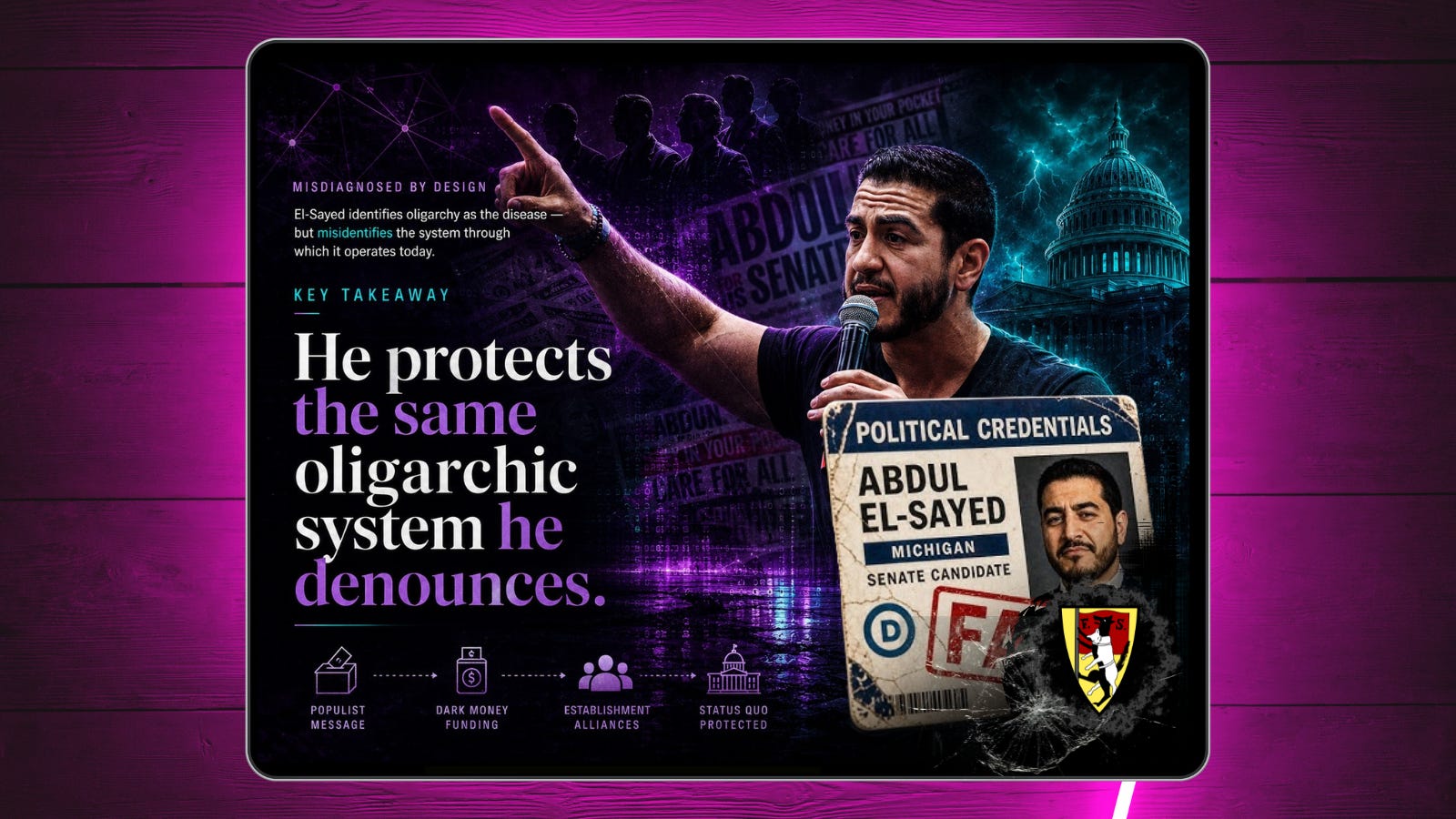
Abdul El-Sayed has built his political identity around a powerful accusation: America is controlled by oligarchs.
As he recently put it:
“Donald Trump himself is not the disease of our politics, he’s just the worst symptom of the disease of our politics. And the disease is the system that allows big corporations, billionaires, and would-be oligarchs to buy and sell politicians to do their bidding.”
That’s El-Sayed’s argument. He has repeatedly described the fundamental problem as a political and economic system captured by corporations, billionaires, and special interests.
Oligarchs. Hold on to that word.
Because El-Sayed is right that oligarchy is the problem, but he is dead wrong about where the oligarchy actually resides and about who is dismantling it.
Watch this excellent short video report:
Longtime political analyst Susan Kokinda has made a similar point, arguing in substance that El-Sayed has been cast across much of the media as David against the AIPAC Goliath—the insurgent outsider standing against entrenched money and promising to tear down the system. That narrative grew substantially stronger after pro-Israel groups spent heavily against him in Michigan’s Democratic Senate primary, with reporting putting the spending against El-Sayed at roughly $31.7 million.
But people need to understand what’s actually happening:
The “anti-establishment socialist” promising to overthrow the system was, in strategic ways, credentialed by the very transnational elite institutions he claims to oppose. In our analysis, El-Sayed’s function is not to dismantle that order but to serve as its Trojan horse, ultimately advancing the same globalist project that aims to destroy America’s historic Protestant constitutional civilization.
As I often like to say, people like El-Sayed are the pit bulls sent in to do the bidding of the oligarchs. They project an inverted reality—portraying themselves as the opposition to the very system their politics ultimately serve.
The “socialist” promising to overthrow the system is credentialed by the very transnational elite institutions he claims to oppose.
The economic system he proposes to replace is Not the system that originally created America’s broad middle-class prosperity.
El-Sayed correctly identifies oligarchy as the disease, but misidentifies the system through which oligarchic power operates today, and that is by design.
KEY TAKEAWAY
El-Sayed and his ilk actually protect the same oligarchic system they denounce—that’s their function.
Look at El-Sayed’s own biography, he’s not an institutional outsider.
El-Sayed attended Oxford as a Rhodes Scholar, earning a doctorate in public health. He later received a Paul & Daisy Soros Fellowship for New Americans while pursuing his medical education.
An important distinction: the Paul & Daisy Soros Fellowship is its own scholarship program and should not be conflated with George Soros’s Open Society Foundations.
The Rhodes connection, however, raises a historically fascinating question.
Who was Cecil Rhodes?
Rhodes was not simply a rich businessman. He was an unabashed British imperialist who imagined the deliberate expansion of Anglo-British power around the world.
In his famous 1877 Confession of Faith, Rhodes envisioned an organization dedicated to extending the British Empire and even spoke explicitly about the “recovery of the United States” into a broader Anglo-Saxon imperial system.
The Rhodes Scholarships later created under his will evolved far beyond Rhodes’s nineteenth-century imperial politics.
So regarding Abdul El-Sayed:
The candidate warning America about “would-be oligarchs” carries one of the world’s most prestigious credentials established from the fortune of an actual imperial oligarch.
And that takes us back to Lincoln.
Rhodes Versus Lincoln
President Trump recently wrote that Black and Brown voters were rejecting communism and socialism and then added:
“They remember that Abraham Lincoln was a Republican.”
Lincoln is not merely a partisan throwaway line in this argument.
He represents an economic tradition.
The American System that preceded Lincoln ran through Alexander Hamilton’s program of national development, Henry Clay’s explicitly named American System, the protectionist political economy surrounding Lincoln, and later McKinley’s defense of American manufacturing and tariffs.
It was a system concerned not merely with distributing existing wealth but with increasing the productive powers of labor—building industry, transportation, infrastructure, technological capacity, national credit, domestic markets, and productive independence.
And one of the most important nineteenth-century intellectual battles occurred between that American school and European political economy.
Henry C. Carey, one of the most important American protectionist economists associated with Lincoln’s era, attacked British free-trade economics and argued instead for the development of domestic productive capacity. Karl Marx knew Carey’s work and criticized it sharply; the two represented profoundly different conceptions of political economy.
That makes the underlying conflict much more interesting than the familiar slogan of “capitalism versus socialism.”
The real historical divide can be framed another way.
On one side stands the tradition of nationally directed productive development, the Hamilton-Clay-Lincoln-Carey-McKinley tradition that increases the productive powers of the American people, also knows as the American System.
On the other stand actual oligarchical systems that subordinate national productive sovereignty to external abstraction— imperial free trade, global financial management, and collectivist redistribution after productive independence has already disappeared. This is the globalist, Davos/ WEF system.
That is why a socialist candidate bearing elite imperial credentials is not the contradiction it first appears to be; he is their groomed pit bull, designed to protect the oligarchy.
El-Sayed denounces oligarchy while ultimately defending the very system through which it exercises power.
The socialist who vows to bring the system down was himself credentialed and elevated by its institutions.
In effect, his politics preserve the oligarchic order while targeting the Constitution, the American System, and our Protestant civilization—all of which stand in its way.
Both imperial political economy and socialist political economy end up attacking the same thing:
the sovereign nation’s independent productive capacity.
And that is the political-economic fight now coming back into view.
El-Sayed says he wants to bring down the system.
But before Americans decide who the rebels are, they should identify which system is actually being dismantled and which system is being defended.
Scott Bessent and the Trump administration are openly rejecting the globalization formula that treated American workers as acceptable collateral damage. They are restoring manufacturing, productive capacity, reciprocal trade, supply-chain security, and the connection between national power and household prosperity.
El-Sayed, meanwhile, diagnoses oligarchy while proposing a political-economic solution rooted primarily in redistribution, taxation, public provision, and expanded government programs. His own campaign emphasizes Medicare for All, higher taxes on billionaire wealth, stronger unions, and a firewall between corporate money and politics.
Those are two fundamentally different diagnoses of how America lost its middle class, and two fundamentally different prescriptions for rebuilding it.
In plain English, El-Sayed’s message and function is designed to misdirect Americans away from identifying the real source of oligarchic power—an enemy that, as we have shown through evidence in our previous reporting and analysis, is clearly not the Trump administration.
So the clearest way to understand the battle is not socialism versus capitalism at all.
It is a much older contest:
RHODES VERSUS LINCOLN.
The transnational system versus the American System.
Managing economic losers versus creating productive citizens who do not need to be managed as losers in the first place.
“Eternal vigilance is the price of liberty.”
If we are to preserve our liberty, we must remain vigilant against every effort to erode the Protestant principles that informed America’s founding and its governing documents.
A century of subversion surrounding America’s true founding and history has left us dangerously vulnerable—unable, in many cases, even to recognize the subtler forms of tyranny when they appear.
“Now the serpent was more crafty than any other beast of the field that the LORD God had made.”
— Genesis 3:1
Will you answer the call to help recover and preserve our nation’s providential foundation, so that future generations understand both what we are defending and why it must be defended?
Faithful stewardship begins with faithful remembrance.
And faithful remembrance begins with truth.
History is not merely something we study.
It is something we steward.
To steward it faithfully requires the discipline and courage to remember accurately, teach rightly, and preserve the biblical principles that made ordered liberty possible.
“Moreover it is required in stewards, that a man be found faithful.”
— 1 Corinthians 4:2
Will you faithfully steward the good gift entrusted to us—our historic Reformed Protestant, Sola Scriptura foundation as a constitutional republic—and teach the next generation why it matters?
That responsibility is especially urgent in an election year, (November elections) when competing worldview movements will present radically different visions of America’s future.
Citizens must understand the principles our Founders sought to preserve, examine carefully which policies strengthen constitutional self-government and productive national sovereignty, and refuse to be manipulated by slogans, personalities, or mass globalist media syndicate political narratives.
The struggle before us is larger than a single election. It is a struggle over whether America will recover the constitutional and economic inheritance that made self-government possible, or surrender ground to the system of concentrated, unaccountable power under the globalists who are the actual oligarchs.
We cannot faithfully defend an inheritance we have been taught to forget.
The inheritance we received is not ours to squander.
It is ours to steward faithfully.
“For from Him and through Him and to Him are all things. To Him be glory forever. Amen.”
— Romans 11:36
Soli Deo Gloria.
Please search our achieve for more, now. HERE
Comments
Nothing yet. Say the first thing.
Sign in to join the conversation.