
AT A GLANCE
The relationship between Protestantism, Roman Catholicism, and America’s constitutional order has become one of the most misunderstood subjects in modern public discourse. Contemporary discussions often wrongly assume that America’s founding emerged from a broad, ecumenical tradition, minimizing the distinctly Protestant theological principles that shaped the nation’s understanding of liberty of conscience, limited civil government, and constitutional self-government.
In this article, we examine how John Locke, America’s Founders, and nearly two centuries of American political history approached questions of divided allegiance, national sovereignty, and public trust.
America’s Protestant constitutional heritage shaped its understanding of public trust and national security.
The Founders, John Locke, and two centuries of American history understood that divided allegiance posed a constitutional threat—a lesson that remains critical for us to understand today.
For much of the colonial era and well into the nineteenth century, many Americans regarded the political influence of the Roman Catholic Church and the European Catholic powers with which it had long been associated, as a matter of national security. Colonial governments, and later several states, enacted religious tests or office-holding restrictions that excluded Roman Catholics from positions of public trust. Although the federal Constitution prohibited religious tests for federal office, anti-Catholic sentiment remained a significant force in American political life for generations.
To understand why these questions mattered so deeply to America’s Protestant constitutional tradition, we must first return to one of its influential political thinkers: John Locke.
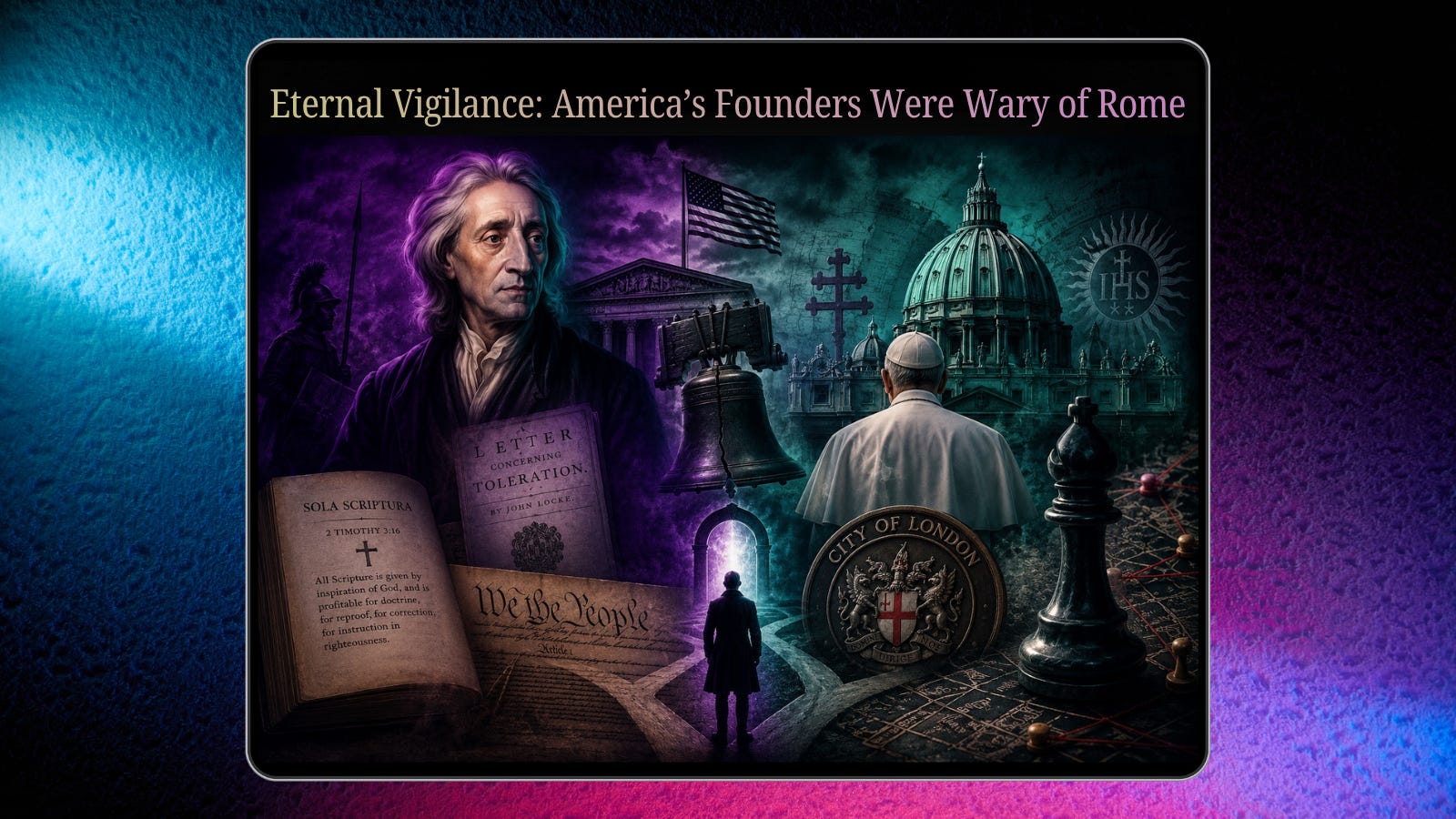
John Locke's A Letter Concerning Toleration warns that granting too much tolerance or political power to Roman Catholics would undermine a Protestant nation.
Primary Source
John Locke, A Letter Concerning Toleration (1689)
Research Summary (Google AI)
In his 1689 A Letter Concerning Toleration, John Locke argued against state enforcement of religion but excluded Roman Catholics from toleration. He warned that their allegiance to a foreign power (the Pope) and their association with absolute monarchs threatened both civil peace and the Protestant establishment.
Locke’s rationale for excluding Catholics stemmed from fundamental fears about dual loyalties and civil survival. He asserted that a commonwealth cannot tolerate any religious group that essentially places its followers under the command of another sovereign.
In Locke’s view, Catholics:
Pledged spiritual and political allegiance to the Pope, which effectively made them subjects of a “foreign jurisdiction.”
Were believed to use their religion as a cover for political factionalism and sedition.
Represented an existential threat to a Protestant nation, as their ultimate loyalty could undermine the sovereign authority of the domestic magistrate.
Locke argued that any church whose members owed allegiance to a “foreign jurisdiction”—referring to the Pope—should not be tolerated, as this would allow citizens to be “enlisted as soldiers against his government.” He believed this dual loyalty created a risk of subversion, arguing that Catholic toleration was only possible if their allegiance to a foreign power ceased.
End of Google AI Research Summary.
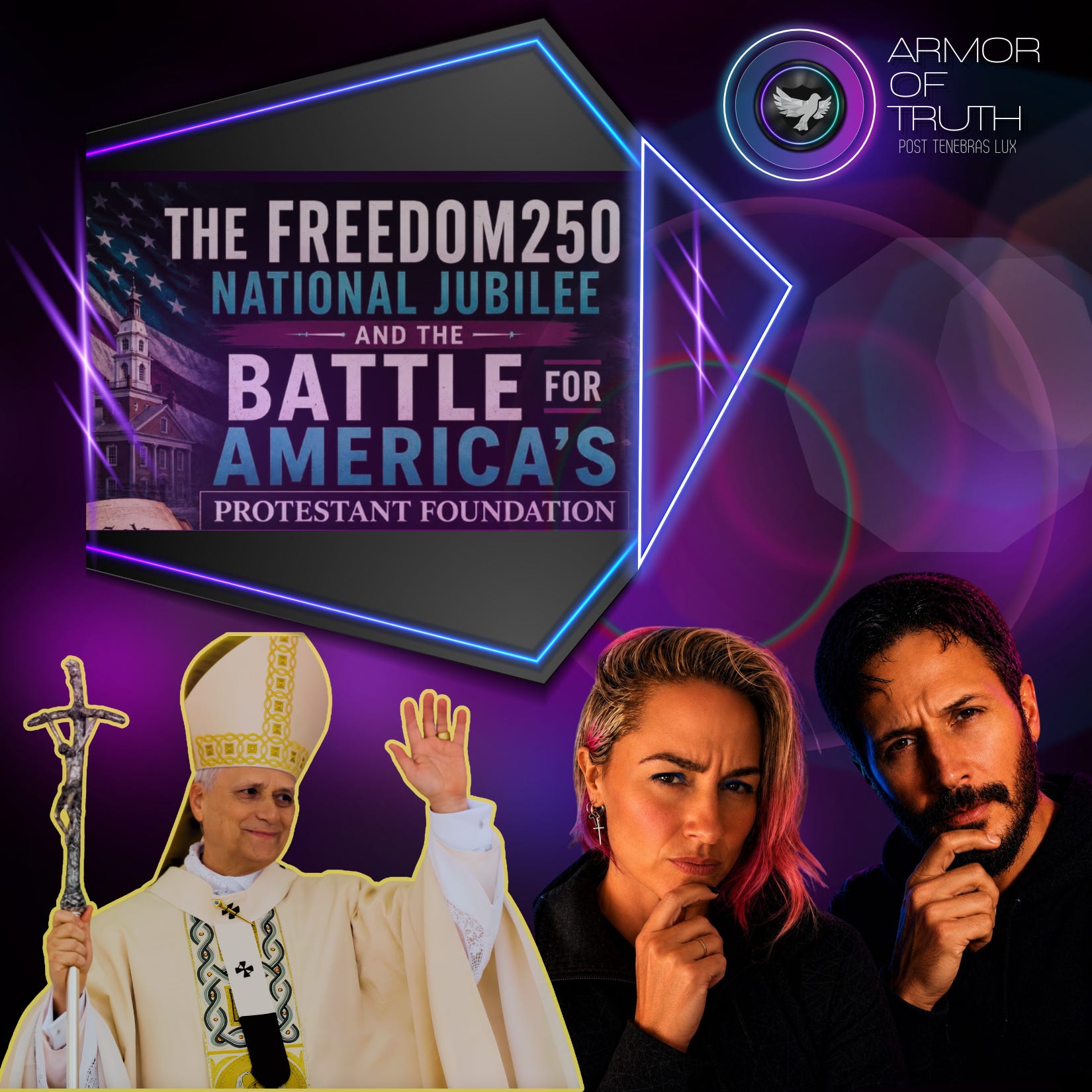
Specifically with respect to our work, we have raised concerns about the prominent Roman Catholic presence within federal initiatives such as the White House Office of Faith, the Religious Liberty Commission, Freedom250’s Rededicate 250 observance, and Secretary Marco Rubio’s recent presentation of America’s religious history. In our view, these developments reflect a coordinated effort to reframe America’s constitutional and theological heritage by minimizing its distinctly Protestant foundations and replacing them with a broader ecumenical narrative.
We contend that this historical reframing is not merely an academic exercise. We believe it has significant implications for how we, and future generations, understand—and ultimately preserve or lose—liberty of conscience, the Constitution, and the proper relationship between church and state. In our assessment, the current narrative being advanced is historically inaccurate because it inflates the role of Roman Catholicism in shaping America's constitutional order while diminishing the central influence of the Protestant Reformation, Sola Scriptura, and the Protestant doctrine that Christ alone is Lord of the conscience.
We further argue that these developments should be evaluated alongside broader patterns of globalist transnational political, financial, and religious cooperation. There is evidence of collaboration between the Vatican and institutions associated with the City of London Corp./Davos WEF agenda to advance global governance. Whether readers ultimately agree with that conclusion or not, we believe these relationships deserve careful historical and constitutional scrutiny rather than being dismissed out of hand.
Locke’s warning is not just a relic of seventeenth-century religious conflict. The underlying principle he articulated was constitutional rather than merely sectarian. His concern was that a free commonwealth could not long remain free if its citizens ultimately owed allegiance to a foreign authority claiming jurisdiction over conscience. For Locke the political implications of divided sovereignty and competing claims of ultimate authority were a threat.
That principle continues to raise important questions for every generation. Americans should understand that modern transnational globalist institutions, ideological movements, and international bodies seek to exercise influence over national sovereignty in ways that diminish the authority of the Constitution and the independence of the American Republic. Whatever conclusions one reaches about particular organizations, the broader constitutional question remains: can a self-governing nation preserve its liberty if ultimate authority is gradually transferred beyond the consent of its own people?
From our perspective, these questions deserve far more attention than they currently receive. We believe that influential global networks, including institutions associated with political, financial, and religious internationalism, are increasingly encouraging forms of governance and public consensus that move authority away from constitutional self-government and toward transnational structures. The Vatican is overt about this devious intention. If that assessment is correct, and we believe there is ample evidence to support it, then the challenge facing America today is like the one Locke confronted: the preservation of national sovereignty, liberty of conscience, and constitutional government against competing claims of authority. Whether one agrees with that conclusion or not, the constitutional principle Locke identified, that divided allegiance can threaten the integrity of a free people, remains a subject worthy of careful consideration.
The concern over competing claims of ultimate authority was not an abstract theological debate confined to universities and church councils. It was written in blood across Europe during the Protestant Reformation. The French Wars of Religion (1562–1598) were marked by decades of violence between Roman Catholics and Protestants (Huguenots), as each side struggled over questions of religious authority, political allegiance, and the future of the kingdom. Entire communities were devastated as the conflict demonstrated that disagreements over the source of ultimate authority inevitably carried profound consequences.
The city of Sancerre became one of the clearest examples of that reality. A stronghold of the French Protestants, Sancerre provided refuge for Huguenots fleeing persecution following the St. Bartholomew’s Day Massacre in 1572. In response, the town endured an eight-month siege by royal and Catholic forces. Isolated from outside assistance, its inhabitants suffered extreme famine and deprivation. Although the siege eventually ended, Sancerre became a lasting symbol of Protestant endurance and of the tremendous cost paid by those who refused to surrender liberty of conscience to an authority they believed contradicted the Word of God.
The Reformers’ insistence that Christ alone is Lord of the conscience was not merely a theological slogan; it was a conviction purchased at enormous human cost. That history helps explain why later Protestant political thinkers, including John Locke, remained deeply concerned whenever any ecclesiastical institution claimed authority that extended beyond the Church into the civil and political life of a nation. Today, those historical struggles deserve to be remembered with honesty, not because they justify hostility toward modern individuals, but because they reveal how profoundly questions of ultimate authority have shaped both the history of the Church and the constitutional development of America.
For much of the colonial period and well into the nineteenth century, Americans commonly regarded Roman Catholic political power, not merely individual Catholic belief, as a potential threat to Protestant liberty and national independence. As we have outlined prior, this concern arose from Europe’s history of religious warfare, papal claims of authority, and the close association between Roman Catholic institutions and Catholic monarchies such as Spain and France. Several colonies and early states therefore imposed religious tests that effectively excluded Roman Catholics from certain public offices. Those restrictions were not adopted at the federal level after ratification of the Constitution: Article VI explicitly prohibited religious tests for federal office. Nevertheless, state-level restrictions and widespread political distrust persisted, reflecting fears that allegiance to a foreign ecclesiastical authority could conflict with the duties of republican citizenship.
Spain also remained a serious geopolitical concern during the early republic. The United States was surrounded by Spanish territories, disputed borders, and European imperial British empire interests throughout North America and the Caribbean. When President James Monroe issued what became known as the Monroe Doctrine in 1823, he was responding in part to fears that Europe’s conservative monarchies might assist Spain in recovering its former colonies in Latin America.
During the nineteenth century, large-scale Catholic immigration intensified these older anxieties. Political movements such as the Know-Nothings sought to restrict immigration, extend naturalization periods, and prevent foreign-born Catholics from gaining political influence. Their program reflected a widespread belief that immigration could be used to expand the institutional power of the Roman Church within the United States.
Notably, exclusion occurred through colonial and state laws, political parties, private organizations, and popular nativist movements.
As we have shown in our recent article series, our nation still faces this threat of Roman Catholic Vatican capture today, as they are quietly gaining access to the halls of power while other threats, such as Islamism, radical leftism, Democratic socialism(which is simply communism) and globalism, take the spotlight. In other words, they are gaining entrance through the back door while the world fixates on and defends against other spectacles. And with what we know about the woke Pope and the Vatican being in total alignment with the globalist project, this is deadly serious for our nation and American liberty.
“The condition upon which God hath given liberty to man is eternal vigilance; which condition if he break, servitude is at once the consequence of his crime and the punishment of his guilt.”
— John Philpot Curran (1750–1817)
It’s not about driving Catholics out of the country. Roman Catholics have grown in number and have made many meaningful contributions to American society since the nation’s founding. Rather, because America stands at a critical crossroads regarding its future, it is prudent to ensure that those entrusted with positions of public trust are ultimately loyal to the Constitution and the nation above all else.
At a time of profound political division, when influential movements openly—and often covertly—seek to fundamentally transform the country, and when candidates and officeholders alike sometimes express opposition to America’s founding principles, this concern should not be directed toward any one religious, political, or ideological group. Instead, we believe this moment calls for an appropriate and constitutional means of determining, well before an individual reaches the point of taking the oath of office, that all who seek positions of public trust are genuinely committed to upholding the Constitution and preserving the Republic as it was founded.
This is not born out of authoritarian impulses or a desire to impose unnecessary legal barriers. Rather, it is a call for prudence in an unusually precarious moment in the history of the American Republic. Every nation has both the right and the responsibility to ensure that those entrusted with governing it are faithful to the constitutional order they have sworn to preserve.
Historically, the Jesuit order has been viewed by Protestant writers as the principal instrument of the Roman Catholic Church’s opposition to Protestantism since the Reformation. Whether that influence has increased or diminished over the centuries, prudence calls for vigilance. It is evident that various ideological movements are seeking to reshape the nation and gain influence through its institutions. That reality should be recognized, and thoughtful safeguards should be developed to protect the constitutional order. Our Roman Catholic friends, if they genuinely care about the future of the country, should understand these concerns and support the principle that every public official’s first and unquestioned loyalty belongs to the Constitution and the United States.
America’s Founders intended to put an end to monarchical tyranny.
As Glenn Sunshine describes:
“But unfortunately, like the Beast rising from the sea in the Apocalypse, Leviathan’s mortal wound has healed (Rev. 13:3). [...] The government we have now would have been unrecognizable to the Founders, and our acquiescence to its systematic encroachments on liberty would have infuriated them... but it would not surprise them.”
A point that is summed up well in a quote often attributed to Thomas Jefferson:
“Eternal vigilance is the price we pay for liberty.”
If we are to maintain our liberty, we must constantly be on guard against the rise of opposition to our Founding Documents’ Protestant principles.
A century of growing complacency within the Protestant church in America has left us today in a dangerously vulnerable position, unable to recognize the more subtle forms of tyranny.
“Now the serpent was more crafty than any other beast of the field that the LORD God had made.” Genesis 3:1
Will you answer the call to help your nation recover its providential foundation so that future generations understand what we are defending—and why it must be defended?
Faithful stewardship begins with faithful remembrance.
And faithful remembrance begins with the truth.
History is not merely something we study.
It is something we steward.
To steward it faithfully requires the courage to preserve, proclaim, and rightly teach the biblical principles that first made ordered liberty possible.
“Moreover it is required in stewards, that a man be found faithful.” 1 Corinthians 4:2
Christian, will you take up your cross today and faithfully steward the good gifts God has entrusted to you?
“For from Him and through Him and to Him are all things. To Him be glory forever. Amen.” Romans 11:36
Soli Deo Gloria.
Summer Black
Armor of Truth
Pastor Jim Osman joins us after recently returning from mission work in the United Kingdom with Justin Peters.
What’s Happening?
President Trump’s Religious Liberty Commission released a controversial draft report calling for the replacement of the separation of church and state with “building bridges,” and more.
Despite how the globalist media syndicate tries to frame it, the Religious Liberty Commission and the White House Office of Faith have the same weaponized effect as multiculturalism in attempting to destroy the United States’ biblical Christian foundation.
Also, in the video:
Is Roman Catholicism compatible with American citizenship? In this discussion, we examine the relationship between faith, civic identity, and constitutional liberty, asking whether Roman Catholicism can be reconciled with foundational Christian doctrine or with the United States Constitution.
We also explain why the National Jubilee of Prayer, Praise, and Thanksgiving event raises grave concerns about the erosion of theological distinctions and the Vatican’s—and therefore globalist—growing influence over America’s Christian identity through the veneer of nominal Christianity, which functions as a form of subversive warfare.
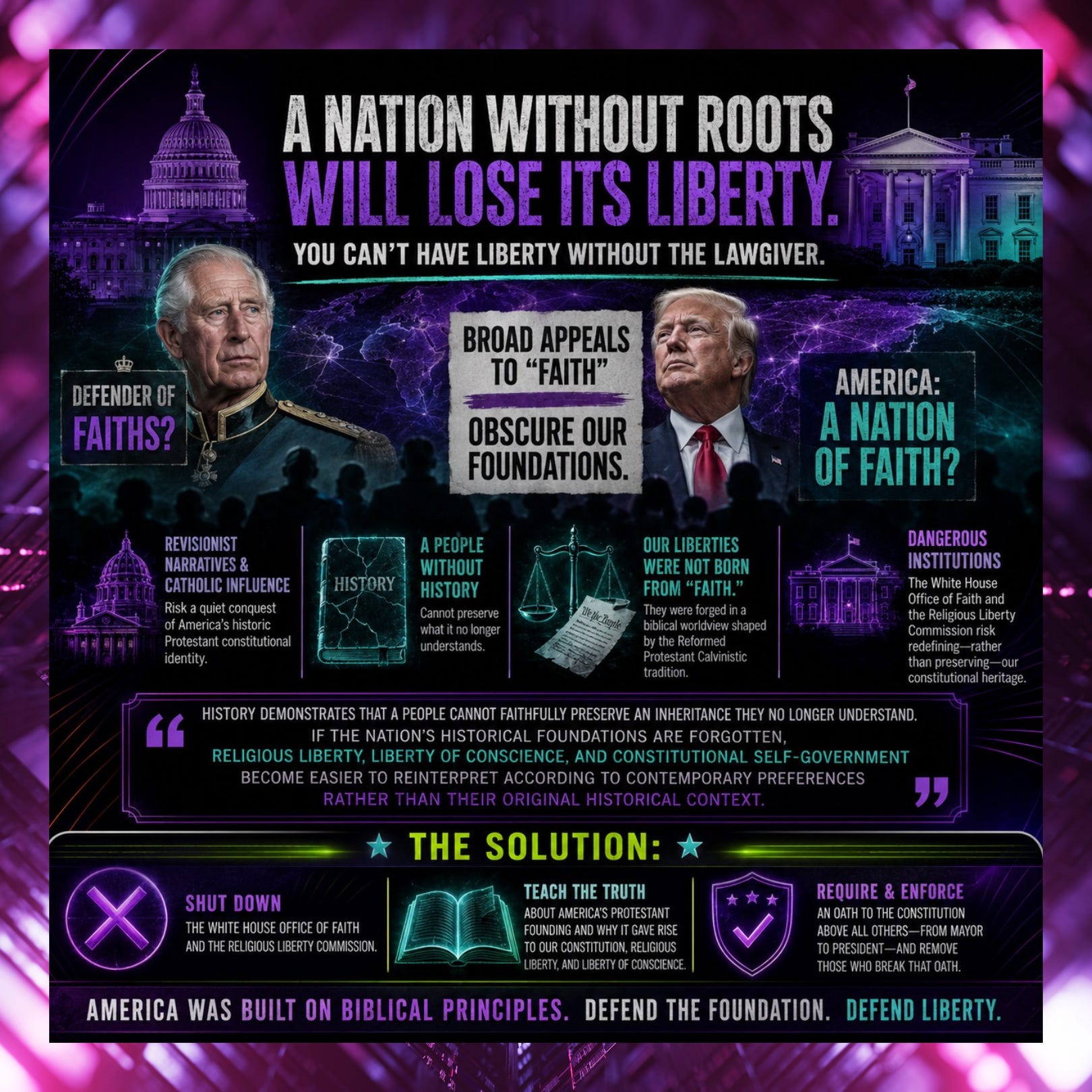
History demonstrates that a people cannot faithfully preserve an inheritance they no longer understand. If the nation’s historical foundations are forgotten, then the principles of religious liberty, liberty of conscience, and constitutional self-government become easier to reinterpret according to contemporary preferences rather than their original historical context.
One noteworthy development is that both King Charles’ language regarding “faiths” and the Trump administration’s repeated references to America as a “nation of faith” employ broad, inclusive religious terminology rather than explicitly identifying the nation’s historic Protestant constitutional heritage. Although these statements arise in different constitutional and political contexts, they reflect a similar rhetorical shift away from confessional language toward more generalized appeals to faith.
This is significant because the Trump administration has not clearly articulated the Protestant foundations of the American Republic or why those foundations historically mattered to the development of the Constitution, liberty of conscience, and limited civil government. As a result, broad references to “faith” or “people of faith” obscure important historical and theological distinctions rather than clarify them.
If every faith(anyone who claims the name Christian) is presented as equally descriptive of the nation’s constitutional identity, then the distinctly Protestant character of that historical inheritance becomes more difficult to recognize and preserve.
Religious liberty, liberty of conscience, and the constitutional order did not emerge from a generic belief in “faith.” They developed within a particular historical and theological framework shaped by biblical principles as understood by the Reformed Protestant Calvinistic tradition at the nation’s founding.
For that reason, we believe broad appeals to “faith” or “people of faith,” when detached from that historical context, risk redefining rather than preserving America’s constitutional inheritance. We are concerned that institutions such as the White House Office of Faith and the Religious Liberty Commission contribute to reframing the nation’s religious identity in ways that dangerously depart from the framework that originally informed America’s constitutional development.
Again, history demonstrates that a people cannot faithfully preserve an inheritance they no longer understand. If the nation’s historical foundations are forgotten, then the principles of religious liberty, liberty of conscience, and constitutional self-government become easier to reinterpret according to contemporary preferences rather than their original historical context.
Furthermore, we are deeply concerned that revisionist historical narratives advanced by several high-ranking Roman Catholic officials in government, together with influential Roman Catholic leaders—namely, the woke, globalist-aligned Pope—represent a quiet conquest of America’s historic Protestant constitutional identity. Through co-belligerence on civic and “Christless Conservative” political matters, theological differences can become strategically obscured, while the nation’s historical foundations are gradually reinterpreted and subverted. In our view, this process deserves careful examination because a people who no longer understand their foundations will ultimately struggle to preserve them, and we will lose our biblically based American liberty. You can’t have liberty without the Lawgiver.
The solution, therefore, is this:
Shut down the White House Office of Faith and the Religious Liberty Commission. The administration should take great care to teach America’s true Protestant founding and why that foundation gave rise to our constitutional order, religious liberty, and liberty of conscience.
Require every public official—from mayor to president—to swear an oath of loyalty to the Constitution above every other allegiance, and promptly remove from office those who violate that oath.
America at 250: The Battle Over Our Founding
·
Jul 4

There is only one true account of how our American nation was formed. Somebody is right, and somebody is wrong. There are not many truths—there is only one. And that truth is that America is a Protestant nation.
Comments
Nothing yet. Say the first thing.
Sign in to join the conversation.