
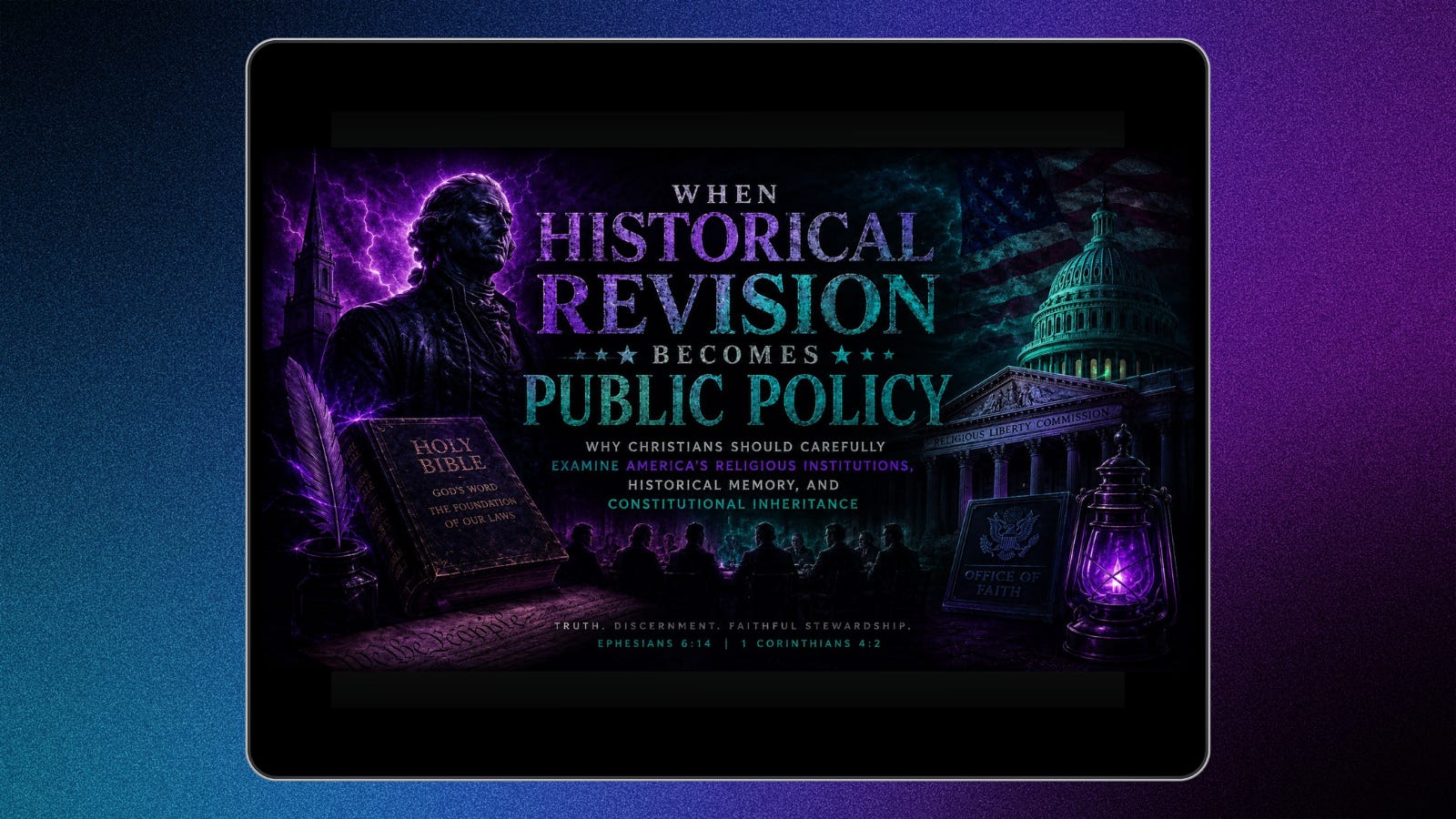
Christian, don’t skip this series. It was written to help orient, equip, and encourage you to walk faithfully according to God’s Word.
If you are not a Christian, we likewise encourage you to read this series. Whatever your beliefs, understanding the historical, moral, and constitutional foundations of the American Republic is essential to understanding both the liberties you have inherited and the challenges they face today.
🇺🇸 America at 250
A Series on the Moral, Theological, and Historical Foundations of American Liberty
Firstly: Go back and read Article 1 Article 2 Article 3, this is Article 4.
“Stand therefore, having fastened on the belt of truth...” - Ephesians 6:14
Throughout this series we have argued that America’s constitutional order did not emerge from a philosophical vacuum. It developed within a civilization profoundly shaped by Protestant Christianity, the authority of Holy Scripture (Sola Scriptura), and the biblical conviction that Christ alone is Lord of the conscience.
We have examined America’s Protestant foundation.
We have explored why liberty of conscience became one of the defining principles of the American constitutional order.
We have considered why historical revisionism is never harmless.
Now we arrive at a different question.
That question is no longer merely historical.
It has become constitutional.
It has become theological.
And increasingly, it has become institutional.
Governments do more than administer laws.
They establish commissions.
They create offices.
They commemorate anniversaries.
They sponsor national ceremonies.
And through those institutions they inevitably communicate a story about who a nation is, where it came from, and what it should become.
That is why Christians and indeed every thoughtful citizen should pay careful attention whenever public institutions begin speaking about America’s religious heritage.
The question is whether America's constitutional inheritance is being remembered with historical precision—or gradually reframed through a different theological understanding.
Our concern is with historical accuracy.
Because constitutional revolutions rarely begin by rewriting constitutions.
They begin by rewriting the theological and historical assumptions upon which constitutions rest.
This article examines several recent developments that deserve careful historical, constitutional, and theological consideration.
One of the developments that first prompted our concern was the Freedom250 initiative and its nationally promoted event, ”Rededicate 250: A National Jubilee of Prayer, Praise, and Thanksgiving.”¹
On its face, the language is attractive.
Christians should indeed pray for our nation. Scripture commands us to pray for rulers and to seek the welfare of the communities in which God has placed us. At the same time, Christians are also called to worship according to the truth revealed in Holy Scripture. Therefore, the question is not whether Christians should pray, but what theological framework is being presented through this national observance.
Who would object to thanksgiving?
What American would not desire national renewal as our Republic enters its third century?
Those are noble aspirations.
Christians should indeed pray for our nation.
Scripture commands us to pray for rulers, for peace, and for the welfare of the societies in which God has placed us (1 Timothy 2:1–2; Jeremiah 29:7).
Yet Christians are also commanded to exercise discernment.
The question is not whether America should seek God’s blessing.
The question is what understanding of God, truth, authority, and worship is being presented under the language of national rededication.
Words matter.
History matters.
Theology matters.
Throughout this series we have argued that America’s constitutional inheritance developed within a distinctly Protestant understanding of Scripture, conscience, and limited civil government.
If that historical assessment is correct, and we believe the evidence overwhelmingly supports it, then any national ceremony describing America’s religious identity should be examined in light of that historical reality.
Freedom250 presents itself as an opportunity for national unity through prayer and thanksgiving.
That aspiration deserves respect.
At the same time, Christians should ask whether the theological framework being presented reflects the convictions that historically shaped America’s constitutional inheritance—or whether it reflects a broader ecumenical understanding of religion that treats foundational doctrinal distinctions as secondary to institutional unity.
That distinction is not trivial.
The Protestant Reformation was not merely a disagreement over styles of worship or denominational preference.
It addressed questions at the very heart of Christian doctrine.
Who possesses final authority?
What governs the conscience?
How is man justified before God?
Who mediates between God and man?
By what authority does the Church speak?
These questions profoundly shaped Western political thought because they also shaped Protestant understandings of liberty, limited government, constitutionalism, and the proper relationship between church and state.
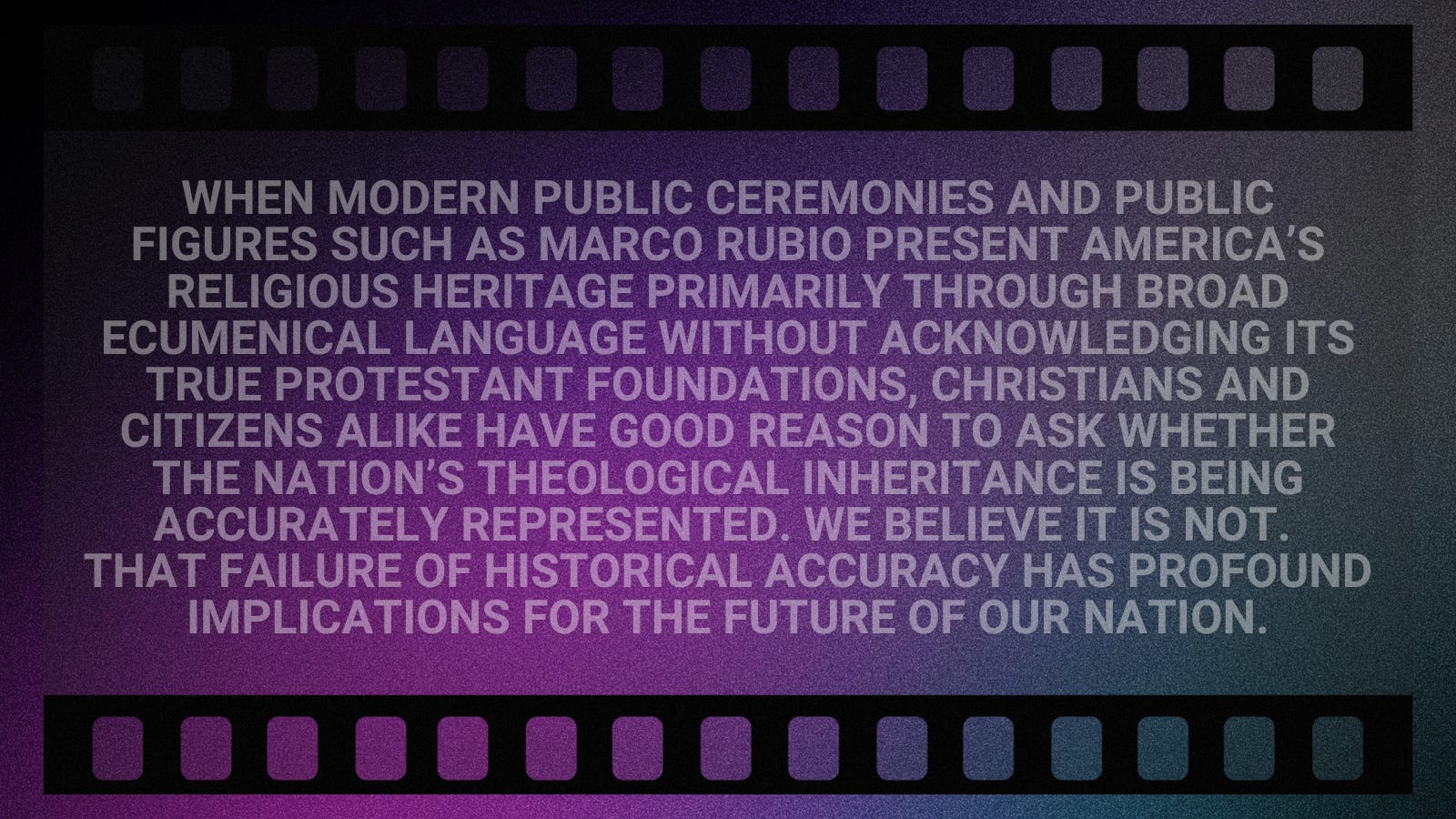
Consequently, when modern public ceremonies present America’s religious heritage primarily through broad ecumenical language without acknowledging those foundational distinctions, Christians have good reason to ask whether the nation’s theological inheritance is being accurately represented.
Our concern is not that Americans from different faith traditions should never cooperate for the common good.
History demonstrates that they often have.
Our concern is different.
Public worship is not identical to civic cooperation.
The Church has always distinguished between working alongside neighbors for temporal goods and confessing together before God in matters of worship and doctrine.
That distinction deserves careful preservation.
Ideas about God inevitably shape ideas about government.
Ideas about authority shape ideas about liberty.
Ideas about conscience shape ideas about constitutional order.
For that reason, Freedom250 becomes more than a civic celebration.
It becomes an opportunity to ask a larger historical question:
What story about America’s religious foundation is now being told?
And equally important:
Does that story faithfully reflect the historical record?
One of the clearest examples of why historical precision matters came in Secretary of State Marco Rubio’s recent address commemorating America’s 250th anniversary.
His speech has circulated widely online, introducing millions of Americans to a sweeping narrative of the nation’s religious origins.²
Secretary Rubio rightly observed that Roman Catholics contributed significantly to the exploration, settlement, and development of North America.
He referenced Christopher Columbus.
He noted the founding of St. Augustine.
He described Catholic explorers, missionaries, soldiers, settlements, and the presence of Roman Catholics throughout much of what would eventually become the United States.
On these points there is little historical dispute.
These events occurred.
Roman Catholics unquestionably occupy an important place in the broader history of North America.
The historical question, however, is not whether Catholics contributed to American history.
They did.
The historical question is different.
Those are not the same question.
Exploration is not constitutional formation.
Settlement is not political philosophy.
Missionary activity is not constitutional design.
Geography is not jurisprudence.
History deserves those distinctions.
Faithful stewardship requires that we preserve them.
Secretary Rubio himself acknowledges one important historical reality.
Only one signer of the Declaration of Independence—Charles Carroll of Maryland—was Roman Catholic.
Only two Roman Catholics signed the Constitution. Their participation reflected a longstanding tension between the American constitutional principle that civil government derives its just powers from the consent of the governed and the Roman Catholic doctrine that the pope possesses "supreme, full, immediate, and universal ordinary power" over the Church. That tension was recognized by Protestants during the Founding era and continued to be debated within Roman Catholicism well into the nineteenth century, culminating in Pope Leo XIII's 1899 apostolic letter Testem Benevolentiae, which condemned what became known as "Americanism."
The Constitution and the Declaration of Independence are both products of Protestant Sola Scriptura. The Protestant principle says Christ alone is Lord of the conscience; vs. the Roman Catholic principle that places the conscience under a supposedly Christ-authorized earthly vicar.
For professing Roman Catholics to have signed the Declaration of Independence or the Constitution would have been a contradiction in belief, as it also conflicts with the American Founders’ principle that no earthly institution possesses final, infallible, and universal authority over the conscience of man. Christ alone is Lord of the conscience and King over every earthly authority.
“Rededicate 250” A False Victory for America
·
May 18

Rather than offering a true rededication of the nation to the God of Scripture and the gospel of Jesus Christ, Rededicate 250, as an interfaith worship event functioned, at best, as an empty civic-religious gesture.
Political scientist Samuel P. Huntington notes that at the Founding approximately one percent of Americans were Roman Catholic, while the overwhelming majority identified as Protestant. He describes the United States as “the prototypical Protestant country,” observing that for more than two centuries Americans largely understood their national identity within a Protestant civilization.³
Huntington’s analysis is particularly significant because he is not writing as a Protestant theologian.
He is describing the historical development of American national identity.
The issue, therefore, is not denominational triumphalism.
The issue is historical causation.
Which theological ideas most directly shaped America’s constitutional understanding of liberty?
Which doctrines most profoundly influenced its view of conscience?
Which worldview supplied the moral architecture upon which constitutional government was built?
Those are historical questions.
Where the discussion becomes more significant is when Secretary Rubio moves beyond describing Catholic contributions to North American history and presents America’s constitutional inheritance as belonging broadly to the same civilizational tradition that produced “the towering cathedrals of Rome” and the philosophy of Augustine and Thomas Aquinas.
That is a much larger historical claim.
It deserves careful examination.
Certainly, Western civilization inherited intellectual influences from many sources.
The Founders drew from classical antiquity.
English common law.
Biblical Christianity.
The Protestant Reformation.
Enlightenment writers.
Centuries of legal development.
No serious historian denies that.
Donald Lutz’s landmark study of more than 3,000 Founding-era citations found that the Bible overwhelmingly surpassed every other source cited by America’s political leaders.⁴
Likewise, the constitutional structure established in 1776 and 1787 reflected assumptions deeply embedded within Protestant political thought.
Government exists under God.
Civil rulers possess limited authority.
Rights are endowed by the Creator rather than granted by institutions.
No earthly authority possesses final jurisdiction over the conscience.
Those convictions became part of the constitutional architecture of the American Republic.
*They are distinctly the fruit of the Protestant Reformers and their biblical worldview.
Huntington also records an often-forgotten chapter of this story.
As Roman Catholic immigration increased during the nineteenth century, many American Catholic leaders sought to reconcile Catholic life with America’s constitutional culture. Others within the Roman hierarchy viewed that accommodation with deep suspicion. The controversy culminated in Pope Leo XIII’s 1899 apostolic letter Testem Benevolentiae, condemning what became known as the doctrine of “Americanism.”⁵
This episode is historically significant.
It reminds us that tensions between America’s constitutional culture and official Roman Catholic teaching were not merely perceived by Protestants.
They were also debated within Rome itself.
History is often more complex than modern narratives allow.
Recognizing Catholic contributions to American history is one thing.
That distinction lies at the heart of this discussion.
And it deserves to be remembered faithfully.
Having considered the historical questions raised by recent public narratives about America’s founding, we now turn to one of the principal institutions through which those narratives may increasingly influence public life: the White House Office of Faith.⁶
Established by Executive Order in February 2025, the Office of Faith was presented as a means of strengthening partnerships between the federal government and faith-based organizations, protecting religious liberty, combating antisemitism, defending religious expression, and encouraging religious organizations to participate in addressing public needs.
Many of those stated objectives are commendable.
Christians have long served their neighbors through churches, schools, hospitals, adoption ministries, disaster relief, education, and countless works of mercy.
The Church should never retreat from faithful service in the public square.
Nor should Christians object merely because public officials recognize that religion has played an important role in American life.
The question, however, is not whether religion should have a public voice.
That distinction is essential.
Throughout American history, religious liberty protected the free exercise of religion while limiting the federal government’s authority over matters of conscience and ecclesiastical life.
The Founders did not establish a national church.
Neither did they authorize the federal government to define theological unity or become the organizer of America’s religious identity.
Those responsibilities belong to the Church under the authority of Christ, not to the civil magistrate.
Our concern, therefore, is not that the Office of Faith acknowledges religion.
Our concern is that it encourages a broad ecumenical understanding of religion that minimizes the theological distinctions which historically shaped America’s constitutional understanding of liberty.
Throughout this series we have shown that America’s constitutional order emerged within a distinctly Protestant civilization.
That civilization did not understand liberty of conscience as the absence of theological truth.
Rather, it understood civil government as possessing limited authority precisely because ultimate authority belongs to God alone.
When public institutions increasingly speak of “faith” in broad, generalized terms while giving comparatively little attention to the theological convictions that historically informed America’s constitutional development, an important shift is taking place.
The language becomes less confessional.
The historical distinctions become less precise.
America’s religious inheritance is increasingly presented as a generalized tradition of faith rather than the particular theological framework within which its constitutional order developed.
Some readers may regard this as a welcome expression of religious inclusivity.
History gives way to symbolism.
Confession gives way to coalition.
Theological precision gives way to institutional consensus.
And over time, the very distinctions that once protected liberty of conscience become increasingly difficult for future generations to recognize.
Ideas shape institutions.
Institutions shape civilizations.
For that reason, Christians should carefully examine not only what government offices seek to accomplish, but also the historical assumptions that underlie their understanding of America’s religious heritage.
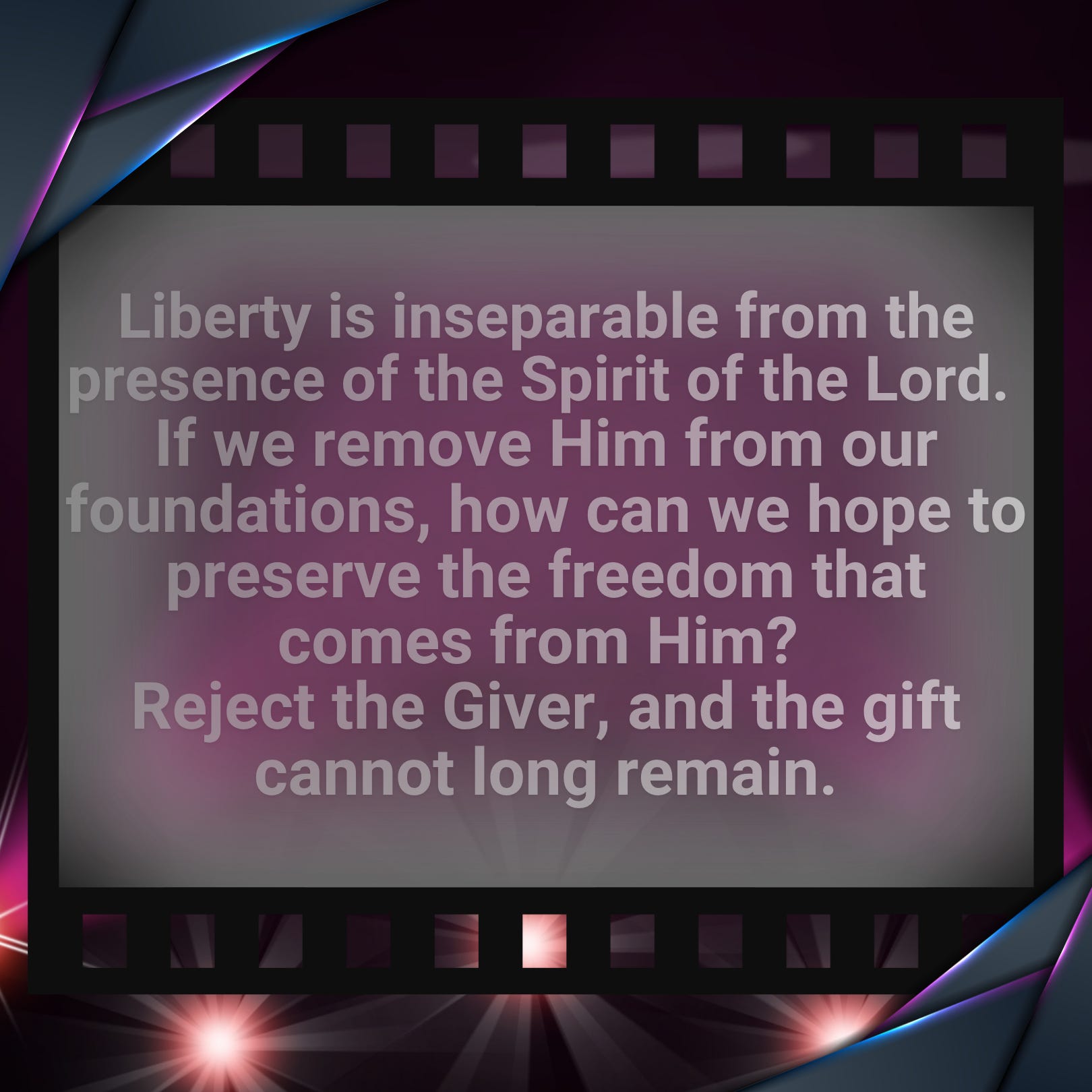
Without a proper understanding of the Lawgiver and His moral reality and laws upon which our nation was built, we will lose our liberty.
Closely connected to the Office of Faith is the Presidential Religious Liberty Commission.⁷
According to its public charter, the Commission exists to advise the President on matters relating to religious liberty and to recommend ways of strengthening religious freedom in the United States.
Few constitutional principles deserve greater protection than genuine religious liberty.
Indeed, throughout this series we have shown that liberty of conscience stands among the greatest gifts inherited from America’s Protestant constitutional tradition.
For that reason, Christians should welcome every serious effort to protect the free exercise of religion.
The question, however, is not whether religious liberty deserves protection.
Throughout the Commission’s public hearings, significant emphasis has been placed upon cooperation among diverse religious traditions, strengthening partnerships between government and faith communities, and encouraging religion’s contribution to American public life.
Christians have long argued that religion contributes to the moral health of society.
America’s Founders likewise understood that liberty cannot long survive among a people who lose their moral foundations; a free people must be virtuous according to God’s moral reality.
So yet another historical question naturally follows.
That question cannot be answered simply by pointing to religion in general.
Nor is it answered by treating America’s religious heritage as though every theological tradition contributed equally to the constitutional principles established during the Founding era.
Throughout this series we have presented evidence that America’s constitutional order developed within a distinctly Protestant theological culture.
Liberty of conscience.
The authority of Scripture.
Limited civil government.
The rejection of universal ecclesiastical jurisdiction over the conscience.
These were not incidental theological preferences.
They profoundly influenced the political vocabulary through which Americans understood constitutional government.
Consequently, if a federal commission presents religious liberty primarily through a broad ecumenical framework while giving comparatively little attention to the Protestant theological convictions that historically shaped America’s constitutional inheritance, an important historical question naturally arises.
Our concern is not that citizens from differing religious traditions participate in civil society.
The Constitution protects their equal civil rights.
Rather, our concern is whether the federal government increasingly functions as a convener of a generalized religious consensus in which foundational theological distinctions become secondary to institutional cooperation.
History teaches that liberty of conscience flourished precisely because no earthly institution possessed final authority over faith and conscience.
The American constitutional order protected religious liberty by limiting the jurisdiction of civil government while leaving matters of ultimate spiritual authority to God and to the conscience governed by His Word.
That distinction deserves careful preservation.
We are, in fact, stewards of a precious inheritance, and there are enemies working to dismantle and obscure the religious freedom and liberty of conscience secured by our Founders. We must not permit our heritage or our rights to be reinterpreted under the guise of religious pluralism or a counterfeit religious unity.
We have no desire to criticize for criticism’s sake.
Indeed, throughout this series we have expressed gratitude for the many just efforts to restore constitutional government, strengthen American sovereignty, secure the nation’s borders, revive domestic industry, and recover appreciation for America’s constitutional inheritance.
For that very reason, this particular issue deserves even greater attention.
Blind spots are often most dangerous when they accompany genuine successes.
Throughout this series we have argued that America’s constitutional order did not emerge from a generalized belief in God.
Nor did it arise from a “Judeo-Christian tradition.” See more on that HERE
Still less did it emerge from an ecumenical consensus among competing theological systems.
It emerged within a civilization profoundly shaped by the Protestant Reformation and its recovery of the authority of Holy Scripture, the lordship of Christ over the conscience, and the limitation of every merely human authority beneath the Word of God.
Those convictions shaped constitutional government.
They shaped the doctrine of limited civil authority.
They shaped liberty of conscience.
They shaped the very assumptions upon which the Constitution itself rests.
The vocabulary remains.
The meaning quietly changes.
This discussion is not relevant only to Christians.
Even readers who reject Christianity altogether have an interest in understanding America’s constitutional origins accurately.
Every constitutional order rests upon assumptions about human nature, authority, justice, law, and moral obligation.
Whether one ultimately embraces those assumptions or rejects them, historical honesty requires acknowledging where they came from.
To misunderstand the origins of America’s constitutional order is to misunderstand the order itself.
Historical accuracy is not sectarian.
It is essential to responsible citizenship.
Our founding is rooted in biblical principles, morality, and law as understood through the Protestant tradition, not in the autonomous rationalism of the Enlightenment, as is so often promoted by captured woke institutions and UNESCO.
Every generation of Christians faces unique challenges.
Some defend the faith against persecution.
Others resist false doctrine.
Still others preserve truths that previous generations assumed would never be forgotten.
We believe our generation has inherited that latter responsibility.
The greatest danger facing the Church is not always open hostility.
Sometimes it is gradual accommodation.
Sometimes it is historical amnesia.
Sometimes it is the quiet replacement of theological clarity with institutional consensus.
That is why Christians must remain people of the Book.
For that reason, Christians should distinguish carefully between civic cooperation and theological unity.
We may gladly work alongside many of our neighbors in pursuing justice, serving the poor, defending life, and promoting the common good.
But federal entities such as the Religious Liberty Commission and the White House Office of Faith pose a danger to religious liberty and liberty of conscience by promoting a false religious unity that obscures the biblical foundations upon which our Constitution and our freedoms rest.
Unity purchased at the expense of truth is not biblical unity.
Every generation receives gifts it did not create.
A Constitution.
A history.
A moral inheritance.
Liberty itself is a blessing….
Those gifts are not self-sustaining.
They must be understood.
They must be preserved.
They must be faithfully handed to those who come after us.
Whether one approaches this question as a Christian, a constitutionalist, a historian, or simply as an American citizen, the principle remains the same:
Stewardship requires more than celebration.
It requires truth.
It requires taking an uncomfortable stand that may divide friendships and families for the sake of the truth.
It requires gratitude.
It requires historical honesty.
And it requires the courage to preserve and rightly teach the principles that first made ordered liberty possible.
“Moreover it is required in stewards, that a man be found faithful.”
- 1 Corinthians 4:2
History is not merely something we study.
It is something we steward.
Christian, will you take up your cross today and faithfully steward the good gifts God has entrusted to you?
Soli Deo Gloria.
Summer Black, Armor of Truth
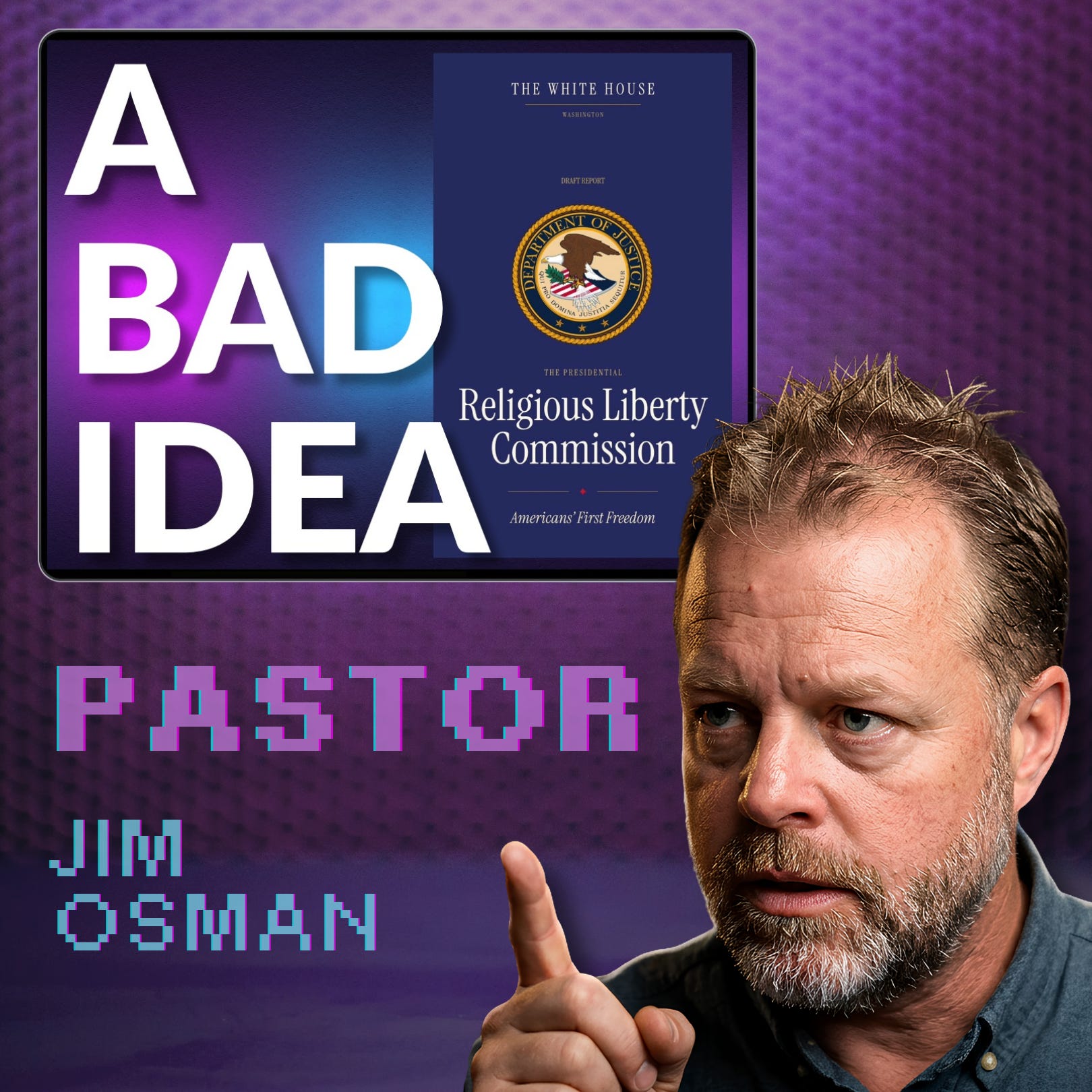
📖 Article 1
Before We Celebrate America, We Must Remember Her Foundation
The Inheritance We Dare Not Lose CLICK HERE
📖 Article 2
The Battle for Liberty of Conscience
Why America’s Founders Rejected Every Earthly Claim to Ultimate Authority CLICK HERE
📖 Article 3
The Great Revision
Who Gets to Tell America’s Founding Story? CLICK HERE

Freedom250, “Rededicate 250: A National Jubilee of Prayer, Praise, and Thanksgiving.”
Marco Rubio, virtual address to Endowed by Their Creator: Catholicism, the Declaration of Independence, and the American Experiment at 250 (Center for the Constitution and the Catholic Intellectual Tradition).
Samuel P. Huntington, Who Are We? The Challenges to America’s National Identity (New York: Simon & Schuster, 2004), 92–95.
Donald S. Lutz, “The Relative Influence of European Writers on Late Eighteenth-Century American Political Thought,” American Political Science Review 78, no. 1 (1984): 189–197.
Huntington, Who Are We?, 95; Pope Leo XIII, Testem Benevolentiae Nostrae (1899).
Executive Order, “Establishment of the White House Faith Office” (2025).
U.S. Department of Justice, Presidential Religious Liberty Commission.
America at 250: The Battle Over Our Founding
·
Jul 4

There is only one true account of how our American nation was formed. Somebody is right, and somebody is wrong. There are not many truths—there is only one. And that truth is that America is a Protestant nation.
Comments
Nothing yet. Say the first thing.
Sign in to join the conversation.