
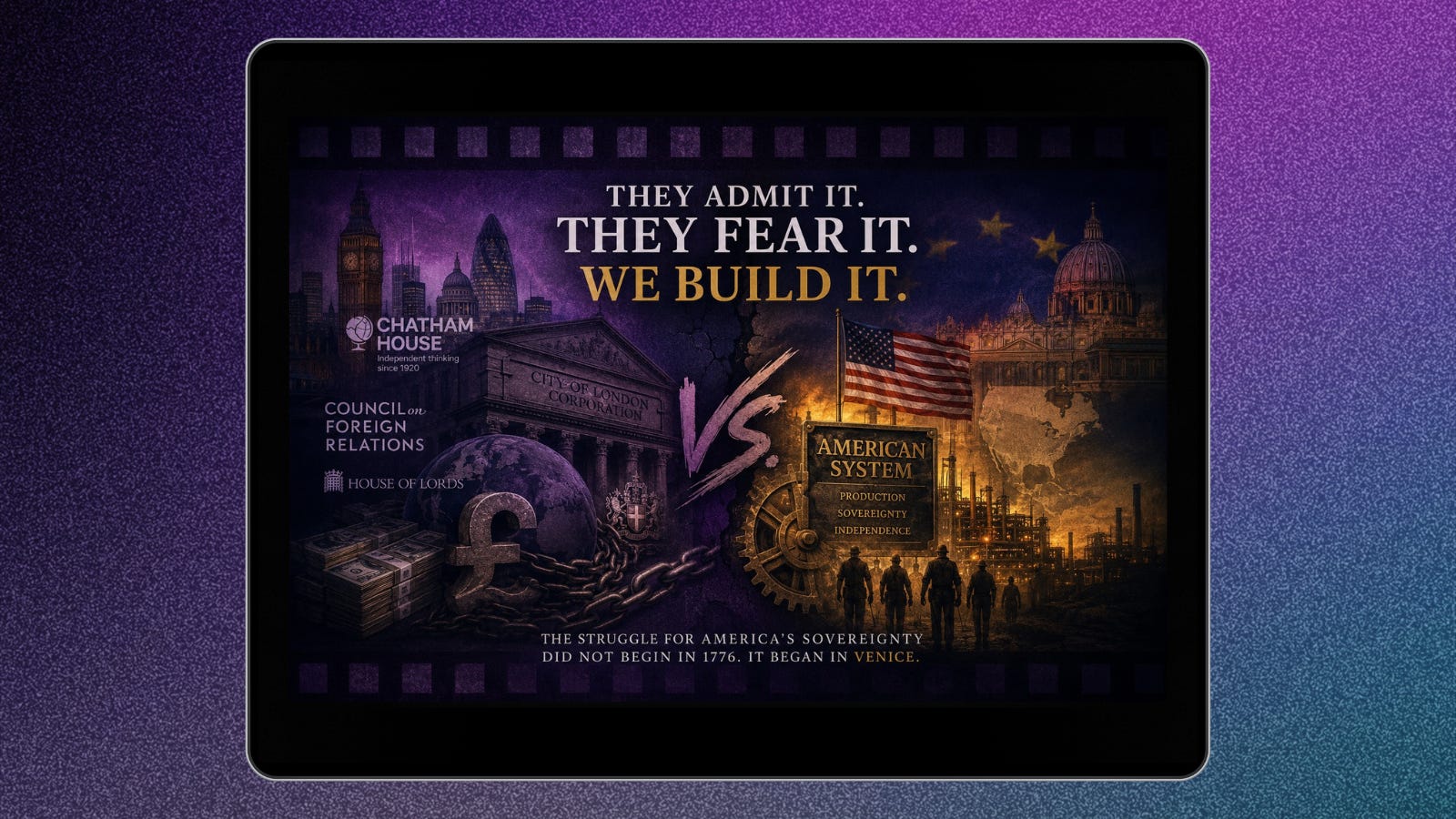
For months now, one of the most revealing developments has not been coming from independent commentators, but from the globalist establishment itself.
Institutions such as the House of Lords in Britain, Chatham House in London, and the Council on Foreign Relations (CFR) in the United States have increasingly acknowledged that the geopolitical order which governed the post-Cold War era is breaking apart. Their own conferences and publications reveal a growing recognition that the assumptions underlying globalization and particularly the Anglo-American “Special Relationship” are no longer holding.
This matters because these are not fringe institutions. They have long served as influential forums through which establishment foreign-policy and economic thinking has been articulated.
Their admissions increasingly stand in sharp contrast to the noise, distraction, and propaganda dominating much of the public conversation.
One of the clearest examples came on July 15, when Chatham House hosted another installment in its America at 250series1 titled:
“Trade vs. Protectionism2: America’s Enduring Economic Debate.” VIEW
Although presented as an historical discussion, the panel quietly acknowledged something far more significant.
It admitted that the era of unrestrained free trade—the defining feature of the global economic order for decades—is over.
And perhaps even more importantly, one panelist openly described how nineteenth-century Americans understood the relationship between protectionism, patriotism, and the British Empire.
During the discussion, Chatham House Fellow Heather Hurlburt observed:
“As late as the 1890s American politicians were equating protectionism with patriotism. The Speaker of the House said, ‘I am an American, and therefore I am a protectionist.’ And not only that, if you were a free trader, you could be accused of being pro-British.’”
https://www.chathamhouse.org/events/all/standard-event/us-250-trade-vs-protectionism-americas-enduring-economic-debate
That statement deserves careful attention.
From the podium of one of Britain’s premier foreign-policy institutions came an acknowledgment that would have been familiar to many nineteenth-century Americans:
Free Trade was widely understood as the British System.
Supporting protectionism was viewed as supporting American national independence.
Supporting free trade could be interpreted as supporting British economic interests.
Whether one agrees with that historical outlook or not, this is not a characterization coming from critics of globalization.
It is coming from Chatham House itself.
For generations, much of this historical debate has been minimized or omitted from mainstream discussions of American economic history. Yet here it was being plainly acknowledged from one of London’s(City of London Corp.’s) leading policy institutions.
Chatham House | US at 250: Trade vs. Protectionism: America’s Enduring Economic Debate
In its own YouTube video description for the July 15 event, Chatham House acknowledged that the debate between national self-reliance and global integration has shaped American economic policy since the Founding and remains central to today’s disputes over tariffs, industrial policy, and the future.
“As the United States marks its 250th year, the debate over trade, protectionism, and America’s economic role in the world remains as alive as it was at the founding. The argument over whether the US economy should prioritise national self-reliance or global integration began with Hamilton and Jefferson and has shaped American economic policy ever since. From early disputes over manufacturing and markets, through the post-war liberal order, to today’s tariff battles, industrial policy revival, and strain on the WTO system, America’s economic history reveals the future direction of US trade policy—and the implications for allies, partners, and the global economy.”
Heather Hurlburt continued:
“McKinley, before he was elected president, championed a tariff that some members of Congress hoped would squeeze Canada so hard it would agree to be annexed to the United States.”
Again, this is significant.
William McKinley’s tariff policies were not being discussed merely as tax policy.
They were being described as instruments of national strategy.
Economic policy was viewed as a means of strengthening American industry, increasing national power, and reshaping North American economic relationships.
This reflects a much older American tradition associated with Alexander Hamilton, Henry Clay, Abraham Lincoln, and later McKinley—a tradition known as the American System.
Its central premise was that productive national development, strategic tariffs, industrial growth, and economic independence were inseparable from political sovereignty. This is the system the Trump administration has brought back today.
The timing of this discussion is difficult to ignore.
As the current administration continues pursuing higher tariffs, industrial reshoring, domestic manufacturing, and strategic economic competition, institutions associated with the post-war global order are increasingly acknowledging that the old consensus(technocratic globalism) has fractured.
The debate is no longer whether the globalization model is changing.
The debate is how nations should respond after its decline.
For decades, free trade was often presented as an unquestioned economic orthodoxy.
Today, even many of its longtime institutional defenders are openly discussing its limitations and historical alternatives.
Another recurring theme across establishment discussions has been the changing nature of the Anglo-American relationship.
For decades, policymakers frequently referred to the “Special Relationship” between Britain and the United States as the foundation of Western geopolitical cooperation.
Now, however, establishment voices themselves acknowledge that this relationship is entering a different phase.
Rather than assuming automatic alignment, discussions now focus on economic competition, industrial policy, and strategic divergence.
In that context, disputes involving tariffs, trade retaliation, and North American supply chains take on broader geopolitical significance than deceptive headlines suggest.
Secretary of State Marco Rubio | Message to the American People on the International Criminal Court (ICC)
In his July 13 address, Secretary Marco Rubio argues that the International Criminal Court and its supporters are using international legal institutions and agreements against the United States.
He concludes by pledging that those challenging American sovereignty will learn "the full meaning of American resolve."
Watch and read the transcript: https://www.americanrhetoric.com/speeches/marcorubioagainstICC.htm
Americans should first understand that this free trade vs. protectionism battle is not new.
They reach back to the earliest decades of the Republic.
Hamilton, Clay, Lincoln, and McKinley each argued that political independence required economic independence.
Their opponents favored integration with the British commercial model.
The fact that Chatham House itself is now revisiting these historical arguments suggests that this older debate has returned.
Viewed alongside recent speeches and policy statements from senior U.S. officials emphasizing national sovereignty, industrial resilience, and strategic competition, this discussion reflects a broader pattern.
Institutions that once championed an increasingly integrated global order are now openly debating what comes after it.
That alone is noteworthy.
Sometimes the most revealing evidence does not come from critics of the prevailing order.
It comes from the establishment itself.
When institutions like Chatham House begin publicly acknowledging that nineteenth-century Americans associated protectionism with patriotism—and free trade with the tyrannical British empire—it shows who the chief enemy of the United States is today. It is the Davos/Club of Rome/Fabian/WEF/City of London Corporation/Vatican faction that has operated primarily out of Europe and now, through Mark Carney, out of Ottawa, Canada as its newest headquarters.
The question now is whether Americans will recognize just how much has already shifted.
The Chatham House admission is important because it points beyond a narrow debate over tariffs.
It raises a larger question:
What kind of economic system preserves national sovereignty, and what kind gradually transfers power away from productive nations and into the hands of financial institutions, creditor networks, and transnational governing bodies?
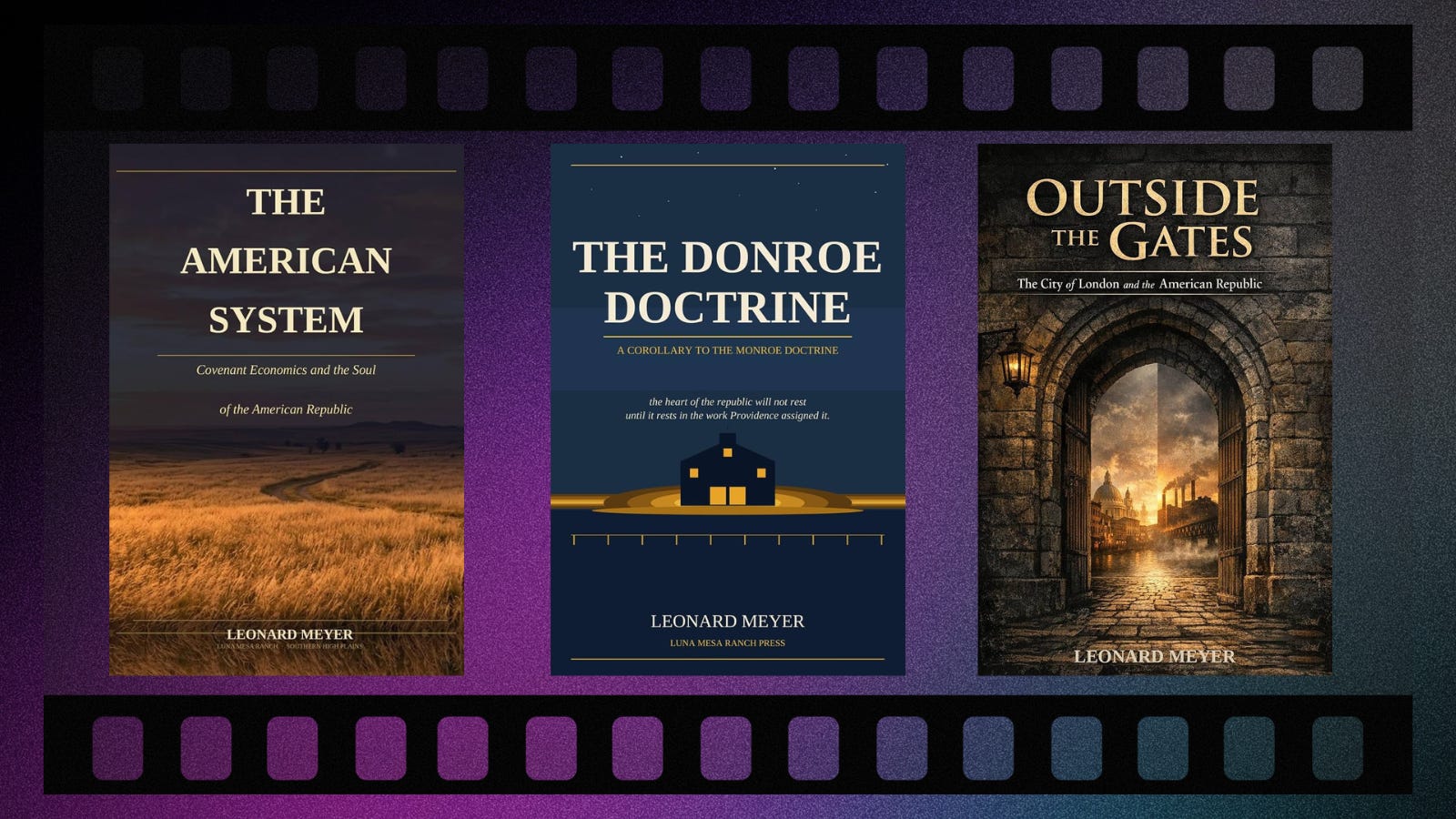
Leonard Meyer addresses that question through what he calls the American Sovereignty Trilogy.3
His argument is that the struggle did not begin with the American Revolution in 1776. In his telling, the deeper conflict began centuries earlier with the rise of a financial-imperial model in Venice.
“The war did not begin in 1776. It began in Venice.”
Meyer argues that this system developed a form of empire capable of ruling without directly governing and extracting wealth without formally owning the nations it subordinated.
Rather than relying primarily upon military conquest, it exercised power through:
debt,
credit,
financial dependency,
control over trade,
monetary institutions,
and the separation of political authority from economic power.
According to Meyer’s framework, this model migrated from Venice to Amsterdam and eventually to London, where it became embedded in the institutions and financial practices that shaped the modern international order.
His thesis is not simply that certain banks or governments became powerful. It is that a distinct governing architecture emerged—one in which creditor institutions could exert decisive influence over productive nations without openly annexing or directly administering them.
Traditional empires conquered territory, occupied cities, and ruled subject populations.
The financial-imperial model Meyer describes operates differently.
It can subordinate a nation while leaving its flag, elections, legislature, and formal political institutions intact.
The nation may appear sovereign while becoming increasingly dependent upon outside systems for:
credit,
currency stability,
industrial investment,
access to markets,
insurance,
shipping,
debt refinancing,
and control over strategic resources.
In this model, political independence can survive in appearance while economic independence disappears in practice.
Meyer argues that this is how financial power can accomplish through debt and dependency what military conquest once accomplished through armies.
Meyer places Alexander Hamilton, Abraham Lincoln, and William McKinley within a continuing struggle to establish and preserve an alternative economic order.
That alternative is the American System.
Although the phrase became most closely associated with Henry Clay, its foundational principles were developed earlier through Hamilton’s program of national credit, manufacturing, infrastructure, and economic independence.
Its principal features included:
protective tariffs,
domestic manufacturing,
internal improvements,
national infrastructure,
productive credit,
strategic industrial development,
and resistance to foreign economic domination.
Under this framework, tariffs were never merely taxes on imported goods.
They were instruments of national development.
They protected emerging industries, strengthened domestic production, preserved skilled labor, and reduced dependence upon foreign powers.
This helps explain why nineteenth-century Americans could equate protectionism with patriotism and why free trade was viewed as serving tyrannical British interests.
Our Founders understood who our chief enemies were: the British Empire and the Roman Catholic Vatican seats of power. Those same enemies remain today.
Meyer highlights that Hamilton, Lincoln, and McKinley each understood some version of the same underlying problem.
Hamilton sought to establish the productive and financial foundations necessary for the young Republic to survive independently.
Lincoln embraced Henry Clay’s American System and supported tariffs, infrastructure, industrial development, and a continental vision of national growth.
McKinley championed protective tariffs and understood industrial strength as inseparable from national power.
Meyer places all three men within a continuous tradition of sovereign economic development.
He also emphasizes that each was removed from the political order before his broader program could fully mature—Hamilton and McKinley through assassination, and Lincoln through assassination at the moment of national reconstruction.
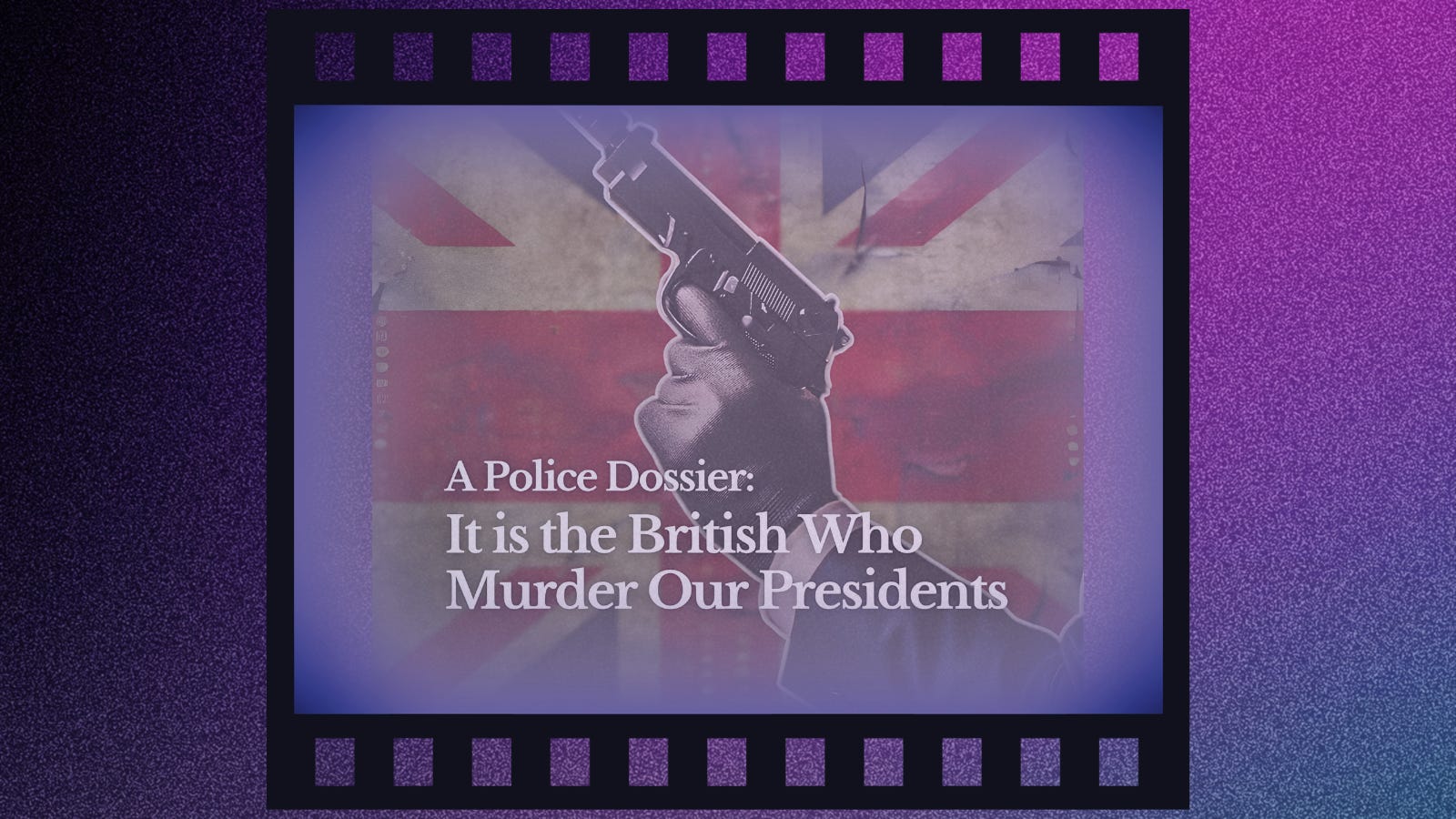
That pattern forms part of a larger interpretation of American history: that statesmen who attempted to construct a durable sovereign alternative repeatedly faced extraordinary opposition.
Meyer describes the economic program associated with Donald Trump as the Fourth American System.
Trump’s tariffs, reshoring policies, industrial strategy, energy development, infrastructure priorities, and opposition to unrestrained globalization are not isolated policy choices.
They represent an attempt to restore the older American tradition of productive sovereignty.
The central question is not merely whether tariffs raise or lower the price of a particular product.
The question is whether the United States will possess the productive capacity required to remain sovereign.
Can America manufacture its own essential goods?
Can it maintain control over energy, technology, transportation, food, defense production, and strategic infrastructure?
Can it sustain a large and independent middle class?
Can it prevent its industrial base from being transferred to nations or systems that may later use that dependency against it?
From the perspective of the American System, these are not secondary economic concerns.
They are matters of national survival.
Whether that restoration succeeds, he contends, depends upon whether Americans understand the nature and duration of the conflict.
Meyer’s argument also extends beyond economics and politics.
He grounds productive sovereignty in the biblical doctrine of creation.
Human beings were made in the image of God and were commanded to exercise stewardship over the created world—to cultivate, build, tend, govern, and produce.
From this perspective, productive labor is not merely a means of generating income.
It is part of humanity’s created purpose.
Meyer therefore argues that productive sovereignty is not simply one economic preference among many.
It reflects the proper relationship between human beings, their labor, their communities, and the material world entrusted to them by God.
An economy ordered around production, stewardship, family formation, skilled labor, and national development recognizes human beings as creators and cultivators.
An economy increasingly ordered around speculation, debt extraction, dispossession, and dependency distorts that calling.
The contrast is therefore not merely between protectionism and free trade.
It is between two different understandings of political economy:
one that builds and one that extracts;
one that cultivates and one that consumes;
one that strengthens sovereign communities and one that dissolves them into systems of dependency.
Meyer then connects this economic framework to foreign policy through what he calls the Donroe Doctrine.
The original Monroe Doctrine declared that the Western Hemisphere would no longer remain open to further European imperial expansion.
Meyer argues, however, that direct territorial conquest was eventually replaced by financial penetration.
European powers no longer needed to occupy nations militarily if those nations could be subordinated through:
debt,
monetary dependency,
strategic investment,
foreign-controlled infrastructure,
resource concessions,
and supranational financial institutions.
In this telling, the financial architecture centered in London eventually achieved through credit and dependency what European armies could not permanently achieve through force.
The “Donroe Doctrine” is the proposed restoration and extension of the Monroe Doctrine for the modern age.
It seeks to identify not only military incursions, but also financial, institutional, and economic forms of foreign control.
Its purpose is to establish the terms under which the American Republic will engage with the world while defending the sovereignty of the Western Hemisphere.
Not Protectionism, It’s the American System
·
Mar 18
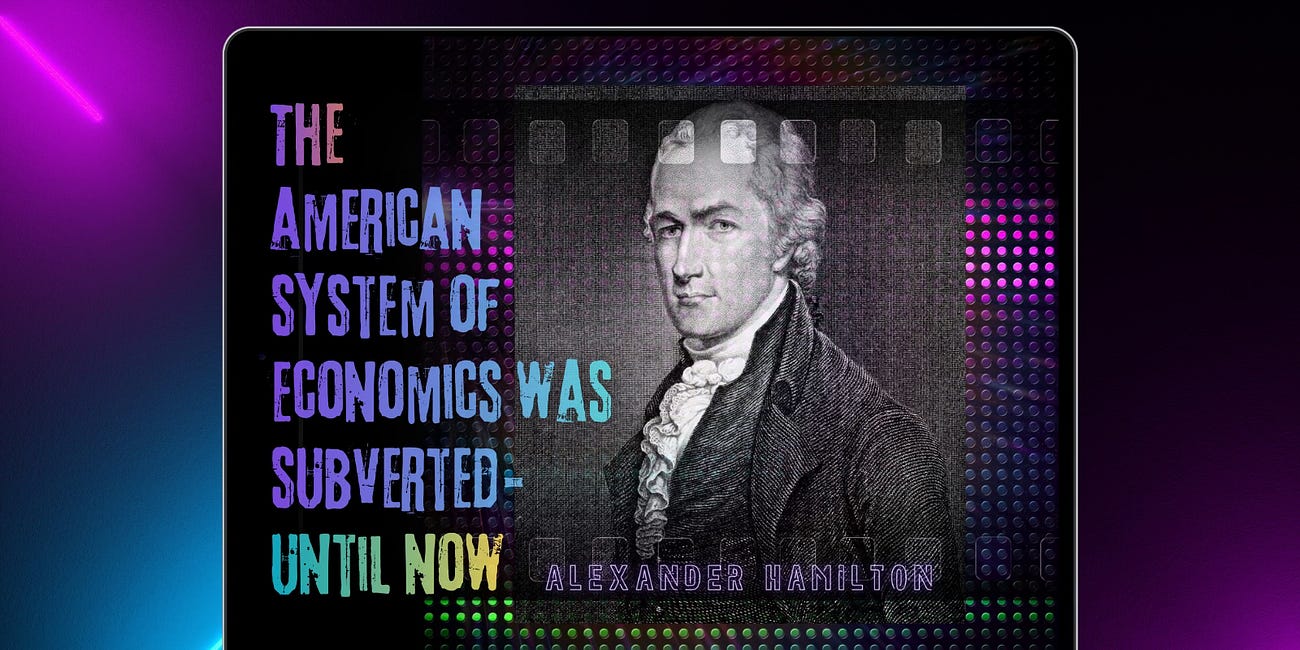
The Trump administration’s revived American System of Economics has been all but hidden from us until he took office for his second term. It is this system of economics and moral reality upon which the Founders built our Republic, but it has been subverted by globalist British influence—until now.
The American System is often dismissed as isolationist.
But sovereign development does not require withdrawal from the world.
It does not forbid trade, diplomacy, alliances, investment, or international cooperation.
It insists that such relationships must strengthen rather than dissolve national independence.
A sovereign nation may trade extensively, but it does not surrender essential production.
It may borrow, but it does not allow creditors to dictate its political future.
It may cooperate with other countries, but it does not transfer ultimate authority to supranational institutions.
It may welcome investment, but it does not permit strategic infrastructure, natural resources, or national policy to fall under foreign control.
This is the distinction Meyer draws between sovereign development and both isolationism and empire.
The goal is for America and every nation willing to do so, to build rather than extract, produce rather than merely consume, and cooperate without surrendering sovereignty.
Meyer’s framework helps explain why the debate over tariffs has returned with such intensity.
The argument is not ultimately about abstract economic efficiency.
It is about who possesses productive power.
It is about whether nations will remain capable of governing themselves or become dependent upon a anti-human, anti-God globalist system they cannot control.
It is about whether finance will serve production or whether production will be subordinated to finance.
And it is about whether the United States will continue functioning as a sovereign constitutional republic or become merely one administrative region within a larger transnational economic order.
That is why the Chatham House discussion is so revealing.
When British establishment institutions acknowledge that Americans once associated protectionism with patriotism and free trade with British interests, they are indirectly reopening the deeper historical debate between the American System and the imperial financial model it was designed to resist.
The argument over tariffs is therefore only the surface.
Beneath it lies a much older struggle between productive sovereignty and financial dependency—between the republic and the empire.
Will you answer the call to help your nation recover its providential foundation so that future generations understand what we are defending—and why it must be defended?
Faithful stewardship begins with faithful remembrance.
And faithful remembrance begins with the truth.
History is not merely something we study.
It is something we steward.
To steward it faithfully requires the courage to preserve, proclaim, and rightly teach the biblical principles that first made ordered liberty possible.
“Moreover it is required in stewards, that a man be found faithful.” 1 Corinthians 4:2
Christian, will you take up your cross today and faithfully steward the good gifts God has entrusted to you?
“For from Him and through Him and to Him are all things. To Him be glory forever. Amen.” Romans 11:36
Soli Deo Gloria.
Summer Black
Armor of Truth
The American System Returns
·
Feb 19
How renewed manufacturing strength, Hamiltonian economics, and the National Security Strategy are reshaping America’s future and why citizens must understand the system before propaganda rewrites the story.
Globalism is OVER.
·
Mar 31
Is Trump different? For the first time at least 50 years a US president has articulated clearly and acted decisively to end the planned, or as the CFR termed it in 1973, “the Controlled Disintegration” of the United States. Secretary of State Marco Rubio sums up the Trump administration’s core foreign policy aim in this clip from his February address to…
Not Protectionism, It’s the American System
·
Mar 18
The Trump administration’s revived American System of Economics has been all but hidden from us until he took office for his second term. It is this system of economics and moral reality upon which the Founders built our Republic, but it has been subverted by globalist British influence—until now.
At some point, the narrative flipped. Ideological subversion was achieved.
The system that actually built the United States was rebranded as “protectionism”—something outdated, inefficient and dangerous.
Meanwhile, British-style free trade was presented as neutral, modern, and inevitable.
But historically, that’s backwards.
Leonard Meyer is a rancher, historian, and Reformed Christian whose work traces the theological and institutional genealogy of American productive sovereignty across four centuries. Drawing on Scripture, the Reformed covenant tradition, and the documented record of the American System’s defenders and adversaries, his writing maps how structures of credit, trade, and sovereign design have shaped the fate of the republic — and how the directive God built into the nature of man keeps asserting itself against every architecture designed to suppress it.
Outside the Gates is the first volume of a three-book argument — the genealogy of the adversary, named and traced from Venice to the present moment.
The American System, the companion volume, makes the constructive case: the Hamiltonian architecture Hamilton designed to stop exactly this, and the century of its dismantlement.
The Donroe Doctrine completes the trilogy with the forward argument: the present assertion of American economic sovereignty and what a restored American System can accomplish in the century ahead.
Meyer lives and works on the Southern High Plains of Colorado, where the argument is not theoretical. He and his wife, Brenda, raise Dexter cattle on Luna Mesa Ranch — ground owned outright, outside the debt architecture, direct to the families who know their name. The cattle graze on proof that the directive still holds. He is a direct descendant of William Brewster of the Mayflower. The chain has not broken.
Comments
Nothing yet. Say the first thing.
Sign in to join the conversation.