
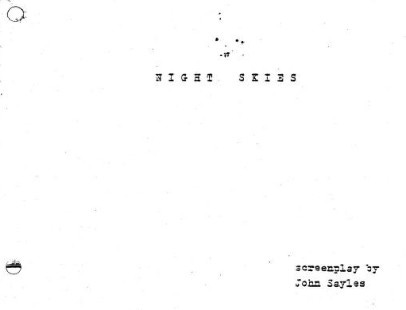
In 1980, John Sayles wrote a screenplay called Night Skies for Steven Spielberg. It was supposed to be a horror film. Specifically, a farmhouse siege movie with UFOs. Which some folks called “Straw Dogs with aliens,” though Sayles himself said his real touchstone was John Ford’s Drums Along the Mohawk (1939). An isolated homestead and things coming out of the dark.
Spielberg had been calling his idea “Watch the Skies,” after the stark warning at the end of Howard Hawks and Christian Nyby’s The Thing (From Another World) (1951).
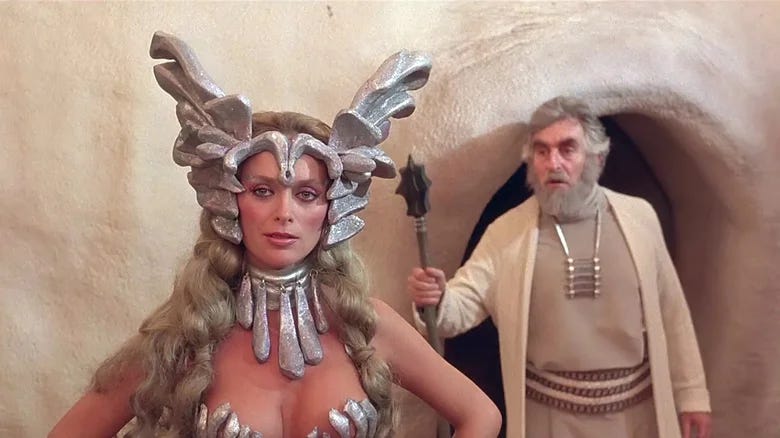
Spielberg wanted Lawrence Kasdan to write it, but Kasdan was busy with The Empire Strikes Back. So he turned to the guy who’d just written Piranha and The Howling and Alligator and, the same year, the cheesy and brittle Battle Beyond the Stars.
Sayles delivered a cracking script, which you can read on the Internet Archive. Make-up genius Rick Baker spent roughly $700,000 on alien creature designs. The script featured alien critters terrorizing a ranch family, including an autistic boy named Jaybird who forms a bond with one of them, and a dangerous critter named Skar.
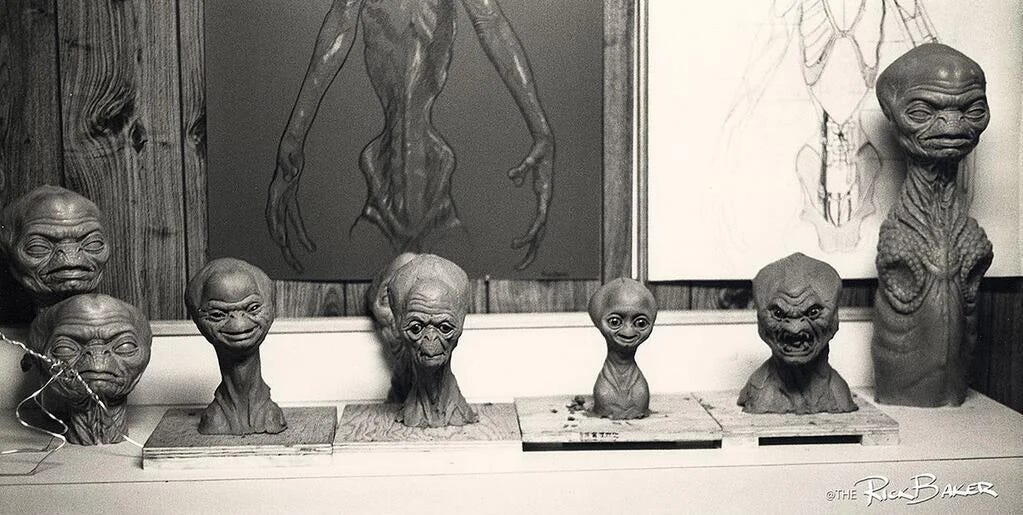
When Spielberg described the project to screenwriter Melissa Mathison, she latched onto the Jaybird relationship: the boy and the creature. And so E.T. the Extra-Terrestrial was born. The invasion elements got folded into Poltergeist. The mischievous critters made their way to Gremlins.
Three of the defining genre films of the 1980s, all carrying DNA from a John Sayles script that never got made.
The same year E.T. opened, John Carpenter’s paranoid, brilliant remake of The Thing died at the box office against it. Carpenter’s film is now regarded as one of the greatest science fiction horror films ever made. E.T. is justly a classic.
Where would Night Skies have fallen?
We’ll never know. Sayles went off and made Baby It’s You and Lianna, and the genre work went semi-underground.
Until Jurassic Park IV.
Like Scorsese. Like Coppola. Like Cameron and Ron Howard and Jonathan Demme. Sayles started with Roger Corman.
Sayles was discovered by Frances Doel, Corman’s script supervisor at New World Pictures, who hired him to rewrite a Jaws knockoff. It became Piranha (1978). He was fast, he was smart, and he could write to budget. Soon enough he was, by any account, the greatest screenwriter to ever work at New World.
“I did Piranha, Battle Beyond the Stars, and Lady in Red for Roger,” Sayles has said, “and then with Joe (Dante) and Lewis Teague, who I’d worked with there, I did The Howling and Alligator.”
Sayles’ relationship with Dante goes deeper than credits. Sayles wrote Piranha and The Howling for Dante, later acted in Dante’s Matinee, and was brought in for an early draft of The Sixth Day — the Schwarzenegger cloning thriller — before Dante dropped out and the project went elsewhere.
These films helped establish a kind of self-aware horror tradition. Sayles wasn’t just writing exploitation. He was smuggling genre literacy into it.
Thanks for reading Ghosts In The Machine! This post is public so feel free to share it.
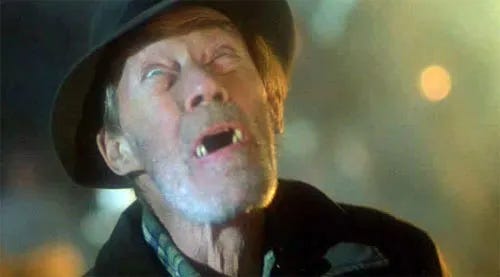
The characters in The Howling are named after horror directors: Erle Kenton, who directed Island of Lost Souls. Terry Fisher, after Hammer’s Terence Fisher, who directed screeds of pictures for the British studio. Fred Francis, after Freddie Francis, fellow Brit, who did Hammer films and also shot The Elephant Man for David Lynch.
In Piranha, Mario Bava star Barbara Steele plays the ominous Dr. Mengers.
In Alligator, you get Rat Pack royalty Henry Silva as the great white hunter, summarily dispatched by the giant gator while his “native” neighborhood helper dudes run off into the night.
Every one of these movies is a real movie wrapped around a bunch of in-jokes. Sayles understood the grammar of monster movies — he name-checked giant ant thriller Them! as his reference point, not Jaws — and deployed it with a literary precision that had little business being in a movie about a giant alligator in the Chicago sewer system.
His horror scripts are funnier, smarter, and more politically pointed than their budgets or their premises would demand.
But Sayles’ more intellectually minded arthouse cinema was no stranger to monsters and aliens.
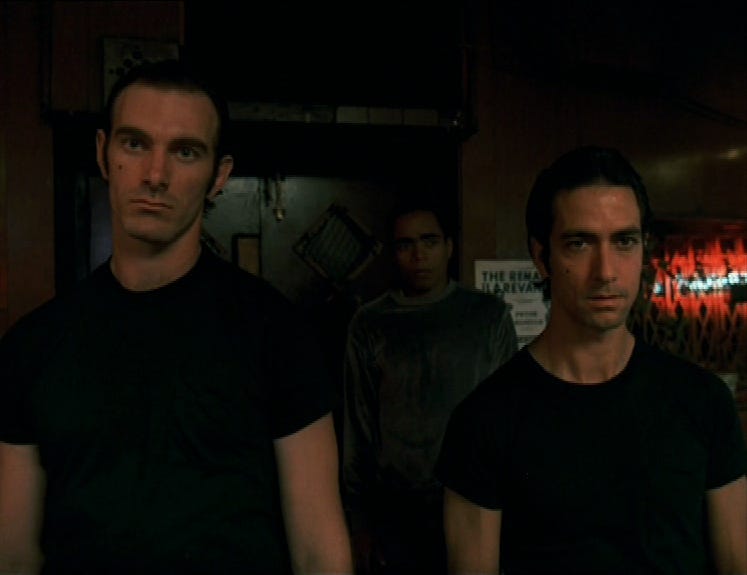
In his The Brother from Another Planet (1984), a mute Black alien, played by Joe Morton, crash-lands in Harlem. He’s pursued by alien bounty hunters, “Men in Black” played by Sayles himself and his later leading man David Strathairn. It’s a science fiction comedy that lacerates American racism with the lightest possible touch.
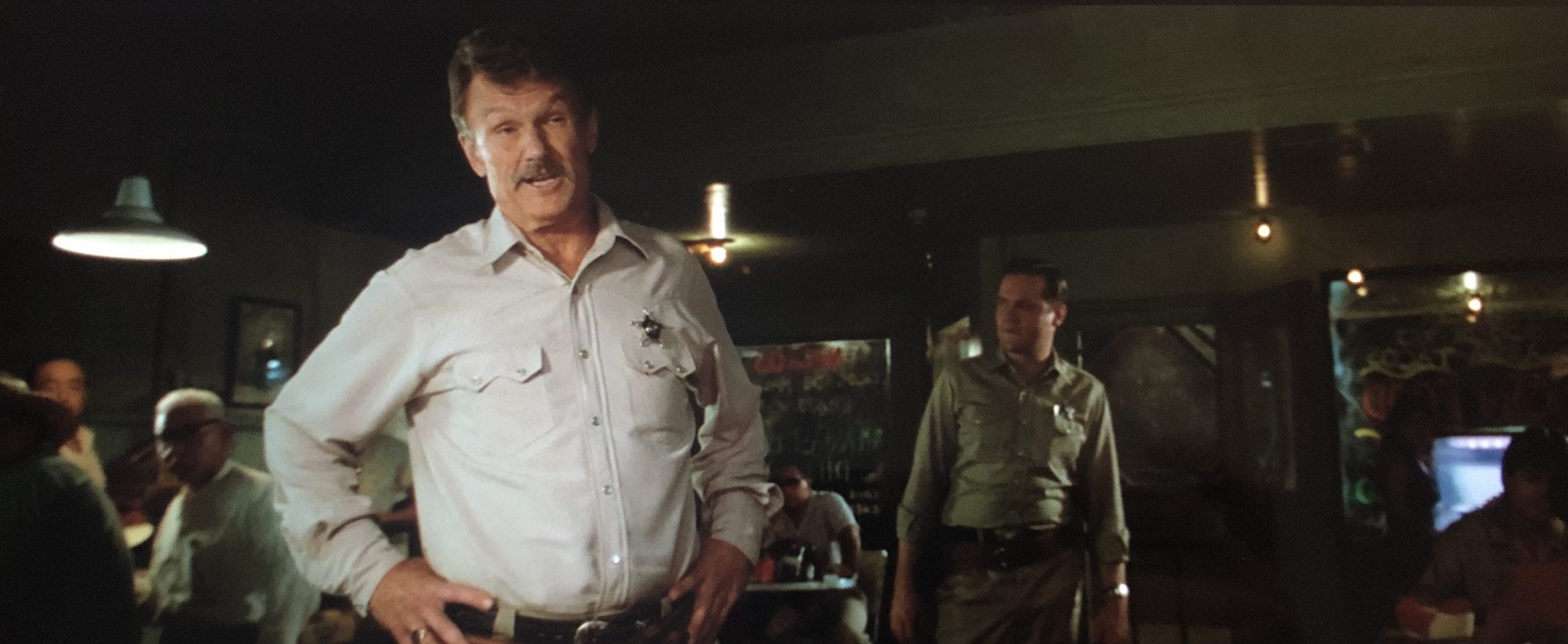
In Lone Star (1996), Kris Kristofferson’s corrupt sheriff Charlie Wade is a terrifying demon in his own right. Sayles cast a young, relatively unknown Matthew McConaughey against Kristofferson, saying he needed someone with that kind of depth to stand up to Kris’ monstrous Wade.
And then there’s the script doctor work, which is arguably how Sayles funded his actual career.
Sayles has done uncredited rewrites on Apollo 13 and Mimic. Over his career, credited or not, he’s worked with Frankenheimer, Spielberg, Demme, Sidney Pollack, Sam Raimi, Rob Reiner, and James Cameron. Over sixty screenplays for hire. He co-wrote The Challenge (1982), a Frankenheimer samurai-vs-modern-Japan film with Scott Glenn and Toshiro Mifune. He wrote The Clan of the Cave Bear for Daryl Hannah. He wrote Wild Thing, a Tarzan-in-the-city exploitation picture.
All of it paying for Matewan and Lone Star and Eight Men Out.
Cut to the early 2000s. Jurassic Park has had two sequels and Spielberg is looking to produce a fourth. Screenwriter William Monahan writes a draft and exits for Kingdom of Heaven. Spielberg reaches back to his old collaborator, and Sayles gets the call.
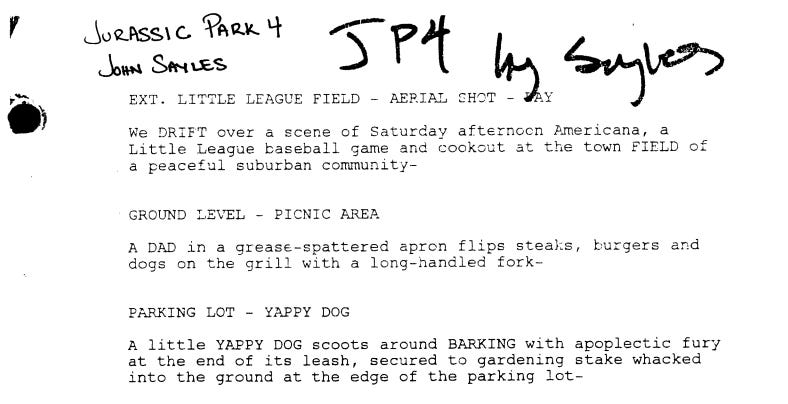
Sayles delivered something genuinely unhinged. Hammond — Richard Attenborough’s Hammond — was the only returning character. He sends a mercenary named Nick Harris back to Isla Nublar to retrieve the shaving cream canister of dinosaur DNA that Dennis Nedry lost in the rain in the original film, right before the Dilophosaurus got him.
From there it goes sideways. Harris gets abducted and hauled to a castle in the Swiss Alps. A Bond villain named Baron Von Drax is engineering super-soldiers from the spliced DNA of dinosaurs, dogs, and humans. The hybrids wear armor. They’re sent on a hostage rescue mission in Tangier. And in an ending Ian Malcolm could have predicted without chaos theory, the dinosaurs break their programming and turn on the scientists.
It’s fairly insane. It’s also, unmistakably, a John Sayles script, with the military-industrial complex meeting genetic hubris meeting monster movie, with a pulp serial framework holding it all together.
The studio didn’t make it. But the DNA-hybrid concept survived, stripped of its politics and its weirdness, into Jurassic World.
Which is exactly what happened with Night Skies.
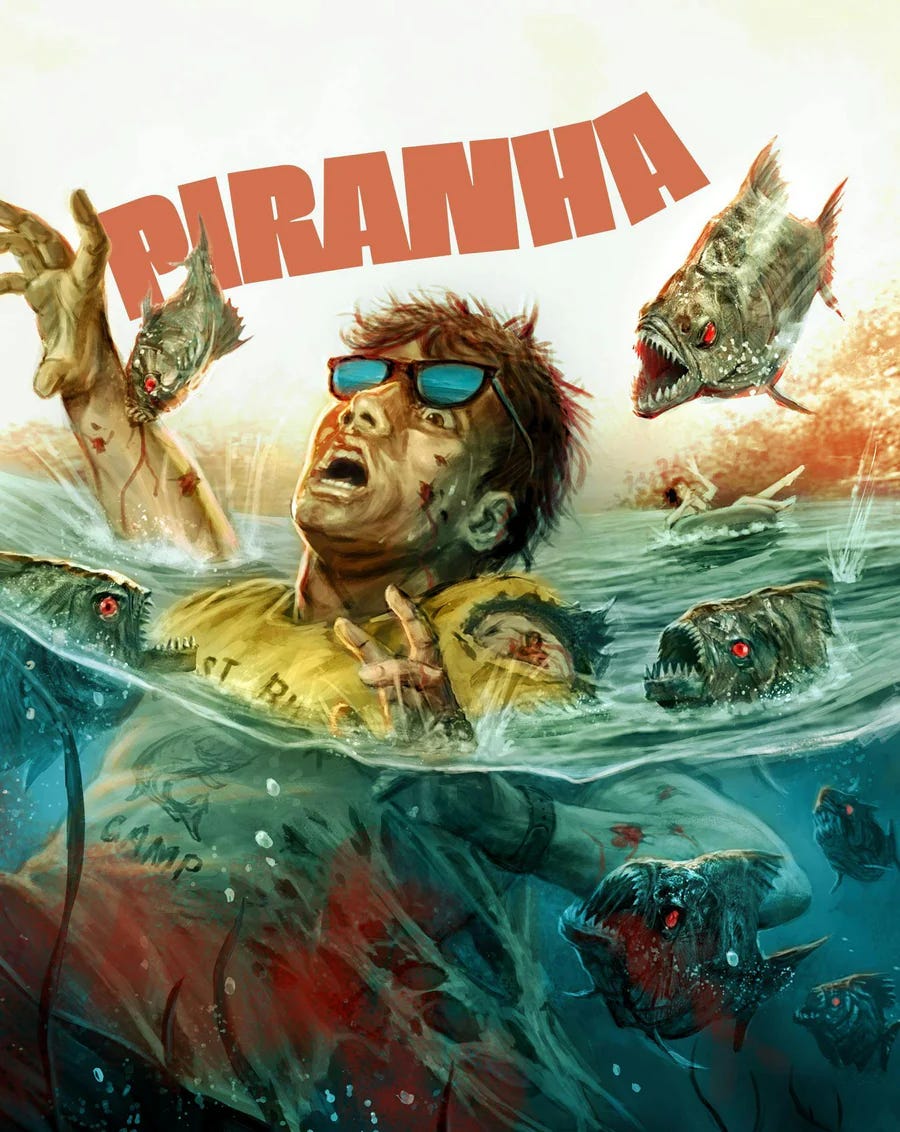
Sayles’ career is defensible. As much as these genre films are slightly ridiculous, they’ve elevated to cult status. You can get a UHD of Alligator or a 4K Steelbook of Piranha these days.
While Lone Star and Eight Men Out weren’t exactly blockbusters, they’re renowned classics.
Sayles writes the thing that’s too smart, too strange, or too politically charged for the megahits. But the DNA of his work, like dinosaur double helix, threads throughout Hollywood history.
It’s not the worst gig.
Ghosts in the Machine is a reader-supported publication. You can watch many of the movies here at this playlist on the Ghost Guide. I’m Nick Tangborn, and you can find me at nick@nicktangborn.com.
Comments
Nothing yet. Say the first thing.
Sign in to join the conversation.