
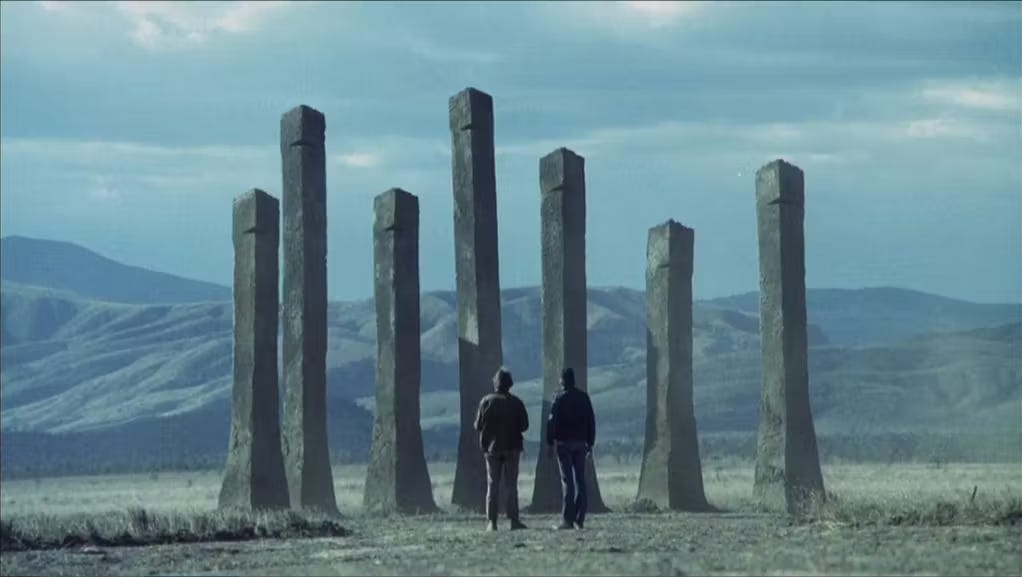
Saul Bass is renowned as the master of film titles and movie poster aesthetics, having created not only the ultra memorable poster and title images for The Shining, The Man with the Golden Arm, Vertigo, but also the title sequences, all linear slashes and powerful iconography, for Psycho and North by Northwest, and later films by Martin Scorsese, like Goodfellas and Casino.
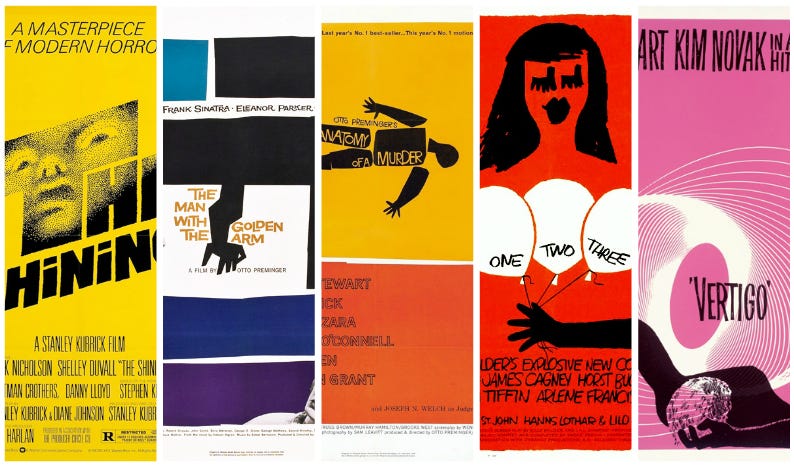
Meanwhile, he was also developing as a visual stylist behind the camera, storyboarding and co-directing the shower scene, murder of Detective Arbogast and final reveal of Norman Bates’ mother’s corpse in one of the greatest horrors of all time, Alfred Hitchcock and Robert Bloch’s Psycho.
The idea for Bass’s feature debut — and only full-length film — Phase IV was apparently hatched over cocktails in 1971, when Peter Bart at Paramount had dinner with producer Raul Radin and asked him what was cooking. Radin responded “an ant story,” though he actually had nothing. Radin subsequently called Bass, who knew about Ken Middleham’s photography of insects and macro/micro cinematic aesthetic, and they quickly agreed to work together.
The film was written by Mayo Simon, who used H. G. Wells’s 1905 short story “Empire of the Ants” as inspiration. Simon was coming off scripting a short animated piece with Bass that won the short film Oscar.
Interiors were shot at Pinewood Studios in England and exterior locations were shot in Kenya, though the film is set in the Arizona desert.
Phase IV is undeniably living in the wake of Stanley Kubrick’s 2001: A Space Odyssey in its visual and sci-fi aspirations.
From its opening shot of the earth in orbit around the sun, accompanied by electronically devised “celestial” voices, Saul Bass’ first feature signals a purposeful reliance on various science fiction works that have preceded it: 2001 first and last.
Phase IV takes an absurd premise — a hyperintelligent, aggressive ant colony with powers granted by a cosmic flash — and gives it the philosophical sci-fi treatment of a heightened genre film like 2001: A Space Odyssey or Andrei Tarkovsky’s Solaris.
Thanks for reading Ghosts In The Machine! This post is public so feel free to share it.
But the parallel goes deeper than atmosphere. Both films are fundamentally about contact with a non-human intelligence and the transformation of the human species. In the restored, originally cut montage ending, James (Altman favorite Michael Murphy) and Kendra (Lynne Frederick, of Hammer’s Vampire Circus, and the great Cornel Wilde’s apocalyptic No Blade of Grass) find themselves running through a gauntlet of geometric structures, eventually ending up in a maze where they are tested and observed in the same way that mankind tested the insects.
In a dizzying and often disturbing montage of imagery, James and Kendra become an embodiment of all mankind as a new species is created: “Phase IV.” The echo of the Star Child is unmistakable.
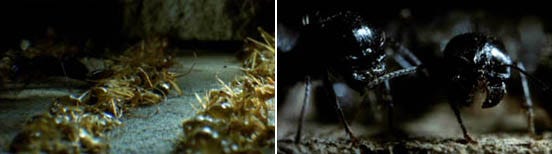
Phase IV doesn’t even really introduce human characters until around ten minutes into the film, which is largely comprised of that remarkable micro photography by Ken Middleham (The Hellstrom Chronicle) establishing the insect world.
Save for brief narration, viewers are treated to a mesmerizing and nearly wordless opening sequence lasting close to ten minutes — a trippy segment in space followed by the first of many micro-photographed ant scenes. Thanks to Middleham’s excellent work, the close-ups on the ants actually make them look somber and vengeful. These ants plan, communicate, and mourn their dead.
Additionally, Mayo Simon is a civil war buff, and thought the iconography that attached to solder units in the war could apply to the ants, so each ant in the community has a symbol on their forehead. Bass’s love of symbology threads through the film, in crop circles, obelisks, signs and arrows.
In the film's opening shot, a field of stars gives way to a cosmic eclipse, gradually transitions to a flare, then a sort of eyeball — circles within geometric shapes recur in the film. The shot gradually transitions to space, suggesting there are worlds within worlds; then to grains of sand, an ant hill, the tiniest creature against a dark field of night. This is not an accident — it's Bass deliberately inverting the cosmic scale of 2001, suggesting that the universe exists at every scale, including beneath your feet.
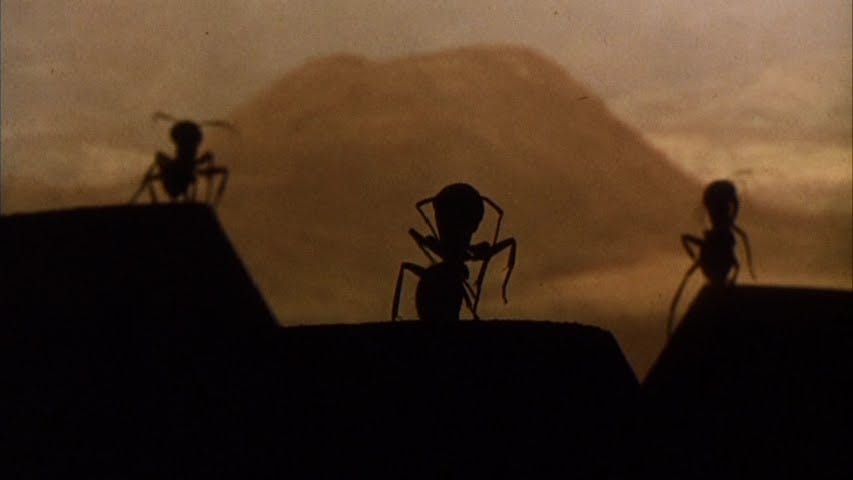
The real wonder of the film are Ken Middleham’s incredibly good macro-cinematographic views of the ants and other insects going about their business. Many shots are over-cranked in beautiful slow motion. The film could easily have employed generic “bugs milling about” shots; instead, these images are planned, choreographed, and executed for maximum graphic appeal.
By keeping the insects at their familiar size, Phase IV remained planted in reality while exploring topics that are anything but. The threat seems more imminent: humanity finds itself being threatened not by being overpowered physically — although the ants do cause massive destruction, crumbling buildings and shaping reflective obelisks to burn with sunlight — but by being knocked down a step on the evolutionary ladder.
This is a crucial distinction from Them! and every other bug movie: the ants don’t need to be big. Their superiority is intellectual. They burn a praying mantis inside an air conditioner, they chew through key electrical cables.
Middleham’s insect work was photographed alongside primary cinematographer Dick Bush, who went on to shoot William Friedkin’s remake of The Wages of Fear, Sorcerer, and Ken Russell’s Tommy in the following years.
Bass filmed a spectacular, surreal montage lasting four minutes (SPOILER ALERT -it’s the video above), showing what life would be like on the “new” Earth, but this was cut by the distributor. As usual, the intent to create a more test-audience pleasing version neutered the film itself. For years it was a sort of joke, even appearing on an early Mystery Science Theater 3000 in the KTMA years in Minneapolis.
The montage was intended to suggest that the two surviving characters were altered by the ants’ creation of the next step in evolution for humanity and ants.
In early 2012, a faded print of the original ending sequence was found in the Saul Bass Collection at the Academy Film Archive in a preview version of the film, originally shown to test audiences in 1973. In June 2012, this excerpt was screened to the public in Los Angeles at the Cinefamily cinematheque following a showing of the theatrical version. The Academy Film Archive found the original film elements — a set of separation masters — in Paramount Studio’s archives, recombined them, color-timed them, and had them digitally scanned.
This recovered montage ending, along with a brand new 35mm print of the theatrical version, premiered at the Alamo Drafthouse in Austin, Texas, as part of a full day of films by Saul Bass in December 2012.
They have now been included in a lovely comprehensive Blu Ray and 4K UHD set from Vinegar Syndrome. And the film’s lost score was finally released by Waxwork Records on yellow vinyl, to match the chemical spray that the ants induce to alter their DNA.
The studio intervention that stripped this ending is precisely what separates the film’s reputation from its potential. As critic A.H. Weiler of the New York Times wrote at the time: “For all of its good, scientific and human intentions, ‘Phase IV’ cries for a Phase V of fuller explanations.” He didn’t know he was reviewing an amputated film.
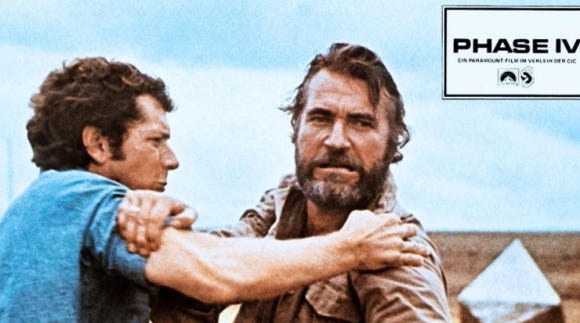
The character split between Dr. Hubbs (Brit Nigel Davenport, also of No Blade of Grass, and Dan Curtis’ Jack Palance-starring Dracula) and James Lesko (Murphy) maps almost perfectly onto the 2001 philosophical divide: the individual is emotional and weak; Lesko keeps his head, sticks to his maths and computers for guidance, sees the community's bigger picture. "Mathematics is the universal language,.” he claims, defending his rational communication with the ants over injured Davenport’s Quatermass-esque rigid, inhuman obsession.
The computers used by Lesko in the film were not dummy sets of flashing lights, but real working computers, like the GEC 2050. Bass’s commitment to scientific credibility was real.
The ant queens seen on screen are actually a species of wasps: a practical choice made to avoid disturbing actual ant colonies.
A novelization of the screenplay, written by Barry N. Malzberg, was published in November 1973 and uses the uncut version of Mayo Simon’s script — giving hints of the full ending Bass intended.
Despite Bass being one of the most recognized names in Hollywood title design, his film Phase IV contains no opening credit sequence, and Bass didn’t even have a hand in designing the theatrical release poster.
Josh Lewis on Letterboxd has an apt summation of the film’s aesthetic: “Has an incredibly strong and unique visual/sonic sensibility that combines macro bug photography, time-lapse imagery, piercing synths, crossfade montages and abstract compositions of landscape formations and light sources that all contribute to this terrifying and surreal but ultimately beautiful acceptance of our new insect overlords.”
Thanks for indulging my ant obsession. If you want to watch Phase IV for free on Kanopy, that’s one option. Of course you can also head over to my Ghost Guide and see lots of streaming options for rent or buy.
I’m Nick Tangborn and this is Ghosts in the Machine. Get in touch at http://nicktangborn.com or at nick@nicktangborn.com.
And of course, if you want to buy me a cup of coffee, I’m not going to fight you.
Comments
Nothing yet. Say the first thing.
Sign in to join the conversation.