
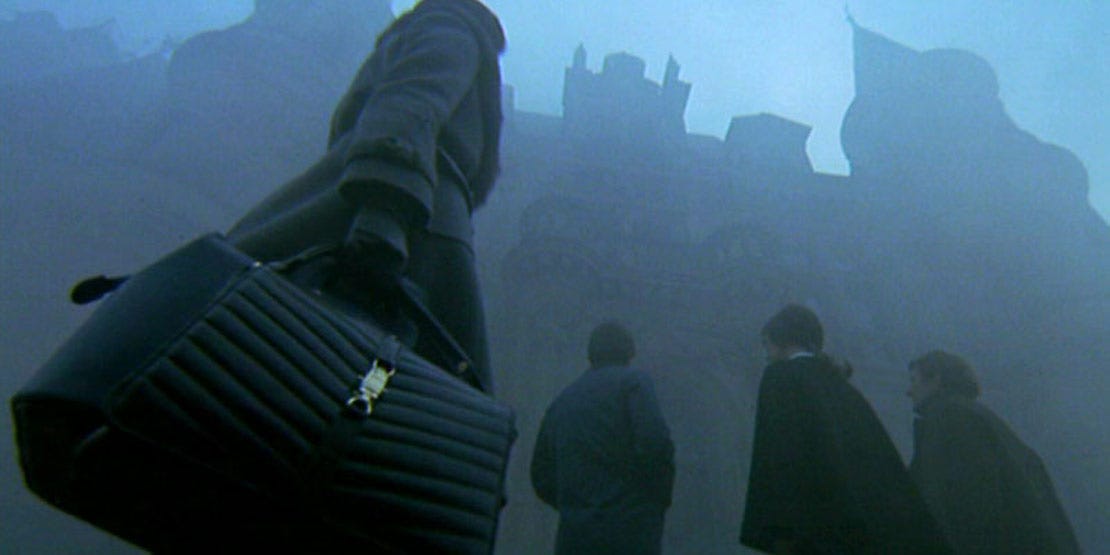
One of the movies I return to again and again is John Hough’s adaptation of Richard Matheson’s novel Hell House, the 1974 James H Nicholson production The Legend of Hell House.
I don’t know that it’s a particularly great film. But it’s the kind of film I like the most, meticulously paced, grounded, ominous, British, and deeply odd.
I first encountered the film not even by seeing it. On the Skinny Puppy industrial-pop record Mind: The Perpetual Intercourse, which I bought in high school, the 4th track, “Love,” featured a sample of Gayle Hunnicutt murmuring “Naked. Drunk. Clutching. Sweating… Biting” with increasing fervor.
I didn’t know that it was a key moment in The Legend of Hell House, but it was certainly compelling stuff for a 16 year old kid in Lakeville, Minnesota.
Shortly thereafter I encountered the film on late night television, and instantly put the sample to the movie. It was one of the first times I noted, and remembered, movies and music in a specific capacity. The birth of a lifetime obsession.
Innocuous stuff, mind you, but it meant something to me.
I quickly put Skinny Puppy and its ilk aside – even a podunk kid could recognize chintzy industrial music as goth cosplay.
But the movie kept coming back.
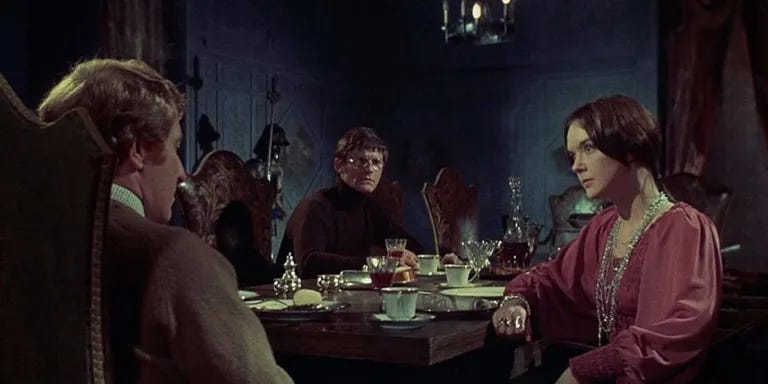
The movie itself has Scientifically Minded physicist Lionel Barrett contracted by uber rich meanie (seen only in close up from below, so you know he’s bad news) Rudolph Deutsch to investigate if there is life after death. To do so, he must head into the legendarily haunted Belasco House, known in whispers as Hell House.
His companions are his prophetically uptight wife Ann, and two mediums, a mental medium Florence Tanner, and physical medium Benjamin Fischer. Fischer is played by a top of his game Roddy McDowall, all turtlenecked and mildly feminine restraint until the gloves come off.
Thanks for reading Ghosts In The Machine! This post is public so feel free to share it.
Via dateline subtitles – to give us both a sense of documentary groundedness, and to let us know where we are in relation to the story’s natural foretold end on December 24th, when the rich folks will come to save them or release them – we are carried along as the house starts to get angry. Then horny. Then outright murderous.
By throwing cats at them.
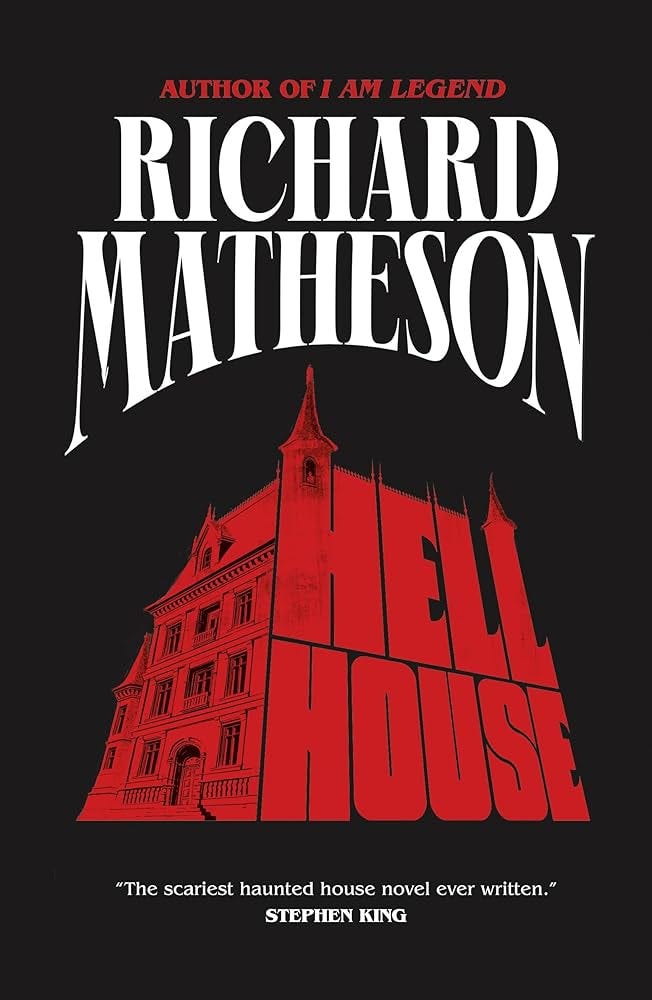
The book is harsher stuff, with the sensual undertones hinted at in this very British movie on its taut surface.
Writer Richard Matheson is worth noting here. An unusually prolific novelist, short story- and screenwriter, his tight grasp on economical storytelling can be felt in media as disparate as the gremlin on the side of the plane in The Twilight Zone’s “The Nightmare at 20,000 Feet,” whether you prefer your tormented passenger as William Shatner or John Lithgow, or Duel, Spielberg’s first real movie, with Dennis Weaver against an implacable 18 wheeler.
Matheson’s work also includes the tightly constructed novella I Am Legend, variously made as the Vincent Price vehicle The Last Man on Earth, Charlton Heston against sunglass-wearing mutants in The Omega Man, Will Smith’s weaksauce I Am Legend, or, arguably, Night of the Living Dead.
There’s more – Karen Black against the Zuni festish doll in Trilogy of Terror, or Kevin Bacon vs ghosts in Stir of Echoes, not to mention all the Corman Poe movies and The Incredible Shrinking Man.
And The Legend of Hell House, from his novel Hell House.
Hell House’s score, by Brian Hodgson and Delia Derbyshire, is propulsive electronic tones and ambient whispers and woodwind and brass shrieks. Its function is akin to the John Carpenter scores underpinning Prince of Darkness, say, or Halloween, acting almost as another character and carrying the lion’s share of the atmosphere.
Director John Hough unsurprisingly got his start with Hammer Productions, directing Twins of Evil after episodes of the Avengers for BBC and the Irwin Allen production Sudden Terror.
Twins of Evil marked the end of Hammer’s Karnstein trilogy of lesbian vampire movies, and the debut of real-life identical twins and Playboy playmates, Madeline and Mary Collinson.
It’s solid work by Hough, but his immediate later efforts were increasingly more successful, whether it was Hell House, or Dirty Mary Crazy Larry, or even the Disney Witch Mountain series — Hough directed Escape to Witch Mountain and Return from Witch Mountain, and even the later Disney horror effort The Watcher in the Woods.
This period marks a highlight for Hough, as his later efforts drifted into television and dreary horror efforts like The Howling IV.
Hough would revisit his Hammer days in 1984, shooting several episodes of the Hammer House of Mystery and Suspense, a 13 show series renamed Fox Mystery Theater.
No less than Martin Scorsese is an avowed fan of the film, having programmed it for BBC film series. In program notes from Martin Scorsese Selects Hidden Gems of British Cinema, we get this exchange:
“Edgar Wright: I wanted to ask about the last film, in terms of chronology, on the list: The Legend of Hell House. I’ve always loved it and I always think it’s interesting because Pamela Franklin is in both The Legend of Hell House and The Innocents [1961]. To me, The Innocents is one of the most subtle evocative horror films, whereas The Legend of Hell House as a counterpoint is like John Hough hitting you in the face with a brick – in a great way! It’s all those low wide angle shots.
Martin Scorsese: Well, that’s the style of it. It’s a serious horror film. It really is. It didn’t evade the issue by shocking cuts and what they call now jump scares. It really placed you in that house and it had a creepy feel to it, especially the ghost who takes down the covers of the bed, and then she gets in the bed and then they find her in the morning and she’s got scratches on her. It had a sense of a deeper element of evil. The sense of evil in that house – it’s titillating in terms of the eroticism of the picture, and what do you do with those wide angle lenses as you say. It certainly was a companion piece for me for The Haunting [1963].”
The movie’s real power is its insistent atmosphere and scary ambience. The aforementioned cat attack is pretty silly stuff. And McDowall’s ACTING! can go over the top.
Not to mention a fairly silly ending, which I won’t spoil for you.
But none of this ruins it for me. The overarching drive of its propulsive score, the dusty, cobwebbed sets, the stylized lighting — whether its stark white light in a purely black frame or vivid, saturated reds — these things drive its canted angles home.
You can find streaming information on the films mentioned here at my Ultimate Guide to Streaming Horror and Genre Film, the Ghost Guide — here’s The Films of John Hough.
A side note: I added a feature on Ghost Guide that lets you write what kind of horror movie (or sci-fi, or dark fantasy) you want to watch, and it’ll dig up some goodies and show you where they’re streaming. Check it out here.
You can find me at nick@nicktangborn.com these days.
Comments
Nothing yet. Say the first thing.
Sign in to join the conversation.