
FIVE AUSTIDELPHISTORY NUGGETS
From last Friday until yesterday, I was in Austin, Texas researching the delightfully Deco Seaholm Power Plant’s history and redevelopment for an upcoming book project (much more information forthcoming shortly!). Archiveadelphia is never far from the mind, and I searched for some intersections between Philadelphia and Texas’s most fascinatingly weird and acceleratingly gentrifying city. These are two towns that have more in common than immediately meets the eye:
On January 28th, 1851, Sam Houston, who had fought for Texas’s independence in its Republican days, served as President of the Republic of Texas, and was by this juncture serving as one of the state of Texas’s inaugural U.S. Senators, gave a lecture at the Musical Fund Hall at 8th and Locust in Philadelphia. Houston, per a letter sent back to his wife Margaret in advance of the talk, was supposed to speak about “Texas, as a subject, or the incidents of the Revolution.” His letter betrays a little nervousness. The speech was part of a fundraiser to rebuild the Southwark Presbyterian Church on Fitzwater Street, which had been damaged in a storm. Houston used the opportunity to passionately praise his sometimes-rival, sometimes-collaborator, Stephen F. Austin, the city’s namesake, who had died of pneumonia just as the Republic was proclaimed. Houston’s Philadelphia speech offers historians some of their best evidence that Houston admired Austin: “I mention the name of Stephen F. Austin, the real father of Texas; not its putative; sire, but the man who planted the American footsteps there, whose memory will be revered as long as the name of Austin shall be sounded, or the gratitude of the human heart be offered as a tribute to worth.” That’s love, y’all. The full, epic speech can be found in The Writings of Sam Houston, 1813-1863, Volume 5, available here at HathiTrust.
Austin classical composer Kent Kennan wrote, in 1936, a flute-centric piece called “Night Soliloquy.” It’s a flighty and fantastical four minute journey and became a favorite of Philadelphia Orchestra conductor Eugene Ormandy and his principal flautist, the profoundly influential William Morris Kincaid. A very entertaining 1960 TIME article reveals that Kincaid played Kennan’s work during his televised retirement concert at the Academy of Music. Sadly, I can’t find this clip, but I do have a 1950 Columbia Masterworks recording of Kincaid and the Orchestra playing Kennan’s Soliloquy. The TIME profile has some real gems on the eccentric Kincaid. He was a champion swimmer, played a $6,000 platinum flute, was a prolific scotch drinker (“the perfect antidote to platinum poisoning,” a Kincaid friend quipped to the publication), and taught a staggering number of flute students in his role at the Curtis Institute—the Institute found that 87% of living American flautists can trace their ancestry to Kincaid’s tutelage.
President and First Lady Johnson loom immensely large in Austin, from Lady Bird Lake, to architect Gordon Bunshaft’s spare and imposing LBJ Library, to tales told with pride by Austinites of Johnson’s first date with Lady Bird at the grand Driskill Hotel (speaking of grand hotels, were you aware that this writer would love to give you a free tour of Philly’s Bellevue Hotel on Thursdays at 10AM and 2PM?) and of his Space Age Bachelor Paddy office in the concrete-gridded J.J. Pickle Federal Building. I wanted to track down a Philly LBJ visit I hadn’t yet explored, and came across his July 4th, 1963 vice presidential address at Independence Hall to mark America’s 187th birthday. Johnson, speaking before 10,000 Philadelphians and flanked by Mayor James Tate and Tonight Show host Johnny Carson (who read Declaration of Independence excerpts), spoke just weeks after the murder of Black civil rights activist Medgar Evers in Jackson, Mississippi and at the height of Southern sit-ins. LBJ offered a full-throated endorsement of governmentally-enforced racial integration: “A President who has the right to order any of us into a foxhole at any time ought to have the right to order that we be permitted to go into a hamburger stand or a toilet or a theater without being harassed.” I also haven’t been able to track down a full transcript (quote is from a Daily News article), but here’s a brief YouTube clip.
Another musical entry, though very different from Kennan: I love Cosmic Country, Outlaw Country, Austin Country—whatever you prefer to call the often-slightly-psychedelic, sometimes-disaffected, genre-bending music that came out of iconic 1970s Austin spots like the Armadillo World Headquarters. I particularly like longtime Austinite Jerry Jeff Walker, the writer of the oft-covered “Mr. Bojangles,” about a down-on-his-luck street dancer. In 1980, the Philly Soul group The Futures offered a sort of discordantly jaunty but somehow mesmerizing version of the song. I also learned that Walker opened for Joni Mitchell on April 20th, 1969 at Philly’s Academy of Music, in a show orchestrated by the legendary Electric Factory impresario Larry Magid. Mitchell’s website has the ads and an Inquirer clip on the show, but I can find nary a bootleg of either Jerry Jeff or Joni from the night’s proceedings. I also really love Walker’s recording of his friend Keith Sykes’ song “About Her Eyes” (1969)—no Philly connection that I know of, but just a crackerjack track in every way, with almost a Velvet Underground patter and soaring slide guitar…
My incredible mom, Sara Ganz, joined me on this Austin work trip. While I was interviewing Seaholm-connected folks, my mom explored the museums and bustling streets of Austin’s downtown. And, being the wonderful friend and supporter she is, she kept an eye out for potential Austidelphian nuggets. While at the Blanton Museum of Art on UT Austin’s campus, she sent me three paintings by Philly-connected artists, all from the first public collection exhibition of Texan H-E-B supermarket chain chairman, billionaire, and prolific modernist collector Charles Butt: The Philadelphia-born precisionist painter Charles Sheeler’s 1956 “On a Shaker Theme,” the Merion Square-born figurative icon Alice Neel’s 1948 “Fire Escape,” and the Chadds Ford-born realist/painterly celebrity Andrew Wyeth’s 1984 “Sea Legs.” Thank you, mom!
THE NON-BUILDING (NON-AULDING) OF THE WEEK: VENTURI AND SCOTT BROWN’S LAGUNA GLORIA
I was lucky to interview a fascinating group of Austin thinkers this last week—architects, activists, developers, and bureaucrats who played some role in the saving and redevelopment of the Art Deco mammoth that is the Seaholm Power Plant.
As will surprise nobody, I was often vocal about my love of Philadelphia, and sometimes asked about potential links between architectural communiques, strands of influence, and cameo appearances by PHL architects over in AUS.
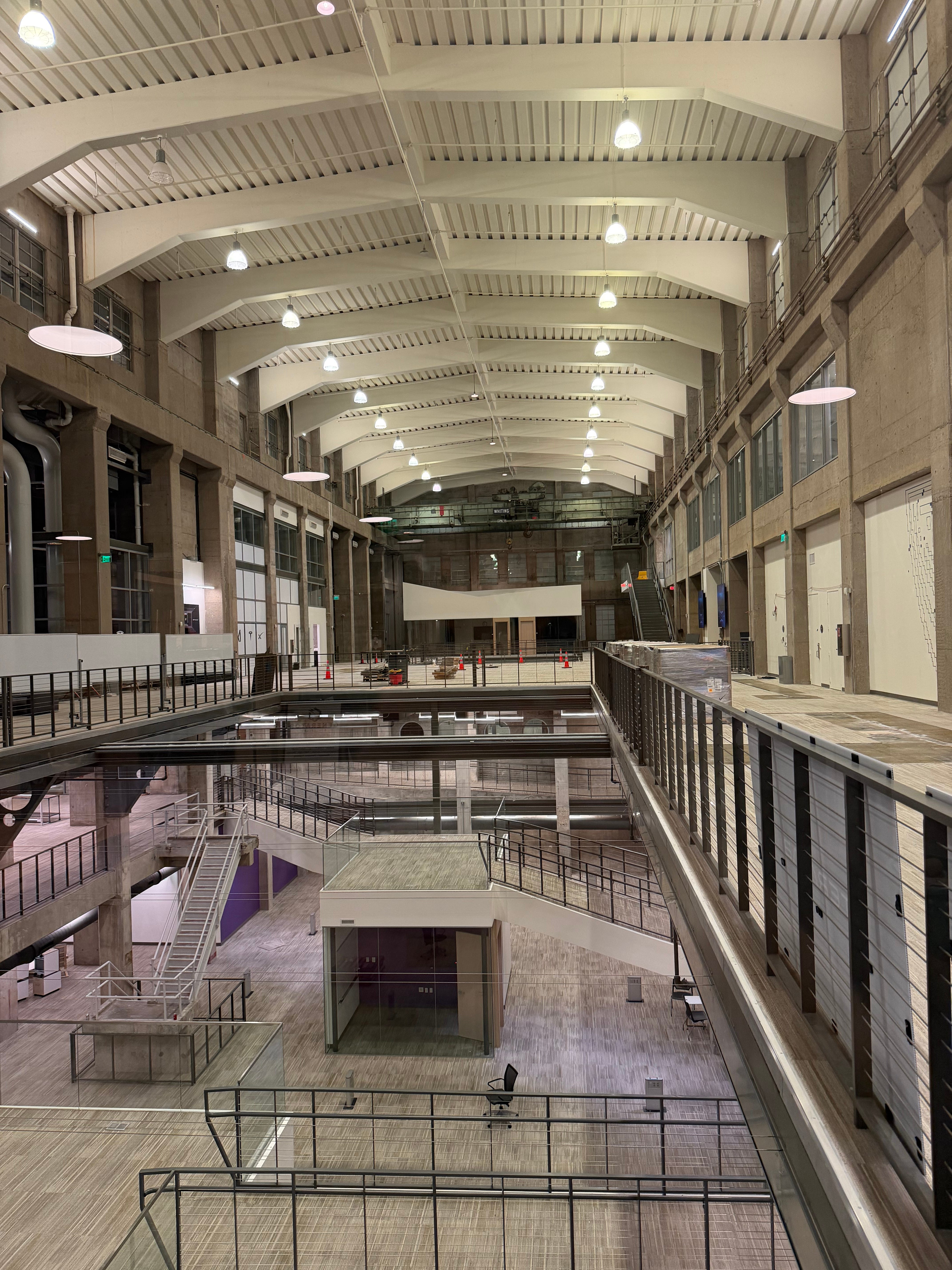
On Saturday, I sat with eminent Austin architect and urban planner Sinclair Black, who taught for 50 years at UT Austin’s School of Architecture. We were having lunch at True Food Kitchen, a healthy lunch spot catty-cornered to the 1950s Seaholm Power Plant, which Black helped to save from demolition. Initially planned to be a cultural center or museum, the 110,000 square foot turbine hall is now an office building that has been leased by Athenahealth, a health insurance company, since 2015. True Food is at the base of a 30-story luxury condo tower, Seaholm Residences. We looked across a bustling interior plaza to another low-rise building, where a massive Trader Joe’s and more office space loomed. The Seaholm District has become a major anchor of Austin’s rapid growth over the last decade.
At one point, Black and I took a break from our discussion and observation of the Seaholm District to discuss an obvious Philly Presence in Austin, Paul Philippe Cret, the French-born Philadelphia architectural sage responsible for many of my favorite Quaker City landmarks—the Benjamin Franklin Bridge, the Rodin Museum, and the Union Trust Building, a smaller jewel bank-building-turned-event-space just blocks from our apartment. Between 1930 and 1942, the University of Texas at Austin retained Cret as its master planner and architect.
During breaks from reshaping the Philly landscape, Cret developed a sweeping master plan for UT Austin’s expansion, designing 20 buildings, including the soaring UT Tower and Goldsmith Hall, which houses the School of Architecture and features a stunning interior courtyard.
In a pause from our power plant discourse, I asked Black about Cret’s profound influence on UT. Black smiled and said, with a twinkle in his eye, “He came here for a while and kind of announced that our climate was like Spain.”
With these Philly convergences in mind, and chuckling at the concept of this Frenchadelphian entering the strange new land of Austin and imagining Madrid, I went to go see Cret’s Spanish-ish buildings at the campus on Monday. I was bowled over:
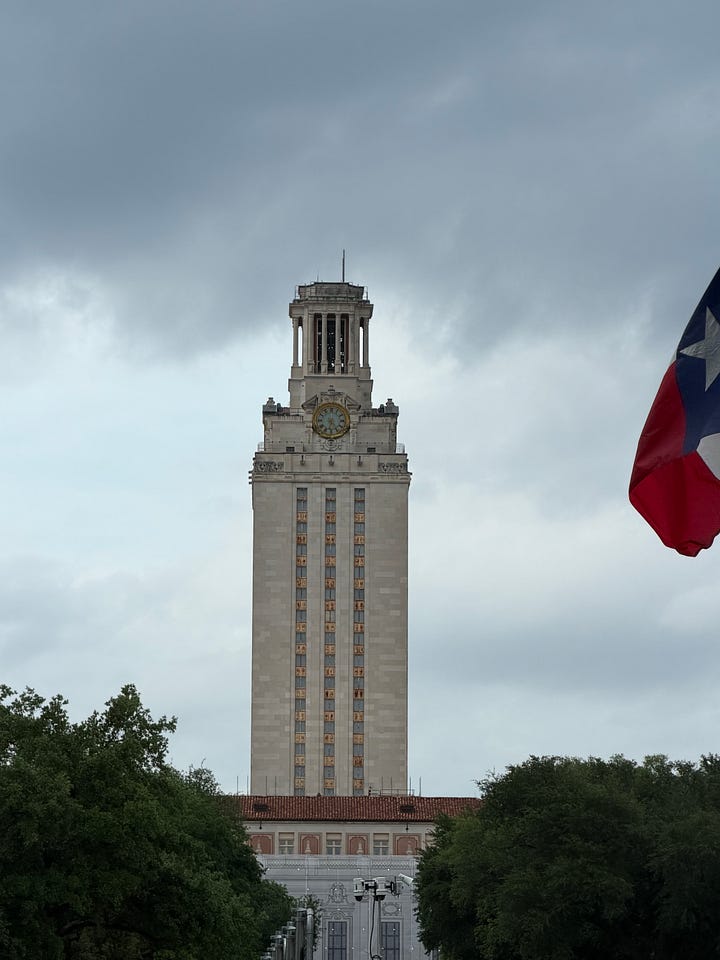
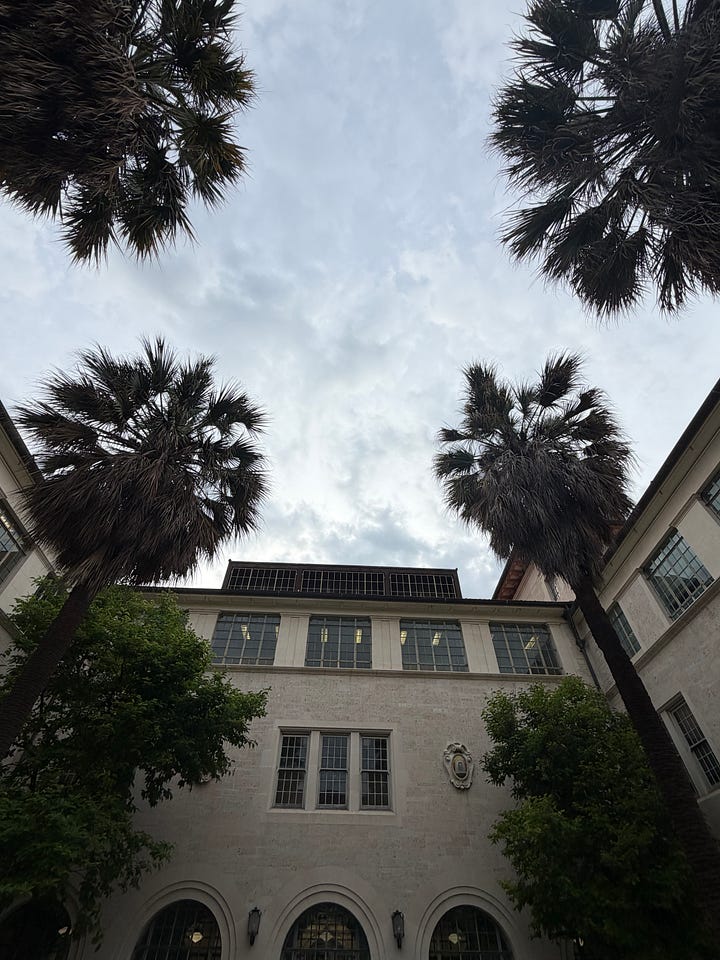
Black had also reminded me that beloved Philadelphia architect and professor Charles Burnette served as the School of Architecture’s Dean in the early 1970s. So, too, did the brilliant Philadelphia preservationist, architect, and writer John Andrew Gallery, for a brief tenure in 1976 before he returned to Philly to create the Office of Housing and Community Development.
A lot of Philly design in Austin! Beyond Cret, I also began poking around about a slightly lesser known and far less successful Philly architectural consultation in Austin. This sojourn concerned the postmodern Philly architectural genii often referred to as “Venturi and Scott Brown”—really Robert Venturi, his wife and close collaborator Denise Scott Brown, and their third architectural partner John Rauch.
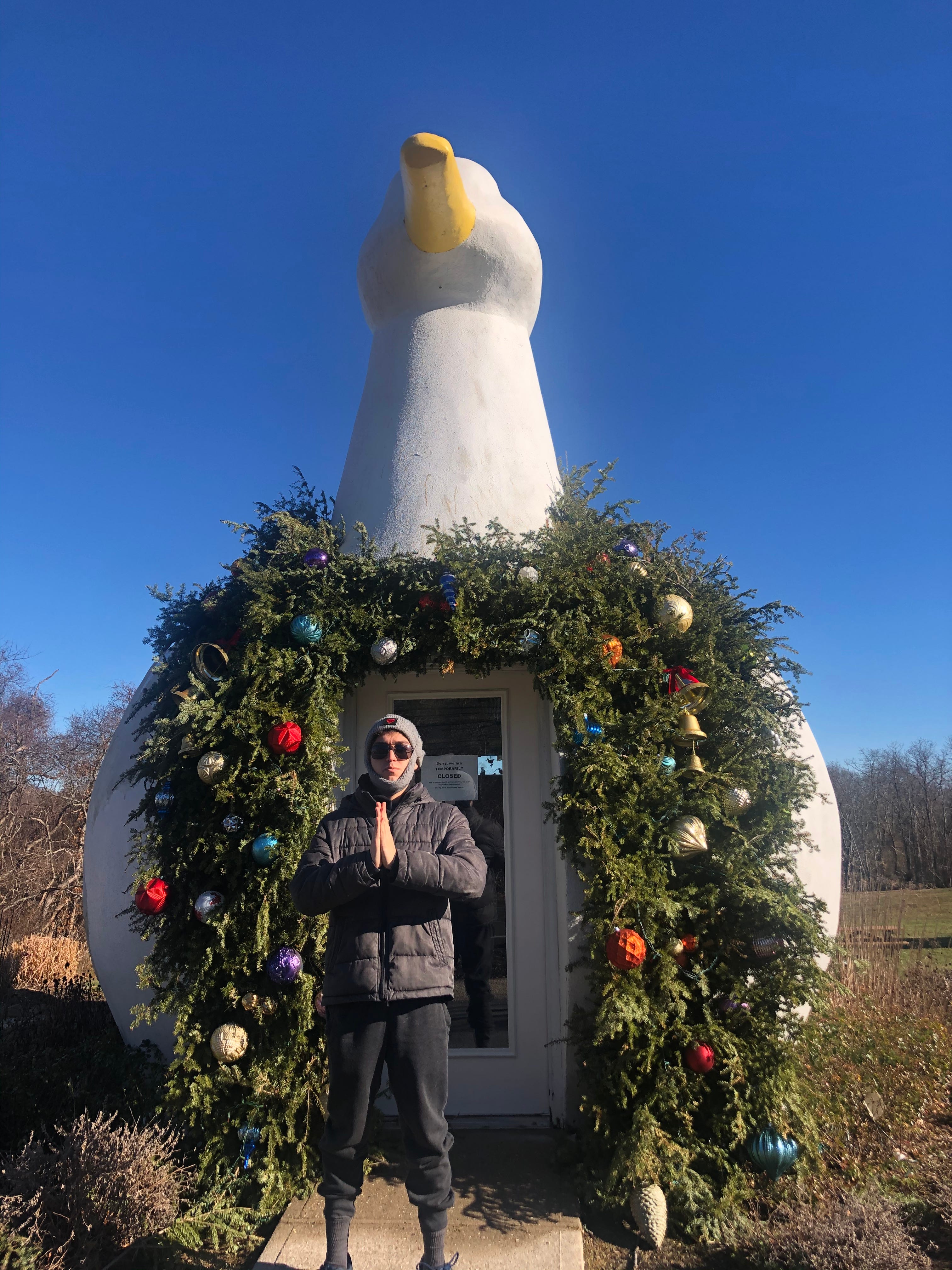
I first encountered Venturi and Scott Brown when I was assigned their epoch-defining Learning from Las Vegas (1972) in Professor Louis Menand’s college course English 170a: High and Low in Postwar America. The book, a takedown of the International Style, typologized a preferred form often seen on the Strip, the “decorated shed” (a straightforward building with eye-catching ornamentation), against the passé, modernist “duck” (a building whose formal architecture was the draw). The “duck” was so named for a fowl and dairy shop on Long Island that was straight up shaped and painted like a duck. Zara and I even made a pilgrimage in January 2021:
Venturi, who usually designed the buildings, Scott Brown, who usually planned the urban design, and Rauch, who managed the technical side, designed one of my all-time favorite Philly spaces, Franklin Court, a Bicentennial-era plaza on the site of Benjamin Franklin’s long-demolished home. Venturi and Scott Brown crafted “ghost structures,” white structural outlines of the house complete with viewing portals down into the archaeological foundations.
In April 1983, the board of Laguna Gloria—Austin’s art museum, so named for its home in a 1916 Italianate mansion on the shores of Lake Austin—selected Venturi, Rauch, and Scott Brown to design a new space for its collection on land in downtown Austin. This was to be Austin’s big, new downtown arts center, a long-desired addition to the city’s cultural offerings at a moment where the central core, after years of neglect, was beginning to blossom as a destination.
The proposed site abutted the South side of Republic Square, one of the original four city squares highlighted in the 1839 plan for Austin designed by Edwin Waller, back when the city was the Capitol of the Republic of Texas.
Two high-flying local developers, Jim Casey and John Watson, controlled the land where the art museum was envisioned. The site housed the low-rise former headquarters of Austin’s main newspaper, the American-Statesman, a milquetoast 1952 structure. In an act of decided corporate largesse, Watson and Casey opted to donate the Statesman land for the new art museum and earmark $3 million to defray some of the construction costs.
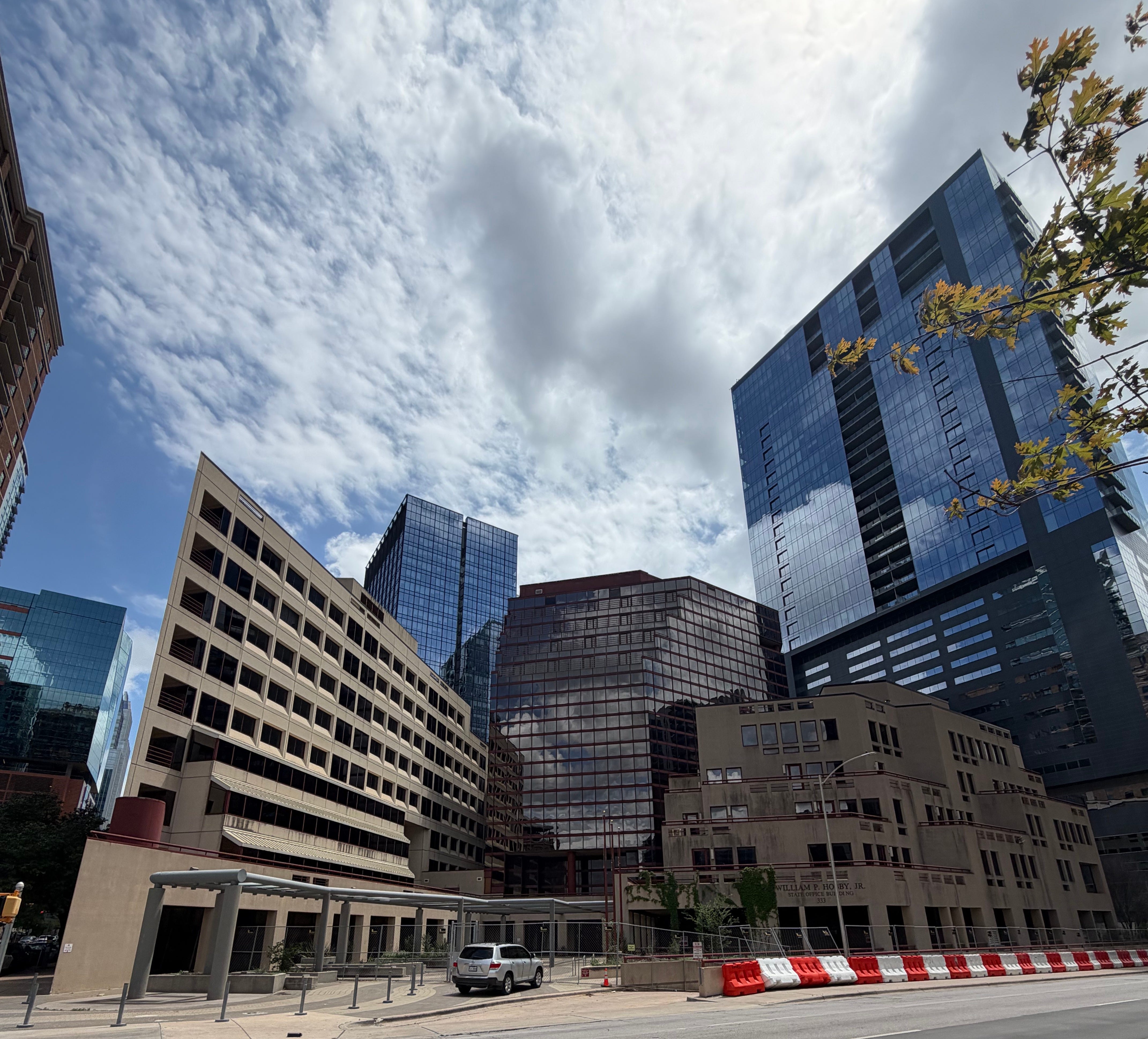
The developers, through their eponymous Watson-Casey Companies, were also in the process of reshaping the East Side of the Square, dubbed Republic Plaza. Watson-Casey’s emerging Plaza was a mélange of three incongruous but oddly appealing postmodern government office buildings (I believe I’m in the minority in having a soft spot for these). I particularly dig Tower Two, a Pueblo Revival joint:
And that was just the tip of the iceberg. Like many of the local 1980s office boom-dependent Philly developers I’ve covered (see: The Weisbein’s Greenwood Group and Independence Place), Watson and Casey tried to do everything all at once. In addition to Republic Plaza and the art museum site, they were also at work on a proposal for a new City Hall and on a staggering collection of other new, gleaming offices in the downtown core. They were civically-minded dudes, and openly strived to be change agents for the blighted zone.
And the data backed the art museum plan, particularly in the hands of these iconoclastic Philly starchitects: One accounting firm estimated that the new art museum might spike property values in the surrounding blocks by 1,150%. 1
Concurrently, Watson-Casey asked Scott Brown to devise a master plan for the 25 square blocks around Republic Square, a down-on-its-heels area often dubbed the Warehouse District. Scott Brown envisioned tree-lined streets and “The Rambla,” a pedestrian-centric shopping and culture thoroughfare modeled after Barcelona’s Las Ramblas.
Initially, vibes between Watson-Casey, the city, and Venturi and Scott Brown were copacetic. At an ebullient December 1983 Laguna Gloria party at Austin’s (still-popular!) Mexican restaurant La Fonda Miguel, the architects were the guests of honor. The museum’s director, Laurence Miller, even predicted that the new building would open as early as Fall 1986 to be “a kind of sesquicentennial gift” to Texas, whose Republic emerged in 1836. 2
Austin voters approved the museum in a bond election in 1985, and the city prepared to take on some of the costs.
Venturi’s design was beautiful—a four-story, 80,000-square foot colossus full of his characteristic arched doors, rectangular designs of limestone, blue tile, and pink granite, and playful, diversely-sized windows. I’m wary of copyright, but here’s an official firm link to Venturi’s finely-wrought design drawings.
Venturi was particularly passionate about the windows and urban placement in the Museum design. “The thrill of art is that you can look out of the window over there and see that you’re in Austin, and this wonderful, magical thing is also in the world,” he told the American-Statesman of his hopes for art gazers at Laguna Gloria. 3
At a Houston show of the preliminary plans, Venturi elaborated on his varied facade: “Sudden changes and contrasts breed vitality and excitement. Civic monuments, if all monumental, are boring.” 4
Amid the fanfare, however, the wheels began to fall off. As I learned more from my interviews about the multi-year collapse of Venturi and Scott Brown’s Laguna Gloria, I realized that I was taking on a Sisyphean task in trying to sum up all the machinations in a single Archiveadelphia—we’re talking squabbles between the sometimes-prickly Philly architects and their inquisitive Austin hosts, eleventh-hour efforts to save the plans, fierce real estate contractions connected to the Savings & Loan crisis and the Dot Com bubble…
Admittedly, every Archiveadelphia simplifies a complex set of real estate, political, and architectural factors. So—a brief, partial chronology of what went wrong: Watson-Casey went bankrupt in 1987, scuttling their broader hopes for the Warehouse District. And to make matters worse, Venturi and Scott Brown, at the peak of their visibility, weren’t exactly the most flexible creative and economic partners, insisting on near-complete design oversight.
In 1988, Austin’s new mayor, Lee Cooke, became concerned about Laguna Gloria’s financial health and began fearing that the city would end up financially liable for the $19 million effort. Competing arts organizations also feared that the quest to complete Laguna Gloria without Watson-Casey was going to soak up all of the available arts funding in Austin and came out aggressively against the project. City Council soon voted to kill the project. The Laguna Gloria dream went through several more ups and downs in the 1990s and 2000s—the collection is now split between downtown Austin’s Jones Center and the original Laguna Gloria villa and is called The Contemporary.
Many of those who I was interviewing about Seaholm sighed when I brought up Laguna Gloria. I sat with Bruce Willenzik, a prolific local arts orchestrator who runs the famed Armadillo Christmas Bazaar arts market, over coffee at a light-filled grocery store cafe in South Austin. “There were just too many cooks added into the project…made it top-heavy,” he said of the Venturi plan.
Fred Evins, who served as the city project manager for both Venturi’s Laguna Gloria and Seaholm, was similarly rueful as we ate flavorful veggie lunch bowls at Flower Child, just West of where Scott Brown had planned La Rambla (the area has become quite successful, despite it all!).
I initially viewed my Laguna Gloria research as distinct from my Seaholm scholarship. Evins, however, revealed that the Venturi and Scott Brown collapse—and its ripple effects—made supporting cultural uses of statement spaces like Seaholm more difficult for the city to stomach. “[The city] knew how much capital investment would be required just to make it habitable and useful, and then, could we find any partner strong enough to operate it without reliable city funding?”
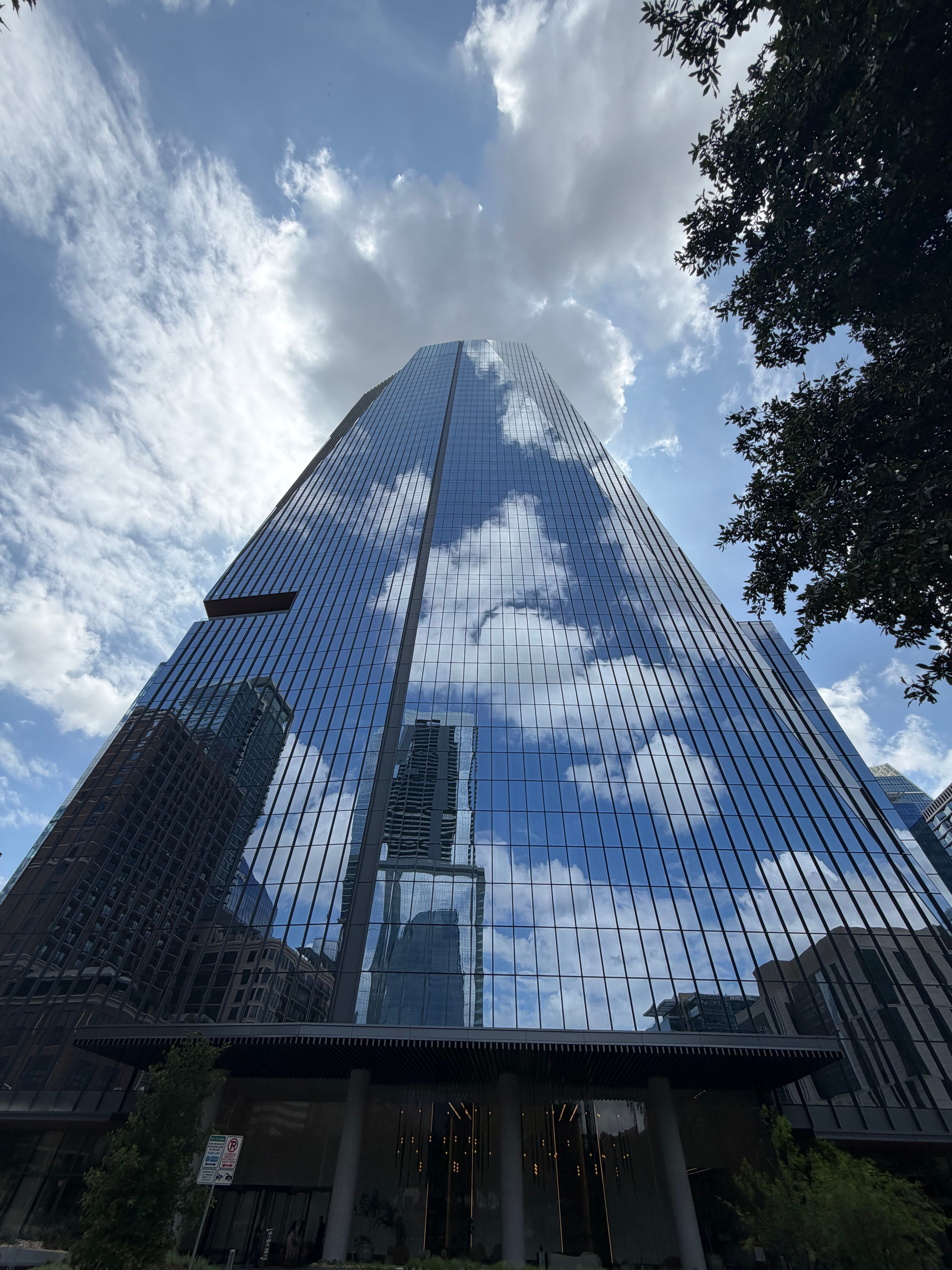
An unexpected butterfly effect has thus emerged, from Venturi and Scott Brown’s unbuilt museum to the broader privatization of Austin’s architectural slate, old and new. The proposed site for Laguna Gloria, for example, now houses The Republic, a brand new, 48-story glass office tower that is the third tallest building in Austin:
And on the Seaholm side, this cultural-to-corporate pivot was made all the more impactful when news broke yesterday that Elon Musk’s xAI company, the Artificial Intelligence colossus behind Grok and that Musk hopes will make galactic travel possible, was subleasing the turbine hall space from Athenahealth…
Clearly, my little dive into Philly architecture in Austin has opened up quite the Pandora’s Box, and I’m excited to keep delving deeper back from my comfortable perch in Philadelphia.
Julie Hutchinson, “Venturi, Brown Building on Ideas,” Austin American-Statesman (AAS), 12/16/1984
Michael McCuller, “Museum Rebuilds Momentum,” AAS, 2/9/1987
Lee Kelly, “Museum Fetes Design Team,” AAS, 12/20/1983
Ann Holmes, “New Austin Museum Shown as Work in Progress,” Houston Chronicle, 4/20/1985
No posts
Comments
Nothing yet. Say the first thing.
Sign in to join the conversation.